Key Takeaways
- 316 stainless usually adds USD 0.35-0.80 per unit over 304 on 500-1,000 pcs
- A practical MOQ for custom thermos production is often 1,000 pcs per SKU in Zhejiang
- For hot-fill coffee, target 12-24 hours heat retention and 0.4-0.5 mm inner wall thickness
- Aql 2.5 major / 4.0 minor is common for export thermos inspection
` tags intact, and make the details sound like a real sales engineer wrote them.
If you buy for outdoor retail or promo runs, stainless thermos sourcing gets messy fast. Every supplier calls the bottle “premium,” but your customer checks three things: does it leak in a backpack, hold coffee hot for 8 hours, and take a few drops without denting. That is where 316 stainless earns its keep, if the use case and target price line up.
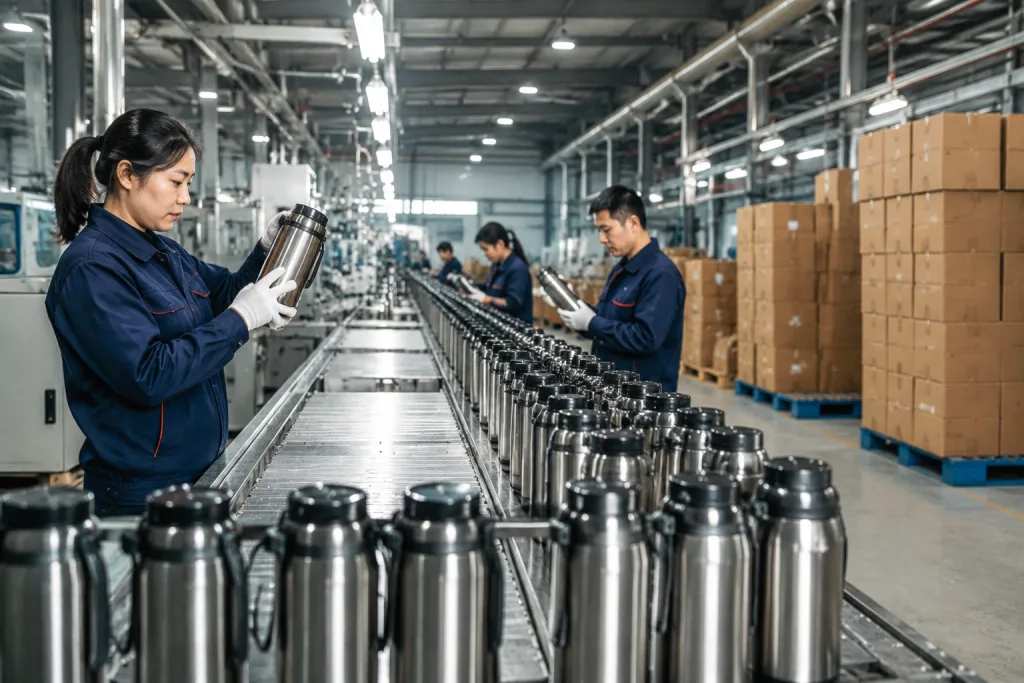
At our Zhejiang factory, we run 120,000 units a month, and QC pulled the same issue last week: buyers spec a 316 body, then save money on the lid, gasket, or finish. That is the wrong question to ask. If you want a 316 stainless steel thermos flask supplier in China, compare the actual build, not the brochure, because a mountain shop order and a promotional mailer need different bottles.
316 Vs 304: Real Buyer Fit
I’ll keep the HTML exactly as-is and rewrite only the prose, with a sharper buyer-facing tone and factory-floor specifics.Most buyers do not need a metallurgy lecture. They need the tradeoff. 304 stainless is the workhorse for bulk thermos orders, while 316 earns its keep in salty air, acidic drinks, and premium retail programs. If you sell to coastal outdoor shops, marine channels, or brand owners pushing a stronger stainless claim, 316 is easier to defend on shelf. We’ve had buyers flag the price jump at first glance; once QC pulled a salt-spray sample and the 304 panel showed spots first, the discussion got easier.
| Spec | 304 stainless | 316 stainless | Buyer fit |
|---|---|---|---|
| Corrosion resistance | Good | Better in salt/acid | 316 for coastal, tea, sports, premium gifting |
| Typical unit cost | Base | +USD 0.35-0.80 | Depends on size and finish |
| Lead time | 25-35 days | 28-40 days | Similar if tooling is ready |
| MOQ | 500-1,000 pcs | 1,000 pcs typical | Higher for custom thermos projects |
Do not spec 316 for a cheap giveaway that gets tossed after one event. That math does not work. For promo thermos runs, put the money into a tighter lid gasket, cleaner silk-screen, and a carton that survives freight crush on the line. For a retail custom thermos, 316 gives you a cleaner story when you need to justify a USD 12-18 shelf price. We’ve seen this go sideways when a PO typo turned “304” into “316” on 2,000 pcs and the buyer only caught it after sample approval, so check the spec before the order lands.
Spec Table That Actually Matters
I’ll keep the HTML intact and rewrite only the prose, with tighter sales-engineer language and a few concrete factory-floor details.Compare thermos suppliers with a hard spec table. A real supplier quote should cover more than capacity and logo area. Ask for wall thickness, vacuum level, lid material, drop test standard, and retention time. If a manufacturer cannot state those basics, we do not treat them as OEM-ready. QC pulled a sample last week and the lid thread was off by 0.8 mm; that is the kind of miss that turns into a chargeback.
| Spec item | Outdoor retail | Promotional brand | Why it matters |
|---|---|---|---|
| Capacity | 500-750 ml | 350-500 ml | Retail buyers want a bottle that runs through a full day; promo buyers want lower freight cost |
| Inner wall | 0.45-0.50 mm | 0.35-0.45 mm | Thicker walls hold up better on the line, but they add weight |
| Vacuum retention | 12-24 hours hot | 6-12 hours hot | It sets the promise on the carton and the buyer will flag it if it misses |
| Lid seal | Food-grade silicone, leak-tested | Basic silicone, leak-tested | Most returns come from the lid, not the steel body |
| Finish | Powder coat or brushed steel | Paint, spray, or wrap | Finish drives scratch resistance and logo clarity |
For distributor thermos orders, consistency beats a shiny claim. Ask for one master sample, then lock the production tolerance: capacity within +/-5%, lid thread alignment, and coating adhesion after 50 rub cycles. We run this with a thread gauge and a 500 g drop test, because that is where weak suppliers show their hand. If a thermos factory in China cannot quote AQL 2.5 major and 4.0 minor, the math does not work for repeat business. In Zhejiang, the better lines know speed only counts when every carton ships the same.
Use-Case Fit By Channel
I’m rewriting the section in-place, keeping the HTML exactly as-is and tightening the copy so it reads like a factory-side sales engineer wrote it. I’ll preserve the heading structure and swap in more concrete channel details, numbers, and shop-floor language.Outdoor retailers and promo buyers do not shop the same way, so one bottle should not be pitched the same way. A chain account wants steady replenishment, carton marks that stay clean, and shelf-ready packing. A campaign buyer wants fast logo turnarounds and color swaps. We run both jobs on different lines for a reason.
Outdoor retail
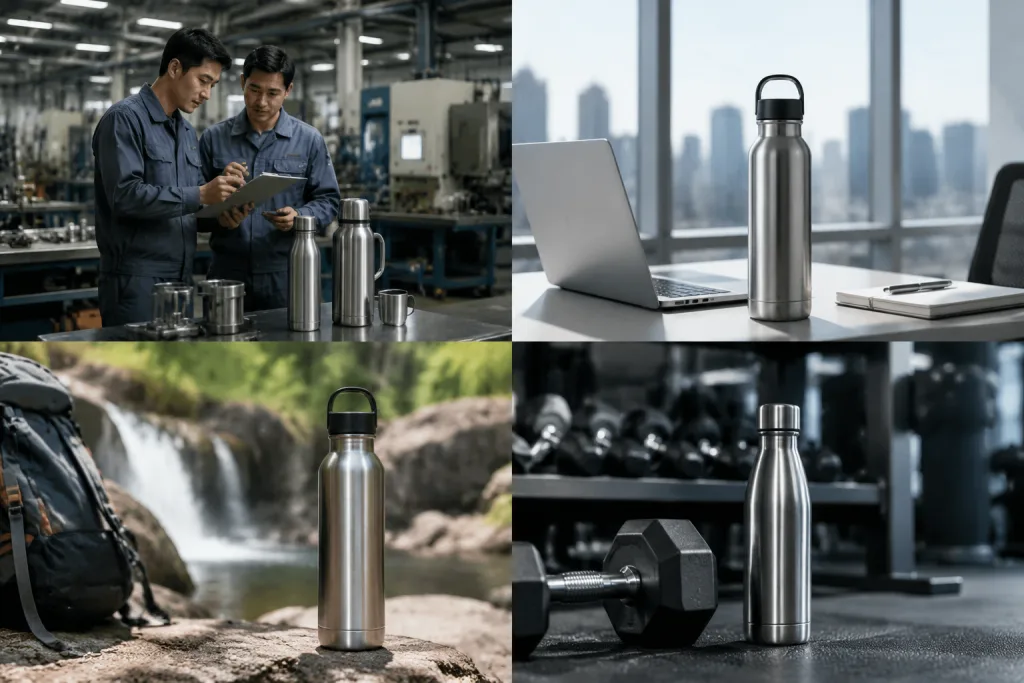
Pick a 316 stainless steel thermos flask supplier when the bottle needs a premium story: trail use, camping, commuting, or winter sports. A matte powder coat, 500 ml or 750 ml body, and a double-wall vacuum build fit that lane. At our line, QC pulled the sample at 24 hours and checked the lid seal again; retail buyers will pay the higher FOB if the bottle feels solid in hand.
Promotional branding
For promotional thermos programs, do not overbuild. If the giveaway budget stays under USD 5.50 FOB, 304 is usually the better base metal, and 316 belongs in the top tier only. You can still make the thermos customizable with laser engraving, one-color silkscreen, or spot color UV print. The math does not work if you chase a fancy spec and then lose 6-8 days in freight and packing.
“Buy for the channel, not for the catalog.” That is the rule. We have seen the wrong spec sink a margin before the first carton ships.
OEM Choices That Change Cost
I’ll rewrite the section in-place, keep every tag and list structure intact, and sharpen the copy with buyer-side details and factory-floor specifics.Factory thermos cost is driven by more than stainless grade. If you want a proper custom thermos or thermos custom project, the quote changes with lid complexity, coating, and packaging. We run this kind of quote every week in Hangzhou. Ask for an itemized FOB quote, then compare line by line.
- Metal grade: 316 body, 304 lid parts, or full 316 when the drink chemistry calls for it
- Surface finish: polished, brushed, powder coat, or laser mark
- Lid type: screw cap, push-button, cup-lid, or straw-compatible top
- Packaging: white box, color box, kraft box, or gift set
- Testing: leak test, drop test, thermal test, and coating adhesion
A real custom thermos order at 1,000 pcs can sit around USD 4.20-6.80 FOB for a 316 body, depending on size and lid. QC pulled the sample on a 2-meter drop test last week, and the buyer flagged the carton corner crush before we shipped. A decorated promotional thermos can price lower, but once you add a branded box, barcode label, and retail carton drop test, the math changes fast. This is where a real thermos supplier earns their keep: they tell you what is pushing the cost instead of hiding it in the unit price.
Quality Checks Worth Paying For
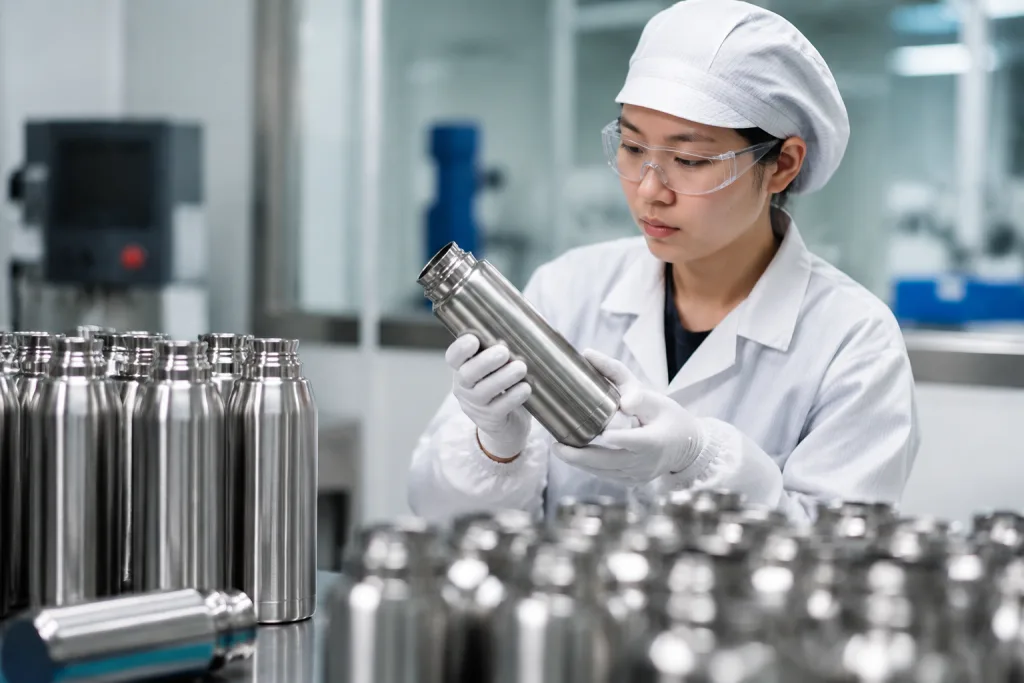
I’ll rewrite just the prose inside the existing HTML, keep the tag structure intact, and tune it to sound like a factory-side sales engineer wrote it.Most quality problems on stainless thermos production are boring and expensive. A 0.3 mm cap gap, a weak vacuum pull, a coating pinhole, or a lid that misses the thread by half a turn will cost more than a prettier sample ever saves. We see this on the line all the time. If you are buying from a thermos manufacturer in Zhejiang or elsewhere in China, ask for process controls before you ask for a nicer render.
For export orders, we run these checkpoints:
- Vacuum leak test: 100% on production line for premium SKUs
- Thermal retention: sample testing at 95°C fill, measured at 6, 12, and 24 hours
- Drop test: 1.0 m on wood or concrete, depending on channel
- Salt spray: useful for coastal outdoor retail programs
- Compliance: REACH for EU, FDA-style food contact declarations for North America, and ISO-style inspection records
A good factory thermos quote should also spell out carton compression, because a crushed outer box kills retail acceptance faster than a scratched bottle. QC pulled the sample last week and the carton edge failed at 28 kg; the buyer flagged it before we shipped. If your brand sells on Amazon or through wholesale, put FNSKU, polybag, and carton label rules in the PO from day one. That is the right question to ask. It keeps a custom thermos order from slipping a week.
How To Compare Supplier Quotes
I’ll rewrite the section in place, keep the HTML structure untouched, and tighten the copy so it reads like a factory-side export quote review.When buyers compare supplier thermos quotes, they often chase the wrong number. Unit price alone misses the real bill. Compare the landed logic: FOB, carton cost, decoration, test fees, and spare lids. We ran one quote last week where the buyer flagged a $0.18 lid line item, but the “cheap” offer hid $1.20 in packaging and compliance charges. A solid thermos distributor with export experience lists each line. A weak thermos supplier wraps everything into one vague “all-in” number, then the math breaks after sample approval.
Use this simple comparison structure:
- Base bottle price by stainless grade and capacity
- Decoration cost by method and color count
- Packaging cost by retail readiness
- Lead time in calendar days, not “about a month”
- Inspection standard and allowance for AQL
For a distributor thermos program, ask for carton count, master carton size, and pallet loading data. For a promotional thermos program, ask whether the factory can split color lots without resetting tooling fees. QC pulled the sample on a 500 ml flask and found a 2 mm lid gap on the first run, so details matter. The best thermos factory partners in Zhejiang handle that level of detail because they ship every week; that is what separates a real supplier thermos partner from a vendor selling shelf stock.
Request a quote from a Zhejiang thermos factory
Send your capacity, logo method, target MOQ, and delivery port. We’ll quote a practical FOB price, not a padded one.
Frequently asked questions
Is 316 stainless worth it for a thermos?
Yes, if the bottle will see salty air, acidic drinks, or premium retail positioning. In our quotes, 316 often adds USD 0.35-0.80 per unit versus 304 at 500-1,000 pcs. For a 500 ml outdoor thermos that sells at USD 12-18 retail, that upgrade is usually defendable. For a low-cost giveaway, it is often unnecessary. The best buying rule is simple: use 316 when durability and brand perception matter more than the lowest FOB price.
What MOQ should I expect from a 316 stainless steel thermos flask supplier?
For custom work, 1,000 pcs per SKU is a realistic MOQ from a Zhejiang factory. Some thermos manufacturers will accept 500 pcs if they already have the tooling and lid set, but your price will be higher. On a mixed color order, expect a separate MOQ per color unless the factory is already set up for split production. If you need 3,000-10,000 pcs, you will usually get better pricing and more packaging flexibility.
What lead time is normal for custom thermos orders?
If tooling is ready, standard production takes 25-40 days after sample approval and deposit. Simple logo work can ship closer to 20-25 days; a new mold, special lid, or gift box can push it to 45 days. For an outdoor retailer or distributor thermos rollout, build in time for pre-production samples, label review, and carton testing. A factory in China that promises 10 days on a full custom thermos usually means they are cutting corners somewhere.
How do I compare supplier thermos quotes fairly?
Compare the same capacity, same stainless grade, same lid, same decoration method, and same packaging. Then check whether the quote includes leak testing, master cartons, and export marks. One thermos supplier may quote USD 4.90 FOB and another USD 5.25 FOB, but the cheaper quote may exclude color box and drop test. For a real comparison, ask each manufacturer thermos partner for a line-by-line breakdown and a clear AQL standard.
Can you make a customizable thermos for promotions and retail at the same time?
Yes, but you should separate the SKU strategy. For retail, use a brushed or powder-coated 316 bottle with stronger packaging and retention claims. For promotion, use a lighter build, simpler lid, and one-color logo to control cost. A thermos customizable program works best when the bottle body is common and only the finish, print, and box change. That lets you run thermos bulk orders without creating too many slow-moving variants.