Key Takeaways
- 316 inner steel typically adds $0.35-$0.80 per unit over 304 in bulk thermos orders
- A practical MOQ for custom thermos runs is often 1,000-3,000 units per SKU
- Good vacuum performance should hold 65°C+ after 6 hours from a 95°C fill in a 500ml flask
- A Zhejiang factory thermos line can often output 80,000-120,000 units per month
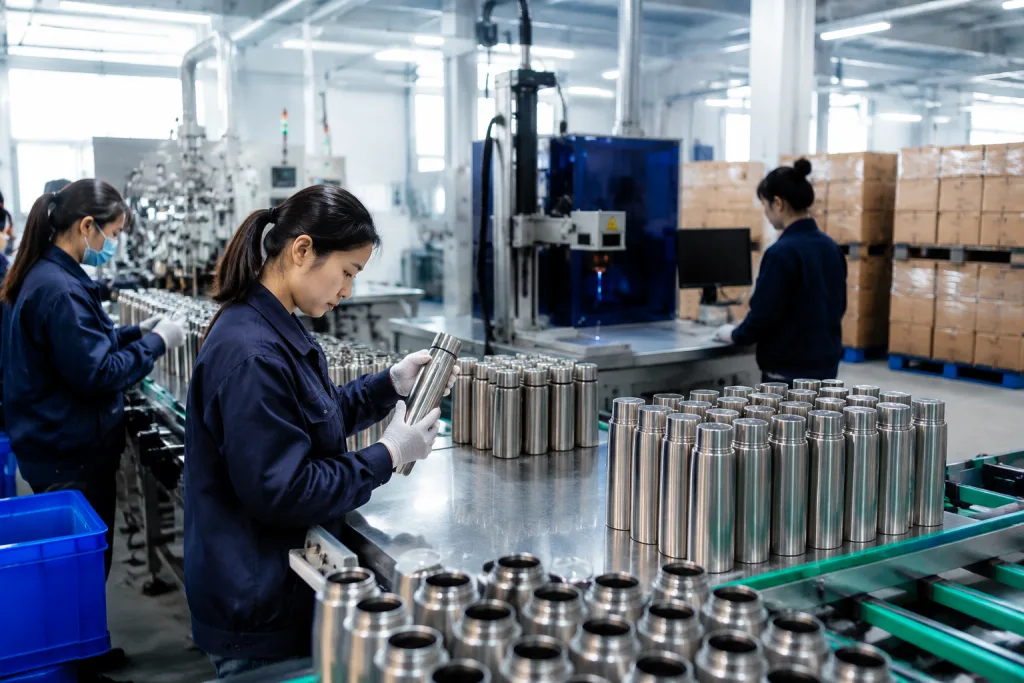
If you are buying for outdoor retail or a promo run, the mistake is usually the same: teams start with print methods, not construction. A 316 stainless steel thermos flask manufacturer should be judged first on steel grade, vacuum hold, and cap sealing. Those three decide whether your bulk thermos ships clean or comes back as complaints.
In Zhejiang, the better shops can make a customized thermos look simple. The hard part is keeping the thermal curve steady, passing REACH, and matching a 3,000-piece MOQ without forcing weak specs. We have seen this go sideways on a 0.35 mm inner wall, and the math does not work if you compare the wrong line item. If you are checking thermos manufacturers, look at the choices that move cost by $0.40 to $1.20 per unit, not the polish that only helps the product photo.
Start with the steel grade
I’ll rewrite the section in-place, keep the HTML structure exactly, and tighten the sales-engineer tone with concrete factory details and fewer AI-style fillers.For a 316 stainless steel thermos flask manufacturer, the first call is simple: where do you need corrosion resistance, and where can you save cost. 316 stainless carries molybdenum, so it holds up better against salt spray, acidic drinks, and harsher wash cycles. We run both 304 and 316 on the line, and the buyer usually feels the difference after a few months, not on day one. If the flask is for hikers, coastal retail, or promo use where coffee sits overnight, 316 gives you more margin against pitting and smell carryover.
On a 1,000-5,000 unit order, a 316 inner liner usually adds about $0.35-$0.80 per piece over 304, depending on wall thickness and finish. That math works for repeat distributor programs; it does not work for a one-off price fight. QC pulled the sample at 0.38 mm once and the buyer flagged it, because the PO said 0.40 mm. Ask for the material certs, not a sales promise. A real supplier thermos or manufacturer thermos in Zhejiang should hand over mill certs and batch traceability without drama.
What to ask:
- Is the inner liner 316 through the full thickness, or only on the contact surface?
- What is the wall thickness: 0.35 mm, 0.40 mm, or 0.45 mm?
- Can you show REACH and food-contact documentation?
Choose the bottle structure
I’ll rewrite this section in a factory-floor B2B tone, keep the HTML exactly as-is, and make the specs more concrete without changing the heading or blockquote structure.The second decision is the thermos body, because the build drives insulation and landed cost. We run double-wall vacuum shells on the line, and premium SKUs get a copper-plated inner wall. For 500 ml and 750 ml bottles, the real tradeoff is weight against heat hold. A heavier shell can work, but retail buyers will cut it fast if the sample feels like a brick in a backpack.
If you are buying custom thermos stock for retail shelves, check the shoulder shape, base ring, and weld line consistency. We have seen a 1.5 mm change in base diameter add $0.10-$0.25 and throw off case packing by one carton per master case. For promotional orders, some buyers push for a 0.35 mm wall to hit price targets. For a premium customizable thermos, 0.40 mm or 0.45 mm is the safer call, especially if the spec includes laser engraving or powder coating. The wrong question is “what is the thickest bottle?” The right one is “what wall spec fits this channel and this decoration process?”
For a 500 ml flask, a stable target is 12-24 hours heat retention in lab conditions, but you should always ask what ambient temperature and fill standard the factory used.
Lock the lid and seal system
I’ll rewrite just the prose inside the existing HTML, keep the tags intact, and tighten it to sound like a factory-side sales engineer.Most thermos returns are not about the liner. They come from lids, gaskets, and how people use the bottle on day three. If a custom thermos program goes bad in the field, we usually find the cap vents too easily, the silicone ring walks out of position, or the thread pitch is off by a fraction. The lid also decides whether the thermos feels solid in the hand or like a cheap giveaway. Buyers miss that and spend all their time on logo placement. Wrong priority.
For outdoor retailers, a screw cap with a silicone gasket and a separate cup stays dependable. For promo brands, a one-touch or push-button lid sells faster, but it brings moving parts and more QC risk. We run drop tests from 1.0 m to 1.2 m, check leak performance at 45 degrees, and measure cap torque with a torque wrench on the line. Ask for AQL 2.5 on critical defects. If your thermos bulk order has mixed colors, each color needs the same leak test; the buyer flagged it once on a PO typo, and we had to rerun 300 pieces. Skipping that step costs more than it saves.
Good lid questions:
- Is the gasket platinum-cured or standard silicone?
- Can the lid survive 3,000-5,000 open-close cycles?
- Will the cap still seal after dishwasher exposure?
Match decoration to channel
I’ll rewrite the section in place, keep the HTML untouched, and tighten the sales-engineer tone with more concrete factory detail.Decoration should follow the sales channel, not ego. For a promotional thermos, screen printing is cheaper and faster, and at 5,000 pieces it usually adds only $0.08-$0.20 per unit. We run that line with a 100-mesh screen and see the best results on simple 1-color logos. For retail and corporate gifts, laser engraving or 360-degree UV printing looks cleaner and holds up better when the buyer flags abrasion after 20 wash cycles. If you are planning thermos custom SKUs for Europe or North America, do not pick a decoration system that cracks after cold washing or rough carton handling.
Outdoor retailers usually want low-key branding, while promo brands push for bigger graphics and faster turnarounds. A sensible manufacturer thermos or thermos supplier in China should offer silkscreen, laser engraving, pad print, and heat-transfer options. The choice comes down to logo complexity, color count, and MOQ. We’ve seen 500 pieces with three Pantone colors blow up setup cost on the first PO proof; the math does not work the same way as 20,000 thermos promotional units. Ask for separate quotes for decoration, packaging, and carton labeling, or the margin disappears into the wrong line item.
For most buyers, the cleanest path is a customized thermos with one laser mark and a neutral box. It ships clean, clears artwork approval faster, and avoids the typo-in-the-logo headache we see on rushed POs.
Check factory proof, not claims
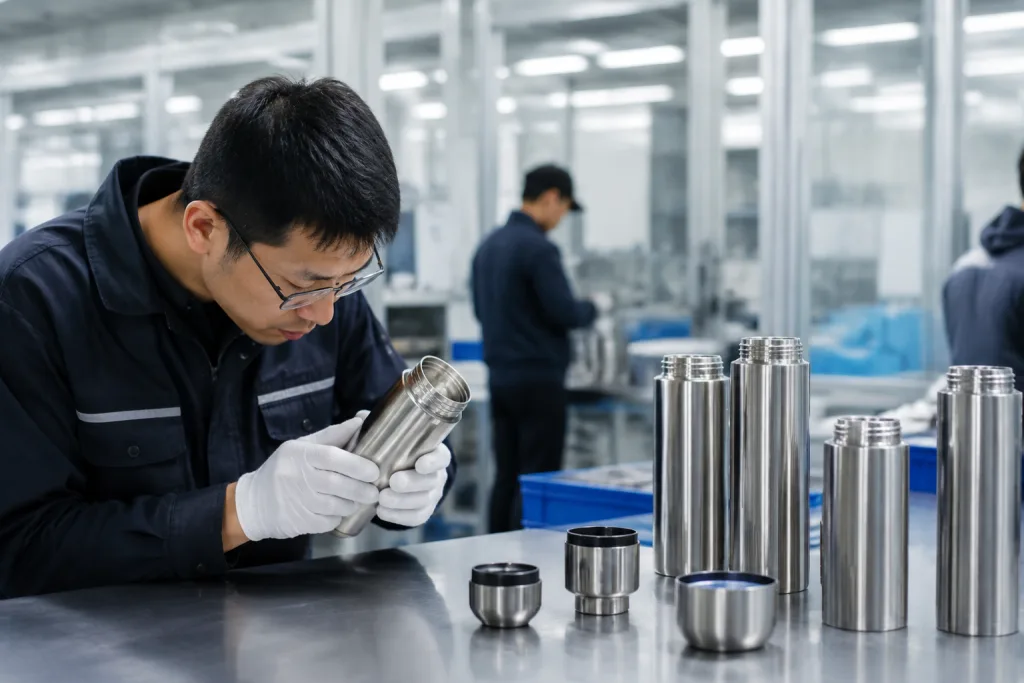
I’ll rewrite the section in place, keep the HTML exactly as-is, and make it sound like a factory-side sales engineer wrote it.Read supplier selection like a sourcing audit. A real thermos manufacturer can show factory photos, the vacuum line, test reports, and export records without stalling. In Zhejiang, we run multiple vacuum lines, and a solid plant can ship 80,000 to 120,000 units a month. That does not make them your best match by default, but it does tell you they know export scheduling better than a small trading desk.
Ask for BSCI if your buyer needs social compliance, then ask for REACH, LFGB, or FDA paperwork based on the target market. If the seller is only sitting on quotes, get clear on whether they own the line or are passing messages from another plant. The real risk is not unit price; it is the gap between the approved sample and the mass run. We always push for pre-production samples, first-article signoff, and packaging specs down to carton size. If they stay vague, you are probably talking to a paper company, not a thermos factory. QC pulled the sample on a 2 mm print shift before it left the line.
Proof points worth checking:
- MOQ per color and per logo variant
- Lead time: 25-35 days after sample approval is common for bulk orders
- Inspection process: in-line check, final inspection, carton drop test
Price the real landed cost
I’ll rewrite the section in-place, keep the HTML tags exactly as-is, and strip the AI-ish phrasing while adding a few concrete factory-floor details and tighter sales-engineer language.The buyer mistake I see most is comparing ex-works prices and skipping packaging, freight, and scrap. A quote that looks cheap can turn ugly when the carton size wastes space or the defect rate runs 3% higher. At our 316 stainless steel thermos flask line, we run landed cost by SKU, not a naked unit price. Bottle, lid, logo, box, carton, and compliance paper all go into the sheet.
Take a 500 ml 316 flask at 3,000 units. It may land around $3.20-$5.80 FOB, depending on finish, lid type, and packing. Add $0.12-$0.40 for a gift box and insert. One buyer flagged a 1.5 mm carton gap on the sample run, and that extra void pushed pallet count up. If you sell into retail chains, the better box can lift sell-through enough to cover itself. If you buy for promo use, the lowest FOB still wins only when the leak and drop tests pass. We’ve seen the math go sideways on claims after a weak cap seal. Zhejiang plants that ship export orders know this and quote by use case, not just by steel grade.
Before you issue the PO, ask for a sample sign-off sheet with logo position, cap color, carton marks, and the outer carton loading plan. QC pulled the sample twice on our side for a 2 mm logo shift, and that small miss would have become a warehouse headache later. This is the wrong question to ask if you only want the cheapest quote.
Send your thermos spec for a fast quote
Share capacity, finish, logo method, and target MOQ. We’ll quote the right factory thermos option for your channel, not a generic sample.
Frequently asked questions
Is 316 worth it for a custom thermos order?
Yes, if your use case involves salty environments, acidic drinks, or long storage times. 316 usually costs $0.35-$0.80 more per unit than 304 in mid-volume orders, but it gives you better corrosion resistance and fewer odor complaints. For outdoor retail, that premium is often justified. For pure giveaway work, 304 may still be enough if you keep the design simple and the fill temperatures normal.
What MOQ should I expect from a thermos factory?
For a serious China factory, a realistic MOQ is often 1,000-3,000 units per SKU, with higher MOQs for special colors or multi-color logos. If you want a customized thermos in several Pantone shades, the factory may split your order by color, which raises cost. A well-run Zhejiang plant can still support pilot runs, but the unit price will be much higher below 500 pieces.
How do I test insulation performance properly?
Ask the thermos manufacturer to specify the test method: fill temperature, ambient temperature, preheat time, and test duration. A practical benchmark for a 500 ml bottle is 95°C fill and at least 65°C remaining after 6 hours, though premium models can do better. The important part is consistency. If one sample performs well and the mass order drops by 10-15%, the problem is usually vacuum quality or lid sealing.
Can I use laser engraving on a 316 stainless steel thermos flask?
Yes, and it is a good option for a durable, low-maintenance logo. Laser engraving usually costs more than single-color screen print, but it survives abrasion better and looks cleaner on brushed steel. For thermos custom orders, engraving is often the best choice when you want a premium retail look without using extra colors. Ask the supplier to show engraving depth and sample wear tests before approval.
How long does production take in China?
Typical lead time is 25-35 days after sample approval for standard custom thermos orders, and 35-45 days if you need special packaging or a new lid tool. If the factory is in Zhejiang and already has your bottle tooling, the schedule can be faster. Add 5-10 days if you need third-party inspection, export carton relabeling, or Amazon FNSKU labeling.