Key Takeaways
- 316 liner upgrades corrosion resistance and is worth it for acidic drinks and coastal use
- A 500 ml thermos bulk order usually starts at 500 pcs MOQ and 25-35 days lead time
- Wall thickness, often 0.4-0.6 mm, matters more than a logo when you judge durability
- AQL 2.5/4.0, REACH, and lid leak testing should be written into the PO
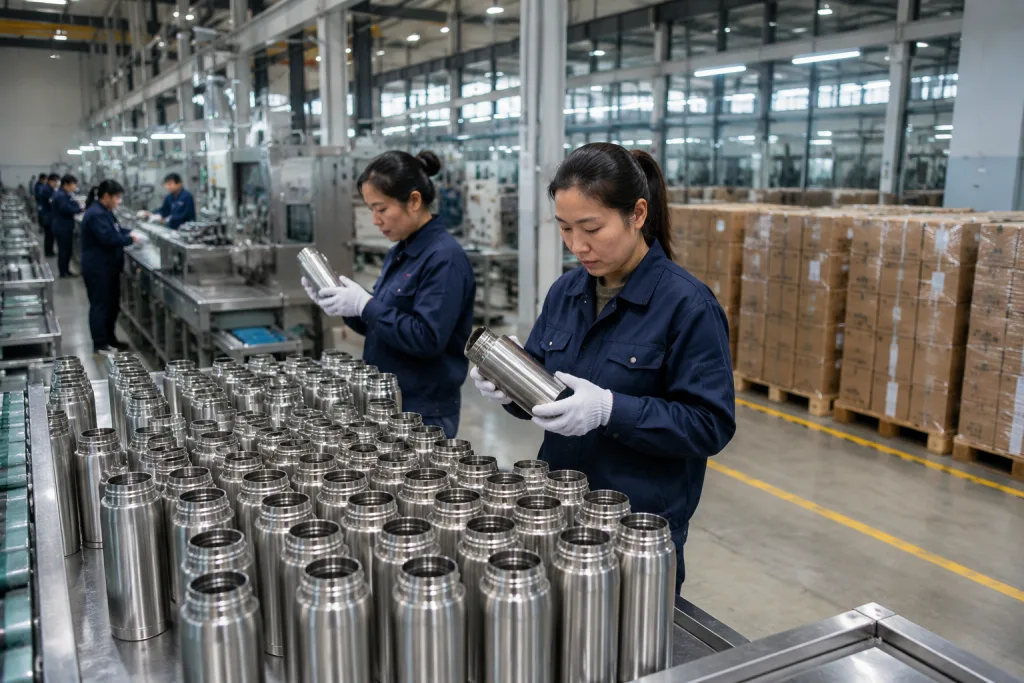
If you buy insulated drinkware for outdoor retail or promotions, the first mistake usually happens before sampling: the spec sheet looks clean, but it hides what changes on the line. A 316 stainless steel thermos flask factory can build a solid bottle, yet the real gap shows up in wall gauge, liner grade, sealing ring fit, and whether we can hold the same tolerance across 10,000 units. QC pulled a sample with a 1.2 mm neck gap once, and the buyer flagged it on the spot.
In Zhejiang, the best thermos factory is not the one with the flashiest catalog. It is the one that can tell you why a 0.5 mm inner wall, 316 liner, and a 70 mm mouth change heat retention, dent resistance, and MOQ. If you are sourcing thermos custom for retail or a promo launch, start with the numbers first and the logo later — the math does not work the other way. We run this every week, and we have seen that shortcut go sideways.
Why 316 changes the spec
I’ll keep the HTML exactly as-is and rewrite only the prose, with a tighter factory-floor tone and concrete spec detail.316 stainless steel is not a slogan; it changes who can buy and use the thermos. Compared with 304, 316 adds molybdenum, which gives better resistance to chlorides and some acidic media. That matters when the drink is citrus, sports mix, or anything salty, and it matters again if the flask sits in a car trunk or a wet warehouse for 6 months.
At a real 316 stainless steel thermos flask factory in Zhejiang, ask for the material declaration on the inner liner, outer shell, and cap insert. We run this check with a thickness gauge and the heat number on the coil, because the buyer flagged it on a PO once and the sample was fine but the paperwork was sloppy. A good thermos supplier will say where 316 is used and where it is not. In our line, many builds use 316 only on the inner liner, since that is the only part touching the liquid; the outer shell can stay 304 if you need a lower FOB. For outdoor retail, that split usually makes sense. For premium promotional thermos programs, full 316 is easier to sell, but it adds about USD 0.25-0.60 per unit depending on size and finish.
Do not accept a “316 body” claim without a drawing. The body, liner, lid, and silicone parts are separate line items, and the math does not work if someone mixes them together. If you need custom thermos for a U.S. chain or a European distributor thermos program, the spec should state the grade on each part, not just the headline description.
Wall gauge and retention
I’ll rewrite this section in-place, keep the HTML structure, and make the copy sound like a factory-side sales engineer wrote it.Thermal performance starts with wall thickness, not slogans. For most vacuum insulated thermos custom builds, the inner and outer walls land between 0.4 mm and 0.6 mm. At 0.4 mm, the bottle ships lighter and costs less, but dent resistance drops fast in carton stacking and outdoor carry. At 0.5 mm to 0.6 mm, the shell feels firmer, handles retail abuse better, and gives the neck weld a cleaner run on the line.
The buyer pushback we hear is simple: “Why pay more for 0.1 mm?” That question misses the math. On a 500 ml bottle, 0.1 mm usually adds about 8-12 grams, and QC pulled the sample aside more than once when the shell was too soft after a 1.2 m drop test. If you sell through distributors, one dented carton can wipe out the savings fast. Ask your thermos manufacturer for the liner and shell gauge, not just the finished weight. A 500 ml bottle around 260-310 g is normal for a practical custom insulated flask; under 240 g, something got cut.
- 0.4 mm: better for price-driven promotional thermos programs
- 0.5 mm: the safe middle for retail and private label
- 0.6 mm: better for premium custom thermos or travel use
If you want a long-life product, write the wall gauge into the PO. We’ve seen this go sideways when a buyer left it out and the factory quietly trimmed the shell during scale-up on a 304 neck spec.
Vacuum gap and heat hold
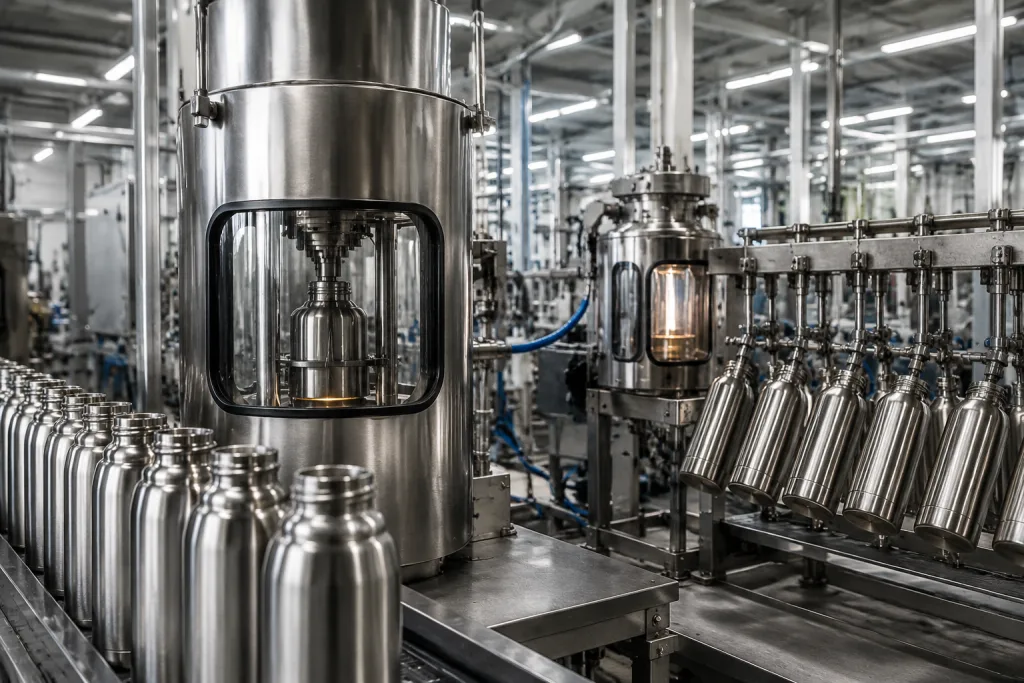
I’ll rewrite the section in-place, keeping the HTML exactly as-is and tightening the sales-engineering voice.Vacuum quality is where a lot of thermos factories talk big and document little. Real heat hold comes from the vacuum gap, the seal at the shoulder, lid geometry, and whether the line uses copper plating or a similar thermal barrier. On a stable process, a 500 ml flask usually lands at 6-12 hours hot and 12-24 hours cold, with room temp and fill level doing more damage than the brochure admits.
Ask for the test setup, not just the headline number. “12 hours hot” means nothing unless the supplier gives you the start water temperature, ambient temperature, and fill ratio; 95°C fill, 20°C ambient, and 90% fill is the kind of record we expect to see on the QC sheet. If the factory only sends a catalog line, that is a sales claim, not a spec. For custom thermos programs in Europe and North America, thermal claims need a lab method or an internal standard. AQL does not measure retention, so you still need separate performance sampling at pre-production and first production. We have seen buyers skip that and get burned.
Buyer rule: if the factory cannot show you the exact test setup, the number is not a spec, it is a guess.
For a bulk thermos order, keep the target grounded. Pushing from 8 hours to 24 hours usually means higher cost in the vacuum process, tighter lid control, and more inspection time on the line; the math does not work for every project. Fine for a premium outdoor bottle. Wrong for a giveaway item.
Lid, seal, and leak risk
I’ll rewrite the section in-place, keep the HTML structure unchanged, and make the copy sound like a factory-side sales engineer wrote it.Most returns do not come from the steel body. They come from the lid. We see this on the line all the time. A thermos customizable in color and print still fails if the cap thread, gasket, or stopper is weak. For a screw-cap style, the silicone ring needs a tight fit and food-grade silicone with stable compression after 5,000 open-close cycles. If the thermos customized design uses a push-button lid, the moving parts need tighter tolerance control and more leak tests.
A practical spec for a 316 stainless steel thermos flask factory order should list the cap type, thread pitch, gasket material, and drop test. Ask for 3 leak checks: upright, inverted for 30 minutes, and shaken. We had a buyer flag a PO typo once because the thread pitch was written as 6 mm instead of 6.0 mm, and the sample failed to match. If you ship via Amazon or retail distribution, a lid that passes only upright testing is not enough. For a thermos distributor or thermos supplier, this is where wholesale complaints start.
- Silicone ring: should be removable for cleaning
- Thread finish: no burrs, no sharp edges
- Seal test: 100% leak check on final assembly if possible
If your customer base includes outdoor retailers, specify glove-friendly torque. That sounds minor, but it is a real user issue when people open the bottle in cold weather. We’ve seen this go sideways when the lid needs two hands at 0°C. A lid that is too tight creates bad reviews even when it does not leak.
Surface finish and decoration
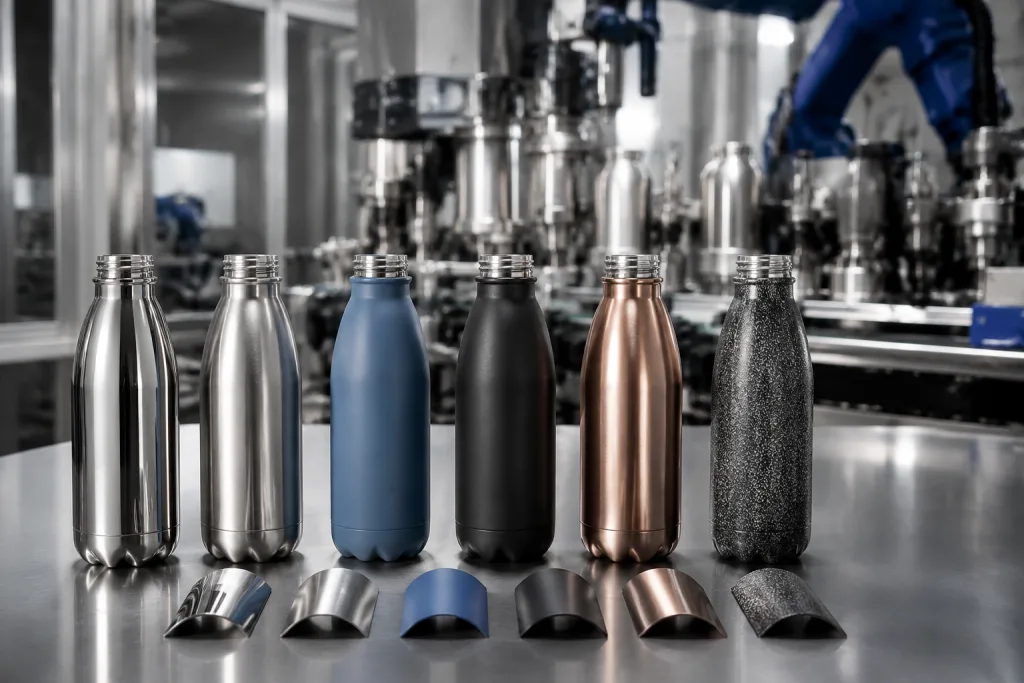
I’ll rewrite the section in-place, keep the HTML tags untouched, and tighten the prose so it reads like a factory-side sales engineer wrote it.Finish drives shelf appeal and print life. On stainless thermos bodies, we run brushed steel, powder coating, glossy paint, UV print, silk screen, laser engraving, and wrap print. Each one changes the look, the scratch pattern, and how the bottle holds up after 20-30 washes. For a promo order, simple print keeps the price down. For retail, powder coat usually wins the first glance and hides fingerprints better.
China factories, especially in Zhejiang, can do clean surface work, but coating thickness and adhesion need control. We normally see 60-80 micron powder coat for retail use. If your brand needs an exact Pantone match, ask for a sprayed sample or lab dip before mass production. We’ve seen this go sideways: the bottle looks sharp on day one, then the buyer flags it after 30 days because the coat is too thin.
Decoration choice also changes MOQ. Laser engraving suits small logo runs and avoids ink wear, but it reads weaker on dark coated bottles. Silk screen fits one-color branding and keeps setup cost low. If you plan several SKUs for distributor thermos channels, keep the body shape fixed and change only the decoration; that is how you keep tooling spend under control.
MOQ, pricing, and lead times
I’ll rewrite the prose in place, keep the HTML intact, and tighten the copy so it sounds like a factory-side sales engineer wrote it.Price comes down to the build, but buyers need a usable range before they greenlight samples. For a 500 ml 316 stainless thermos flask factory order, FOB China usually lands at USD 3.20-6.80 per unit, depending on wall gauge, lid type, coating, and packing. We had one PO typo where the buyer wrote 500 ml but wanted 350 ml, and that kind of slip changes the math fast. Full 316 inner and outer construction, plus a better lid and a retail box, pushes the quote up. If you only need a plain thermos bulk run with one-color print, the low end is still realistic once the line is stable.
MOQ usually starts at 500 pcs per design for custom thermos projects in this category, though some manufacturers thermos teams will go down to 300 pcs for repeat buyers or simple decoration. Standard lead time is 25-35 days after sample approval and deposit. QC pulled the sample last week and found a 1.2 mm lid gap on one set, so yes, small details do matter. If you add new tooling, special packaging, or a more complex cap, build in another 7-10 days. A Zhejiang supplier with 300,000 units/month capacity can run mixed orders, but your slot depends on the queue on the floor, not the brochure number.
For a distributor thermos program, push for a fixed yearly price with quarterly call-offs if your volume is steady. That gives the factory a clean steel-buying plan and keeps your landed cost from jumping around. We ship enough stainless to know this: the market moves, and the supplier should not lock 12 months with no adjustment clause. If the buyer wants that, the math does not work.
Testing that protects your margin
I’ll rewrite the section in-place, keep the HTML tags intact, and tighten the sales-engineer tone with a few concrete factory details.Testing is where serious buyers separate themselves from spec-sheet shoppers. A proper thermos manufacturer should show salt spray results for coated parts, cross-hatch adhesion on prints, vacuum retention checks, lid torque data, and food-contact paperwork. We run these on the line with a torque wrench and a vacuum gauge. For Europe and North America, ask for REACH on coatings and seals, plus FDA food-contact declarations where they apply. If your channel needs it, BSCI audit status still comes up in retail approval.
Use one inspection standard and stick to it. AQL 2.5 for major defects and 4.0 for minor defects is common for drinkware, but that only works if you define the defect list. Major means vacuum failure, leak, sharp edge, visible dent, wrong logo position, or color off by Delta E 2-3. We’ve seen buyers skip that part and then argue over a 0.8 mm logo shift after packing. For custom thermos with retailer branding, packaging defects hurt just as much as product defects. A crushed retail box can trigger chargebacks even when the bottle is fine.
Ask for pre-shipment photos of cartons, drop-test records, and carton markings. If the product is going into Amazon FBA, the carton and barcode system must match the plan, not just the bottle spec. The buyer flagged a PO typo once—one missing digit on the FNSKU—and the whole lot had to be relabeled. A thermos partner in China that tracks these details saves money on rework, relabeling, and delayed inventory. The math doesn’t work any other way.
Send your thermos spec for a quote
We can review your material, lid, print, and packaging line by line and give you a realistic FOB price from Zhejiang.
Frequently asked questions
Is 316 stainless really worth the upgrade for a thermos?
Yes, if you sell to outdoor customers, coastal markets, or users who put acidic drinks in the bottle. 316 improves corrosion resistance because of the molybdenum content, and that matters most on the inner liner. The typical premium is about USD 0.25-0.60 per unit versus a standard 304 build, depending on size and finish. For promo giveaways, 304 may be enough. For a retail thermos line or a premium custom thermos launch, 316 is the safer spec and easier to defend on quality.
What MOQ should I expect from a 316 stainless steel thermos flask factory?
A normal MOQ is 500 pcs per design, sometimes 300 pcs if the decoration is simple or you are a repeat buyer. If you want multiple colors, special lids, or full retail packaging, the factory may ask you to split by SKU. For thermos bulk orders, keep the design stable if you want the MOQ to stay low. A Zhejiang factory with a large monthly output can still insist on MOQ because setup time, print fixtures, and packaging labor are real costs.
How long does production take for custom thermos orders?
For a standard custom thermos order, count 25-35 days after sample approval and deposit. If you add tooling, new cap parts, or special packaging, add 7-10 days. If the order needs multiple print colors or complex color matching, samples can take 5-10 days before production starts. For seasonal retail launches, you should leave at least 45 days from final artwork to ship-ready goods. China factories can move fast, but only when the spec is frozen.
What should I test before approving mass production?
Test leak resistance, thermal retention, lid torque, logo placement, and finish adhesion. A practical sample plan is 5-10 pilot units, then a first article review with photos and measurement checks. For production, use AQL 2.5 for major defects and 4.0 for minor defects. Ask the thermos supplier for vacuum performance under defined conditions, such as 95°C fill at 20°C ambient. If the factory cannot state the test setup, the data is not useful.
Can I order a promotional thermos with custom branding and retail packaging?
Yes, and that is common for distributors thermos programs and brand campaigns. You can choose silk screen, laser engraving, or full color print, then add a color box, hang tag, or barcode label. Retail packaging adds cost, usually USD 0.15-0.60 per unit depending on material and print. If the product is going to stores or Amazon, make sure carton markings, FNSKU, and unit labels are confirmed before production. The bottle and the box must match the channel.