Key Takeaways
- 316 stainless steel usually adds $0.35-$0.90 per unit over 304, depending on wall build and finish
- A clean RFQ cuts sample iterations from 3 rounds to 1 or 2
- Most custom thermos programs start at 3,000 units MOQ and 25-35 days after sample approval
- For export, ask for REACH, food-contact test reports, AQL 2.5/4.0, and carton pack details in the PO
If you are buying a 316 stainless steel thermos flask custom for outdoor retail or a promotional campaign, the first miss is usually the same: the RFQ is too vague. The buyer asks for “good quality,” then the line gets stuck guessing lid type, coating, and pack method. We’ve seen a sample pass visual check and fail on the first hot-fill test at 95°C, so this is the wrong question to ask.
The cleaner way is strict. Lock the bottle spec, approve the sample, then send a bulk order the factory can build against. At our Zhejiang factory, we run thermos programs from 3,000 units MOQ and ship around 500,000 units a month across stainless drinkware lines, so speed only works when the paperwork is clean; last week QC pulled a 316 sample with a 0.3 mm wall deviation, and that kind of miss is what a clear PO catches early.
Start With the RFQ
I’ll rewrite just the prose inside the existing HTML, keep every tag and list structure intact, and make it read like a factory-side sales engineer wrote it.For a 316 stainless steel thermos flask custom job, the RFQ should look like a build sheet, not a shopping note. If you want a clean quote from a thermos factory in Zhejiang or anywhere else in China, spell out capacity, lid type, finish, logo method, target retail, and the destination market. We run quotes every day; vague inputs waste rounds, and the math does not work.
Use this sequence in the RFQ:
- Capacity: 350 ml, 500 ml, 750 ml, or 1,000 ml
- Body spec: 304 inner/outer or 316 inner with 304 outer, vacuum insulated
- Wall build: 0.4 mm or 0.5 mm inner wall, depending on price target
- Finish: powder coat, matte paint, polished steel, or engraving-ready bare metal
- Logo: silk screen, laser engraving, or UV print
- Order plan: sample quantity, thermos bulk quantity, and target ship date
A serious thermos manufacturer will come back with unit price, tooling if needed, sample charge, carton data, and lead time. We had a buyer flag a PO typo on carton size once, and QC pulled the sample again because the outer box spec was missing. If the quotation skips carton specs or test standards, it is not a complete manufacturer offer. In promotional thermos work, that is where margin slips away.
Good RFQ math saves money. A clear spec can cut quote spread by 10% to 18% across different suppliers’ thermos offers.
Choose 316 Where It Matters
I’ll rewrite the three paragraphs in-place, keep the HTML exactly as-is, and make the copy sound like a factory sales engineer wrote it.Not every custom thermos needs 316, and that is the straight answer a lot of suppliers dodge. If the bottle only carries water or regular coffee, 304 is enough. We ran this on the line last month: the buyer asked for 5,000 pcs, then pushed back after QC pulled a salt-spray note. If your customer sells into coastal stores or outdoor kits, 316 is the safer call and the story holds up.
316 stainless steel has molybdenum, which helps resist chloride attack. That is the main reason it behaves better with sports drinks, flavored tea, and buyers who read spec sheets line by line. For a 316 stainless steel thermos flask custom, the upgrade usually adds about $0.35 to $0.90 per unit, depending on the double-wall 18/8 build, copper coating, or a special paint finish. We ship these orders all the time, and the math works when the brand needs a cleaner premium pitch.
Ask your thermos supplier for the exact split: 316 on the inner liner only, or 316 on both the liner and contact parts like the straw tube or infuser basket. One PO typo changed “inner” to “entire,” and that turned into a cost fight nobody wanted. In China, plenty of factories can quote in 2 hours, but fewer will spell out each grade clearly. That is the wrong question to skip when you buy through a distributor thermos channel or compare thermos distributors for a launch.
Approve the Sample Like A Buyer
I’ll rewrite this section in-place, keep the HTML structure untouched, and tighten the wording so it sounds like a buyer-side factory note with concrete details.The sample stage is where you protect the bulk order. Do not approve a custom thermos because the print looks clean in photos. Put the sample through a real accept list. If you are sourcing from a China thermos manufacturer or a Zhejiang thermos factory, ask for two physical samples: one golden sample for appearance, one pre-production sample for function. We had a buyer flag a 0.8 mm lid gap on a 500 ml cup, and that saved a messy PO later.
Your sample checklist should include:
- Capacity tolerance: within ±5%
- Vacuum hold: 12 hours hot retention target, 24 hours if the claim needs it
- Leak test: 8-hour upside-down check
- Drop resistance: 1 meter carton simulation or agreed test method
- Odor check: no coating smell after wash and air-dry
- Logo durability: rub test after 50 cycles, if decorated
For a promotional thermos, the sample is also a branding check. Verify Pantone matching, logo placement, and whether the lid color reads correctly under retail lighting. A good thermos factory will mark the sample with revision history and show what changed between rev 1 and rev 2. We run this on the line with a laser marker and a simple photo log. If they cannot do that, you are not ready for thermos customized mass production.
Typical sample timing from a competent manufacturer thermos line is 5 to 10 days. If tooling is needed for a new lid or cap, allow 12 to 18 days. Ask for the sample invoice to show unit sample cost, courier cost, and whether the charge is deductible from bulk PO value above a threshold like 5,000 units. The math does not work if you ignore that line item.
Write the Bulk PO Correctly
I’ll rewrite the section in-place, keep the HTML structure intact, and tighten the copy so it sounds like a factory-side sales engineer wrote it.Once the sample is signed off, the purchase order should leave no room for guesswork. This is where buyers lose control. A bulk PO for thermos bulk production should spell out the BOM, carton data, inspection standard, and shipment split. Leave one item blank, and the line will fill it with the cheapest assumption. That is not bad faith; that is how the factory runs.
For a custom thermos PO, include these line items:
- Product name: 316 stainless steel thermos flask custom
- Item code: your SKU or factory code
- Material: 316 inner liner, 304 outer shell, PP lid parts, silicone gasket
- Decoration: laser logo, 1 color silk screen, or full-wrap print
- Packaging: individual box, master carton count, barcode, and FNSKU if needed
- Inspection: AQL 2.5 major, 4.0 minor, or your house standard
- Trade term: FOB Ningbo, FOB Shanghai, or other agreed term
For distributors thermos programs, ask the supplier to state whether cartons are export-ready and whether the goods pass REACH and food-contact requirements for your destination market. We had one buyer flag a PO because the carton typo said 24 pcs when the outer box held 12; QC caught it before packing, and that saved a mess. Factories in Zhejiang that ship to North America and Europe already know these papers matter. The right supplier can drop the PO into production on the same shift, no second call.
Control Price Without Cutting Corners
I’ll rewrite the section in-place, keep the HTML exactly as-is, and tune the prose to sound like a factory-side sales engineer with concrete pricing detail.Price on a 316 stainless steel thermos flask custom is not just a unit cost; it comes out of the full build. If you want a lower quote, we usually see three levers: simplify the lid, trim decoration, or change capacity. Cutting wall thickness too far is the wrong move. A 0.4 mm inner wall is standard on mid-range models; once you go under that, heat retention and dent resistance start to slip.
Here is the pricing logic we run on the line:
- Material upgrade: 316 inner liner costs more than 304
- Finish: powder coat adds labor and oven time
- Lid complexity: a one-piece PP lid is cheaper than a multi-part drinking lid
- Decoration: laser engraving is often cheaper than multi-color print at volume
- Pack-out: custom boxes, inserts, and retail hangtags add carton labor
As a sourcing benchmark, a plain 500 ml custom thermos in 316 grade may start around $4.10-$5.80 FOB China at 3,000 units. A more finished promotional thermos with coated body and retail packaging can land in the $6.20-$8.50 range. The math does not work any other way. Exact numbers depend on lid tooling, vacuum spec, and carton layout; QC pulled a sample once with a 0.35 mm liner, and the buyer flagged it before shipment. If a thermos supplier quotes far below that, check whether they are quoting 304, thinner steel, or a stripped-down pack.
A vendor that knows export programs will tell you where the cost sits instead of hiding it. That is what you want from a thermos vendor, thermos supplier, or thermos distributor relationship: clear cost, stable lead time, and fewer surprises in China shipping documents. We’ve seen this go sideways when a PO had a one-digit typo on carton count, and the whole booking got pushed.
Plan Bulk Production and Inspection
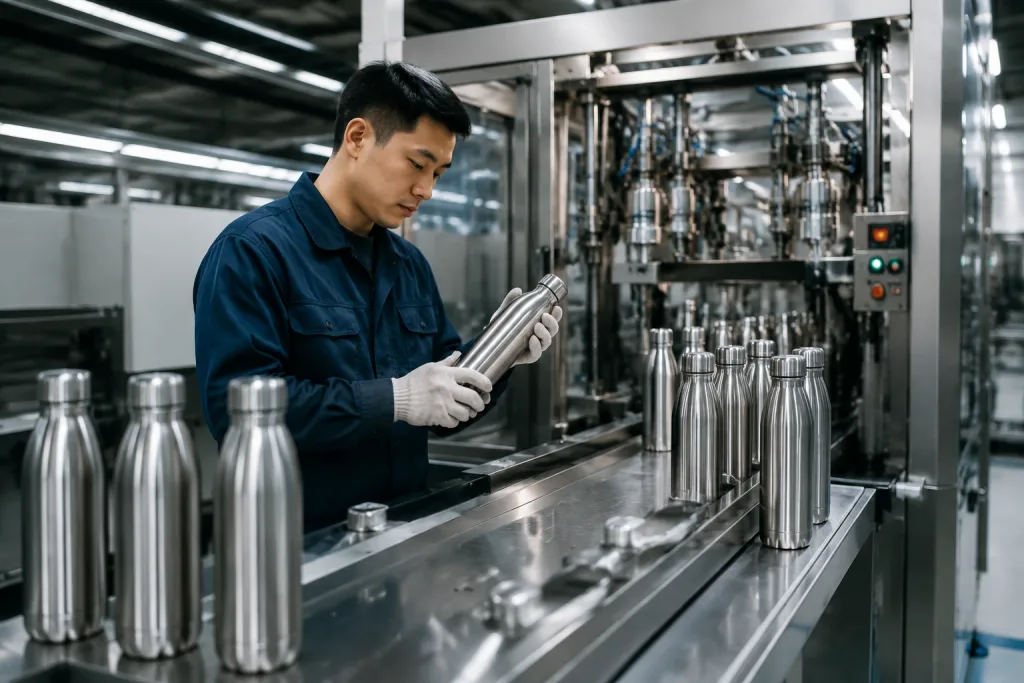
I’ll rewrite the section in place, keeping the HTML exactly as-is and tightening the sales-engineer tone. I’m going to preserve all numbers and inspection terms, while adding a few concrete factory-floor details and removing the AI-ish filler.After PO approval, bulk production runs in a fixed sequence: raw material check, tube forming, welding, vacuum drawing, leak test, decoration, assembly, and final packing. On the line, we freeze one pre-production sample check before full volume starts. If the order is large, ask for a midline inspection after 20% to 30% of the batch is done; QC pulled the sample on a 316 stainless run and caught a lid thread issue before it spread.
For export buyers, the inspection setup stays simple. Use AQL 2.5 for major defects and 4.0 for minor defects unless your retailer wants tighter limits. Check vacuum performance on random pulls, lid torque, logo consistency, and carton drop resistance. If you are buying from a manufacturer thermos team in Zhejiang, ask for photo records and lot traceability. We’ve seen this go sideways when the buyer flagged a PO typo on carton count, then the boxes and barcode labels no longer matched the shipment plan.
Lead time for a standard custom thermos order is often 25 to 35 days after sample approval, plus 5 to 10 days for sea freight to the West Coast or 30 to 40 days to Northern Europe, depending on routing. A rush promotional thermos program can move by air freight, but the math doesn’t work unless the margin is strong. If the launch date is fixed, ask the factory thermos team to stage production in partial lots and confirm packing carton counts before shipment; we ship better when the plan is locked at 1,000 pcs per lot instead of scrambling at the dock.
The process is not complicated. The hard part is discipline: a clear RFQ, a serious sample review, and a PO that leaves no room for interpretation. That is how you turn a thermos custom project into a repeatable supply program.
Send your RFQ for a faster quote
Share capacity, logo method, carton needs, and target market. We will quote the build, sample timing, and bulk lead time without filler.
Frequently asked questions
What is the MOQ for a 316 stainless steel thermos flask custom order?
Most factory thermos programs start at 3,000 units per design, sometimes 1,000 units if the lid is already in stock. For a new lid or custom color, 5,000 units is more realistic. In Zhejiang, we often see repeat buyers split orders by color to manage MOQ while keeping branding consistent.
How much more does 316 cost than 304?
For a standard custom thermos, 316 usually adds about $0.35 to $0.90 per unit versus 304, depending on the wall structure, finish, and whether lid-contact parts also use 316. On premium retail models, the gap can be wider if you add powder coating or laser engraving.
How long does sample development take?
A basic custom thermos sample usually takes 5 to 10 days. If you need a new lid mold, special coating, or revised logo tooling, allow 12 to 18 days. The fastest approvals happen when your RFQ already includes capacity, decoration method, and carton requirements.
What documents should I ask from a thermos supplier?
Ask for commercial invoice, packing list, product photos, material declaration, and any relevant test reports such as REACH or food-contact compliance for your market. For bulk shipments, also confirm carton dimensions, gross weight, HS code guidance, and whether the factory can print barcodes or FNSKU labels.
Can I order mixed colors in one thermos bulk PO?
Yes, but it depends on the model and color split. Many thermos manufacturers accept mixed colors if the total order stays above 3,000 units and each color is at least 500 to 1,000 units. Mixed colors usually add sorting time and can slightly increase carton labor or packing cost.