Key Takeaways
- 316 inner walls usually add USD 0.35-0.90 per unit versus 304, depending on 500-750ml size and lid type
- For custom thermos orders, define AQL 2.5/4.0, 24-hour heat retention, coating adhesion, and carton drop standards before deposit
- A practical MOQ for a customized thermos is often 1,000-3,000 pcs per color, while new mold lids can push MOQ to 5,000 pcs
- Typical Zhejiang, China lead time is 35-55 days for mass production after sample approval and 30% deposit
You can approve a stainless bottle sample that looks perfect, then watch margin disappear once the bulk run starts leaking, chipping, sweating, or landing with logo defects. That is the real issue with 316 stainless steel thermos bulk: not finding a supplier quote, but writing a spec that still holds up on a 20,000-piece run.
For outdoor retailers and promo brands, the weak spots are predictable. Vacuum loss, tea-stain corrosion at welds, powder coat scratches, lid odor, crooked prints, and cartons that fail drop tests show up when the thermos program is under-specified. We see the same pattern in Zhejiang all the time. A buyer once sent a PO with the lid code typed wrong by one digit, and QC pulled the sample before the line even packed it. The wrong question is “what is the unit price?” Ask which failure mode is most likely, how we test it, and who covers the loss if it misses AQL 2.5.
Where 316 actually matters
I’ll rewrite the section in-place, keeping the HTML structure and the existing specs intact while making the prose sound like a factory-side sales engineer wrote it.Buyers ask for 316 stainless steel thermos bulk because they heard 316 is the better spec. That is true in the right spot. In a vacuum bottle, the inner liner is where 316 pays off. It holds up better against chlorides, acidic drinks, and salt exposure than 304. We ship these for hikers, anglers, and marine accounts, and for promo programs where the end user fills the cup with coffee, electrolyte drinks, or tea every day.
The wrong move is asking for full 316 without checking cost or forming behavior. Most manufacturer thermos factories in China run 316 inner + 304 outer as the sane build. You get the corrosion benefit where the liquid touches metal and avoid paying for 316 on the shell. For a 500ml to 750ml vacuum flask, we usually see 0.4mm inside and 0.5mm outside. If a suppliers thermos quote says "316 bottle" and does not state inner only or inner and outer, the quote is not ready. Simple as that.
- Good spec: SUS316 inner liner, SUS304 outer shell, food-contact PP lid, LFGB or FDA-compliant silicone gasket
- Useful test request: material certificate plus salt or acidic beverage exposure verification on finished goods
- Common price band: USD 3.80-6.80 FOB Ningbo for standard 500-750ml units at 3,000 pcs, depending on lid and finish
On the line in Zhejiang, the better factory thermos suppliers explain this in one pass. QC pulled the sample, and if the mill cert only says "food grade stainless," we flag it back. For a distributor thermos program, the exact steel grade placement matters more than the slogan.
Vacuum failure starts at welding
I’ll rewrite the section in place, keep the HTML exactly as-is, and strip the AI-style phrasing while adding factory-floor specifics and sharper buyer language.The priciest failure in thermos bulk is vacuum loss. The bottle looks fine on the shelf, then insulation falls off after shipping or two weeks in use. Buyers blame the factory. The root causes are narrower: unstable welding at the bottom getter, weak vacuum pull control, pinhole leaks, or rough handling between vacuuming and powder coating.
A custom thermos spec should never stop at "vacuum insulated." Put a number on it. For a 500ml bottle, one workable commercial target is 95°C fill, then 24 hours later at least 45-50°C, depending on body shape. Cold retention can be written too, but heat retention gives faster feedback on the line. Ask how many pieces per lot get tested, and whether QC pulled the sample apart or used a non-destructive check.
What to lock before PO
- Heat retention standard: 95°C hot water, ambient 20°C, after 6 hours at least 68°C, after 12 hours at least 55°C
- Vacuum inspection method: full inspection with temperature spot-checks plus leak detection by vacuum meter or oven test
- Reject rule: any lot that misses the agreed retention data gets reworked or replaced before shipment
At BottleForge Industrial, a Zhejiang stainless line can run around 300,000 units per month, but that number means little if vacuum consistency drifts in peak season. We run welding, vacuuming, coating, and assembly as separate stations so finished semi-products are not getting knocked around on a trolley. I have seen buyers push back on an 18-day lead time in China during September to November, and the math does not work unless someone is rushing vacuum stabilization or final QC.
Most insulation complaints are process-control problems, not design problems. The buyer flagged it after sampling, but the spec was loose from day one.
Corrosion hides in the seam
I’ll rewrite the section in place, keeping the HTML tags and structure intact while stripping the AI-ish phrasing and adding more factory-floor detail.316 is picked to cut corrosion risk, but buyers still come back with metallic taste, rust-like spots, or tea staining. The base grade is usually not the problem. We see bad pickling, uneven passivation, contamination during forming, or a weld zone that got cooked and left uncleansed.
This matters more for a customizable thermos going into outdoor retail than for a cheap promo bottle. A camping buyer may leave soup, coffee, lemon water, or electrolyte mix inside for 6 to 8 hours. If the inner neck or seam is rough, deposits build fast and cleaning gets ugly. We’ve had QC pull a sample from the line at 9 a.m., and the buyer flagged the weld halo right away. When you source from thermos manufacturers in China, ask for close-up shots of the inner seam and neck transition, not just lifestyle renders.
A clean spec looks like this:
- Material certificate for SUS316 inner liner
- Food-contact compliance such as REACH screening for applicable components and LFGB or FDA migration compliance where required
- Internal cleaning and passivation controls documented in the QC sheet
- Random soak test with acidic solution or saline simulation on production samples
For a thermos custom order, ask whether the bottle is electro-polished inside. It adds cost, but on higher-end customized thermos projects it cuts odor hold and makes washing easier. On a 500 ml bottle, the uplift is often around USD 0.12-0.25 per unit. We’ve seen buyers push back on that number, then pay more later on returns. If the bottle is headed for premium outdoor channels, the math works. If it is a giveaway, it doesn’t.
Corrosion claims get messy when the buyer never wrote down the use case. Coastal carry, fishing, and sports drinks all change the risk. Put that in the RFQ. A thermos vendor in Zhejiang cannot spec around a use condition you never mentioned, and we’ve seen that typo on the PO turn into a 12-day delay versus an 18-day rework loop.
Lids fail more than bottles
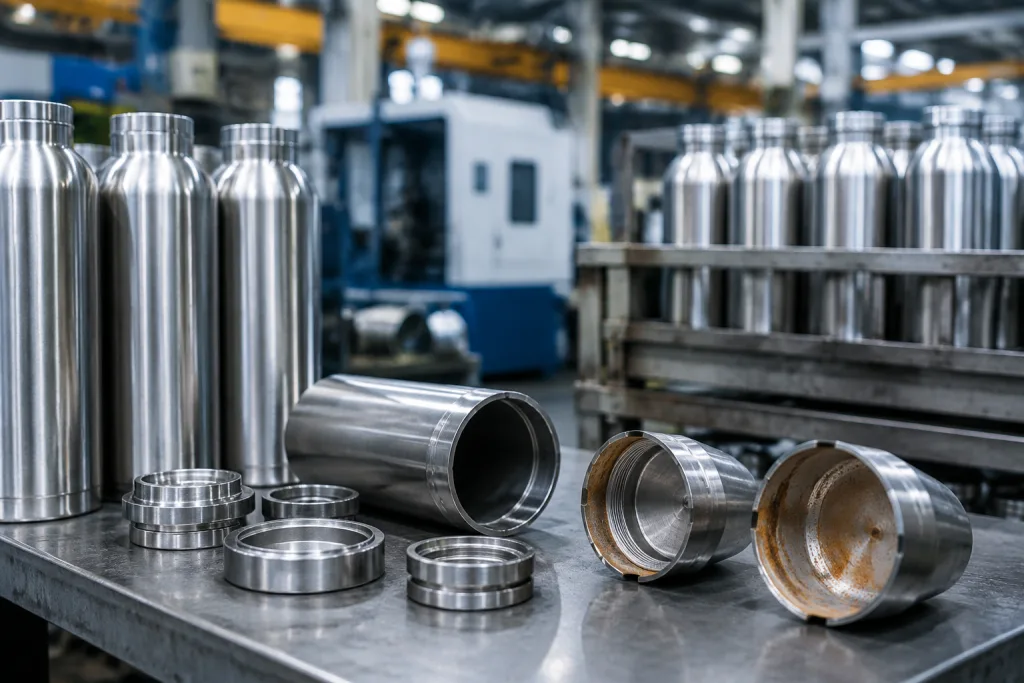
I’ll keep the HTML exactly as-is and rewrite only the prose, with tighter B2B sales-engineer language and a few concrete factory details.Most buyer complaints in a bulk thermos project start at the lid, not the 316 stainless body. We see the bottle leak in a backpack, the flip spout crack after a few drops, the handle go loose on the line, the threaded cap cross-bind, or the silicone seal pick up odor after one hot coffee run. If you only check the shell, you miss the part that drives returns.
Lid failures usually come from three sources: too many moving parts, weak resin selection, and no torque or cycle test. A plain screw lid with PP and food-grade silicone beats a fancy one-touch lid on most programs. We’ve seen that go sideways fast. For a customized thermos built for giveaways, simple wins because field use is rough and spare parts are not cheap.
Lid points that deserve written specs
- Resin grade: PP is common; Tritan may be used for clear parts; do not accept vague "plastic" labeling
- Leak test: 100% inverted test plus random pressure or shake test
- Cycle life: 3,000 open-close cycles for threaded lids is a workable baseline on repeat-use SKUs
- Seal odor: require no abnormal smell after hot water fill test
- Torque standard: define opening and closing torque range so retail customers can use it without fighting the cap
If you need a thermos customizable lid color or a fully new closure, ask early whether an existing mold is on hand. New lid tooling in China can run USD 2,000-8,000 and push pre-production samples out by 20-30 days. The math does not work the same after that. A standard bottle with logo may start at 1,000 pcs, but a new-lid custom thermos job usually shifts to 5,000 pcs or more—we have seen a buyer flag a PO typo on MOQ and lose a week fixing it.
For promotional brands buying from suppliers thermos programs, I’d put budget into a stable lid before chasing a wild bottle shape. The bottle can be plain. QC pulled the sample on a lid that passed drop test but failed after 800 cycles. Users forgive a basic silhouette. They do not forgive leaks.
Decoration breaks under real handling
I’ll rewrite the section in place, keeping the HTML exactly as-is and tightening the prose so it sounds like a factory-side sales engineer wrote it.Print and coating failures are what buyers notice first in a thermos promotional or retail launch. The sample looks clean, then the mass run shows color drift, scuffed powder coat, laser marks 8 mm off, or logos that fail dishwasher and rub tests. We see this on the line all the time. At that point, the buyer needs QC thinking, not marketing talk.
Powder coating is the main finish for stainless vacuum bottles because it hides small shell marks and gives better grip. It still needs thickness control, surface pretreatment, and adhesion testing. A matte finish that looks good under showroom lights is not enough. For a manufacturer thermos program, ask for coating thickness targets and cross-hatch adhesion results. If the body uses rubberized paint, scratch risk goes up and transit damage usually follows. The math does not work if you skip that step.
- Powder coat thickness: commonly around 60-80 microns
- Adhesion: cross-hatch test with no significant peeling
- Print alignment: define logo position tolerance, for example ±1.5mm
- Color tolerance: approve against Pantone reference under consistent lighting
- Rub test: dry and wet rub standard on printed logos before packing approval
Laser engraving lasts longer than surface print, but it changes the look and can expose the base metal tone. Silk screen gives more color options, though it wears faster unless the process matches the coating. For a thermos customized order going to outdoor retail, do not trust a hand sample alone. Ask for a pre-production sample from actual line conditions in China; QC pulled the sample, and that is where we catch masking and registration problems before 3,000 units turn into dead stock.
Be strict on defect allowances. No thermos factory ships zero cosmetic defects, and anyone promising that is selling air. Set AQL 2.5 for major and 4.0 for minor, then spell out what counts as major: wrong logo, visible dent, coating peel, leak, odor, unstable base. That protects both you and the thermos supplier.
Packing is a quality issue
I’ll keep the HTML structure intact and rewrite only the prose, with tighter factory-floor language and concrete packing details.Buyers often treat cartons as an afterthought. Then a clean bottle turns into a bad shipment. We’ve seen dented bases, chipped shoulder coating, broken handles, and crushed gift boxes come from weak inner packing, carton counts cranked too high, or a sloppy pallet pattern. On a China-to-North America or Europe ocean move, that is common because the cargo gets handled 6 or 7 times.
If you are buying distributors thermos volume, ask for the full pack-out spec before you sign off. We want the inner bag type, egg-crate or divider layout, gift box board grade, master carton burst strength, carton size, gross weight, and pallet plan on the PO. Good packing is cheaper than claim work. On our line, a carton upgrade usually adds USD 0.08-0.18 per unit; replacing damaged promotional thermos stock costs far more.
For retail-ready jobs, call out carton drop standards. A normal checkpoint looks like this:
- 1 corner, 3 edges, 6 faces drop test on the packed gift box or master carton, based on the sales channel
- No product leak after drop
- No functional damage
- Cosmetic limit defined before production
If you sell through e-commerce, the spec gets stricter. FNSKU labeling, barcode scan readability, and single-unit parcel survival matter more than pretty shelf packing. A thermos distributor program for stores and a thermos vendor program for Amazon are different jobs. Same bottle. Different carton.
Ask your thermos suppliers in Zhejiang whether they run in-line carton drop checks and whether pallet photos go into the final inspection report. If they do not, put it on the QC sheet. Freight damage fights usually start because nobody wrote the packing spec clearly before loading; QC pulled the sample, but the carton layout was never locked down.
Spec the project, not just the bottle
I’ll rewrite the section in-place, keeping the HTML tags and structure intact while making the copy sound like a seasoned export-sales engineer.The cleanest stainless program starts with a full commercial and technical spec before the first deposit. Write down the material callout, finish, lid, performance target, packaging, compliance, inspection, and claim handling. A solid thermos manufacturer will fill gaps, but they cannot guess your market plan. QC pulled a sample with a 2 mm lid gap last week; that kind of miss comes from an unclear brief, not a bad machine.
For a typical 316 stainless steel thermos bulk project in Zhejiang, China, the baseline usually looks like this:
- MOQ: 1,000 pcs per color for standard shapes; 3,000 pcs total gives better carton loading and lower unit cost
- Sampling: 5-10 days for an existing model logo sample; 15-25 days for color or structure changes
- Lead time: 35-55 days after sample approval and deposit
- Terms: 30% deposit, 70% balance before shipment on initial orders is still common
- Inspection: pre-production sample signoff, in-line checks, final inspection to agreed AQL
For outdoor retail, put heat retention, corrosion resistance, and leak performance at the top of the sheet. For promotional brands, lock down decoration consistency, gift-box presentation, and ship date. If you are a thermos distributor or managing multiple thermos distributors, keep one master QC sheet and copy it across SKUs. We’ve seen this go sideways when the buyer flagged the same logo drift on three colors; one sheet would have saved two rounds of rework.
Split suppliers into three buckets: a trading quote source, a real thermos factory, and a project manager who can handle production plus export compliance. The cheapest supplier thermos offer usually skips one of those jobs. The math doesn’t work. You pay later in claims, delays, or stock that sits in a warehouse because the carton typo says 12 pcs and the PO says 120.
Send your 316 thermos spec for a factory review
We will check material callouts, lid risk, decoration method, MOQ, and packaging points before you place a bulk order from China.
Frequently asked questions
Is 316 always better than 304 for bulk thermos orders?
Not automatically. For most 316 stainless steel thermos bulk projects, the best value is SUS316 on the inner liner and SUS304 on the outer shell. That controls cost while improving corrosion resistance where liquid touches metal. Full 316 construction usually increases cost without much practical benefit for standard outdoor or promotional use. Expect roughly USD 0.35-0.90 extra per unit for a 500-750ml bottle when changing the inner wall from 304 to 316, depending on volume and lid design. If your end users handle salt exposure, acidic beverages, or heavy daily use, 316 inner is worth it. If the item is a short-cycle giveaway, 304 may be enough if the factory thermos build quality is stable.
What MOQ should I expect for a custom thermos with my logo?
For an existing bottle shape with standard lid and one-color logo, MOQ is commonly 1,000 pcs per color, though some thermos suppliers in China will quote 500 pcs at a higher unit price. A more workable order for better pricing is 2,000-3,000 pcs total. If you want a custom color, gift box, or mixed decoration, MOQ may stay similar but setup charges increase. If you need a new lid mold or structural change, MOQ often jumps to 5,000 pcs or more, and tooling can add USD 2,000-8,000. For distributor thermos programs, ask whether MOQ is by SKU, by color, or by carton multiple. Those details affect your inventory risk more than the headline MOQ alone.
How do I reduce leak and insulation claims before shipment?
Put the tests into the purchase order, not just the email thread. Require 100% leak testing in the factory, plus random shake or pressure tests on finished goods. For insulation, define a measurable retention standard such as 95°C fill and minimum 45-50°C after 24 hours for a standard vacuum flask. Also ask for pre-production sample approval, in-line QC records, and final inspection to AQL 2.5/4.0. If the lid has moving parts, ask for cycle-life testing of at least 3,000 open-close cycles on sample units. In China, the best thermos manufacturer will document these checkpoints. If a supplier thermos quote cannot state test methods clearly, you should expect more arguments after the goods are finished.
What certifications or compliance documents matter for Europe and North America?
For Europe and North America, the key documents usually cover food-contact safety and social or quality system controls rather than one universal bottle certificate. Ask for material declarations for stainless steel, PP, Tritan if used, and silicone. For food-contact components, request FDA or LFGB compliance depending on your market, plus REACH screening where applicable. ASTM requirements may apply more on children’s items or specific packaging claims than on standard adult thermos bottles, so check your product category carefully. On the factory side, BSCI audits and ISO-managed quality systems are useful signs of process discipline, though they do not replace product testing. If you sell through major retail channels, confirm barcode, labeling, and carton specs early as well.
What lead time is realistic for thermos bulk from Zhejiang, China?
For a standard customized thermos using an existing mold, plan on 5-10 days for a logo sample and 35-55 days for mass production after sample approval and deposit. During peak season, especially from September to November, lead time can stretch closer to 60 days if the supplier is busy with coating or vacuum lines. A brand-new mold project usually needs another 20-30 days before production samples are ready. Ocean transit is separate, so do not confuse factory lead time with landed timing. If a thermos vendor promises unusually fast production, ask whether they are skipping pre-production approval, shortening coating cure time, or compressing final QC. Speed in China is possible, but not for every process without trade-offs.