Key Takeaways
- 316 inner steel typically adds USD 0.35-0.85 per piece versus 304 on a 500 ml thermos, depending on structure and finish
- Most private label thermos programs in Zhejiang start at 1,000-3,000 pcs MOQ, with 20-35 day lead time after sample approval
- A 0.45-0.50 mm inner wall and a 0.40-0.45 mm outer wall are common for retail-grade stainless thermos bottles
- For outdoor and promo buyers, leak testing, drop testing, and REACH documentation matter more than a flashy render
If you are buying a 316 stainless steel thermos bottle private label for outdoor retail or a promotional campaign, the wrong spec costs more than the bottle. We have seen it turn into taste complaints, dented cartons after a 1.2 m drop test, loose lid torque, and a margin that vanishes once you add laser engraving and ocean freight. The question is not just “316 or 304?” You need to decide where 316 actually matters, which capacity moves on shelf, and whether your launch can handle a 35-day lead time without choking the line.
From Zhejiang, we see the same pattern every week: buyers want a custom thermos that looks premium, runs through daily use, and still lands at a workable FOB price. QC pulled the sample last Friday and found a 0.3 mm wall variation on one lot; that is the kind of thing that later shows up as uneven heat retention. A good thermos manufacturer will break down the marketing spend from the build cost. A weak one prints “316” on every email, then downgrades the lid, the vacuum pull, or the steel thickness. You need to lock the trade-offs before bulk order, especially for a promotional thermos or a distributor thermos program that has to repeat without drama.
Start with the use case
The first decision is use case, not decoration. We see this all the time on the line. A 316 stainless steel thermos bottle private label for hikers, field crews, and commuters should not be built like a cheap giveaway item. If the bottle will hold coffee, tea, or acidic drinks for 8-12 hours, 316 stainless in the inner liner pays off because it resists corrosion better than standard 304. That matters when the buyer runs citrus tea, sports mixes, or salty water on the road.
For outdoor retailers, the bottle has to feel like a product, not a promo throw-in. The lid threads need to cut clean, the silicone seal has to pass a boil test, and the vacuum should hold after a 1.2 m drop test. We had one buyer flag a lid typo on the PO last month, and QC pulled the sample before packing. For promotional brands, the math changes: a custom thermos for a campaign can use a simpler lid if the print area is bigger and the unit cost stays under target. A supplier thermos program starts with a few blunt questions:
- Will the bottle be sold at retail, bundled, or handed out as a promotional thermos?
- Is temperature retention the main selling point, or is branding the main value?
- Do your customers expect dishwasher use, or hand wash only?
If you skip this step, you end up paying for steel grade the customer never sees, then cutting corners on the cap and seal that get touched every day. That is the wrong question to ask.
Decide where 316 pays off
I’ll rewrite the section in-place, keep the HTML structure unchanged, and tighten the sales-engineer tone with more concrete sourcing detail.316 stainless is a cost call, not a magic upgrade. On a typical 500 ml double-wall vacuum bottle, moving the inner liner from 304 to 316 can add about USD 0.35-0.85 per piece, depending on body shape, cap system, and surface finish. On a 3,000 pc order, that is real money. On one outdoor program we ran, the buyer flagged the extra USD 1,800 as fine because the retail sat above USD 24.99; on a low-ticket distributor line, the math does not work.
Use 316 where the bottle sees aggressive liquids or where the sales story depends on stronger corrosion resistance. Keep the outer shell in standard stainless if the market does not ask for full-grade matching. Most of the programs we ship use 316 on the inner bottle only, and that keeps tooling simple and stops the cost creep that comes with full-grade matching.
Do not let a thermos factory sell you a “316” bottle without checking the steel spec on each wetted part. Ask for:
- Inner liner material report
- Lid contact-point material
- Silicone grade and odor test result
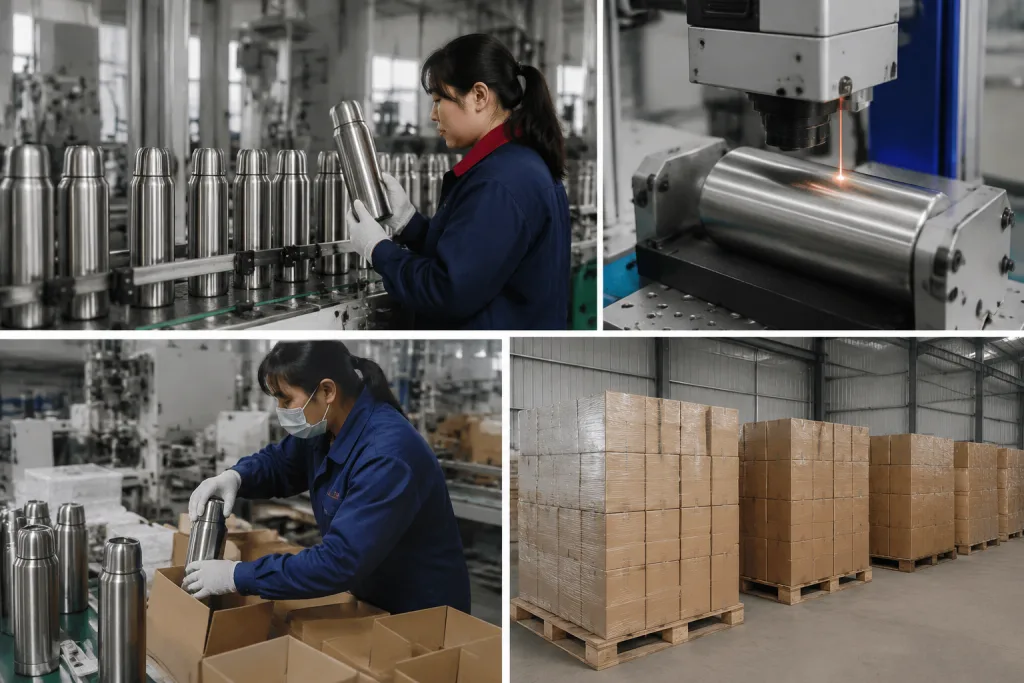
For China sourcing, this is where a real factory thermos partner beats a trading-only thermos vendor. In Zhejiang, the serious plants will hand over a material trace sheet and a photo set from the line, plus monthly output of 600,000-900,000 units. QC pulled the sample on one order we saw because the PO typo listed the lid as 304 instead of 316, and that kind of miss is exactly why you want the paper trail before private label artwork goes to print.
Choose the bottle spec first
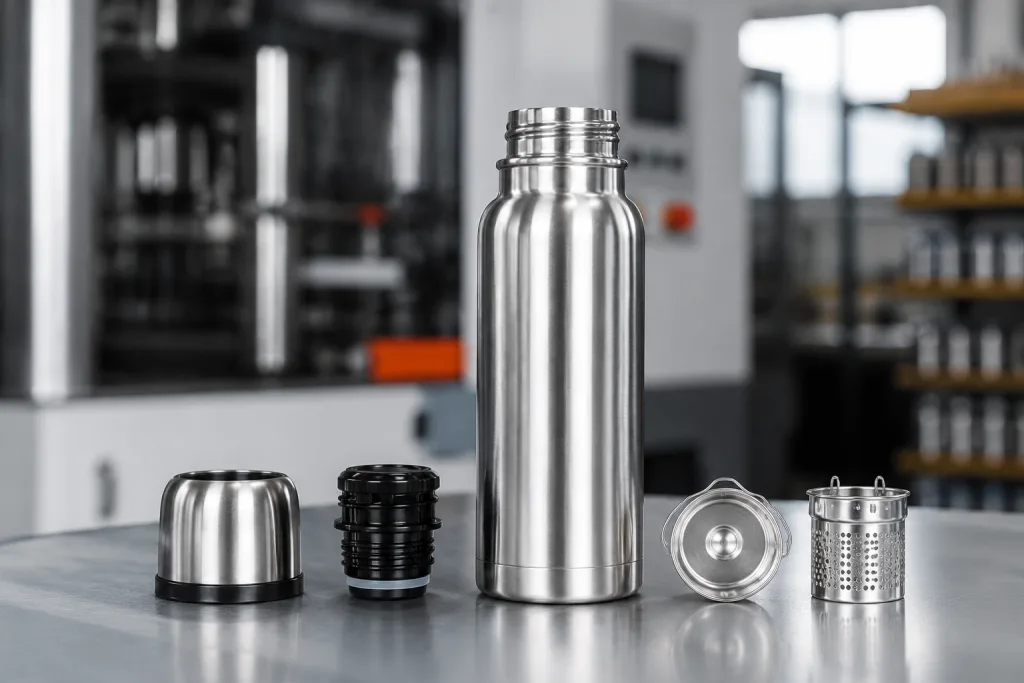
I’ll rewrite just the prose inside the existing HTML, keep the tags and structure intact, and make it read like an experienced sales engineer.The bottle structure decides whether a cup feels worth the money or just costs more. For a 316 stainless steel thermos bottle private label run, the spec we usually ship is 500 ml, 750 ml, or 1,000 ml, with a 0.45-0.50 mm inner wall and a 0.40-0.45 mm outer wall. That band keeps the bottle from feeling flimsy while the vacuum line still holds up. Go thinner and dents show fast; we’ve seen a 750 ml sample come back from QC with flat spots after one week in a backpack test.
Capacity should follow the channel, not guesswork. Outdoor buyers move 500 ml and 750 ml first because those sizes fit a day hike and a commuter bag; one client pushed for 1,200 ml, and the math did not work for shelf space or freight. Promotional brands often stay with 500 ml because the unit cost stays lower and the logo area reads better on the body. If you are selling to distributors on thermos programs, run three capacities off one body style so the same line can cover three price tiers. That keeps MOQ cleaner and saves us from splitting tooling across too many SKUs.
Decide the mouth type early. A narrow-mouth bottle holds heat better and pours cleaner, but it is harder to wash; a wide-mouth custom thermos is easier to fill with ice, yet the lid usually costs more. On one order, the buyer flagged a PO typo on the mouth diameter, and we had to stop the line before the cap tooling moved. In bottleforge-style production in China, that one change can add 7-12 days to tooling lead time, so this is the wrong question to leave until the end.
Lock the decoration method
I’ll rewrite this section in-place, keep the HTML exactly as-is, and tighten the copy so it sounds like a factory-side sales engineer wrote it.Private label is where a lot of margin disappears. A clean bottle with weak decoration still sits on the shelf, and a bottle with decoration that fails abrasion testing gets returned just as fast. We run this every week on the line. The right method depends on your brand position: laser engraving holds up on brushed stainless, while silk screen stays cheaper for a single-color logo. UV print gives more color options, but if the coating chemistry does not match the lacquer, the buyer flags it before mass production.
For a retail thermos, laser is usually the safer long-term call because it survives handling better than most print methods. For a promotional run, silk screen can be the better fit when the buyer wants a lower entry cost and a large logo. On our last 5,000-piece order, the decoration gap was about USD 0.10-0.40 per piece for one-color print versus USD 0.30-1.20 for more complex finishing, depending on placement and quantity. That math does not work the same for every SKU.
Ask your supplier to show abrasion results after 50-100 rub cycles. If the logo starts to flake, the bottle is not ready for outdoor retail. QC pulled the sample with a 3M tape check on one batch and caught edge lift before packing. Confirm the surface too: powder-coated, painted, or raw stainless. Powder coating gives better grip and color control, but it can blur fine engraving detail. Raw stainless looks sharper and suits a 316 stainless steel thermos bottle line aimed at premium hardware stores.
If you want the print decision handled cleanly, review the options with a decoration-focused brief and a matched production sample. See silkscreen vs laser engraving for custom thermos and line it up with your MOQ and target retail price. We’ve seen this go sideways when the PO says “laser logo” and the art file only has a 0.2 mm line.
Price the order like a buyer
I’ll rewrite the section in-place, keep the HTML untouched, and make the pricing language sound like a buyer-facing sales engineer.FOB only means something when the build is clear. On a 500 ml 316 inner liner thermos in Zhejiang, a workable private label FOB range usually sits at USD 4.80-7.40 at 1,000-3,000 pcs, depending on cap style, coating, and decoration. At 5,000 pcs, we usually see 5-12% off the unit price if the drawing stays fixed and the line can run the same setup for a full shift. We had one PO typo that dropped the coating code by one digit, and the price changed the next morning. A supplier who will not break out the structure is hiding something.
Price the landed program, not just the bottle. Add decoration, inner cartons, inserts, drop-test packaging, and the freight band from China to your warehouse. QC pulled a sample from a 24-piece master carton and the corner crush failed after one meter; that is the kind of miss that eats margin fast. If you sell retail, test shelf-ready cartons. If you sell on e-commerce, make sure the master carton survives FBA handling and palletization. We keep 8-15% of product cost aside for compliance, packaging, and freight swings, and the math works better that way.
When you compare thermos quotes, ask for three builds: base spec, mid spec, and premium spec. That gives you a real spread instead of one slippery number. If one quote is 18% lower than the rest, check the lid, coating, and vacuum process first; paper 316 is cheap, a real 316 bottle is not. The buyer flagged a quote here once, and the wall thickness was 0.35 mm thinner than the sample. That is the wrong question to ask if you only look at the headline price.

Test before you reorder
I’ll rewrite the section in-place, keep the HTML tags intact, and make the prose sound like a factory-side sales engineer wrote it.If you plan a repeat program, testing is not paperwork. It is what keeps you from cutting a second PO for the same bad lid or coating issue. For a 316 stainless steel thermos bottle private label launch, we run a basic approval set: boil-water retention, 1.2 m drop test, 24-hour inversion leak test, and a dishwasher or hand-wash durability check based on the claim on the box. On one 500 ml run, QC pulled the sample and found a lid torque issue at 32 N·cm, which is the kind of miss that shows up after shipment if you skip the test. If the bottle goes into food-contact markets in Europe or North America, confirm REACH and BPA-free statements where applicable, and keep the paperwork ready for customs and marketplace audits.
Quality control should use AQL, not hope. For export orders, AQL 2.5 for major defects and 4.0 for minor defects is common, but some brands push tighter limits on color match or logo placement; that is fine, and the math still has to work. Ask for pre-shipment photos, carton counts, and random sample records. We had a buyer flag a PO typo on the carton mark once, and it saved a reprint. A serious thermos manufacturer in Zhejiang will not argue about this because the line knows the result protects both sides.
Most buyers get better long-term pricing after the first stable order. Once the factory has your tooling, logo file, carton spec, and compliance pack, the re-order cycle can drop to 18-25 days for a standard thermos bulk run; we have seen 12 days versus 18 days when the artwork and inserts are already locked. That is the real advantage of working directly with a China-based manufacturer instead of juggling multiple thermos distributors.
Get your private label thermos spec right
Send your target capacity, logo method, and order size. We’ll quote the right 316 stainless steel thermos bottle private label build from Zhejiang, not a guess.
Frequently asked questions
Is 316 stainless really worth it for a private label thermos?
Yes, if your bottle is used with acidic drinks, tea, supplements, or premium retail positioning. In a 500 ml bottle, 316 inner steel usually adds USD 0.35-0.85 per piece versus 304. For a mass promo item, that extra cost may not pay back. For an outdoor retail SKU above USD 19.99, it often does because corrosion resistance and brand story matter more. Ask the factory to confirm the steel grade for the inner liner and any liquid-contact cap parts.
What MOQ should I expect for a custom thermos order?
Most Zhejiang factories quote 1,000-3,000 pcs MOQ for a standard shape with private label decoration. If you need a new mold or a special lid, MOQ can rise to 5,000 pcs or more. A simple logo-only thermos customizable run is easier to launch than a fully customized thermos with new tooling. Lead time is usually 20-35 days after sample approval, assuming carton art and compliance files are ready.
Which decoration method lasts longest on stainless thermos bottles?
Laser engraving is the most durable for raw or brushed stainless. It does not peel and usually survives 50-100 rub cycles better than basic print. Silk screen is cheaper and fine for one-color logo work, but it can wear faster on high-touch areas. For promotional thermos programs, silk screen is often acceptable if the target life is short. For retailer thermos custom lines, laser is usually the safer choice.
How do I check if a supplier is a real factory thermos partner?
Ask for production photos, monthly output, QC records, and a material trace sheet. A real factory thermos partner in China should be able to show 600,000-900,000 units/month capacity, vacuum testing steps, and sample reports. Also check whether they can issue REACH documents, food-contact declarations, and carton specs without delay. If the seller cannot explain inner steel thickness or lid structure, treat them as a trading layer, not the manufacturer.
What tests should I require before approving shipment?
At minimum: leak test, drop test, temperature retention check, and logo abrasion check. For export orders, use AQL inspection, usually 2.5 for major defects and 4.0 for minor defects unless your channel requires tighter control. If the bottle is sold in Europe or North America, keep REACH and food-contact paperwork organized. For Amazon-bound programs, make sure outer cartons and labels are ready for FNSKU handling if needed.