Key Takeaways
- 316 inner liner is worth the premium when chloride exposure or acidic beverages are involved; expect 18/8 outer shell and 0.35-0.45 mm liner thickness
- For bulk thermos orders, a serious factory in Zhejiang should quote MOQ around 1,000 pcs and 30-45 days lead time for standard custom colors
- Leak and vacuum failures usually come from lid tolerance, weld quality, or poor evacuation, not from the logo process
- Demand AQL 1.0 or 1.5 on critical defects, 48-hour hot/cold retention tests, and 96-hour salt spray for outdoor retail programs
If you buy drinkware for outdoor retail or promo programs, the expensive mistakes are usually quiet. Salt-spray corrosion shows up after 3 months, vacuum loss comes after a few drops on the line, lids seep in a 24-pack carton, and print starts flaking after one wash. That is the gap between a real 316 stainless steel thermos bottle manufacturer and a generic thermos supplier. You are not buying “a bottle.” You are buying a set of failure points with numbers behind them.
In Zhejiang and across China, the better factories already run this way. We do not open with a color card; we check wall thickness, seam quality, lid torque, and whether the inner liner survives 96-hour salt fog. QC pulled a sample with a 0.2 mm weld gap last week, and the buyer flagged it before the order moved. For a bulk thermos order, that is the difference between a clean margin and a pile of returns. If you need custom thermos, customized thermos, or thermos custom for a distributor program, set the specs first and let production follow.
Where Thermos Projects Fail First
I’ll rewrite the section in-place, keep the HTML exactly as-is, and tighten the language so it reads like a factory-side sales engineer wrote it.Most buyer pain starts before the first carton leaves the warehouse. The sample passes, then the mass run shifts by 0.2 mm, the vacuum pull changes, and your thermos manufacturer is suddenly sitting on a 3% leak rate. Small number. Big headache. We have seen a buyer approve samples on Monday and flag leaks on the second shift because the neck die wore faster than expected. In drinkware, the first failure is usually dimensional drift, not cracked shells.
For a 316 stainless steel thermos bottle manufacturer, the controls are plain but they matter: shell thickness, neck roundness, laser seam continuity, and lid-thread fit. If the inner liner runs too thin, heat retention drops and dent resistance goes with it. If neck ovality goes past 0.3 mm, the cap stops sealing cleanly. On our line in Zhejiang, QC pulls the sample every shift and checks it against the go/no-go gauge, not just at the end of the lot.
Do not keep the thermos discussion at “capacity” and “finish.” Ask for:
- inner liner thickness: 0.35-0.45 mm for most 500-750 ml bottles
- outer shell thickness: 0.35-0.50 mm depending on embossing and size
- vacuum retention test after 24 hours post-production
- sampling plan based on AQL 1.5 for major defects
If you are comparing thermos suppliers, the one that shows process data beats the one that talks in sales talk. That is the wrong question to ask: who has the prettiest sample. Ask who can hold the same numbers after 10,000 pieces, because that is where the math either works or falls apart.
Why 316 Fails Less
I’ll rewrite the section in-place, keep the HTML structure, and strip the AI-ish phrasing while adding a few factory-floor details and buyer-side specifics.316 stainless is not a marketing upgrade; it is a corrosion-control choice. For outdoor retailers and promo brands selling into coastal towns, ski resorts, humid warehouses, and sports channels where electrolyte drinks are common, 304 can work, but 316 gives more margin. The molybdenum helps against chloride attack. We see the difference on bottles left in a salty car for 3 weeks, or filled with sports drinks and forgotten on the line.
Buyers often get this wrong: 316 does not rescue bad welds, poor polishing, or dirty tooling. If the forming oil is not washed off, you get odor complaints and spot corrosion. If the TIG bead is rough, the vacuum gap can drift. QC pulled a sample once and found 0.8 mm bead unevenness after polishing; that batch never cleared. So when you spec a customized thermos, treat 316 as one piece of the build, not the whole answer.
For a serious manufacturer thermos program, check whether the inner contact surfaces are documented for food-contact use in your market. In North America, buyers usually ask for FDA-relevant paperwork; in Europe, REACH and LFGB show up more often. If you need promotional thermos bottles for a brand campaign, material choice alone will not fix weak compliance files. We run export orders from a Zhejiang thermos factory with traceable coil lots, incoming inspection sheets, and surface finish checks at each stage.
Use 316 when you expect:
- chloride exposure, sports drinks, or fruit-infused beverages
- premium positioning where the buyer reads the spec sheet
- 12-day to 18-day longer in-market life and fewer complaints
The Leak Problem Hides In The Lid
I’ll rewrite the section in place, keep the HTML untouched, and tighten the prose so it reads like a factory-side sales engineer.Most leak complaints get blamed on the bottle body, but the lid is usually where the trouble starts. Thread pitch, gasket squeeze, cap flatness, and the torque window all show up in the leak report. We’ve seen a thermos distributor lose a full Q4 push because the gasket was 0.5 mm too soft, or because the cap shoulder came off the mold a touch out of square. The bottle can pass, and still fail on the shelf.
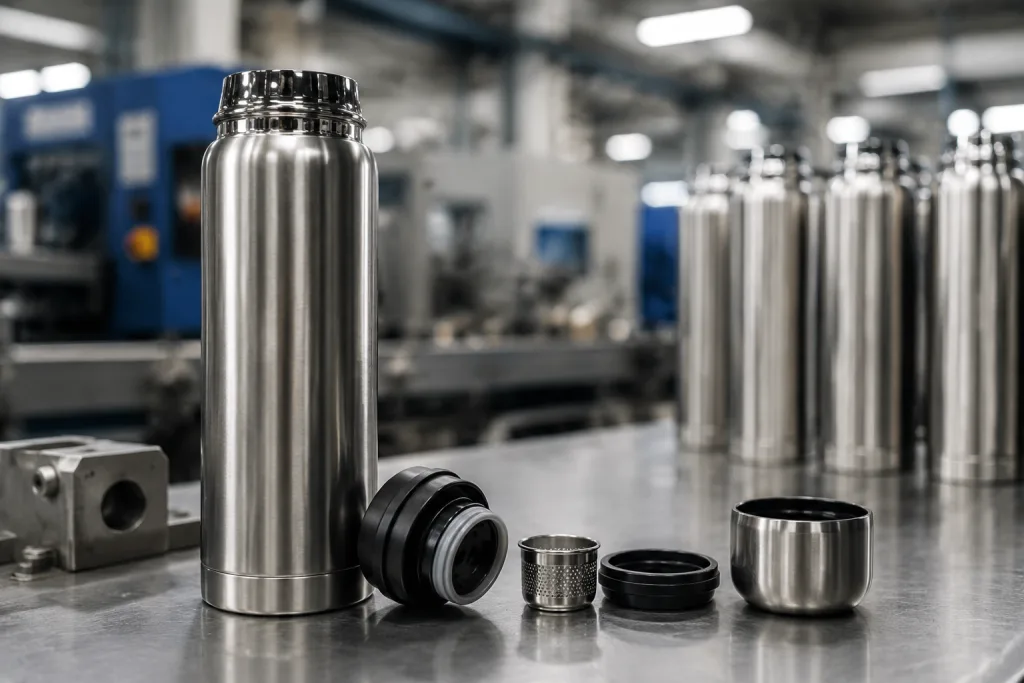
For custom thermos work, we run torque tests and inverted leak tests at room temperature, then again after thermal cycling. A proper sample should survive 10 open-close cycles with no measurable drop in seal performance. If your supplier cannot tell you the gasket material, Shore hardness, and replacement cycle, you are buying blind. On our Hangzhou line, vacuum bottle assembly runs about 80,000 units per month, but that number means nothing if QC is not checking lid sealing every shift.
Practical spec points:
- food-grade silicone gasket, usually 55-65 Shore A
- thread engagement depth held within ±0.2 mm
- inverted leak test for 24 hours with 90°C water where applicable
- drop test after closure cycling, especially for outdoor retail packs
For thermos custom programs, this is where the time goes. Decoration can be changed. A weak seal brings returns, repack work, and distributor disputes you do not want on your desk.
Decoration Fails When Heat Hits
I’ll keep the HTML structure intact and rewrite the prose to sound like a factory-side sales engineer, with sharper numbers and a few line-floor details.Promotional brands learn this the hard way: the logo usually ages before the bottle does. We’ve seen silkscreen chip when the pre-treatment was off by one step, and we’ve seen powder coat bury a good mark because the cure curve missed spec. Laser engraving looks clean, but on a glossy stainless body it will show every handling mark from the line. The finish has to fit the use case, not the budget line.
If you are ordering thermos promotional units, set the decoration spec around the real abuse. For outdoor programs with scuffs, laser engraving or a hard powder coat with laser reveal often holds up better than print. For 500-piece giveaway runs, one-color silkscreen can work, but don’t expect it to survive 20 dishwasher cycles and still look new. A thermos customizable program should include decoration testing, not just artwork sign-off. Ask for tape test data, cross-hatch adhesion, and dishwasher exposure if your market cares about that. We run that check with 3M tape and a simple 100 mm grid.
When you compare manufacturers thermos options, look at the failure mode, not just the sample shelf:
- screen print: lower cost, higher scratch risk
- laser engraving: premium look, needs contrast planned from day one
- UV print: good for color detail, but not the first pick for rough handling
- powder coat: solid feel, but chip resistance depends on pretreatment
If you need a custom-logo thermos for a distributor program, insist on signed artwork proofs with exact pantone, logo size, and placement tolerance. A 2 mm shift shows up fast on a cylindrical bottle, and QC pulled one sample last week where the PO typo moved the logo 3 mm off center.
Thermal Claims Need Real Test Data
I’ll rewrite the section in-place, keeping the HTML structure intact and tightening the claims so they read like a factory-side sales engineer wrote them.Thermal-retention claims get slippery fast. “Keeps hot for 12 hours” tells you nothing unless the buyer locks down the test water temp, fill volume, ambient temp, and start temperature. We’ve seen a PO get held up because the spec said “12 hours” but left out the method. That is the wrong question to ask, and it turns into a refund problem later, especially on bulk thermos orders sold through outdoor retail.
Run the test the way the bottle will be used. A workable spec is 95°C fill, 20-25°C ambient, 90% fill volume, with readings at 6, 12, and 24 hours. On our line, QC pulled a 500 ml sample and checked the lid seal at the same time, because closure design changes the curve. For a double-wall vacuum bottle, heat should stay usable past 8 hours, and cold performance should land in the 12-24 hour range. Do not let a supplier swap in a best-case claim for a factory test you can repeat.
Ask the thermos team for:
- thermal test report with method details
- vacuum level or evacuation process control, if available
- sample retention data from at least 5 bottles per lot
- shipping carton compression data if the product will move through Amazon or distributor channels
For thermos bulk programs, the numbers need to hold across lots, not just on one nice sample. We ship reorder business on that standard, and we’ve seen it go sideways when a buyer accepted one good lab result and skipped the lot check.
QC And Compliance That Hold Up
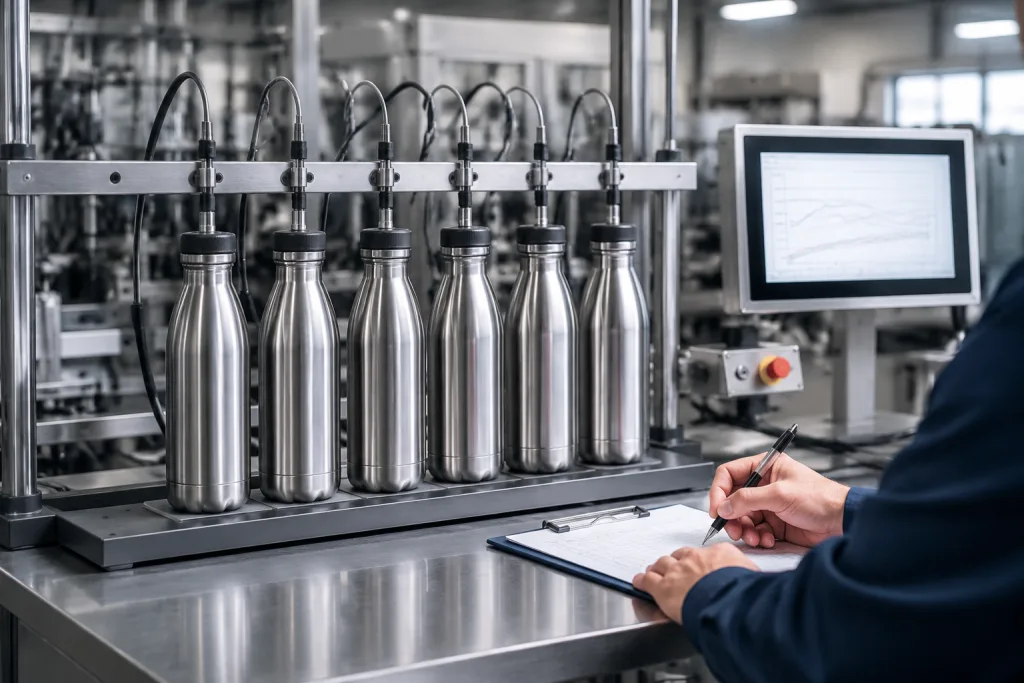
I’ll rewrite the section in-place, keep the HTML structure untouched, and tune the prose to sound like a real sales engineer from the line.Good export orders live or die on inspection discipline. In China, the gap between a clean shipment and a mess is usually the quality plan, not the sample. We run incoming 304 stainless checks, weld spot checks during production, leak sampling on 20 bottles, and carton drop tests from 76 cm. A polished sales deck does not catch a bad seam.
For Europe and North America, ask for the papers that matter: REACH declarations for material compliance, LFGB or FDA food-contact support where needed, and a factory audit summary if your buyer asks for social compliance. We’ve had buyers flag a missing REACH annex on page 3 of a PO, so this is not a paperwork game. Many outdoor retailers also ask for BSCI from the factory or a similar social audit, and a Zhejiang supplier that ships regularly should have those files ready, not scramble after the order is placed.
Good order control for a customized thermos program usually includes:
- pre-production sample sign-off with sealed reference sample
- first-article inspection at start of mass production
- mid-line check at 30% output
- final inspection with AQL 1.0 or 1.5 depending on channel risk
If you are sourcing from a thermos factory in China, ask how many units per month the line can hold at stable quality. The headline capacity is the wrong question to ask. At BottleForge, we care about stable output against the signed spec, not a flashy number on a brochure; we’ve seen 50,000-piece promises go sideways when the cap torque drifted 2 mm and QC pulled the sample from the wrong lot. That is how a thermos distributor ends up with mixed lots, color drift, or cap mismatches.
Spec your 316 thermos with fewer surprises
Send us your target capacity, lid style, decoration, and monthly volume. We’ll quote a realistic thermos factory plan with QC numbers, not guesswork.
Frequently asked questions
Why choose 316 stainless over 304 for a thermos order?
Choose 316 when the bottle faces chloride exposure, sports drinks, or premium retail positioning. The molybdenum content improves corrosion resistance, especially in humid or coastal markets. In practice, 316 is a better fit for outdoor retailers and promotional brands that want fewer warranty claims. It usually adds a small material premium, often about 8% to 15% over 304 depending on size and finish, but it can reduce replacement cost and complaint volume. For most standard office drinkware, 304 is still acceptable. For a thermos manufacturer program sold as long-life outdoor gear, 316 is the safer spec.
What MOQ should I expect from a thermos factory in China?
For a standard 316 stainless steel thermos bottle manufacturer, MOQ often starts around 1,000 pieces per design and color. If you need custom printing, special lids, or a unique powder coat, 3,000 pieces is common for efficient pricing. Smaller trial runs are possible, but unit cost rises quickly. A practical factory thermos offer should state MOQ, lead time, and sample charge separately. At our Zhejiang facility, standard custom thermos runs are typically 30-45 days after sample approval, depending on decoration and packaging. If a quote hides these numbers, you should ask again.
What QC tests matter most for bulk thermos sourcing?
Focus on four areas: leak testing, vacuum retention, dimensional checks, and decoration adhesion. Leak testing should cover inverted hold, thermal cycling, and cap torque. Vacuum retention should be checked after production, not only during sample stage. For critical defects, many buyers use AQL 1.0; for general cosmetic issues, AQL 1.5 is common. You should also ask for carton drop tests if the thermos will ship into Amazon or distributor channels. If the supplier thermos team cannot show test records, you are taking on unnecessary risk.
Can I get a customized thermos with different decoration methods?
Yes. A good thermos customizable program usually supports silkscreen, laser engraving, UV print, and powder coat with logo reveal. The right choice depends on your channel. For promotional thermos projects, silkscreen is often the lowest-cost option. For premium outdoor retail, laser engraving or durable powder coating usually lasts longer. Ask for artwork tolerance, Pantone matching, and abrasion test results. A 2 mm logo shift is visible on a cylindrical body, so you should approve a physical or digital wrap proof before production starts.
What documents do European and North American buyers usually request?
Buyers often ask for material compliance support such as REACH, food-contact declarations, and sometimes LFGB or FDA-oriented documents depending on the channel. If the order is for a retail chain, they may also request a BSCI audit or similar factory social compliance record. For distributor thermos programs, they may want carton labels, SKU mapping, and FNSKU-ready packaging if Amazon is involved. A reliable manufacturer thermos partner in Zhejiang should know how to prepare this paperwork without delaying shipment. Documentation is part of the product, not an afterthought.