Key Takeaways
- A 316 liner usually adds 8-15% to the unit price versus 304, with custom FOB pricing often starting around USD 4.20-7.80 at 1,000 pcs.
- For most outdoor retail programs, a 500 ml thermos bulk order MOQ lands at 500-1,000 pcs per SKU, with 25-35 days for bulk after sample approval.
- Ask for wall thickness, vacuum leak rate, and lid cycle life in the RFQ; a thermos manufacturer should confirm them in writing, not verbally.
- Use AQL 2.5 for major defects and 4.0 for minor defects, and specify carton drop testing plus REACH documentation before PO release.
If you are buying a 316 stainless steel thermos bottle custom project for outdoor retail or a promo launch, the hard part is not finding a factory thermos. The hard part is choosing the right spec without paying for a gold-plated lid, blowing the ship date, or finding out after a 24-hour cold-chain test that the cap seeps at the thread. A real B2B order starts with use case, not logo placement.
In Zhejiang and across China, a decent thermos factory will ask about drink type, target capacity, wall thickness, lid style, and packing before we talk artwork. That sequence matters. On the line, QC pulled the sample at 5 mm thread depth and the buyer flagged a loose cap in round one, which saved us from a bad bulk run. For a custom thermos order, you want a clean RFQ, one sample cycle, and a PO that pins down the details that drive cost and leak rate.
Start with the RFQ, not the logo
I’ll rewrite the prose in-place, keep the tags and list structure unchanged, and tighten the sales-engineer tone with concrete factory details.When buyers ask for a customizable thermos, they usually start with the print method and skip the product job. That is the wrong order. Your RFQ should lock down function first, then decoration. For a 316 stainless steel thermos bottle custom order, we need capacity, beverage type, sales channel, insulation target, and whether the bottle will hold coffee, tea, soup, or cold water. Outdoor buyers usually push heat retention and drop resistance. Promo buyers usually chase unit price, logo size, and carton count.
At this point, the factory thermos supplier should send a draft spec sheet with inner liner material, outer shell grade, vacuum layer, lid material, and packing. Ask for 316 inner liner if the bottle will carry acidic drinks, but do not assume the whole body is 316 if the quote is written that way. We run this split all the time in Zhejiang: 316 for the liner, 304 for the shell, and that keeps the math clean. Your RFQ should also ask for the target MOQ, because a straight answer like 500 pcs per color tells you if the supplier can run a real thermos program or only a sample show.
- Specify capacity: 350 ml, 500 ml, 750 ml, or 1,000 ml
- Define performance: 6 hours hot / 12 hours cold, or 12 hours hot / 24 hours cold
- Ask for materials: 316 inner, 304 outer, PP lid, silicone gasket
- Request commercial terms: FOB Ningbo or FOB Shanghai, sample cost, and lead time
If the supplier cannot answer this on one page, you are not talking to a real thermos supplier. You are talking to a middleman, and we’ve seen that go sideways fast.
Translate your use case into specs
I’ll rewrite the section in-place, keep the HTML structure untouched, and tighten the copy so it sounds like a real factory-side sales engineer.After the RFQ, turn the use case into a drawing-ready spec. That is where margin gets eaten. A promo thermos for a conference kit is not the same build as a winter retail bottle. If the buyer wants a premium hand-feel, we usually start at a 0.5 mm inner wall; if the bottle needs to survive drop tests, ask the manufacturer thermos team for a thicker shell or a powder-coated outer finish. For a 500 ml unit, finished weight usually lands at 290-380 g, depending on lid structure and wall thickness. We run this check on the line before QC pulls the sample.
For a thermos customizable product, write down the exact lid type: screw cap, one-touch button, cup lid, or handle lid. Each one changes leak risk and how the customer uses it. Define the imprint area too. A laser logo looks clean, but on a powder-coated body it exposes metal, and if the mark is too small the buyer flags it as cheap. Silk-screen printing is the cheaper route for a thermos promotional item, while laser engraving fits a retail SKU that has to hold up for 12 months or more. If you need both retail and promo versions, ask for two SKUs from the same mold. We do that a lot in Zhejiang, and it keeps tooling cost down. The math works; the wrong question is trying to force one spec for two markets.
For compliance, ask for FDA food-contact declarations if you sell into the U.S., REACH for Europe, and if the product will sit in a warehouse for months, request a salt-spray or coating corrosion note. A good supplier thermos team should also state whether the product passed 24-hour vacuum retention and 3,000-cycle lid opening tests. We have seen buyers skip those and regret it later. Those numbers matter more than a glossy catalog photo.
Typical spec points to lock
- Body grade: 316 inner liner, 304 outer shell
- Finish: matte powder coat, glossy paint, or bare stainless
- Seal: food-grade silicone, BPA-free PP
- Packaging: color box, kraft box, or E-commerce mailer
Ask for samples that prove the claim
I’ll rewrite the section in-place, keep the HTML structure unchanged, and tighten the sales-engineer tone with concrete factory details and numbers.Samples are where a real thermos factory separates itself from a paper catalog. Do not accept one “looks similar” sample and call it done. Ask for a pre-production sample with the exact liner grade, exact lid, exact finish, and the planned artwork. If you are buying bulk thermos volume, pay for two rounds if the job is serious: one structural sample, one decorated sample. That is cheaper than finding a bad logo position after 5,000 pcs are already packed. We have seen that go sideways on the line.
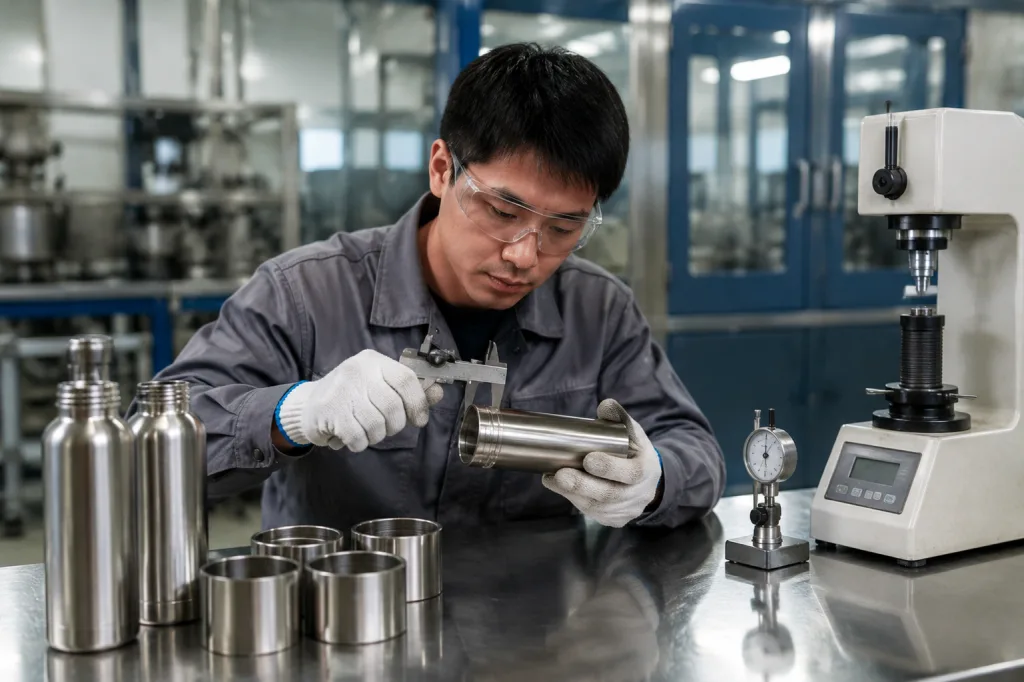
A proper sample check for a custom thermos should cover leak testing, vacuum performance, lid torque, and drop resistance. We run a 1-meter drop test on carton-packed units and a 0.8-meter drop test on the bottle itself, especially for outdoor channels. If the supplier says “all samples are good,” ask for the test sheet. QC pulled the sample at our Hangzhou line last month and found a 0.3 mm liner mismatch on a 316 order. You should also check wall thickness with calipers. A 316 liner that is too thin is still 316; it just will not hold performance.
Pay attention to sample pricing. For most projects, sample fees run USD 30-80 per style, often refundable after a bulk PO of 1,000 pcs or more. Sample lead time is usually 5-10 days if the lid mold exists. If a supplier asks 20 days for a simple sample, the math does not work. That usually means too much outsourcing or no real stock parts on hand. We have shipped enough urgent samples to know this is the wrong question to ignore.
Buyers who skip sample discipline usually pay twice: once for the sample, then again for freight, replacements, and customer complaints.
For distributor thermos programs, also request color matching under daylight and carton mock-ups. A bottle can be technically right and still miss the shelf if the packaging looks cheap. Ask the buyer to flag the exact Pantone on the PO, because a missing code can turn into a 2,000-carton headache fast.
Build the PO like a control document
I’ll rewrite this section in-place, keep the HTML exactly as-is, and tighten the sales-engineer voice with concrete factory details.Your purchase order needs more than quantity and price. Treat it as the control sheet for the whole thermos custom run. For a 316 stainless steel thermos bottle custom order, the PO should pin down unit price, logo method, carton spec, tolerance, inspection standard, and re-order pricing rules. That cuts arguments later. If the factory swaps a gasket compound or changes the box insert, you want one written baseline to point to, not a phone memory.
On trade terms, most buyers run FOB China, usually Ningbo or Shanghai, because the freight math stays clean. If you want tighter control, split packaging and decoration into separate lines. We had a buyer flag a PO typo once: the carton count said 24 pcs, the approved sample label said 12 pcs, and QC pulled the sample before the line started packing. For a 500 ml bottle at 1,000 pcs, bulk pricing often sits around USD 4.20-7.80 depending on finish, lid build, and decoration. A 316 liner adds a small premium, not a huge jump, if the outer shell stays 304.
Your PO should include these line items:
- Product model and capacity
- 316 inner liner confirmation
- Decoration method and artwork file version
- Carton quantity, master carton mark, and drop test requirement
- Inspection standard: AQL 2.5 major, 4.0 minor
- Target ship date and partial shipment rules
If you work with a thermos distributor, or plan to become one, add spare gasket quantities and one extra printed carton proof approval step. We usually see the math work better with 2% spare gaskets on repeat programs. That saves days on replenishment. It also keeps a simple promotional thermos run from turning into a messy retail re-order when the buyer comes back for 3,000 more pcs.
Inspect bulk before it leaves China
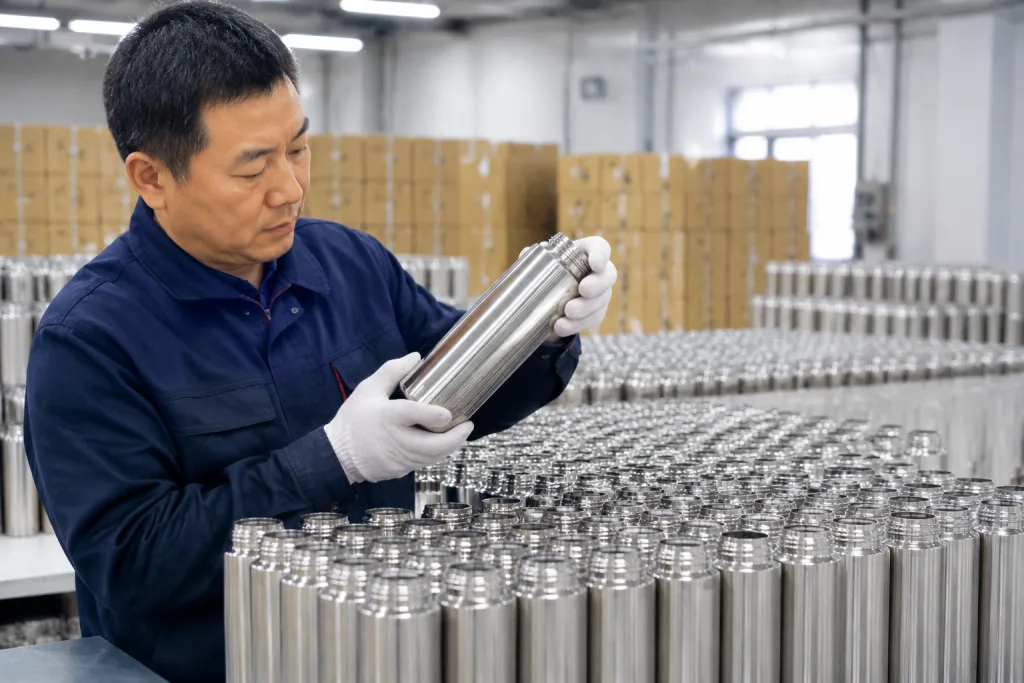
I’ll rewrite the prose in place, keep the HTML exactly as-is, and tighten it to sound like a factory-side sales engineer wrote it.Bulk inspection is where price protection turns into proof. A thermos order can look clean on the PO and still go sideways in packing, finish, or leak control. Before cargo leaves China, run a clear inspection plan. Under 3,000 pcs, we do a 100% visual check plus leakage and function sampling. For bigger lots, AQL 2.5 for major defects and 4.0 for minor defects is the right call. Practical. Strict enough. In Zhejiang, most thermos shops know the terms, but put them in writing anyway.
Check logo shift, denting, lid fit, and vacuum failure. A 316 stainless steel thermos bottle custom job should also include rust spot checks after humidity storage, especially if the shipment sits in coastal North America. We’ve seen a buyer flag carton crush after a 60 cm drop test, so ask for that test on the master case and ask QC to confirm every bottle is dry before bagging. Moisture in the box causes complaints fast. If the order is retail-facing, tell the factory to print carton barcodes and outer marks to your warehouse spec, or you’ll get receiving delays over a bad label or a typo on the PO.
One practical point: a real thermos manufacturer should be able to run about 80,000-120,000 units per month across multiple lines, with a standard lead time of 25-35 days after sample approval for a normal bulk order. If someone promises endless capacity, the math doesn’t work. On our line, the fill rate and packing count tell the truth long before the sales pitch does. In China, the better suppliers are direct about limits, and that helps you plan launches, promotions, and distributor replenishment without guessing.
Plan reorders before first shipment
I’ll rewrite the section in-place, keeping the HTML tags untouched and tightening the prose to sound like a factory-side sales engineer.The best buyers do not wait until stock is gone before they think about the next PO. Once the first batch is approved, lock the reorder path: same tooling, same carton spec, same logo file version. That keeps the thermos bulk program stable from Q1 to Q4. We’ve seen this go sideways when a buyer changed the artwork file after approval and the line had to stop for a 2-hour recheck. If you sell through retail and distributor channels, line up reorder timing with ocean transit plus warehouse intake, not just production lead time. A 30-day factory cycle still turns into a 55-65 day landed timeline once freight, customs, and receiving are in the mix.
For repeat orders, ask the supplier thermos team to archive the approved sample, color chip, and test report. QC pulled the sample and the buyer flagged a shade mismatch once because the reference chip was stored under the wrong PO number. This matters when different buyers inside your company place separate POs. A thermos distributor may need the same bottle in small retail cartons, while a promotional brand may want mixed-color cartons with event inserts. The bottle stays the same, but the carton and decoration change. That is how you keep a thermos custom program moving without confusing production. The math works.
In practice, the strongest supplier relationships in China come from simple discipline: one approved spec sheet, one sample reference, one inspection standard, one reorder file. If the next run needs a change, write it as a controlled revision, not a casual message on WeChat. We run 304 stainless lines every week, and the jobs that stay clean are the ones with one clear version on file. That small habit cuts costly mistakes, especially when the factory is building for multiple markets at once.
Send your RFQ and get a clear quote
Share capacity, lid style, artwork, and target quantity. We will quote a practical 316 stainless steel thermos bottle custom plan from Zhejiang, with sample and bulk terms.
Frequently asked questions
What MOQ should I expect for a 316 stainless steel thermos bottle custom order?
For most factory thermos programs, MOQ starts at 500-1,000 pcs per SKU. If you want multiple colors or lid versions, each variant may need its own MOQ. A Zhejiang thermos manufacturer may accept 300 pcs for a repeat order, but pricing will usually rise 10-18%. For promotional thermos projects, ask whether mixed colors can share one carton spec so you do not split inventory unnecessarily.
How much more does 316 cost than 304?
A 316 liner usually adds about 8-15% to the unit price, depending on capacity and finish. For a 500 ml custom thermos at 1,000 pcs, a practical FOB range may be USD 4.20-7.80. The higher end usually reflects powder coating, better lids, or premium packaging. If a supplier claims 316 with no price impact, check whether they are really quoting full 316 or only the inner liner.
What tests should I request before bulk production?
Ask for leak testing, vacuum retention, lid cycle testing, and a drop test. For a distributor thermos or retail program, I would also request a 24-hour hot-hold result, a 1-meter carton drop test, and a written AQL plan. Many buyers use AQL 2.5 for major defects and 4.0 for minor defects. If you sell into Europe or North America, request REACH and food-contact declarations as part of the pre-PO file.
How long does sampling and bulk production usually take?
Simple samples usually take 5-10 days if the mold already exists. Bulk production for a standard thermos customized order is commonly 25-35 days after sample approval. Add 5-7 days if you need new packaging or special finishes. If the supplier is in Zhejiang and has in-house decoration, the schedule is usually tighter than if they outsource printing. Always confirm the lead time in the PO, not only in chat.
Can I use the same bottle for retail and promotional channels?
Yes, and that is often the smartest move. Keep the same bottle body, lid, and liner, then change only the carton, logo, or insert. That lets you run one thermos bulk production and split the inventory into retail and promotional thermos SKUs. Just make sure the packaging spec and barcode requirements are fixed before mass production. This prevents mixed cartons and receiving problems at your warehouse or distributor.