Key Takeaways
- 316 stainless steel improves corrosion resistance, especially for salty, acidic, or sports-use beverages.
- A practical private-label MOQ is often 500 units per SKU, with 35-45 day production after sample approval.
- Ask for REACH, LFGB, and FDA-related testing plus vacuum insulation performance data before confirming.
- Good B2B sourcing starts with wall thickness, lid seal type, and decoration method, not just logo placement.
You are not here for a bottle story. You need a product that moves, clears compliance, and does not come back with insulation complaints or lid leaks. That is why a 316 stainless steel thermal bottle private label program works: better corrosion resistance than basic 304, enough margin for premium retail, and a branding surface that looks like a real product, not a giveaway.
The trap is paying for vague promises. We see the same mistakes every season in Zhejiang: a buyer signs off a 1.2 mm wall spec without checking the mouth finish, assumes a 300-unit MOQ that the line cannot hold, then sends artwork that cracks on a curved body after laser marking. If you are sourcing custom drinkware for Europe or North America, you need numbers, not pitch copy. The right canteen manufacturer will put 500-unit MOQ, 35- to 45-day lead time, 120,000 units per month capacity, and test files on the table before your deposit clears.
Why 316 matters here
I’ll rewrite the section in-place, keeping the HTML tags and structure unchanged while making the prose read like a real factory-side sales engineer.Q: Why pay for 316 instead of standard 304? Because 316 stainless steel has molybdenum in the mix, and that gives better resistance to chloride attack and pitting. We see the difference when buyers run electrolyte drinks, citrus mixes, salty hydration formulas, or sell into coastal markets. For a premium private-label line, 316 is a clean upgrade. It is not a miracle fix, and a weak bottle stays weak, but it gives you a material story that holds up in a sales call.
For a 316 stainless steel thermal bottle private label program, we usually put 316 on the inner wall and food-contact parts when the bottle sits in the premium custom drinkware tier. On the line, a lot of Zhejiang canteen factories quote 304 outer shells with 316 inner liners, and that math works. If you want full 316 body construction, expect the unit cost to go up by about USD 1.20 to 2.80, depending on capacity, finish, and lid style. If your retail price can carry it, this is the better move.
Do not skip the small stuff. A 0.4 mm inner wall is standard for mid-range thermal bottles, while 0.5 mm gives better rigidity and a more solid hand feel. QC pulled a sample once that looked fine until the wall gauge came back short by 0.03 mm, and the buyer flagged it before shipment. Ask for the grade certificate, the heat-retention test result, and the surface finish spec in writing. If a supplier cannot give you those, they are not ready for serious sourcing.
Private-label setup questions
I’ll rewrite the section in-place, keep the HTML exactly as-is, and tighten the sales-engineer tone with concrete factory details and cleaner buyer language.Q: What should you define before asking for a quote? Start with capacity, use case, and decoration. A 500 ml canteen custom bottle for office gifting is a different job from a 1,000 ml customizable canteen for outdoor retail. Decide early whether this is a custom canteen for brand stores, a canteen promotional item for events, or a customized drinkware SKU for distribution. Those three uses change the lid, the insert card, and the unit price.
Write the brief like a buyer, not like a marketer:
- Capacity: 350 ml, 500 ml, 750 ml, or 1,000 ml
- Material: 316 inner / 304 outer, or full 316
- Insulation: 6-8 hours hot, 12-24 hours cold, depending on structure
- Finish: powder coat, brushed steel, or lacquer
- Decoration: laser engraving, silkscreen, UV print, or wrap label
- Packaging: bulk, color box, or Amazon-ready set with barcode
If you are comparing canteen vendors or canteen suppliers, ask them whether the bottle body is straight-walled or tapered. The answer changes logo placement and carton loading, and we have seen a 1 mm wall taper throw off a 24-piece master carton. A canteen factory that ships 120,000 units per month should quote fast when the brief is clean. If it takes three rounds to price one sample, the line is not set up for distributor drinkware business.
Checklist for factory evaluation
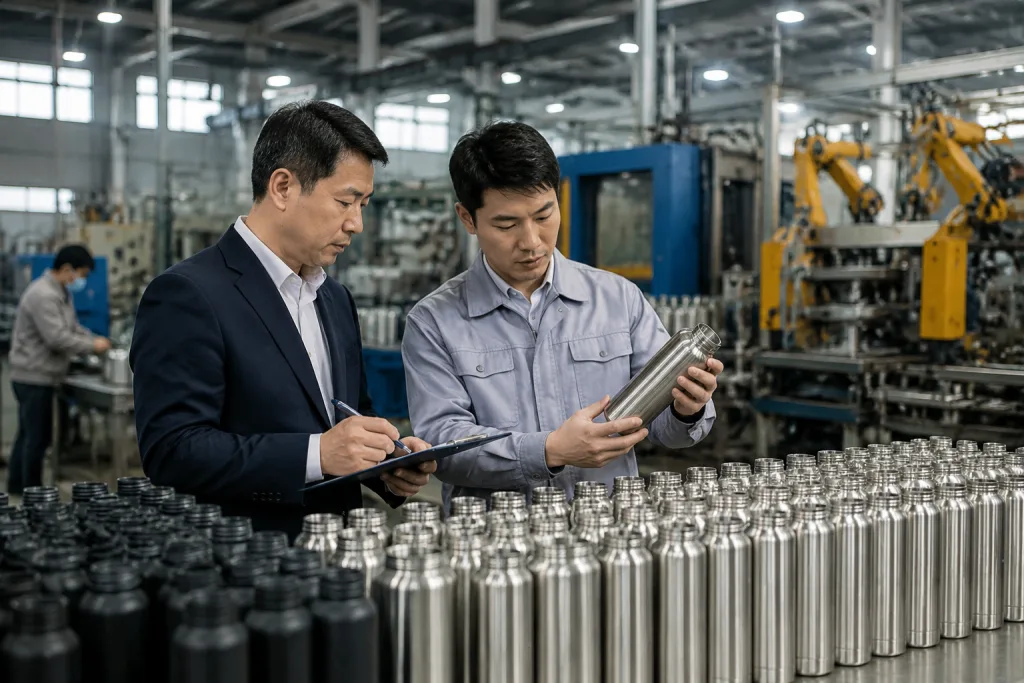
I’ll rewrite the section in-place, keep the HTML structure exactly, and make the prose sound like a factory-side sales engineer wrote it.Q: How do you judge the factory, not just the sample? Use a plain procurement checklist. A real canteen factory should show production photos, incoming 316 stainless inspection, in-process vacuum leak testing, and final inspection records. We run into this all the time in Zhejiang: a clean sample means little if the line cannot hold the same neck finish and lid torque across 5,000 units.
Check these items before you place order:
- MOQ by color and logo method: 500 units works for one-color pad print; 1,000 is common for laser logo plus custom box
- Lead time: 7-10 days for samples, 35-45 days for bulk production
- Vacuum retention: ask for measured hot/cold hold data, not a slogan
- Inspection system: AQL 2.5 for major defects is standard for many drinkware shipments
- Compliance: REACH for Europe, LFGB where needed, and material declarations for North America
- Carton test: drop, compression, and transit fit if you sell through distributor canteen channels
For a canteen distributor, repeatability beats a one-off perfect sample. You want the same weld line, the same cap feel, and coating adhesion that survives 20 dishwasher cycles. We’ve seen this go sideways: the buyer flagged a PO typo on the logo position, QC pulled the sample, and the bulk still came back with 2 mm lid offset because the vendor skipped the leak test pressure log. If the factory cannot tell you the test pressure and cycle count, the math doesn’t work.
Decoration that survives use
I’ll rewrite this section in-place, keep the HTML untouched, and make the prose sound like a factory-side sales engineer wrote it.Q: Which branding methods hold up best? Laser engraving is the safest pick for premium custom drinkware. It does not fade, peel, or crack. On our line, QC checks engraving depth at 0.15-0.20 mm before packing. Silkscreen works for simple logos and lower-cost canteen promotional orders, but you still need to confirm ink adhesion and dishwasher resistance. UV print gives more color control. Heat transfer can handle detailed artwork on a customized canteen or customized growler, though abrasion results depend on the coating and wash cycle.
For a 316 stainless steel thermal bottle private label launch, keep the first run simple. One logo. One position. One color if possible. A 3,000 pcs PO with a three-color wrap almost always slows sample approval and raises defect risk, and we have seen that go sideways more than once. A canteen vendor in Zhejiang can print detailed branding, but that is the wrong question to ask on the first order. Get the packaging and fit locked first, then add the fancy artwork on the second run.
If you are building a range across canteen customizable products, a single decoration spec makes life easier. We usually map it like this: laser on brushed steel for premium retail, silkscreen on powder-coated bodies for price-sensitive channels, and an engraved mark for custom growler or customizable growler items. That keeps the distributor drinkware program clean and cuts tool changes on the line. One buyer once sent a PO with the logo position listed as “front maybe”; we had to stop and redraw the artwork before the sample even left QC.
Pricing without hidden surprises
I’ll rewrite the prose in place, keep the HTML exactly as-is, and tighten the sales language so it reads like a factory-side quote breakdown.Q: What price should you expect? For a 500 ml premium insulated bottle with a 316 inner wall, basic powder coating, and one-color logo, FOB China usually lands around USD 4.20 to 7.80. The gap comes from lid structure, surface finish, and pack-out. Add a gift box, a custom insert, or a special lid, and the quote can move above USD 8.50 fast. Full 316 construction and extra decoration push it further; we’ve seen buyers try to hold the same target price with a magnetic lid, and the math just doesn’t work.
Ask every canteen supplier for a clean price split. Body, lid, print, packaging, carton. That is the only way to compare apples to apples. If a supplier sends one flat number, QC pulled the sample apart and found the carton cost buried inside on one recent PO. Also check whether the quote covers export carton marks, barcode labels, and master carton count. Those details matter when a canteen distributor ships into warehouse systems in Europe or North America.
Watch the low quote that leaves out compliance, spare parts, or packaging fixes. A cheaper canteen manufacturer looks fine until they start charging for each revision, and we’ve seen that go sideways on the line more than once. Real pricing is landed consistency, not just FOB China. For branded custom drinkware, a supplier who is 20 cents higher on paper can save more over a 12-day shipment cycle and a full season of reorder work.

Lead time and order control
I’ll keep the HTML structure intact and rewrite the prose in a more field-tested sales tone, with a few concrete shop-floor details and tighter pacing.Q: How should you manage the first order? Treat it as a pilot run, not a launch. Approve the pre-production sample, lock the print file, and check carton drop and fit before the line starts. A serious 316 stainless steel bottle factory in Zhejiang will hand you a real schedule with cutting, forming, welding, polishing, vacuum sealing, coating, printing, and packing checkpoints—our line usually runs those in that order, and QC pulled the sample twice before bulk on a 500 ml bottle job last month.
A practical flow looks like this:
- Sample confirmation in 7-10 days
- Deposit received and artwork approved
- Bulk production in 35-45 days
- Final inspection and AQL sampling
- Balance payment and shipment booking
If you source for retail or Amazon-style channels, leave room for labels, FNSKU application, and carton compliance checks. We shipped one PO where the buyer missed a 3 mm carton spec on the file, and the whole booking slipped 4 days. Even if you never sell on Amazon, the same control saves you time. More customization means more places for the order to go sideways. This is the wrong question to ask if you want a smooth container: “Can you rush it?” Ask where the bottleneck sits, then fix that step before deposit. That is the kind of answer you want from China sourcing—straight numbers, no theater.
Request a quote with your exact spec
Send capacity, logo method, packaging, and target market. We will quote a 316 stainless steel thermal bottle private label program with clear MOQ, lead time, and compliance.
Frequently asked questions
Is 316 stainless steel worth the upgrade for a thermal bottle?
Yes, when your product is positioned as premium or used with acidic and salty beverages. 316 offers better resistance to corrosion than 304 because of molybdenum content. In practical sourcing, the upgrade often adds USD 1.20 to 2.80 per unit depending on size, lid, and finish. For Europe and North America, that premium is easier to justify if you are selling custom drinkware above the mass-market tier. If your customer base is gym, outdoor, or coastal, the argument is stronger. If the bottle is purely price-driven, 304 may be enough.
What MOQ is normal for private label drinkware?
For a new private-label bottle, 500 units per SKU is a realistic starting point, especially for a single-color logo and standard packaging. Some canteen manufacturers can do 300 units, but unit cost usually climbs fast. For multiple colors, special lids, or complex printing, 1,000 units is more common. A Zhejiang canteen factory with stable capacity should also be able to scale repeat orders without retooling. Ask whether MOQ is tied to color, print method, or packaging, because the answer changes your real commitment.
How do I check if the supplier is reliable?
Ask for three things: material declarations, process evidence, and test reports. A serious canteen supplier should show stainless steel grade confirmation, vacuum leak testing, and compliance docs such as REACH for Europe and food-contact statements for North America. If they can share AQL inspection records and production photos from the same line, that is a good sign. Also confirm their monthly output; a canteen factory making around 120,000 units per month usually has enough discipline for repeat B2B orders. If they cannot explain defect control, be cautious.
Can I order custom logos on the bottle and box?
Yes, and that is usually the right move for a private-label program. Most buyers do one logo on the bottle body plus branded packaging. Laser engraving works well for premium custom canteen or custom growler products; silkscreen is better for simple, lower-cost runs. For boxes, confirm whether the factory can print outer cartons, apply barcodes, and prep retail inserts. If you are selling through distributor canteen channels, packaging consistency matters as much as the bottle itself. Keep the first order simple so you can control quality.
What should I ask before approving samples?
Ask for insulation data, wall thickness, lid torque, finish sample, and artwork proof. A practical spec sheet should list body thickness, often 0.4 mm or 0.5 mm, plus the exact lid material and seal type. Request hot and cold retention results, not just a claim, and confirm the sample matches the production mold. If the bottle is a customized canteen for Europe, also ask about REACH and LFGB status. A sample is only useful if the factory can reproduce it at scale without changing the mold or coating.