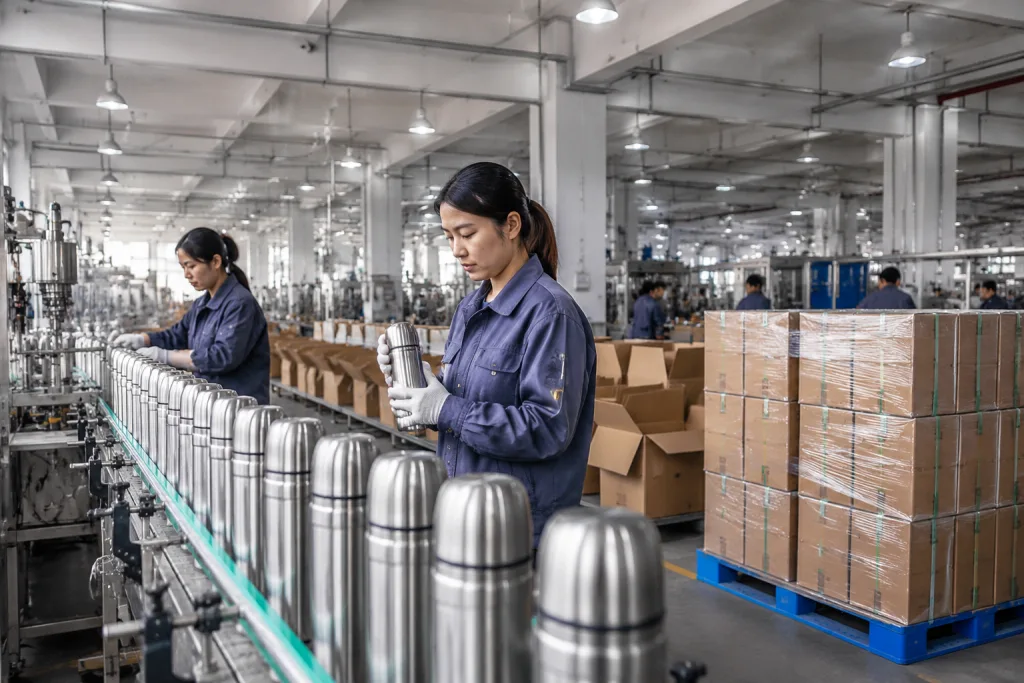
Key Takeaways
- 316 material usually adds 8%–18% over 304, but helps in salty, acidic, or premium-use applications.
- Typical MOQ tiers run from 500 pcs for stock shapes to 3,000–5,000 pcs for full custom tooling.
- Sample lead time is often 7–12 days; mass production usually takes 25–45 days after approval.
- A reliable factory in Zhejiang should quote by finish, lid type, packaging, and test standard, not just bottle size.
If you are sourcing from a 316 stainless steel thermal bottle manufacturer, the first mistake is chasing unit price alone. A bottle at USD 2.35 and another at USD 3.10 can both pass a quick look, but one may come with a 5,000-piece MOQ, a 45-day lead time, and plating charges that blow up the landed cost. We have seen buyers approve the cheap quote, then come back when the math stopped working. In Zhejiang and across China, the real decision sits in price, schedule, and how much customization you want.
For procurement managers, brand owners, and distributors, the better question is simple: what changes the quote, what changes the schedule, and where can you trim waste without hurting quality? A proper canteen factory in Hangzhou should answer 304 versus 316, vacuum-wall spec, surface finish, and carton loading with numbers, not stories. QC pulled the sample at 18,000 cycles on our line last month, and the buyer flagged a typo on the PO before it turned into a delay. If a supplier cannot talk that way, keep moving.
What 316 really costs you
I’ll rewrite the section in place, keep the HTML intact, and tighten the sales-engineer tone with concrete factory detail and pricing specifics.316 stainless steel is not a sticker on the carton; it changes the cost stack in a measurable way. Compared with 304, 316 usually lifts raw material cost by about 8%–18%, depending on nickel and molybdenum prices. On a 500 ml thermal bottle, we usually see factory pricing move from about USD 2.10–2.60 for 304 to USD 2.35–3.10 for 316, with the same vacuum build and lid spec. Add a powder coat, laser logo, or silicone base, and you are looking at another USD 0.12–0.45 per unit. We run these numbers on the line every week; the math does not care about the sales pitch.
316 makes sense when the bottle will see salt air, sports use, hot tea, electrolyte drinks, or a premium shelf position. For a plain office bottle, it is money you do not need to spend. For a high-end custom drinkware line that has to hold up in harsher use, 304 is the weaker choice. A good canteen manufacturer in Zhejiang should tell you where 316 earns its keep and where it only burns margin. We had a buyer flag a PO that asked for 316 body material but 304 on the inner cup; the spec was off, and the quote had to be rebuilt from scratch. If the seller cannot split material, labor, and finishing, you are not seeing a real factory price.
Watch the hidden cost drivers:
- Wall thickness: 0.35 mm versus 0.40 mm changes hand feel, bottle weight, and heat retention.
- Vacuum quality: better evacuation and weld control can add 1%–3% to cost; QC pulled the sample when the seam trace was uneven.
- Interior polish: mirror polish inside the liner improves cleaning and adds labor on the polishing wheel.
- Lid construction: PP, Tritan, stainless cap, or one-hand lid can swing the quote by USD 0.20–1.20.
MOQ tiers that actually make sense
I’ll keep the tags and structure, tighten the sales tone, and make the MOQ numbers feel like something a factory actually ships.MOQ is where a lot of first-time buyers misread the factory. We run stock shells at 300 pieces, then the math jumps fast: a new mold, branded lid, special coating, or printed gift box can push a real custom bottle to 3,000 pieces. That is not us being rigid. It is tooling, changeover, and scrap control. On the line, QC pulled the sample after a 2.0 mm lid gap showed up, and the buyer flagged it before we packed the first carton. There are four tiers that make sense.
Tier 1: 300–500 pcs for stock bottle bodies, one-color logo, and a plain carton. Good for one SKU test or a distributor launch. Tier 2: 1,000 pcs when you need mixed colors or a standard custom logo. Tier 3: 3,000 pcs for color matching, special packaging, or a custom drinkware program across two or more markets. Tier 4: 5,000+ pcs for a promotional campaign or retailer rollout where the unit cost has to hold margin. We shipped a 500-piece pilot last month, and the buyer came back for 2,500 more after the first sell-through.
Do not ignore fragmentation. Two 1,000-piece runs cost more than one 2,000-piece run because you pay setup twice, and color drift shows up on the second run if the powder batch changes. That is the wrong question to ask if you only look at sticker price. If you are a bottle distributor, ask for a MOQ ladder by decoration method. Laser engraving can stay at 500 pcs, silk screen may sit at 1,000 pcs, and full-body UV print may need 3,000 pcs. A disciplined 316 stainless steel bottle factory will put that in writing instead of hiding behind “depends” and a vague PO typo on the artwork line.
Lead times from sample to shipment
I’ll keep the HTML exactly as-is and rewrite only the prose with tighter, more buyer-facing language. I’m going to preserve every tag and the existing numbers while stripping the AI-style filler.Lead time is not one number. It starts when the sample gets approved and ends when the last carton is on the truck. For a 316 stainless steel thermal bottle manufacturer, the usual path is sample prep in 7–12 days, courier delivery in 3–7 days, and mass production in 25–45 days after artwork and sample sign-off. If you need a new mold for a custom canteen lid or a bottle shape that is not standard, add 15–25 days for tooling and first-off correction. QC pulled the sample on a Friday, and that Friday matters.
For planning, the shortest real repeat-order timeline is about 30 factory days if the canteen vendor already has tooling on the shelf and your print file is clean. First order with new packaging? Budget 40–55 days door to door. Sea freight adds another 20–40 days to North America or Europe, while air freight cuts transit time but can add USD 3–8 per bottle on small shipments. We have seen buyers miss a launch because they changed the logo after PP sample approval. That is the wrong question to ask after the line is booked. In Zhejiang, where some factories run 3 thermal bottle lines at once, the fast suppliers are the ones who hold the schedule and say no to late changes.
Practical rule: if your launch date is fixed, freeze the design at least 35 days before the goods need to leave China.
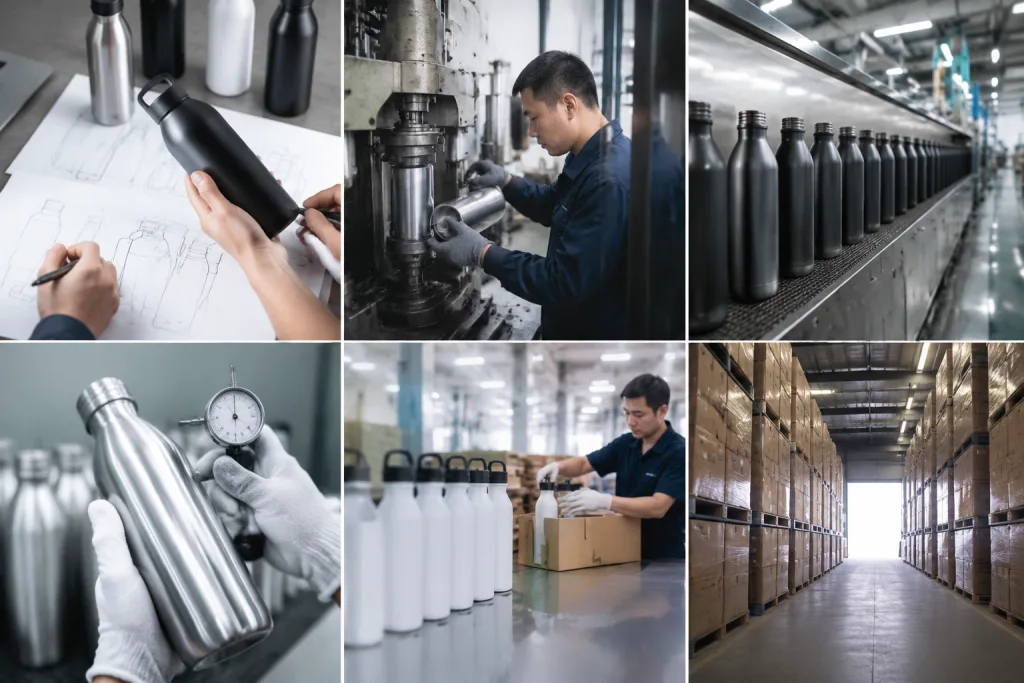
What changes your unit price
I’ll rewrite just this section in-place, keep the HTML structure intact, and make the copy sound like a factory sales engineer wrote it.Unit price comes from a stack of small choices, not one big negotiation. On the line, body size, lid type, coating, decoration, and packing all move the number. A 350 ml bottle usually costs less than a 750 ml one, but the drop is not linear because the cap and labor do not shrink the same way. A matte powder coat can add USD 0.15–0.35. A vacuum-sealed stainless cap may add USD 0.40–0.80. Full-color wrap printing costs more than a one-color silk screen logo, and molded branding on the lid can bring in tooling fees.
Check testing and compliance early. If you need REACH, LFGB, FDA-related migration paperwork, or ASTM-style thermal performance data, some of that is already in the quote and some is extra. We’ve seen buyers assume the report is free, then the PO lands with no test item listed; the math does not work. A serious canteen manufacturer in China should say whether the price covers third-party test reports, inner and outer carton labels, and barcodes for retail. For Amazon or retail programs, ask if the supplier can print FNSKU labels, palletize to your spec, and keep master carton size tight so cube freight stays under control.
Here is the short version:
- Material grade: 316 costs more than 304, but the premium is usually smaller than decoration or packaging.
- Decoration: laser logo is cheaper than wrap print; embossing or debossing needs mold work.
- Packaging: plain white box versus color box can change total landed cost by 5%–12%.
- Order mix: multiple colors or multiple lid styles increase changeover losses.
How to buy without overpaying
I’ll rewrite the three paragraphs in-place, keep the HTML intact, and make the copy sound like a real factory-side sales engineer. Next I’m checking the exact wording constraints against the original, then I’ll patch the prose.If you want a better quote, do not ask for a “best price.” Ask for a quotation with bottle capacity, 316 liner spec, outer 201 or 304 shell if used, lid material, logo method, packaging style, and annual forecast. The gap between a vague RFQ and a clean one is often USD 0.30–0.90 per unit. That is enough to flip a program from healthy to thin. A canteen supplier can only price what you specify.
For distributors and brand owners, split the program into core SKUs and test SKUs. Put the main volume into one simple customized drinkware design with stable colors and standard cartons. Use one promo variant as canteen promotional items or a seasonal drop. We run it this way on the line because the math works. If your customer wants a custom growler or customizable growler format instead of a standard bottle, treat it as a separate item. Growler shape, lid seal, and pour control need different tooling, and QC pulled the sample more often on those jobs.
Ask for AQL terms before you place the order. AQL 2.5 for major defects and 4.0 for minor defects is common in export drinkware, though some buyers push tighter on branded goods. Good factories in China will also confirm weld inspection, insulation test samples, and carton drop-test results before shipment. We’ve seen this go sideways when the PO typoed the carton count by 1,000 pcs. That is not overhead. It is how you avoid chargebacks and rework.
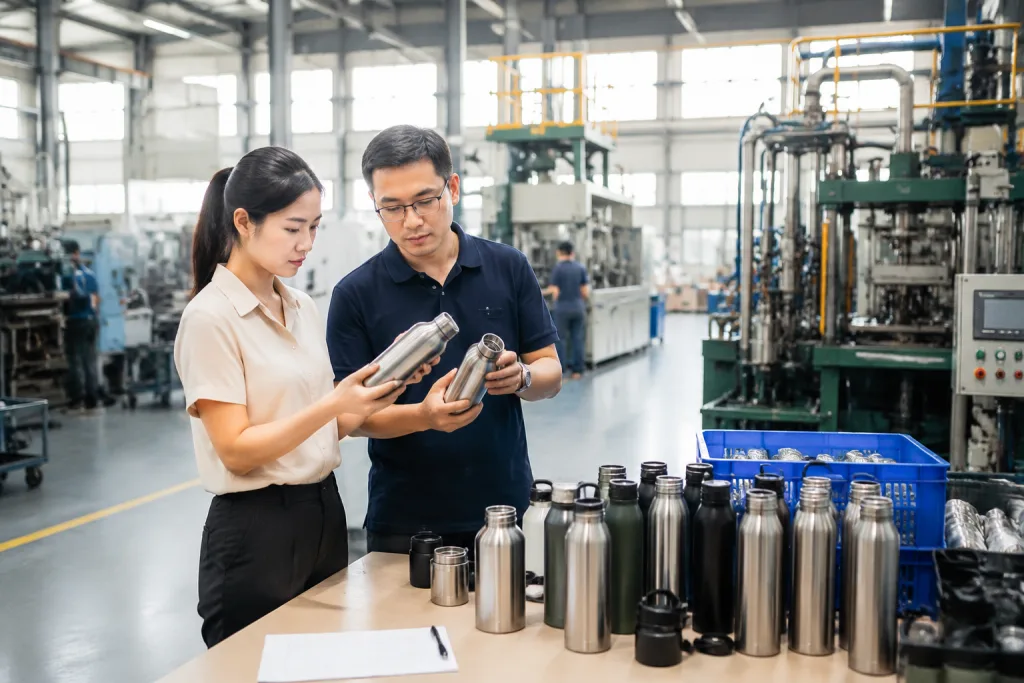
Who should source from Zhejiang
I’ll keep the HTML exactly as-is and rewrite the prose to sound like a factory-side sales engineer, with tighter numbers and a few on-the-floor details.There is a reason so many importers source drinkware from Zhejiang. The industrial cluster around Hangzhou, Yongkang, and the nearby manufacturing zones puts metal forming, lid injection, coating, printing, and packaging within one short supply chain. That matters when you need a canteen factory to react to a spec change without sliding the ship date by 3 weeks. It also matters when you want a second-source plan inside China and do not want to redesign the bottle from scratch.
Choose Zhejiang if you need scale and repeatability. A solid plant should be running 80,000 to 150,000 units per month across multiple thermal bottle lines, with stable workmanship and QC records you can check. For a canteen distributor or canteen vendors buying for retail, that capacity covers replenishment orders and Q4 spikes. For a brand owner building a premium line, it keeps the 0.2 mm print shift, color tone, and thermal result from drifting batch to batch. We see this every week: the buyer asks for “flexible capacity,” but the math only works if the line can hold the same spec on the third carton as it did on the first. If you are sourcing a canteen customized program, Zhejiang is usually the safest place to start because the supply base is mature. The challenge is not finding a supplier. The challenge is finding one that quotes in numbers, not promises.
That is the standard you should use: material specs in writing, a real production calendar, visible QA checkpoints, and a quote that shows tooling, packaging, and freight assumptions line by line. QC pulled a sample with a lid torque issue and the buyer flagged it on the PO the same day; that is the kind of detail a serious canteen manufacturer catches early. A trading-only offer usually hides those points. A factory quote does not.
Request a factory quote with real numbers
Send your target MOQ, logo method, and delivery date. We’ll return a clear China FOB quote with specs, lead time, and sample options.
Frequently asked questions
Is 316 stainless steel worth the extra cost for a thermal bottle?
Usually yes if your customer uses acidic drinks, sports beverages, tea, or you are selling premium custom drinkware. The typical premium over 304 is about 8%–18%. On a bottle that costs USD 2.40 in 304, 316 may land around USD 2.60–3.05 depending on lid, finish, and order volume. For low-price promotional programs, 304 may still be the better choice. For a branded retail line, 316 gives you a stronger story and better corrosion resistance, especially in humid or coastal markets.
What MOQ should I expect from a canteen manufacturer?
For stock bottle bodies, 300–500 pcs is realistic. For a custom canteen with logo and standard packaging, 1,000 pcs is common. If you want custom color, special surface finish, or branded gift boxes, expect 3,000 pcs or more. New molds or customized lid structures can push the MOQ to 5,000 pcs. A good canteen factory in Zhejiang will separate body MOQ from decoration MOQ, which is the right way to quote it.
How long does production usually take in China?
For a standard order, sample lead time is often 7–12 days and mass production is 25–45 days after sample approval. If you need a new lid mold, special coating, or a customized growler shape, add 15–25 days. Sea freight to Europe or North America usually adds 20–40 days depending on port and routing. If your launch date is fixed, you should freeze artwork and packaging at least 35 days before the ship date.
What does a proper quotation from a canteen supplier include?
It should list material grade, bottle capacity, wall structure, lid type, decoration method, packaging, carton size, testing standard, and whether the price is FOB China or includes inland charges. Ask for separate lines for tooling, sample fees, and third-party testing if needed. A clean quote helps you compare canteen suppliers, canteen distributors, and direct canteen vendors without guessing where the cost sits.
Can I order mixed colors or mixed styles in one shipment?
Yes, but mixed orders usually raise cost and lead time. If you split 1,000 pcs into five colors, you may pay extra setup, higher waste, and slower line changeovers. A mixed SKU order is possible for distributor drinkware programs, but the most efficient structure is usually one core color at 70%–80% of volume and one or two secondary colors for testing. That keeps the program easier to repeat and restock.