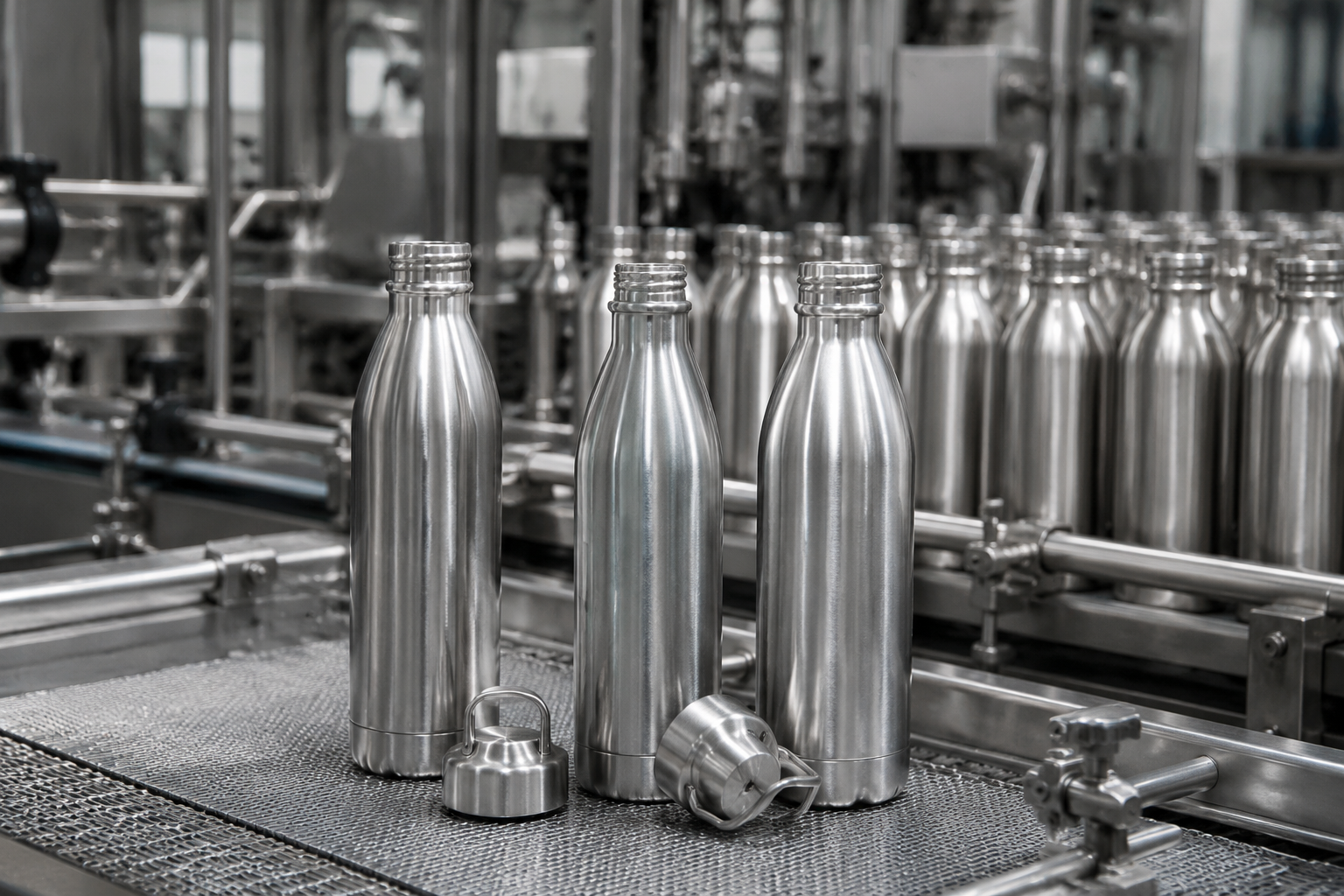
Key Takeaways
- 316 stainless steel usually adds USD 0.35-0.90 per unit over 304 on a 500 ml vacuum bottle
- Typical MOQ starts at 3,000-5,000 pcs for canteen wholesale and 5,000 pcs for custom color bottles
- Standard lead time is 25-35 days after sample approval, plus 7-25 days freight
- A factory in Zhejiang with 200,000 units/month output can still be slow if coating or packaging is the bottleneck
If you are sourcing a 316 stainless steel stainless steel water bottle wholesale program, the first question is not whether 316 looks better on paper. It is whether your margin, MOQ, and lead time still hold once we add caps, carton specs, and freight. In Zhejiang and across China, the quote spread on 316 premium bottles is wide, so we run the numbers before you send artwork. QC pulled the sample at 500 ml, and the buyer still asked why the cap added USD 0.18; fair question, but the math has to work first.
For North America and Europe, buy on landed cost, not just unit price. A 500 ml 316 bottle can sit at FOB USD 2.80, then land at USD 4.10 after vacuum cup polishing, laser logo, color coating, and a retail box. We’ve seen this go sideways when a PO typo changed the carton count from 24 to 20 and the buyer got hit on freight. If you are buying wholesale drinkware or building a bulk canteen line, a 12-day slip on ship date hurts sell-through more than a weak sample ever will.
Why 316 changes your cost base
I’ll rewrite the three paragraphs in-place, keep the tags intact, and tune the tone to sound like a factory sales engineer.316 stainless steel is not a marketing line. It changes raw material cost, forming behavior, and QC expectations. Compared with 304, 316 adds molybdenum, which gives better corrosion resistance in salty water, acidic drinks, and harsher use. That matters for coastal buyers, gym programs, and specialty beverage packs. It also means you should not price it like standard bulk drinkware.
On a typical 18/8 vacuum bottle, 316 shell material adds 8-15% to the body cost. The full bottle cost usually climbs more once we add tighter polishing control and extra rework on the line. For a 500 ml bottle, a sensible FOB range from a Zhejiang factory is USD 2.60-4.80, depending on finish, lid, and decoration. We ran a batch with a brushed body last month; QC pulled three samples for surface marks, and the buyer flagged the gradient paint version as the expensive one for a reason.
Use the material premium as a business decision, not a free upgrade. If your bottle is a best wholesale drink bottle for premium retail, 316 earns its place. If you are building a price-led canteen program, 304 usually makes more sense unless the PO calls out 316 on the spec sheet. The math does not lie.
What actually drives unit price
I’ll keep the structure intact and rewrite the prose to sound like a factory-side sales engineer, with sharper price drivers and one or two shop-floor details per paragraph.Most buyers start with steel grade, then get surprised by the add-ons. On the line, we see the quote move with capacity, wall thickness, lid build, finish, and packaging. A 350 ml straight-body bottle with a PP lid prices lower than a 1,000 ml sports bottle with a spring lid and silicone base. In China, those choices can swing the factory quote by USD 0.40-1.20 before print or carton changes. QC pulled a sample last week and the buyer flagged the lid spring as the first cost jump.
Asking for one “drinkware wholesale” price across every SKU is the wrong question. It never lands. A laser logo may add only USD 0.08-0.18, while full-color UV print can add USD 0.25-0.60. A matte powder coat often adds USD 0.20-0.45. Double-wall vacuum construction is standard here, but 0.5 mm inner and outer walls will quote higher than 0.4 mm, and the math shows up fast. We had one PO typo last month where “0.4 mm” was keyed as “0.5 mm”; the buyer caught it before we ran the vacuum test.
- Raw steel grade: 316 vs 304 premium
- Body spec: 18/8, 18/10, or thicker gauge
- Lid: simple screw cap, loop cap, straw lid, or flip top
- Decoration: silk screen, laser, pad print, UV print
- Packaging: bulk pack, white box, color box, mailer-ready set
If you source beer tumbler bulk, beer growler bulk, or alcohol flask wholesale bulk, the same rule applies: the bottle body is the easy part, the finish and cap system drive the real cost. For wholesale canteen and wholesale growler programs, ask the supplier to separate body cost, lid cost, and decoration cost line by line. We run that way because the combined quote hides too much. That’s the clean comparison if you want to shop Zhejiang suppliers without guessing.
MOQ tiers that make sense
I’ll rewrite the section in-place, keep the HTML structure intact, and tighten the sales tone with concrete factory details and cleaner MOQ language.MOQ is not a moral issue; it is production math. On a Zhejiang vacuum bottle line that ships 200,000 units per month, the number changes with tooling, lid type, and packing. For a plain 316 bottle with a standard cap and no custom box, 3,000 pcs is a workable floor. If the buyer wants a special shape, a Pantone body color, or retail packaging, 5,000-10,000 pcs is the range we run.
For canteen wholesale and canteen bulk distribution, a low MOQ looks friendly on paper. The math does not work if the unit price jumps. We’ve seen a 1,000 pc pilot land 12-18% above a 5,000 pc run, and that gap eats margin fast. If the channel is Amazon, DTC, or regional retail, test 500-1,000 pcs of one SKU, then place the next order after sell-through is clear. Mixed-SKU cartons can help wholesale drinkware distributors, but only when the lid bin and body bin stay balanced on the line.
As a rule, if a supplier offers 316 stainless steel bottles at a tiny MOQ and a very low price, ask where the lid came from, whether the steel grade is real, and whether the quote includes the box. QC pulled the sample once and found a missing gasket on a “cheap” offer; the savings were gone before we reached packing.
For alcohol flask bulk, alcohol flask in bulk, and alcohol flask wholesale, the structure is simpler, so 2,000-3,000 pcs is common. Beer tumbler wholesale bulk and beer growler wholesale bulk usually need a higher MOQ when the buyer asks for engraved branding or custom lid inserts. One PO typo can push it up too; we’ve had “316L” written as “361L” and had to stop the job until the buyer flagged it.
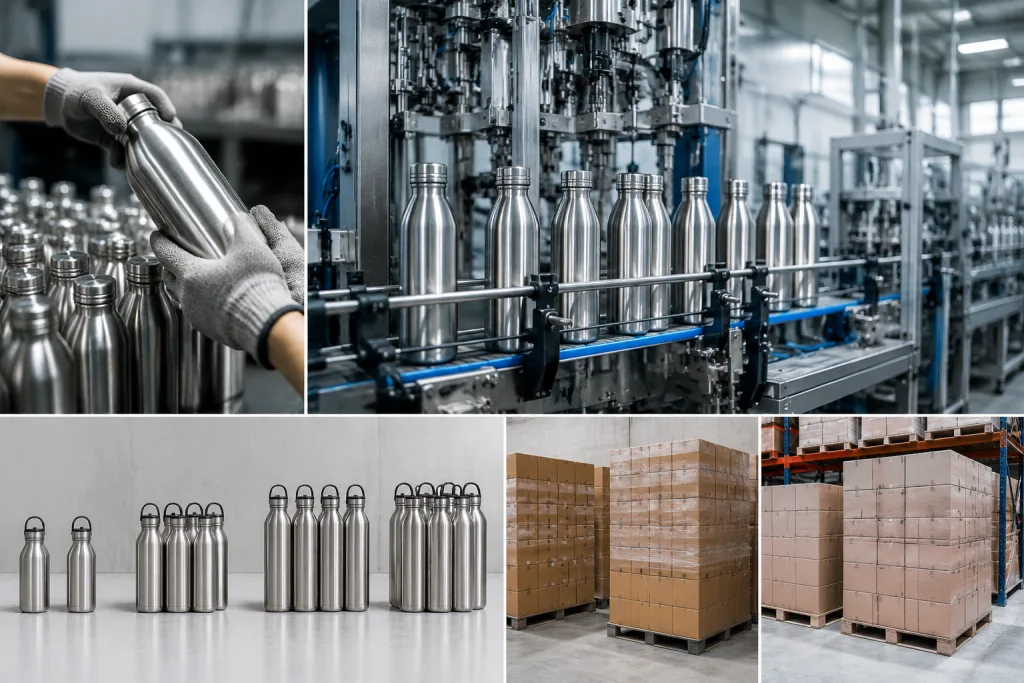
Lead time from sample to shipment
I’ll rewrite the prose in place, keep the HTML untouched, and make the timing more concrete and buyer-facing.Lead time is where sourcing either holds up or slips. For a standard 316 bottle with existing tooling, the sample cycle usually runs 5-10 days. Once the buyer signs off, mass production takes 20-30 days for stock colors and standard caps. Add a custom coating, special carton, or a new lid mold, and you need another 7-15 days for prep. In practice, you are looking at 25-35 days before freight. We run this every week on the line, and the math is the same.
Sea freight is the part buyers like to shave off in their heads. To Europe, expect roughly 25-40 days port to port depending on routing. To the U.S. West Coast, 18-28 days is common; East Coast usually lands at 30-45 days. Air freight is faster, but on metal drinkware it eats margin fast unless the order is small and urgent. For a 5,000 pc wholesale growler order, ocean freight is the right call. For a 300 pc sample launch, air makes sense if you need retail photos or a trade show in two weeks. QC pulled the sample last month on a 300 pc rush job, and the buyer still asked for sea rates afterward.
If a supplier in Zhejiang says they can finish a complex custom order in 12 days, ask what got cut. Usually it is coating curing time, internal leak testing, or carton compression testing. We’ve seen this go sideways when a PO typo changed the lid spec from 55 mm to 58 mm, and the whole schedule slipped. A real schedule should include 48-hour seal checks, random leak tests, and one full pre-shipment inspection window. This is the wrong question to ask: not “can you do 12 days,” but “what tests are still in the plan?”
Quality checks buyers should demand
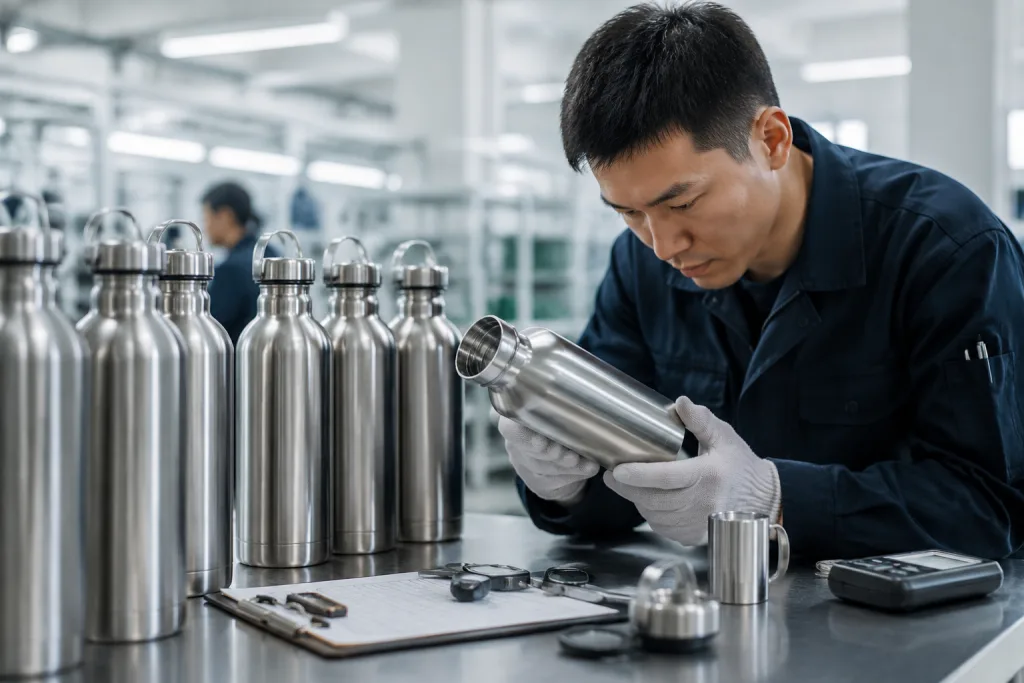
I’ll keep the HTML exactly as-is and rewrite only the prose with tighter, more buyer-side language. I’m checking the section for the factory-floor detail, the compliance points, and the list wording so it reads like an export-sales engineer wrote it.316 material by itself does not make a bottle clean. We ask buyers to pull the material report, vacuum test record, and food-contact file before they place an order. For Europe, REACH paperwork is the line item that gets flagged first. For the U.S., FDA food-contact declarations and an accredited lab report still matter. If the supplier shows ISO or BSCI, good. That helps on supplier screening, but it does not replace product testing. QC pulled a coil sample at 0.40 mm last week and the buyer still asked for traceability back to the mill.
The checks on the floor are straightforward. Ask for wall thickness data, neck finish consistency, lid torque, and leak testing at room temperature plus after hot-fill cycles. If the bottle is sound, vacuum retention stays stable after repeated use. We ship these checks with a gauge, a torque meter, and a water bath, not guesswork. For serious wholesale runs, ask for AQL 2.5 on critical defects and AQL 4.0 on minor defects. That is the base line. Anything looser usually comes back to bite you.
- 316 verification: material spec sheet and incoming coil traceability
- Leak test: 100% or statistically sampled before packing
- Finish check: coating adhesion, print rub test, color consistency
- Carton test: drop test and compression test for export cartons
For bulk drinkware or drinkware bulk programs, keep the same standard across every SKU. The wrong question is whether the shell looks fine on the sample table. We’ve seen 5,000-piece orders fail on the lid liner and thread tolerance, not the bottle body. Same story with beer tumbler wholesale: the print can pass eye test, while the seal and finish fail after freight and warehouse stacking.
How to compare supplier quotes
I’ll rewrite this section in-place, keep the HTML intact, and tighten the procurement language so it sounds like a factory-side sales engineer.Do not compare quotes by unit price alone. A clean quote should spell out steel grade, wall thickness, capacity, finish, lid style, packing method, and Incoterms. If one factory gives you FOB and another gives you EXW, the math does not line up. For procurement managers and brand owners, we run a one-page RFQ and make every supplier fill the same fields. QC pulled a sample at 1.2 mm once, and the buyer flagged it because the PO only said “stainless bottle.”
Take a 500 ml 316 vacuum bottle. One offer may land at USD 2.95 FOB Ningbo with a standard cap and one-color print. Another may come in at USD 3.40 FOB Shanghai with a retail box, a lower defect rate, and dispatch 4 days faster. The second quote can still be the better buy. We’ve seen this go sideways on canteen wholesale jobs, where freight and carton count eat the margin faster than the bottle cost.
If your line includes promotional SKUs like alcohol flask wholesale or alcohol flask wholesale bulk, split the RFQ by use case. Retail needs gift packaging. Corporate gifting needs laser logo and an individual polybag. E-commerce needs FNSKU labeling, carton pack count, and case dimensions. Good suppliers in China can do all three, but they need exact instructions up front. A typo on the PO, like “2500 pcs” instead of “2,500 pcs,” can throw the line off for a full shift.
When you source in Zhejiang, the best suppliers are usually not the loudest ones. They quote line by line, show what is included, and tell you what changes when you move from 1,000 pcs to 5,000 pcs. One buyer pushed back on a quote that looked cheap, then found the carton spec was 10 kg over the freight limit. That is the wrong question to ask: the real comparison is landed cost, not unit price.
Send your RFQ for a clear factory quote
Get line-by-line pricing, MOQ, and lead time from a Zhejiang supplier that ships 200,000 units a month.
Frequently asked questions
What is a realistic FOB price for a 316 stainless steel bottle?
For a 500 ml double-wall bottle, a realistic FOB range is USD 2.60-4.80 depending on lid, finish, and packaging. A brushed stock-cap model may sit near USD 2.60-3.10, while a powder-coated retail version with custom logo can move to USD 3.50-4.80. Smaller 350 ml units are usually 8-12% lower, and large 750 ml models are often 10-18% higher.
What MOQ should I expect for wholesale drinkware?
For standard 316 wholesale drinkware, expect 3,000 pcs for stock specs and 5,000-10,000 pcs for custom colors or packaging. If you want a mixed program across canteen bulk, growler wholesale, or beer tumbler bulk SKUs, many factories in China will still ask each SKU to clear 2,000-3,000 pcs. Lower MOQ is possible, but the unit price usually rises 12-18%.
How long does production take in Zhejiang?
For an established factory in Zhejiang, sample lead time is usually 5-10 days and mass production is 20-30 days after sample approval. If you add a new mold, special coating, or custom carton, add 7-15 days. Shipping adds another 18-40 days depending on destination and freight method. So a realistic door-to-door project often runs 35-60 days.
Do I need REACH or FDA testing?
If you sell in Europe, REACH-related compliance documents are standard, and many buyers also ask for LFGB or migration tests depending on the channel. For the U.S., FDA food-contact declarations are commonly requested, even when not legally mandatory for every case. For premium wholesale canteen or wholesale growler orders, ask for third-party lab reports before you confirm mass production.
Is 316 worth it versus 304 for bulk drinkware?
If your bottle will be used around salt, acids, or harsher environments, 316 is worth the premium. If you are selling a price-sensitive bulk drinkware line, 304 is usually the more efficient choice. In many cases 316 adds USD 0.35-0.90 per unit, which is fine for retail and gifting but can be too expensive for low-margin canteen wholesale or promotional runs.