Key Takeaways
- 316 stainless steel usually adds USD 0.35-0.90 per bottle over 304, depending on size and finish
- Typical MOQ is 500-1,000 pcs for a customized canteen, with 3,000+ pcs unlocking better unit pricing
- A normal production lead time is 25-35 days after sample approval; peak season in Zhejiang can push it to 40-45 days
- Logo method and lid structure can move the final cost by 8-20%, which matters more than the steel upgrade on small orders
If you are sourcing a 316 stainless steel stainless steel water bottle manufacturer, the first mistake is chasing unit price only. A bottle that looks cheap at USD 2.10 can turn expensive once you add 18/8 lid swaps, laser logo setup, vacuum failure risk, and a 35-day delay because the supplier did not stock the right inner cup material. We saw this on a 500-piece PO last quarter; the buyer flagged the lid spec after sample sign-off, and the line had to stop for two days. In Zhejiang, where most of the serious drinkware supply chain sits, the job is not finding the lowest quote. It is finding a factory that holds tolerance, hits your timeline, and still clears REACH or food-contact checks.
We build custom drinkware in Hangzhou, Zhejiang, and the buyers who do best ask about steel grade, MOQ, and packing sequence on day one. QC pulled the sample with a 0.3 mm weld gap once, and that kind of miss is why the wrong question is always “what is your best price?” If you want a canteen custom project, a customized growler, or a distributor drinkware line, the numbers matter more than the pitch. Below is the practical breakdown: what 316 changes, what it costs, how MOQ tiers work, and how long each step takes when you are buying from China, not browsing a catalog.
What 316 really changes
I’ll keep the tags and structure intact, rewrite the prose in a more field-tested sales tone, and fold in a few concrete factory details without changing the specs or numbers.316 stainless steel is not a label trick. It gives better resistance to chlorides, salt spray, and some acidic drinks. If your buyers are coastal, in the gym channel, or mixing electrolyte powders, the upgrade is worth the talk. On a 500 ml vacuum bottle, the steel cost gap versus 304 is usually USD 0.20-0.45, then another USD 0.15-0.40 for slower buying, tighter incoming checks, and yield control. We run that math on the line all the time.
For a 500 ml bottle, most China factories only quote 316 when the volume can support a separate material lot. That is normal. A Zhejiang canteen factory should say that straight. We had a buyer push back on MOQ once, then the QC team found the 316 coils were mixed with 304 on a WPS card; that line stopped fast. If you sell premium outdoor gear, corporate gifts, or branded custom drinkware, 316 makes sense. If you are pushing low-price canteen promotional items into retail, the customer will not pay back the spec.
Buyer rule: ask for the inside liner grade, not just the product family name. Some suppliers write “316 body” when only the liner is 316 and the outer wall is standard stainless steel. Fine, if it is disclosed. If not, the margin math breaks. A serious canteen manufacturer should put the material statement, thickness, and finish spec on the quotation sheet, and we have seen a PO typo swap “316” for “316L” before—small typo, big headache at receiving.
Cost drivers that move your quote
I’ll keep the HTML intact and rewrite only the prose, with sharper sales-floor language and concrete cost details. Then I’ll return just the updated HTML.Most buyers think steel grade sets the price. It does not. On a custom canteen order, the quote usually moves on lid construction, surface finish, packing, and how many changeovers you force on the line. A one-color silk-screen logo is cheap; a full-wrap print, gradient powder coat, or fine laser pattern changes labor time and can push MOQ up. We run these jobs every week, and the buyer usually flags decoration first.
- Material: 316 liner usually adds USD 0.35-0.90 per unit, depending on capacity and wall thickness.
- Lid: PP basic lid can stay under USD 0.60; stainless or bamboo-accent lids often add USD 0.30-1.20.
- Finish: matte powder coating or anodized-looking paint can add USD 0.20-0.70.
- Decoration: laser logo is often USD 0.08-0.20; multi-color print or wrap can be USD 0.15-0.60.
- Packing: retail box, barcode label, and insert cards can add USD 0.20-0.80.
In Zhejiang, factories quote hard when they know you understand the cost stack. That is why a distributor buyer should ask for a line-by-line quote, not one flat number. Ask for bottle, lid, logo, carton, and export packing split out. The math does not work any other way. We’ve seen a PO typo on “plain box” turn into color box + polybag, and the gap looked fake until we checked the spec sheet. One supplier may quote FOB Ningbo with simple packing, another with retail packaging, and the spread is just assumptions.
Practical benchmark: for a 500 ml custom growler or insulated bottle, a realistic FOB China range is USD 2.80-5.80 depending on steel grade, lid, and packaging. Once you move to 316 and premium decoration, USD 4.20-7.50 is normal, not expensive. QC pulled the sample on a 0.3 mm lid gap before ship, which is the kind of detail that changes the real cost.
MOQ tiers and pricing logic
I’ll rewrite just the prose inside the existing tags, keep the structure intact, and make it sound like a factory-side sales engineer wrote it.MOQ is where a lot of projects break. The buyer wants retail-grade customization, but the order is still too small for the line. A bottle factory in China has steel purchasing, printing setup, and packing slots to cover. At 300 pcs, the fixed cost per unit gets ugly fast. That is why MOQ tiers are not random; they protect margin and keep delivery from slipping.
Typical tiers for a customized canteen or customizable growler look like this:
- 300-500 pcs: Sample-style production, fewer logo options, and a 15-30% price premium.
- 1,000 pcs: Common MOQ for full custom drinkware, better print choices, and steadier lead time.
- 3,000-5,000 pcs: Better steel buying, tighter carton packing, and piece cost down by 8-18%.
- 10,000+ pcs: Distributor volume, used for canteen distributors and chain programs.
For a 316 stainless steel stainless steel water bottle manufacturer in Zhejiang, 1,000 pcs is often the cleanest break point. You still get real customization without a painful setup charge. We have seen buyers push for 500 pcs per color, then split into five colors and wonder why the math falls apart. It does, because the line loses efficiency.
Do not chase the lowest MOQ if your retail channel needs consistency. A 600-piece order that ships 12 days late is worse than a 3,000-piece order that lands on time. For canteen customized programs, stable supply beats a fake bargain. QC pulled the sample on one run because the matte finish shifted by 0.3 mm, and that is the kind of miss that wrecks repeat orders. If you are comparing canteen manufacturers in China with a Zhejiang factory, ask who can repeat the same finish next quarter. That is the real test.

Lead time from sample to vessel
I’ll rewrite just this section, keep the HTML intact, and make the timing sound like a real factory answer with concrete lead-time numbers and shop-floor detail.Lead time is where a decent quote gets you in trouble. For custom drinkware from China, the clock starts with sampling, not with bulk production. If the shape is plain, we can turn a sample in 7-10 days. If the buyer asks for a new cap mold, an embossed logo, or a special coating, 12-20 days is the real window before the first piece is approved.
Once the sample is signed off, standard production for a 316 vacuum bottle usually runs 25-35 days. That covers steel cutting, shell forming, liner welding, vacuuming, coating, printing, assembly, and packing. If the line is stacked up, especially in Zhejiang before peak export windows, 40-45 days is the number we give when the math still works. Then add 3-7 days for export documents, stuffing, and inland movement to Ningbo or Shanghai.
Good buying practice: ask for a week-by-week production schedule, not a single delivery promise. A real canteen supplier should tell you when steel is booked, when first inspection happens, and when cartons are ready.
For a canteen promotional order tied to a trade show or retail reset, build in buffer time. We’ve seen it go sideways on carton artwork, late barcode approval, and customs holds. If your bottle needs FNSKU labels for Amazon or mixed-language compliance copy for North America, add 5-8 days at the front end. QC pulled the sample, the buyer flagged a typo on the PO, and that one line item cost more time than the whole mold check. A solid canteen vendor in China will say so up front, not sell you a miracle timeline just to land the PO.
How to compare supplier quotes
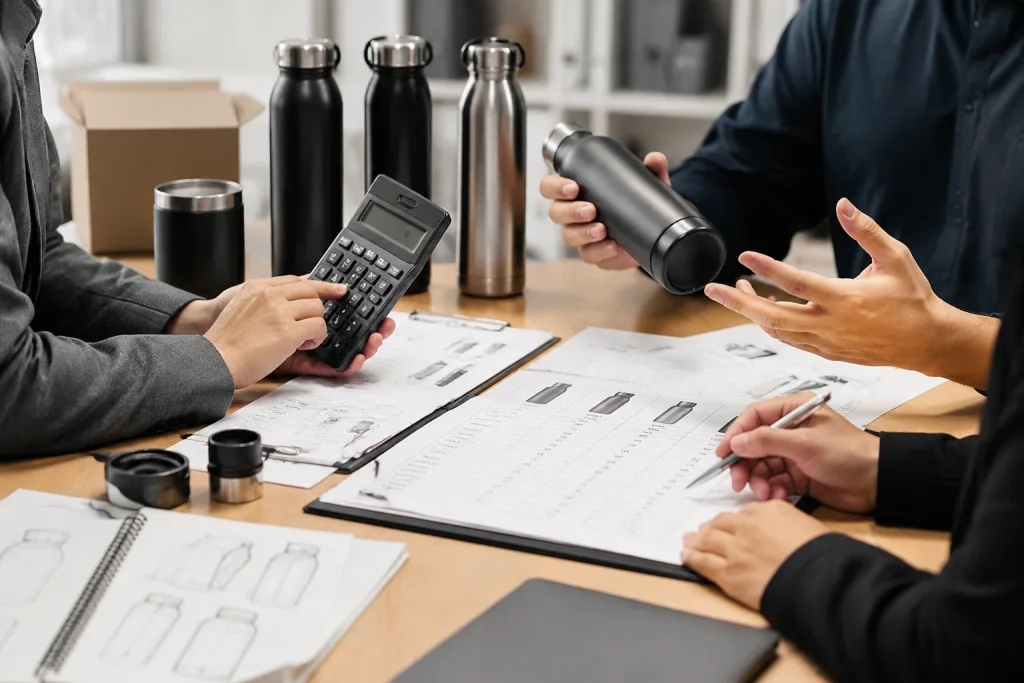
I’ll rewrite the section in-place, keep the HTML structure intact, and make the prose sound like a factory-side sales engineer wrote it.Comparing quotes from canteen suppliers without one common spec sheet is dead time. We run this every week: same capacity, same 316 stainless steel grade, same wall thickness, same finish, same lid, same packing, same delivery terms. If one supplier is pricing a bare bottle and another is quoting retail carton + barcode sticker, the low number is fake.
A quote check should cover:
- Steel thickness: outer wall and liner gauge, shown in mm, not “thickened” wording.
- Vacuum spec: insulation target and whether hot/cold retention was tested on the line.
- Compliance: REACH, FDA food contact, LFGB if needed, plus a BPA-free note for lids.
- Inspection: AQL level, usually AQL 2.5 for major defects and 4.0 for minor defects.
- Incoterms: FOB, EXW, or CIF, because freight can swing the quote hard.
For a custom canteen or custom growler, ask for photos or a short video from current production, not a catalog shot. A real canteen manufacturer can show welding, polishing, leak testing, and packing in the same shift. We had a buyer flag one PO because “316” was typed as “316L” on the draft, and that small typo changed the spec review. If a canteen manufacturer in China cannot tell you why a 316 liner adds a specific cost, the math does not work — they are guessing or reselling. That is a bad setup for a distributor canteen order or a branded line for North America.
Good suppliers will tell you where the limits are. If a matte finish only holds at 3,000 pcs, they should say it before sampling. We’ve seen that go sideways when a buyer pushed for 1,000 pcs and the line had to stop for rework. That kind of honesty saves a launch.
Quality checks worth paying for
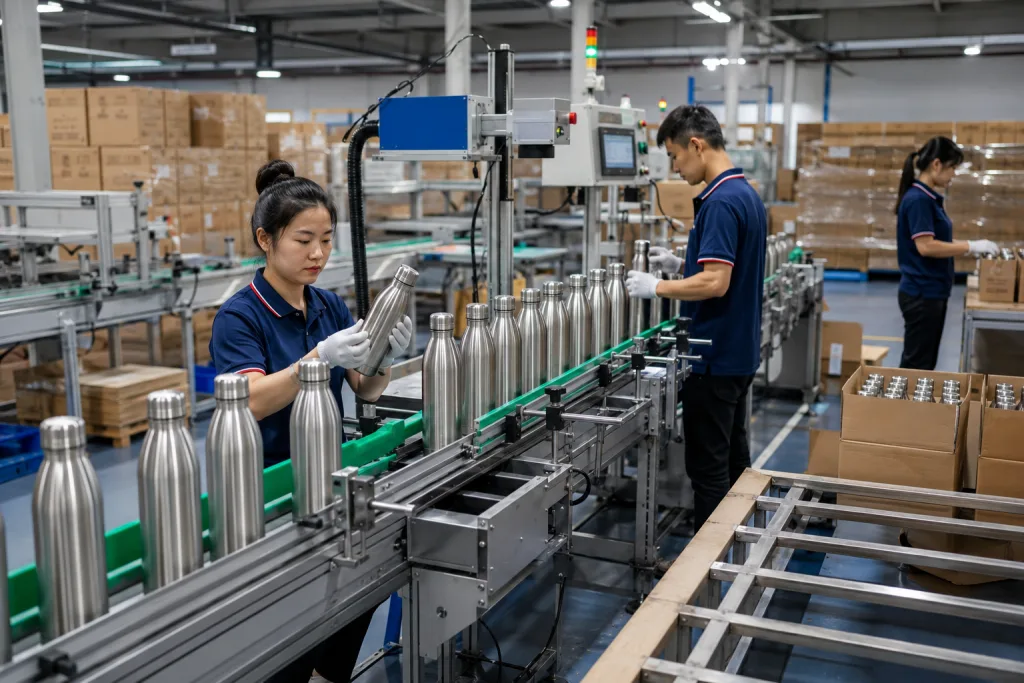
I’ll rewrite the section in place, keep the HTML structure intact, and tighten the prose so it sounds like a factory-side sales engineer wrote it.Quality is not a final stamp. We run checks before welding, during assembly, and after packing. On a 316 stainless steel bottle order, the weak points are weld seam quality, vacuum loss, coating adhesion, and lid sealing. If one slips, the bottle still looks clean in photos and fails in a buyer’s hand.
A competent factory should check:
- Material verification: incoming steel matched against your PO and material declaration, with coil batch numbers logged at the line.
- Leak testing: 100% air or water leakage test for vacuum insulated units, not a spot check on a random carton.
- Drop and torque tests: especially for distributor drinkware and travel-use bottles, using a torque meter and a 1.2 m drop height.
- Visual inspection: print alignment, scratch limits, and coating uniformity under AQL sampling, with QC pulling the sample off the conveyor.
If you are buying canteen customizable products for retail, ask for pre-shipment inspection by a third party. We’ve seen this go sideways when the buyer skipped it to save USD 180-350 per visit. SGS, Intertek, or a local QC agent is common in Europe and North America, and the better Zhejiang factories do not make a scene when you request it.
For canteen distributors, the real cost of poor quality is not replacement bottles. It is support time, chargebacks, and shelf space lost after one bad launch. A 2% defect rate can still wreck the math if the lid squeaks or the carton print is wrong. Pay for the checkup once, not for the apology twice.
Request a 316 bottle quote today
Send your capacity, logo file, and target MOQ. We’ll give you a clear China FOB price, lead time, and packing spec.
Frequently asked questions
What should I ask a canteen supplier before ordering?
Ask for steel grade, wall thickness, leak test method, MOQ, lead time, and packaging details. Then ask for AQL level, compliance documents like REACH or FDA food-contact statements, and whether the quoted price is FOB Ningbo, FOB Shanghai, or EXW. A serious canteen supplier should also tell you if the logo method changes the MOQ or adds setup cost. If they cannot give you a line-by-line quote, they are not ready for a B2B order. That is especially true when you are buying from China and need consistent repeat production from the same factory.