Key Takeaways
- 316 stainless usually costs 10% to 25% more than 304, but corrosion resistance is better for acidic or salty use.
- Typical MOQ from a Zhejiang factory is 3,000 to 5,000 pcs per SKU, with 30 to 45 days lead time after sample approval.
- Ask for 0.5 mm to 0.7 mm inner wall thickness, 18/8 outer body specs, and passivation test records before you approve production.
- For branded programs, one-color logo printing often starts around USD 0.12 to 0.30 per piece, while laser engraving is cleaner for premium custom drinkware.
You are probably here because someone on your team asked for 316 stainless steel, and now you need to decide whether it is a real upgrade or just a premium-sounding line item. Fair question. On drinkware, the material changes corrosion resistance, flavor stability, and how clean your claim really is, but it also moves cost, tooling, and lead time. If you are sourcing from a 316 stainless steel stainless steel water bottle factory in Zhejiang or elsewhere in China, you need numbers, not brochure talk.
The real issue is simple: your buyer, retailer, or distributor wants a bottle that holds up against salt spray, acidic drinks, repeated washing, and a basic drop test, while your margin still makes sense. We run that math on the floor all the time. A good canteen factory will tell you where 316 is worth it, where 304 is enough, and what extra you pay for custom logos, Pantone colors, or a custom cap. That is the standard you should expect from any canteen manufacturer, canteen supplier, or custom drinkware partner.
Why 316 matters here
I’ll rewrite the prose in-place, keep the HTML intact, and make it read like a factory-side buyer note with tighter, more concrete language.If you are buying from a 316 stainless steel stainless steel water bottle factory, the first question is not “Is 316 better?” It is “Better for what?” 316 adds molybdenum, which improves resistance to chlorides and some acidic drinks. That matters when the bottle will hold sports drinks, citrus water, supplements, or sit in salty air near the coast. We’ve seen 304 cups show light pitting after 12 weeks in a beach channel test, and the buyer flagged it fast. For a custom canteen project, that extra margin cuts down on complaints when cartons sit in hot trucks, gym lockers, or marine retail stock.
Do not oversell it. For plain water in an office or school run, 304 is still enough. If your buyer is pushing premium outdoor, marine, or health channels, 316 gives you a cleaner sales story. One PO typo we caught last month called out “316L” on the quote but “304” on the carton spec, and QC pulled the sample before packing. A serious canteen supplier in Zhejiang should call out the grade gap plainly. That beats dressing up every SKU like it needs top metal.
- 316 is usually the right call for acidic drinks, salty climates, or premium positioning.
- 304 is still fine for most everyday water bottles and lower-cost distributor drinkware.
- Ask for material certificates and confirm the steel grade by lot number, not just on the quote.
What a factory quote should show
I’ll rewrite the section in place, keeping the exact HTML tags and list structure, while making the wording sound like a factory-side sales engineer.A clean factory quote tells you whether the supplier understands procurement or just wants a fast PO. For custom drinkware, we expect the quote to show material grade, capacity, surface finish, logo method, carton spec, test standard, and delivery terms. I’ve seen buyers get burned on a USD 0.18 gap once the cap, box insert, and export carton with FNSKU labels show up. That math doesn’t work.
In China, especially in Zhejiang, some factories quote a base body price and add accessories later. Fine, if the structure is clear. What you want is a line-by-line view: bottle body, lid, finish, logo, packaging, and freight terms such as FOB Ningbo or FOB Shanghai. QC pulled the sample, and the 316 stainless steel callout was missing from the PO, which is exactly the kind of typo that turns into a dispute. A solid canteen vendor will also state whether the sample fee is refundable, and whether the MOQ is 3,000 pcs or 5,000 pcs per color.
Ask for one quote with no decoration, one with one-color logo, and one with full packaging. That is the fastest way to see the real margin impact.
- Base body price for stainless bottles often starts around USD 1.80 to 4.20 depending on size and lid style.
- Logo cost can be USD 0.12 to 0.45 per piece depending on silkscreen, UV print, or laser engraving.
- Packaging upgrades can add USD 0.08 to 0.60 per unit, which matters for customized drinkware programs.
Checklist for samples and tests
I’ll keep the HTML structure intact and rewrite the prose to sound like a real factory-side sales engineer, with tighter wording and more concrete shop-floor detail.Samples are where weak suppliers slip. If you are buying from a canteen factory in China, do not stop at the finish and say it feels good. Check the lid seal, weld line, vacuum hold, coating adhesion, and odor after a hot water rinse at 95°C. We had a buyer flag a sample because the gasket swelled after two rinse cycles. A proper custom growler or customized canteen should pass a leak test at room temperature, then again after thermal cycling. If the bottle is for retail, your buyer may also need REACH, LFGB, or FDA declarations, depending on the destination market.
For a procurement manager, the useful checklist is plain, and that is the point. Measure wall thickness with calipers at three spots. Confirm the inner stainless grade. Ask for a salt spray result or corrosion note if the bottle goes outdoors. If the supplier says BSCI or ISO 9001, ask for the certificate number and the expiry date. We run this check every week on the line, and the math does not work if the supplier keeps dodging basic proof.
- Confirm wall thickness: common inner wall ranges are 0.5 mm to 0.7 mm.
- Inspect the lid seal: no seepage after 8 to 12 hours of upside-down hold.
- Request compliance docs: REACH, LFGB, FDA statement, and factory audit if needed.
- Run a drop check: a 1-meter or 1.2-meter drop on carton and unit sample tells you more than a brochure.
Custom branding without wasting margin
I’ll rewrite the section in-place, keep the HTML structure untouched, and tighten the sales-engineer voice while preserving the heading and list.Branding is where buyers burn margin. If the bottle is a campaign canteen promo, you do not need every decoration method on the quote. If it sits in a premium retailer, you probably do. Match the decoration to the channel. On a distributor canteen order, one-color silkscreen is usually enough. For a direct-to-consumer line, laser engraving or durable UV print looks cleaner and holds up better after 50 wash cycles. We tell buyers the abrasion risk up front; the cheapest setup is not always the right one.
At our Zhejiang line, one logo plate or one print color is easy. The trouble starts when a buyer wants five colors, a soft-touch finish, a custom gift box, and low MOQ in the same PO. The math does not work. On a recent 5,000-piece run, QC pulled the sample after the lid logo shifted 1.5 mm. If you want customizable canteen SKUs for a regional rollout, keep the body color fixed and vary only the lid or logo. That keeps the canteen customizable without pushing MOQ out of range. For custom canteen and customized canteen programs, the smart move is fewer variants, not more.
What usually works best
- Silkscreen for high-volume distributor drinkware and lower-cost promotions.
- Laser engraving for premium, durable custom drinkware with no ink wear.
- UV print for colorful retail pieces when coating and curing stay under control.
MOQ, lead time, and pricing reality
I’ve got the section and constraints. I’m rewriting the prose in-place, keeping the HTML and the list structure intact, and tightening it to sound like a factory-side sales engineer.Buyers ask for the same three things: lower MOQ, faster lead time, better unit price. The math does not work that way. For a standard 500 ml or 750 ml stainless bottle at our Zhejiang line, MOQ usually sits at 3,000 to 5,000 pcs per SKU and per color. If you change the cap, add matte powder coating, or switch to imported packaging, the floor moves up fast. We run 2 coating lines and a cap workshop, and the order only stays on track when artwork and carton files clear QC on the first round.
Lead time is where people get caught. Sample approval usually takes 5 to 10 days, and we have seen that stretch because the buyer flagged a logo typo on the PO. Mass production normally needs 30 to 45 days after deposit and artwork sign-off. For a distributor program with 3 launch dates, build in an extra 7 days for carton check and vessel booking. A real factory will tell you FOB, CIF, or DDP straight, and it will not sell you on air freight as a normal plan. If the quote looks too low, the math is missing testing, inner carton material, or truck pickup.
- MOQ: 3,000 to 5,000 pcs per design is the normal floor for custom drinkware.
- Lead time: 30 to 45 days is the realistic window for decorated stainless bottles.
- Price spread: 316 usually adds 10% to 25% over a comparable 304 build.
How to choose the right supplier
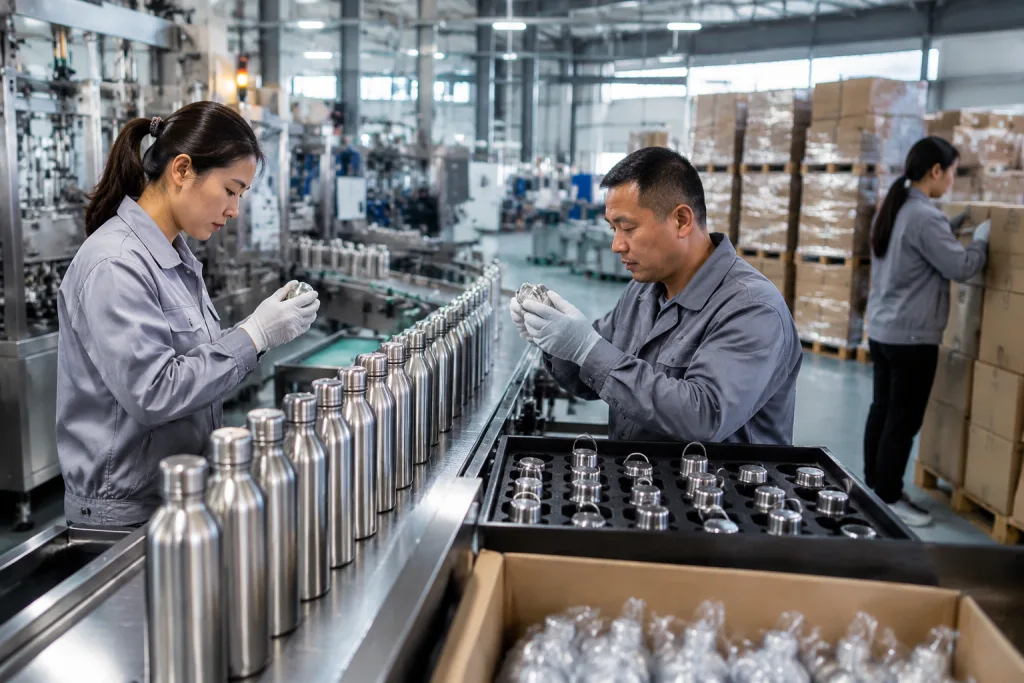
I’ll rewrite the prose to sound like a factory-side sales engineer, keep the HTML exactly as-is, and preserve the heading and list structure.You do not need the loudest supplier. You need the one that can hold the same quality on lot 1 and lot 18. When we quote custom 316 stainless steel bottles, I look at process control first. Do they keep polishing, vacuum sealing, coating, and printing on their own line, or do they push half the job outside? Can they show AQL records, a pre-production sample, a first article check, and a final inspection report? That is the split between a working factory and a trading desk with a nice website.
For Europe and North America, paperwork is part of the product. Ask for BSCI, ISO 9001, or whatever audit file they actually have on hand. Ask if they can print carton barcodes, FNSKU, or retail stickers without a three-day back and forth. We had a buyer flag a PO typo on lid color once, and the fix only took 20 minutes because the line sheet was clean. If you are buying custom growler or distributor growler projects, check handle strength, cap torque, and neck threading at scale. Zhejiang factories that ship every week answer these points in writing, not with a vague “yes, no problem.”
If the supplier cannot explain defect rate, inspection points, or packaging damage control, keep looking.
- Ask for AQL level: common export checks use AQL 1.5 or 2.5 depending on category.
- Ask for production photos: especially welding, vacuum sealing, and packing stations.
- Ask for re-order consistency: same color, same gloss, same lid fit across repeat runs.
Send your spec, get a real factory quote
We can review your artwork, confirm 316 or 304, and quote MOQ, lead time, and packaging for your canteen custom project from Zhejiang.
Frequently asked questions
Is 316 stainless steel worth it for a water bottle?
Yes, when the bottle is used with acidic drinks, electrolytes, coastal transport, or premium retail positioning. 316 usually costs 10% to 25% more than 304, but it handles chlorides and corrosion better. If the product is plain water for offices, schools, or general promotion, 304 is often enough. For a custom canteen line, choose 316 when the end user is likely to wash aggressively, store the bottle in humid conditions, or use it in outdoor and marine markets.
What MOQ should I expect from a factory in China?
For a standard decorated stainless bottle, expect 3,000 to 5,000 pieces per SKU and color from a real canteen factory in Zhejiang or broader China. If you add special lids, multiple print colors, or retail gift boxes, MOQ can rise. Some factories can sample below 100 pcs, but sample MOQ is not the same as production MOQ. Ask for one quote at 500 pcs only if you accept a higher unit cost. Serious canteen distributors usually plan around full production MOQs.
How long does production usually take?
After sample approval, production usually takes 30 to 45 days for stainless drinkware, depending on decoration and packaging. Add 5 to 10 days for sampling, artwork confirmation, and test adjustments. If you are ordering customized drinkware with multiple variants, build in extra time for carton labels, barcode checks, and final inspection. Fast orders are possible, but only if your logo files, Pantone references, and packaging specs are approved on the first round.
What documents should I request before paying a deposit?
At minimum, request a proforma invoice, material specification, artwork confirmation, and compliance declarations for your market. If needed, ask for REACH, LFGB, FDA-related statements, BSCI audit status, ISO 9001 certificate, and a recent inspection report. For export projects, confirm FOB port, carton count, unit weight, and outer carton dimensions. A good canteen supplier in China should provide these without hesitation, especially if you are buying custom drinkware for retail or distributor channels.
How do I compare two canteen suppliers fairly?
Compare them on the same basis: steel grade, wall thickness, lid type, logo method, packaging, test standards, MOQ, and lead time. A quote that is USD 0.20 cheaper can become more expensive if the lid leaks, the coating scratches, or the carton fails transit. Ask for a sample from each canteen manufacturer, then do a leak test, hot-fill test, and drop test. For a canteen distributor program, repeatability matters more than the lowest first quote.