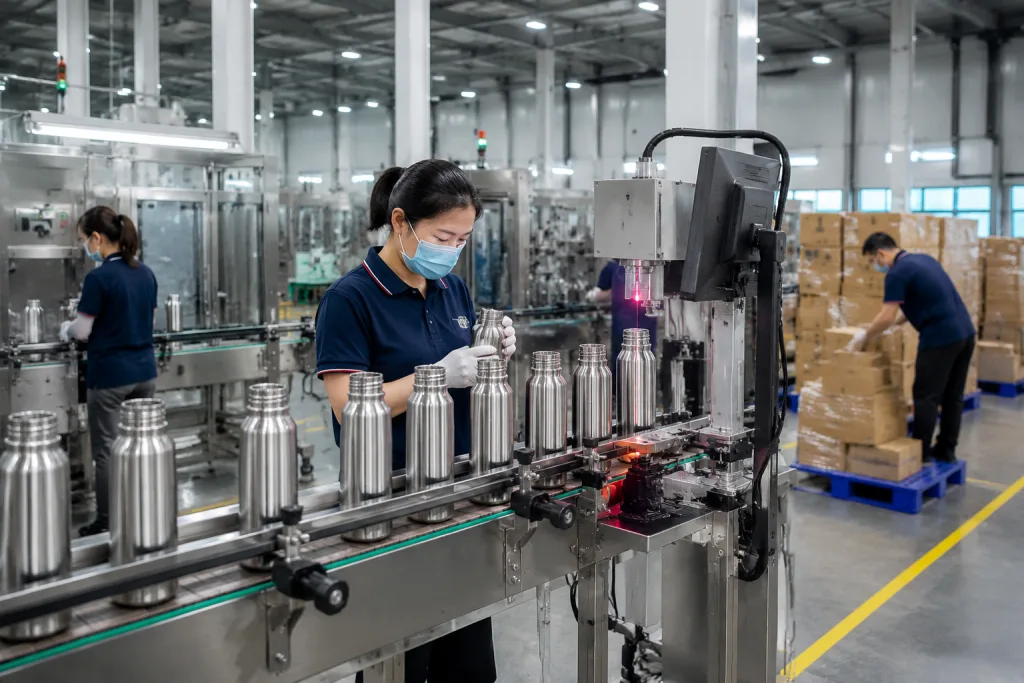
Key Takeaways
- 316 stainless usually adds 8%–20% over 304, but the corrosion benefit is real for salty, acidic, or coastal use.
- A 500 ml double-wall bottle with 0.5 mm inner and outer shells is a common commercial spec; thinner walls can dent faster and raise reject risk.
- Most custom orders in Zhejiang start at 1,000–3,000 units MOQ, with 25–35 days lead time after sample approval.
- Ask for REACH, LFGB, and AQL 2.5 inspection terms in writing; otherwise your customized drinkware quote is not comparable.
If you are sourcing a 316 stainless steel stainless steel water bottle custom, the first mistake is treating “316” like a marketing label. It is a material call, and it changes corrosion resistance, price, forming behavior, and how you write the spec. For a buyer in Europe or North America, that matters when you are matching a retailer margin, a distributor quote, or a private-label launch with a real factory offer from Zhejiang or elsewhere in China.
At BottleForge in Hangzhou, we see the same thing every week: a buyer asks for a “premium stainless bottle,” then QC pulls the sample and finds the lid liner is wrong or the wall is 0.35 mm instead of 0.45 mm. The landed cost moves 12% to 28% once you lock down passivation, coating method, and test standard. That math does not lie. If you are comparing custom drinkware options, a clean spec sheet beats vague samples and last-minute substitutions. Below, I’ll break the bottle down line by line, the way we run the line, so you can buy with fewer assumptions and better pricing.
What 316 really changes
316 stainless steel is not a cosmetic upgrade. The real change is molybdenum, usually around 2% to 3%, and that cuts pitting and chloride attack. We see it pay off on coastal retail runs, gym bottles that ride in sweaty bags, coffee-and-tea programs, and any canteen custom order that spends time near salt or acidic drinks. On one 5,000-unit PO, QC pulled three rust spots on a salt-spray check at 48 hours; the buyer flagged the 304 sample and moved the line to 316.
The question is not “Is 316 better?” The math does not work that way. Ask where the bottle lives. Plain water for office or school use? 304 usually covers it. Premium outdoor, marine, wellness, or hospital-adjacent? 316 is easier to defend. On a 500 ml bottle, the base steel often adds about USD 0.35 to 0.90 per unit, depending on steel market moves and gauge. We have seen this go sideways when a supplier quoted 316 but left the lid, welds, and brushed finish unchanged; the PO even had a typo on the spec line, and the whole order had to be rechecked at the line.
Buyer impact: 316 helps most when the bottle sees salt, acid, heat, or a long service life. It does not fix poor welding, weak vacuum, or cheap coatings.
Wall thickness and gauge
I’ll keep the HTML exactly as-is and rewrite only the prose, with tighter factory-floor language and concrete specs.Wall thickness sets the hand feel and the dent rate. On a double-wall stainless bottle, we usually quote 0.4 mm to 0.5 mm for the inner and outer shell. Drop to 0.35 mm and you shave weight and cost, but the line starts giving you trouble at stamping, neck forming, and vacuum sealing. We’ve seen that turn into reject spikes on tall shapes like a 750 ml custom growler or a 1 L distributor item.
For a real custom drinkware program, ask the canteen factory for the steel gauge, not just the volume. Gauge terms shift by market, so I put millimeters on the PO every time. A 0.5 mm shell on a 500 ml bottle usually lands around 220 g to 280 g finished weight, depending on cap and coating. If the sample comes in much lighter, the buyer flagged it for a reason: somebody cut the wall. On one Zhejiang run, QC pulled the sample with a micrometer at 0.41 mm instead of the quoted 0.5 mm, and the math did not work. Hold the body thickness steady and tune the lid, powder coat, and packaging instead.
- 0.35 mm: cheaper, lighter, dents faster
- 0.4 mm: workable for promo runs and short campaigns
- 0.5 mm: better for retail, reuse, and rough handling
For canteen promotional orders, thickness is where buyers often pay for print and underpay for durability. That is the wrong question to ask.
Vacuum, insulation, and heat hold
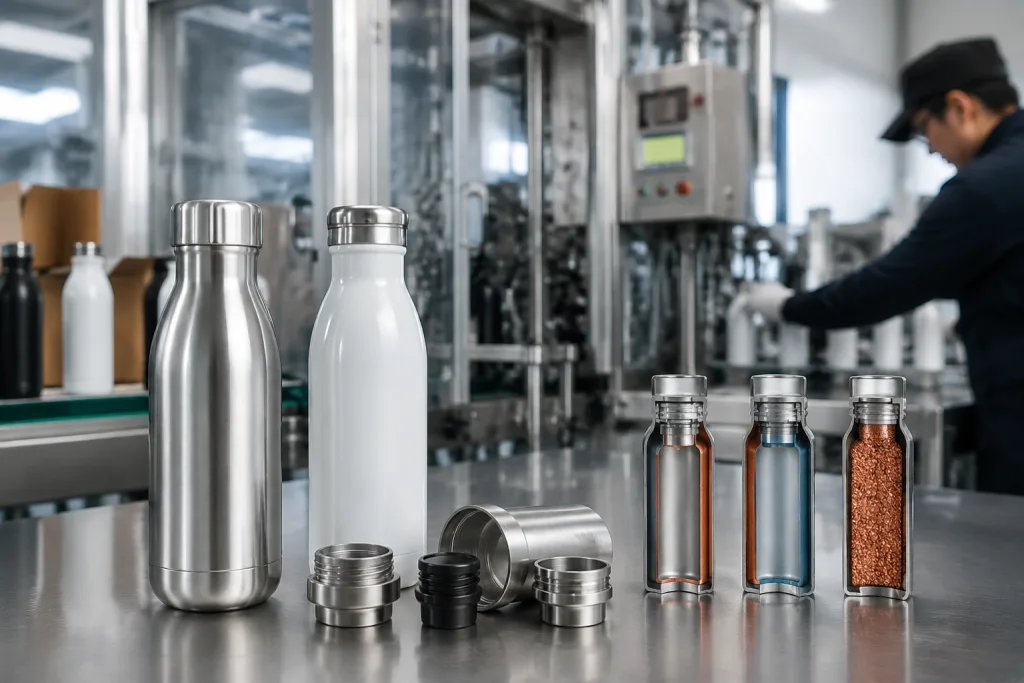
I’ll rewrite the section in-place, keep the HTML exactly as-is, and tighten the prose so it reads like a factory-side sales engineer.Once you pick 316, the next number on the spec sheet is vacuum performance. A double-wall bottle lives or dies by the vacuum seal and neck finish. For a typical 500 ml stainless bottle, hot hold usually lands at 6 to 12 hours and cold hold at 12 to 24 hours, depending on lid type, ambient temperature, and fill level. If a supplier throws out 24 hours hot on a basic straight-wall canteen customized model, that math does not hold. Heat loss hits returns and reviews fast.
Ask how the vacuum is made and checked. A proper canteen supplier should state the vacuum leak rate or confirm 100% thermal retention sampling during QC. We run this with in-line checks, then final AQL 2.5 sampling for appearance and function. On higher-end customized drinkware, a laser-welded seam and tight mouth finishing matter more than a printed slogan. We once had a buyer flag a PO typo on the lid code, and the wrong gasket spec would have killed the carry claim. A leak-resistant screw cap helps, but a bad gasket wipes that out in one shipment.
Rule of thumb: a premium shell without a reliable lid is still a mid-grade bottle.
Lid system and seal
I’ll rewrite the prose in place, keeping the HTML exactly as-is and tightening the language toward a factory-floor sales tone.The lid is where a lot of canteen vendors cut corners. The body gets the spec sheet; the cap gets blamed after the first leak. For 316 stainless steel stainless steel water bottle custom jobs, we treat the lid as its own part spec: material, gasket, thread pitch, venting, and opening torque all need to be locked down. A food-grade PP or Tritan lid with a silicone gasket is the normal starting point. If the bottle is meant for hot and cold use in premium channels, the lid has to hold up through repeated open-close cycles without cracking or backing off.
For a custom canteen built for outdoor, school, or corporate gifting buyers, we ask for three things up front: leak test standard, drop performance, and spare-part supply. We can run a 2-minute inverted leak test, or a 1 meter drop test on a closed bottle, right on the line. One buyer once sent a PO with “lid” typed as “lead”; QC pulled the sample, and the carton label had to be fixed before shipping. If the bottle uses a straw lid, flip lid, or tea infuser, the gasket count goes up and the failure risk does too. This is why canteen factories often separate body warranty and lid warranty inside the plant, even if they do not spell it out to you.
- Silicone gasket: best for sealing
- PP lid: lower cost for large runs
- Tritan lid: cleaner look for premium branding
If you are buying as a canteen distributor, push for replaceable lids. The body should not need remanufacturing just because a cap failed.
Surface finish and branding
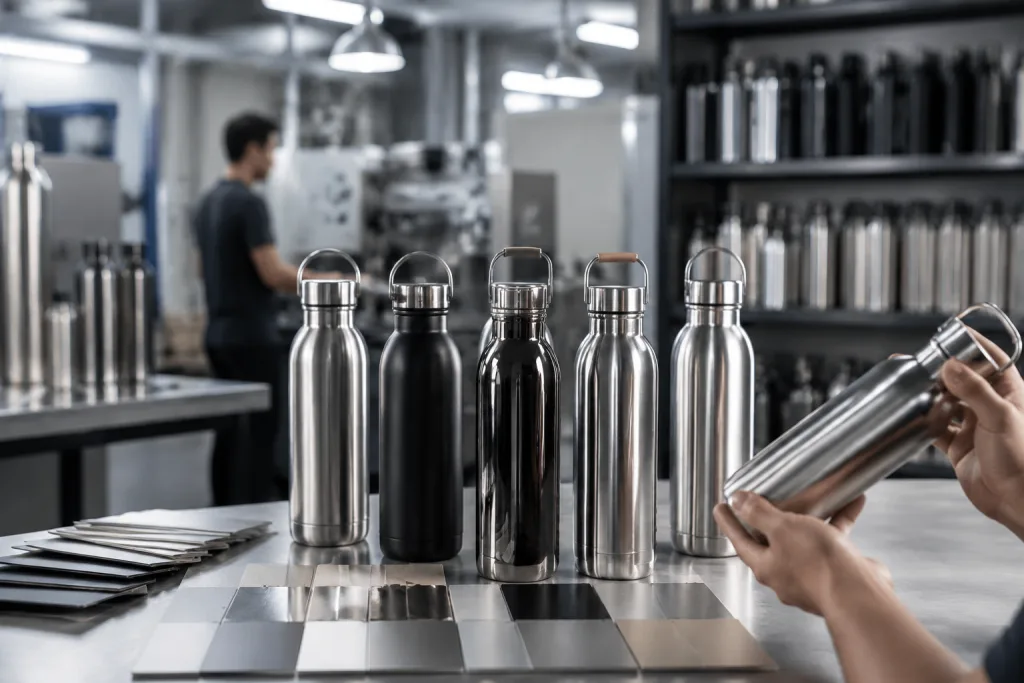
I’ll rewrite the prose only, keep the HTML structure intact, and make it read like a factory-side sales note with concrete details and cleaner wording.Finish changes buyer perception faster than steel grade. Brushed steel, powder coat, matte paint, UV print, and laser engraving each change resale price and defect risk. A brushed 316 surface hides handling marks better; powder coat gives more color options and stronger shelf appeal. For canteen customizable programs, powder coat usually gives the best cost-to-display ratio. Laser engraving lasts longer, but it cuts into bare metal, so the logo file and depth control have to stay tight.
If your buyer is a distributor canteen program or a customized canteen retail line, ask what happens after 500 abrasion cycles. QC pulled a sample last month and the edge wear showed up first because the coating was under 35 microns. The math does not work there. For a canteen promotional giveaway, print quality matters less than line speed, so a single-color screen print is often enough. For a premium custom growler or customizable growler, laser plus powder coat is usually stronger and easier to price above USD 6.50 FOB China, depending on size and packout.
Practical note: if your artwork has fine text, confirm minimum line width before approving production. A 0.2 mm line can look fine on screen and disappear on a curved bottle wall.
Compliance and test paperwork
I’ll rewrite the prose in place, keep the HTML structure intact, and tighten the compliance language so it sounds like a buyer-facing factory note.For Europe and North America, paperwork ships with the bottle. A clean quote for custom drinkware should list REACH, LFGB for food contact when needed, BPA-free lid materials, and the inspection standard. For the U.S. market, ask for material declarations that back FDA food-contact positioning, plus any state-level requirement your importer follows. “Safe material” is not enough. Customs and marketplace review teams will kick that back.
On our side, ask whether the bottle factory holds BSCI or another social audit. A lot of retail buyers will not onboard without it. For QC, AQL 2.5 is the usual line for major defects; some programs use 4.0 or 6.5 for minor cosmetic marks. On a 5,000-unit order, we run retention samples and a signed golden sample. The buyer flagged it once over a PO typo on “316L” versus “316,” and that small miss turned into a document loop nobody wanted. Good suppliers in Zhejiang know this drill. The weak ones dodge the details because the file set is thin.
- REACH: standard ask for Europe
- LFGB: the test buyers ask for when they want food-contact proof in Germany
- BSCI: common retail audit gate
- AQL 2.5: practical default for defects
MOQ, price, and lead time
I’ll keep the tags and structure intact, rewrite the prose to sound like a sales engineer, and make the numbers and factory-floor details feel concrete without changing the original meaning.This is where the order gets real. For a custom canteen in 316 stainless steel, a Zhejiang factory usually asks for 1,000 to 3,000 units per color or per artwork, and the number moves with mold work and packing. A plain straight bottle with one-color logo can start at about 1,000 units. A heavier custom growler with a special lid and two coatings can go higher. If a canteen supplier says 300 units for a fully custom body, the math does not work; either the unit price jumps or the tooling compromise shows up later on the line.
On price, a plain 500 ml 316 bottle FOB China usually lands around USD 4.20 to USD 7.80 before freight, depending on finish, lid, and packaging. A premium branded model with gift box and laser engraving can push above USD 8.50. Standard lead time is 25 to 35 days after sample approval and deposit, and custom printed packaging adds another 5 to 10 days. We run a monthly output of about 600,000 units, so larger distributor schedules do not stall because one small SKU is late. QC pulled the sample last week and caught a 2 mm lid gap on a carton-run check; that is the kind of issue you want fixed before you book a season for Europe or North America.
When you compare canteen distributors, ask for the full landed requirement: body, lid, insert card, carton marks, and carton strength. We’ve seen this go sideways when a buyer only chases bottle price, then the carton fails at drop test and the margin disappears. A canteen distributor that quotes the real packing spec protects the deal.
Send your spec sheet for a fast quote
We’ll sanity-check your steel grade, lid, MOQ, and branding before production, so your next custom drinkware order from China lands cleanly.
Frequently asked questions
Is 316 stainless steel worth the extra cost for a water bottle?
Yes, when the bottle will see salt, acids, sweat, or long-term premium use. In practice, 316 often adds USD 0.35 to USD 0.90 per unit on a 500 ml bottle, sometimes more if the lid and finish are upgraded too. If your market is office hydration or school use, 304 may be enough. If you are selling a custom canteen into coastal retail, outdoor, or high-end corporate gifting, 316 is easier to justify and usually generates fewer corrosion complaints.
What MOQ should I expect from a canteen factory in China?
For a standard 316 stainless steel stainless steel water bottle custom project, expect 1,000 to 3,000 units per SKU, color, or artwork set. Simpler shapes and one-color logo work can start around 1,000 units. Complex lids, special coatings, or gift packaging can push the MOQ higher. If a supplier offers 200 or 300 units with fully custom tooling, check whether they are using stock parts or charging a premium that destroys your landed margin.
How do I check if the thickness is acceptable?
Ask for the body thickness in millimeters, not just the product volume. For a premium bottle, 0.5 mm inner and outer walls are a solid target. Around 0.4 mm is acceptable for many promotional programs, while 0.35 mm is more fragile and can dent more easily. You can also ask for finished weight, because a 500 ml bottle that is unusually light often signals thinner steel. A good canteen manufacturer should provide both numbers before sample approval.
What compliance documents should I ask for?
For Europe, ask for REACH declarations and, where relevant, LFGB support for food-contact parts. For North America, request material declarations and any testing your importer needs for food-contact positioning. Also ask whether the factory has BSCI or another social compliance audit if your retail channel requires it. For quality control, agree on AQL 2.5 for major defects and keep a signed golden sample. Without this paperwork, your customized drinkware quote is not truly comparable.
Can I use the same bottle for retail and promotional orders?
You can, but the spec should change. For canteen promotional runs, you can simplify the finish, carton, and lid to hit a lower price. For retail, you need stronger coating, tighter logo control, and better packaging. The same shell can work for both channels if the canteen supplier keeps the body spec fixed and only changes branding and packaging. That is how distributors protect margin while keeping one core product family.