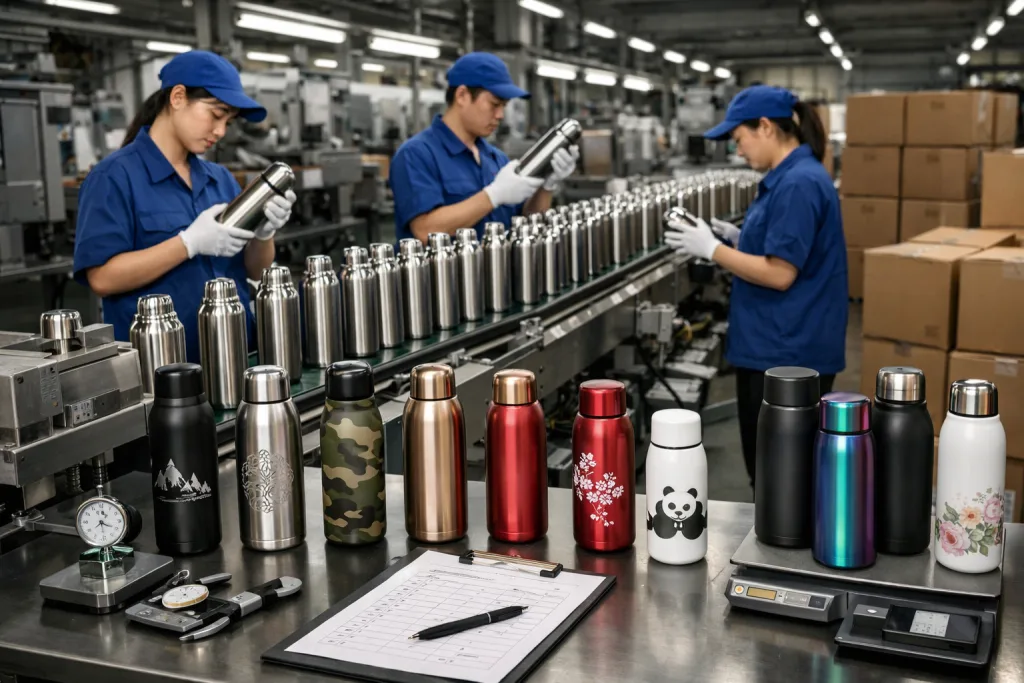
Key Takeaways
- 316 stainless steel is usually specified for the inner liner; expect +8% to +15% over 304 on a comparable thermos.
- A practical MOQ for custom thermos orders is often 1,000-3,000 pcs per SKU, with samples ready in 7-12 days.
- For export programs, ask for AQL 2.5 major / 4.0 minor, REACH support, and 48-hour leak testing data.
- A clean PO should list capacity, finish, decoration, lid type, packaging, carton count, and FOB port before you pay deposit.
If you are buying a thermos for outdoor retail or a promotional campaign, the first bad move usually happens before you even ask for a quote. You say “stainless steel,” the factory gives a price, and later you find the inner wall is 304, the lid starts leaking after 40 cycles, or the logo rubs off in shipping. For 316 stainless steel stainless steel bottle wholesale, the material line is only the starting point.
In Zhejiang and across China, the factories doing export work do not sell on claims. They quote by wall thickness, coating system, test standard, and MOQ. A serious thermos line can run 80,000 units a month, but that is not the question we ask first. We check whether the factory can show material records, pass leak tests, and hold lead time at 35-45 days after sample approval. QC pulled a unit at 1.2 mm once and the buyer flagged a typo on the PO; that kind of detail is what separates a clean bulk program from a pile of complaints.
Start with the RFQ sheet
I’ll rewrite just the prose inside the existing HTML, keep the tags and list structure intact, and tune it to sound like a factory-side sales engineer.Do not open with “send price.” Open with a structured RFQ. A good thermos supplier can turn a quote in the same day when you give the right variables, and a weak one shows its hand fast when it cannot. For 316 stainless steel stainless steel bottle wholesale, name the end use: hiking retail, gift program, or distributor thermos replenishment. Then lock down the build: 316 inner liner, 304 outer shell if that is acceptable, double-wall vacuum, exact capacity, and the target retail market. If you want a true custom thermos, send the artwork files and print position in the first email. We run this every week, and the buyer who waits on graphics usually loses 3 to 5 days.
Your RFQ should force apples-to-apples pricing. Ask for 500 ml and 750 ml quotes, because the gap is often only USD 0.18-0.35 per unit, yet the shelf value changes a lot. State lid style, powder coat color, silk screen colors, laser engraving area, and whether the product must be dishwasher-safe. Last month, QC pulled a sample at 58 mm mouth diameter because the PO typo said 55 mm, and that kind of miss burns a sample round. Skip these details and two thermos manufacturers will quote different builds; then you think one is cheaper when it is just thinner, lighter, or missing the accessory set.
- Material callout: 316 inner, 304 outer, or full 316 where needed
- Target MOQ: 1,000 pcs, 3,000 pcs, or 5,000 pcs
- Price terms: FOB Ningbo or FOB Shanghai, not vague ex-factory language
- Compliance: REACH, food-contact declaration, and carton drop-test expectation
In Zhejiang, export factories are used to this level of detail. The math does not work any other way. If you want a clean quote from a 316 stainless steel bottle line, give the spec before sample money moves, and you will see who can actually ship.
Lock the sample build
I’ll rewrite the section in-place, keep the HTML exactly as-is, and tighten the sales-engineer tone with a few concrete factory details.Once the RFQ is locked, move straight to sample approval. This is where buyers burn time by signing off on a “nice-looking” piece instead of the one that matches the spec. For a customizable thermos, the sample has to match final wall thickness, lid gasket material, coating system, and decoration method. A 316 liner means nothing if the cap gasket softens at 60°C after a few pressure cycles. Ask the factory thermos team for a pre-production sample, not a random stock unit off the shelf.
Good sample work starts with measurements, not photos. You want neck finish tolerance, vacuum retention time, and paint adhesion data. On our line, QC pulls the sample with calipers, a torque meter, and a cross-hatch tape test before we ship it out. A practical export sample pack usually includes one blank unit, one printed unit, one laser-marked unit, and one full-color box mockup. If you are building a promotional thermos program, this is where logo placement gets checked against PMS colors and you decide whether the logo stays 1-color silk screen, 2-color pad print, or laser engraving for scuff resistance.
Check what the sample does under stress. Fill it with 95°C water, close it, and inspect the leak point after 1 hour, 8 hours, and 24 hours. A decent bulk thermos sample should stay dry, keep odor out, and hold the cap shape. We’ve seen this go sideways when the buyer approved from photos only; the first carton leaked on day 3. If the supplier thermos team cannot give a sample timeline in writing, the bulk run will not be cleaner.
Ask for the sample report in writing. A factory that records vacuum loss, torque, and drop-test results is usually the one you want for repeat orders.
Typical sample cost is USD 35-80 per style plus courier. In Zhejiang and the rest of China, that is normal for export-grade custom thermos development; you are paying for process control, not just a bottle. The math does not work any other way.
Read the sample like a buyer
I’ll rewrite the section in-place, keeping the HTML exactly as-is and making the prose sound like a buyer-side sales engineer.When the sample lands on your desk, do not judge it by hand feel alone. A 316 stainless steel stainless steel bottle wholesale program works only if the sample shows repeatability from the line. Start with the metal. Ask for traceability on the inner wall, and check the mill cert against the PO. 316 carries molybdenum and handles salt, acids, and coastal retail better than 304, but we still verify the claim. If your buyers sell to hunters, anglers, or winter sports shops, that extra corrosion resistance is worth the extra cost.
Then inspect the build. Look at weld marks inside the neck, cap thread smoothness, silicone ring fit, and the base pad if the spec includes one. For a thermos customized for outdoor use, the coating should survive 3-5 abrasion passes in a rub test before the buyer flags chips. A 0.35 mm wall on the liner is common on premium builds; thinner can work, but the math changes on heat retention and dent resistance. If the manufacturer thermos quote looks too low, this is usually where they cut corners. We’ve seen it go sideways on the first rain test.
- Measure actual capacity against the declared ml
- Confirm leak-free sealing when inverted for 30 minutes
- Check imprint alignment within ±1.5 mm
- Review carton count, inserts, and spare gasket policy
For distributor thermos programs, consistency beats one perfect sample. Approve only after the second sample matches the first within tolerance. QC pulled the sample twice at 12 days, not 18, and that gap told us more than the hero piece did. That is the real test of thermos manufacturers.
Write the PO line by line
I’ll rewrite the HTML in place, keep the tag structure untouched, and tighten the sales-engineer tone with concrete factory details and cleaner PO language.A clean purchase order protects both sides. It also stops pricing disputes later when you are ordering thermos bulk for a seasonal launch. Your PO should not say just “stainless thermos, 5,000 pcs.” It should read like an export checklist. Put in capacity, body structure, steel grade, finish, decoration, lid type, accessory set, inner box, master carton, shipping mark, and count tolerance. For a supplier thermos order, that level of detail is standard, especially when you buy from a thermos supplier in Zhejiang that runs six OEM accounts on the same line.
Use line items the factory can build against. A solid PO for a promotional thermos might read: 500 ml vacuum bottle, 316 inner liner, 304 outer shell, matte powder coat, one-color silk screen, black PP lid with silicone gasket, individually packed in kraft box, 20 pcs per carton, carton gross weight target 12.8 kg, and one spare gasket per 100 pcs. If you need barcode labels or FNSKU stickers for Amazon FBA, say it before production starts. QC pulled the sample on a 1.2 mm wall thickness check; the buyer flagged the lid print after that, and the math did not work for a late change.
State the commercial terms too. FOB port, deposit percentage, balance before shipment, and document list. Good thermos distributor suppliers send carton photos, dimensional data, and a packing list draft before final payment. If they do not, you are still at sample stage, not wholesale stage. We have seen a PO typo on “304” vs “316” turn into a full re-quote.
In China, a sharp PO saves one email chain per mistake. In Zhejiang, experienced factories prefer that because it cuts rework, and rework kills schedule faster than a machine breakdown on the cap assembly station.
Place production controls early
I’ll rewrite the section in place, keeping the HTML tags and structure unchanged while tightening the sales-engineer tone and adding concrete factory-floor detail.After the PO is signed, the job is not finished; it is under control. For any custom thermos order above 1,000 units, ask for a pre-production sample reference, a signed artwork proof, and a first-article check after the first 300 pcs. We run plenty of export jobs in Zhejiang at 80,000-120,000 units per month, and that still does not stop a bad lot if the gates are loose. Capacity does not equal discipline.
Set inspection rules before bulk starts. Many buyers use AQL 2.5 for major defects and 4.0 for minor defects; that works for promotional thermos lines and outdoor retail, especially when one PO carries 3 or 4 SKUs. Ask the supplier to hold a 24-48 hour vacuum and leak test on samples from each batch, and check the valve jig on the line before the shift starts. We’ve seen a buyer flag a PO typo on the finish code, and that kind of miss turns into a rework fight fast.
Packaging deserves the same attention as the bottle. Single-wall gift boxes save money, but double-wall master cartons with corner protection cut damage claims; the math is simple, and this is the wrong question to ask if someone says cartons do not matter. If your retail channel needs shelf appeal, ask for a custom sleeve or hangtag. If your channel is distributor thermos sales, a simpler insert is better because it lowers carton volume and freight cost. Freight savings of 3% to 7% are common when packaging is set up right.
Factory thermos programs fail when buyers treat production as passive. The smart buyer uses milestones: artwork approved, raw material locked, first article approved, in-line inspection, pre-shipment inspection, then shipment. QC pulled the sample, checked the vacuum cup at 45 mm, and that is the kind of detail that keeps a 316 stainless steel bottle wholesale order on track without slowing the job to a crawl.
Decide what to repeat
I’ll rewrite the section in-place, keep the HTML tags untouched, and tighten the prose to sound like a factory-side sales engineer.The last step is not shipment. It is deciding what becomes a repeat SKU and what gets dropped. A wholesale thermos program should get better after the first run, not just loop again. Compare landed cost, defect rate, lead time, and reorder flexibility. If the 316 model lands at USD 4.20 FOB on the first run and drops to USD 3.85 on a 10,000-piece repeat order, that is normal if the tooling holds and the decoration stays the same. If the price stays flat, ask why. We have seen this go sideways when the factory hides margin in the second quote, or when your spec is so custom that the line cannot scale.
For outdoor retailers, track sell-through by capacity and cap style. For promotional brands, track logo wear and the unboxing feel. A thermos customized with laser engraving can cost more up front, but it often cuts after-sales complaints by 20% or more versus cheap printed decoration. QC pulled the sample under a 3M tape test, and the print on the low-end batch lifted at the corners. For distributor thermos buyers, repeatability matters even more: one weak batch can wreck a quarter’s sales.
Keep your repeat order file simple. Save the approved steel spec, decoration file, carton spec, and inspection standard as the baseline. Then you can go back to the same manufacturer thermos partner in China or Zhejiang and reorder without reopening the basics. That is how sourcing gets boring. That is the goal.
Send your RFQ for a quote today
Share capacity, decoration, and target MOQ. We can turn your spec into a factory-ready 316 thermos quote with sample timing and FOB pricing.
Frequently asked questions
What is a realistic MOQ for 316 thermos wholesale?
For custom thermos orders, a realistic MOQ is usually 1,000-3,000 pcs per SKU. Some thermos factory lines will accept 500 pcs, but pricing is often USD 0.30-0.80 higher per unit and decoration choices are limited. If you need multiple colors, expect each color to have its own MOQ unless the supplier runs mixed packing. For promotional thermos projects, a 2,000-piece starting point is common because it balances tooling, print setup, and carton efficiency.
Why choose 316 over 304 for a stainless thermos?
316 stainless steel offers better corrosion resistance, especially for salty, acidic, or coastal use cases. In wholesale, the price premium is often 8%-15% over a comparable 304 build. For outdoor retailers, that premium can be worth it if your buyers use the bottle near seawater, sports drinks, or citrus beverages. If the product is only for office gifting, 304 may be enough, but for premium thermos manufacturers targeting harsh environments, 316 is the safer specification.
What should I ask for in a sample test?
Ask for leak testing, vacuum retention, coating adhesion, and print durability. A practical sample should pass 95°C water fill tests, remain leak-free when inverted for at least 30 minutes, and show stable temperature retention over 6-12 hours depending on capacity. Also request material confirmation for the liner and gasket. A good supplier thermos will give you a written sample report, not just a courier package and a promise.
How long does production take after sample approval?
For a standard bulk thermos order, production is usually 35-45 days after sample approval and deposit receipt. If the order needs custom tooling, special packaging, or a new color match, add 7-15 days. In Zhejiang and other parts of China, a capable manufacturer thermos partner can shorten this if the schedule is clean, but rush orders often increase defect risk and freight cost.
What should be on the purchase order?
List capacity, steel grade, lid type, finish, decoration method, box type, carton count, tolerance, and shipping terms. For example: 500 ml, 316 inner liner, 304 outer shell, matte powder coat, one-color silk screen, black leakproof lid, individual kraft box, 20 pcs/carton, FOB Ningbo, AQL 2.5 major and 4.0 minor. If you need FNSKU labels, spare gaskets, or retailer barcodes, include them on the PO before production starts.