Key Takeaways
- 316 inner liners usually add about USD 0.35-0.90 per unit versus 304 on a 500 ml thermos
- Typical MOQ starts at 1,000 units for custom thermos and 3,000+ units for decorated promotional thermos
- Sample lead time is often 7-15 days; bulk production from approved artwork is commonly 25-40 days
- A Zhejiang thermos factory with 200,000 units/month capacity can handle distributor thermos programs without extending schedules
If you are sourcing a 316 stainless steel stainless steel bottle supplier, the first question is not “Can you make it?” The real questions are cost, lead time, and what moves the quote. We get the same buyer pushback every week: “Why did a flip lid add $0.18?” That math is the whole game.
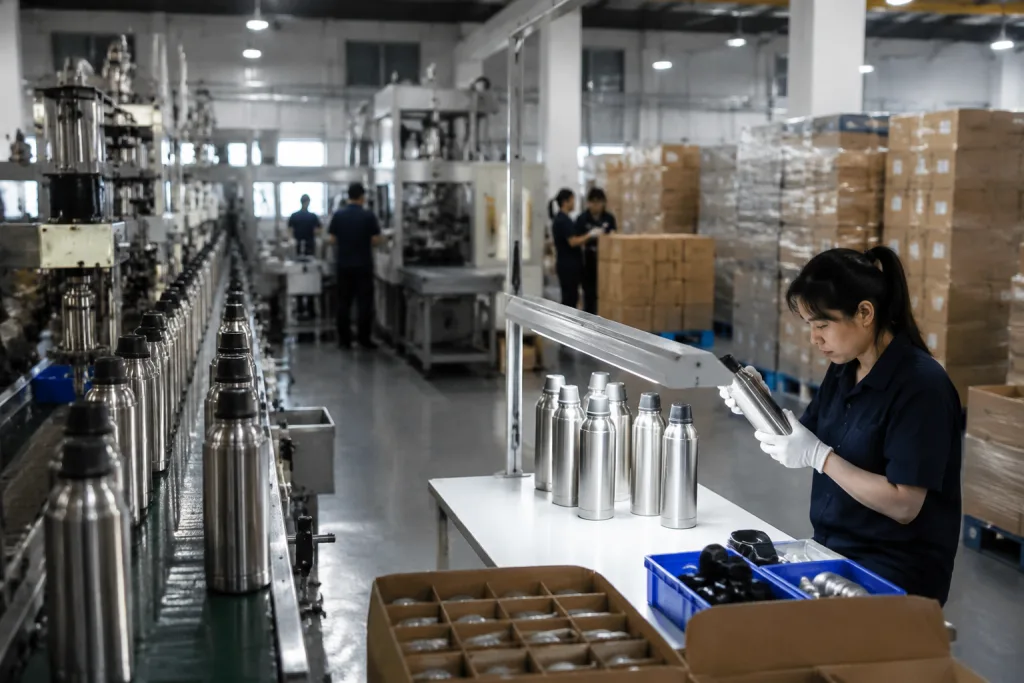
In Zhejiang and across China, a lot of thermos plants can make bottles that look the same on the shelf. On the line, the gap shows up in wall thickness, liner grade, vacuum yield, print method, and whether QC pulled the sample against the PO before packing. For a custom thermos order, a good supplier should quote clean numbers: USD per unit, 30-45 days for sample-ready tooling, and 25-40 days for mass production after the spec is locked. We run it this way because anything fuzzy gets expensive fast.
What drives the quote
I’ll keep the HTML structure intact and rewrite the prose with sharper pricing language, factory-floor detail, and fewer generic AI turns.When you ask a thermos manufacturer for pricing, the quote is built from six working variables: steel grade, capacity, lid structure, surface finish, decoration, packaging, and order size. The main mistake is treating 316 as a small upgrade. On a 500 ml vacuum bottle, 316 can add about USD 0.20-0.45 per piece on the inner liner alone, and we have seen that jump again if the outer shell also goes 316 or the polishing line needs one extra pass.
For outdoor retailers, the price usually moves on durability and finish. A powder-coated customized thermos with a laser logo and matte cap can land at USD 4.20-6.80 FOB Ningbo or Shanghai at 1,000-3,000 units. A basic promo thermos with one-color print and a standard gift box is closer to USD 2.60-4.00. If the buyer wants a straw lid, handle cap, or sip-top, the line adds another USD 0.15-0.60, and that depends on whether the mold is already on the shelf or needs new tooling.
Factories in Zhejiang that ship export orders should break the quote down cleanly. Ask for:
- Material spec: 316 inner, 304 outer, or full 316 where needed
- Thickness: common is 0.35-0.45 mm inner wall
- Vacuum performance: 6-12 hours hot retention claims must match testing
- Finish: spray paint, powder coat, or brushed steel
- Packaging: bulk pack, white box, or retail carton
MOQ tiers that make sense
I’ll rewrite the section in-place, keeping the HTML exactly as-is and tightening the sales tone. Next I’m making the prose sound like a factory-side rep with concrete MOQ numbers and a few floor-level details.MOQ is where a lot of buyers burn days. A thermos supplier prices a 500-unit custom run differently from a 5,000-unit order because the fixed setup sits on every piece. We run the same drill on the line: one new lid mold, one carton dieline, one logo screen, then QC pulls the sample and checks the first 20 pcs. If you want a special lid, printed carton, or two-color logo, the math lands on your quantity fast. That is why 500 units looks painful, while 3,000 units starts to make sense.
A clean tiering from a China thermos factory is this: 300-500 units for a stock shape with one-color logo; 1,000 units for full custom thermos decoration and packaging; 3,000-5,000 units for better pricing and some room on the cap or box. On a 500 ml model, the unit price can move from USD 4.80 at 500 pcs to USD 3.60 at 3,000 pcs, then to USD 3.10-3.30 at 10,000 pcs, depending on finish and vacuum test loss. We’ve seen buyers flag a PO typo on the MOQ line and lose a week; this is the wrong question to ask if the target is landing cost.
For distributor thermos programs, do not chase only the lowest MOQ. Ask if the manufacturer thermos team can mix colors in one order, how many cartons they allow per SKU, and whether they can hold 200-500 pcs of safety stock. A serious thermos factory in Zhejiang will answer straight: low MOQ is possible, but it is not the cheap route unless you are testing the market. We ship those small runs too, but the buyer needs to know the price per unit is carrying the setup.
Lead time by stage
I’ll rewrite the prose only, keep the HTML structure intact, and make the timeline sound like a factory-side sales engineer wrote it.Lead time is easier to control than price, but only after the spec is frozen. We break a customized thermos order into four stages. First is sample confirmation. A stock-mold item usually takes 7-15 days; if you want a new lid or a new surface finish, plan on 15-25 days. QC pulled the sample twice on one 32 oz order because the cap thread was 0.3 mm off, and that kind of miss burns time fast.
Second is pre-production approval, usually 3-5 days once artwork and carton details are locked. Third is mass production. For a mid-size Zhejiang supplier running 1,000-10,000 units, 25-40 days is the normal window if the line is already moving the body shell, vacuum forming, and coating. We ship faster when the coating booth is not backed up; if it is, the buyer flags it right away and the math does not work.
“Fast” usually means the factory has stock shells on the shelf, not that every detail is ready. If your logo file, cap color, and retail box are still changing on day one, the calendar slips immediately.
Fourth is export packing and booking. Add 5-10 days if you need third-party inspection, FNSKU labeling, or palletized carton packs for Amazon or retail DC delivery. For seasonal outdoor retail, we build in a 15% buffer. A PO typo on the carton count can cost a full day, and that is before freight cut-off. If the launch is tied to a trade show, lock the sample at least 45 days before ship date.
316 versus 304 decisions
I’ll rewrite the section in-place, keep the HTML exactly as-is, and tighten the language so it sounds like a factory-side sales engineer wrote it.Most buyers do not need 316 on every wall of a bottle. The question is use case, not status. For coffee, tea, and standard promo thermos orders, 304 does the job and keeps the price down. For salty drinks, acidic fills, coastal retail, or a premium outdoor line, 316 is the safer call because it holds up better against corrosion and gives the brand a cleaner story.
On cost, full 316 usually adds 8-18% to factory price, depending on shape and finish. We’ve seen a plain promo thermos at USD 3.00 FOB jump to USD 3.30-3.60 once the steel grade changes. If you are running a double-wall insulated bottle with powder coating, the gap can feel smaller on paper because the coating, lid, and vacuum process still carry their own cost. The math does not work if you pay for 316 where the buyer never sees it.
For sourcing, ask for material certs and heat numbers if you are building a premium line. QC pulled a mill cert on a 316 sample last month because the buyer flagged a PO typo on the steel grade, and that saved a bad shipment. A solid thermos supplier should give REACH declarations for Europe and the test set your U.S. customer asks for. If the factory says “it is 316” but cannot show the test method or the component split, that is a red flag, not a minor gap.
Decoration and packing costs
I’ll rewrite the prose in place, keep the HTML unchanged, and tighten the sales-engineer tone with concrete factory details and fewer AI-style fillers.Decoration is where custom thermos orders slip if the buyer does not lock the spec early. A single-color silk-screen logo is the cheapest, usually adding USD 0.05-0.15 per unit. Laser engraving looks cleaner and holds up better; on the line, we see it land at USD 0.10-0.30 depending on the mark size, and painted bottles need a different fixture than bare steel. Full-wrap UV print or gradient art can add USD 0.25-0.70, and if the printer queue is backed up, lead time can stretch by 7 days.
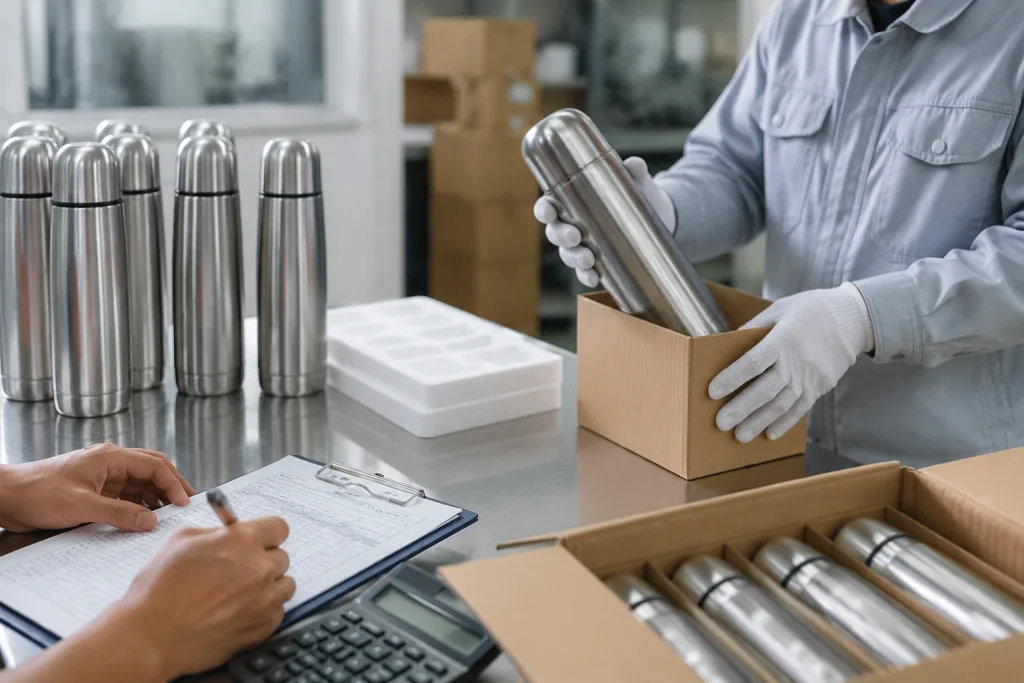
Packaging changes the landed cost faster than most thermos buyers expect. A plain bulk carton keeps freight light and usually saves USD 0.20-0.45 per unit versus a retail box, but it is the wrong call for premium retail. If you want a custom insert, hangtag, barcode sticker, and color box, add another USD 0.30-0.80. QC pulled the sample last week on a 500 ml bottle pack, and the buyer flagged the inner tray thickness at 1.5 mm because the bottle rattled in transit.
Ask your thermos factory for a packaging matrix. We run bottle-only, bottle-plus-box, and shelf-ready pack as separate quotes, because the math does not work if you bundle them into one line item. That gives you a clean path from distributor placement to retail-ready packaging without redoing the bottle. One PO typo on our side turned “white box” into “window box” once; the carton dieline had to be reissued, and that mistake cost a full day.
How to compare factories
I’ve got the section and the tone constraints. I’m rewriting it to sound like a factory-side sales engineer, keeping the HTML structure intact and tightening the wording with concrete shop-floor details.Not every thermos factory in China prices the same way, even when the photos look the same. Compare three things: export readiness, QC, and line capacity. A Zhejiang thermos partner should tell you its monthly output, the in-line checks, and which defects get pulled before carton sealing. On a 200,000-300,000 units/month line, a bulk order usually lands without blowing up your ship date.
Ask for AQL before you wire money. For drinkware, we often see AQL 2.5 for critical defects and 4.0 for major defects, though some branded programs push tighter. Ask whether the factory works to ISO 9001, BSCI, or both. Those papers do not make a bottle better, but they do show a thermos supplier has a system the buyer can audit. QC pulled a sample with a 0.3 mm lid gap last week; that is the kind of detail that matters.
- Request FOB and EXW separately so you can see labor, carton cost, and inland freight on the page.
- Check sample consistency against bulk color, lid fit, and vacuum performance.
- Verify test reports for REACH, LFGB where relevant, and insulation claims.
- Confirm change control so carton art or logo edits do not reset the schedule.
If a vendor prices in 10 minutes and asks nothing, the number is a guess. That is the wrong question to ask. A serious thermos manufacturer in Zhejiang will ask for capacity, artwork, target market, and packout before it commits. We’ve seen it go sideways when a PO typo changed the lid color code by one digit.
Request a 316 thermos quote today
Send your capacity, logo, and packout spec. We will return a clear FOB price, MOQ, and 25-40 day production plan.
Frequently asked questions
What is a realistic MOQ for a 316 custom thermos?
For a stock shape with your logo, 300-500 units can be possible. For a true customized thermos with custom lid, finish, or retail box, 1,000 units is the practical starting point. If you want better unit cost and fewer setup penalties, 3,000 units is where most China factories become much more competitive. At 1,000 units, a 500 ml 316 bottle may sit around USD 3.80-5.20 FOB depending on decoration and packaging.
How much more does 316 stainless steel cost than 304?
On a standard double-wall thermos, 316 usually adds around USD 0.20-0.45 per unit for the liner, sometimes more if the factory also upgrades polishing or material traceability. In retail terms, that often becomes an 8-18% premium over a comparable 304 model. If you need full 316 on both inner and outer parts, the increase can be higher, but most buyers only need the inner liner to carry the corrosion-resistance story.
What lead time should I plan for bulk thermos orders?
For a stock mold and approved artwork, sample lead time is usually 7-15 days. After sample approval, mass production commonly takes 25-40 days for 1,000-10,000 units. Add 5-10 days if you need third-party inspection, labeling, or pallet packing. If your order needs a new lid mold or complex print, plan closer to 45-60 days total. Zhejiang factories can move fast, but frozen specs matter more than promises.
Can I get custom branding without a big MOQ?
Yes, but the price will be higher. A simple thermos promotional order with one-color logo and standard carton can sometimes start at 300-500 units. If you want laser engraving, custom packaging, or mixed colors, most thermos distributors will find 1,000 units much more workable. Below that level, the setup cost per unit climbs quickly because printing, packing, and QC are spread across fewer pieces.
What compliance documents should a supplier thermos factory provide?
For Europe and North America, ask for material declarations, REACH-related compliance statements, and any relevant food-contact test reports. If you sell into retail or marketplace channels, you may also need carton labels, barcode verification, and sometimes FNSKU prep. A reliable manufacturer thermos team should share the test scope before production, not after shipment. If they are in Zhejiang and export regularly, they should know these requirements without needing a long explanation.