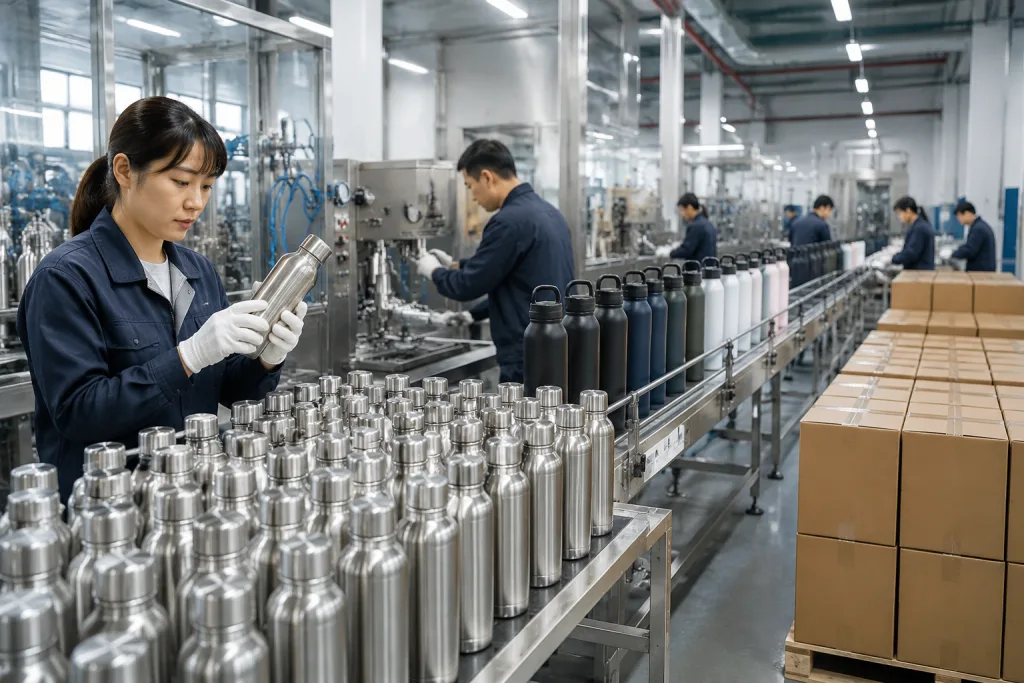
Key Takeaways
- Specify 316 stainless steel for all liquid-contact parts and verify by PMI or XRF testing on at least 3 samples per batch
- For bulk sports water bottle orders, a realistic MOQ is 1,000 pcs per color/logo with 25-35 day production after PP sample approval
- Powder coating failure often comes from poor pre-treatment, not the coating brand; request cross-hatch adhesion testing before shipment
- Custom logo shaker bottle projects need lid, thread, gasket, and ball testing because most leaks start above the bottle body
A 316 stainless steel sports water bottle bulk order looks simple on the PO. Then the gym chain locks the launch date, 42 cartons land at the warehouse, and the problems become physical: lids sweat in the carton, powder coating chips at the bottom radius, logos fade after 300 washes, or shaker balls rust because someone quietly substituted 304 or 201 steel. QC pulled a random sample last month with a magnet sticking to the ball. Bad sign.
If you buy for a fitness brand, studio franchise, or distributor gym water bottle program, unit price is the wrong question to ask first. Your real cost is rework, delayed campaigns, and returns from members who use the bottle daily. From our line in Zhejiang, China, we see the same 6 failure modes every season, and most start with a weak specification: no steel grade on the lid parts, no coating thickness in μm, no logo wash-test requirement, no AQL 2.5 inspection note. We run 316 stainless programs every month, and the jobs that ship clean are written like production files, not catalog wish lists.
The steel substitution problem
I’ll rewrite the section in place, keep the HTML structure intact, and tighten the copy so it reads like a factory-side sales engineer wrote it.The first failure mode is quiet. No one catches it at carton opening. The bottle looks fine, the logo looks fine, and the buyer thinks the 316 stainless steel sports water bottle bulk order is on track. Three months later, after protein drinks, citrus electrolyte powder, and dishwasher cycles, rust shows up near the weld line or inside the cap insert.
316 stainless steel costs more than 304 because it carries molybdenum, usually around 2.0-3.0%, which lifts corrosion resistance. For gym users running salty hydration powders, acidic drinks, and whey mixes, that gap matters. We’ve seen suppliers quote a bulk gym water bottle with a 304 inner wall and still call it “stainless.” The math does not work if the bottle sits in a chain gym and starts spotting.
Your purchase order should name the steel grade by part, not only by product title. Use wording such as: inner liner 316 stainless steel, outer shell 304 stainless steel, liquid-contact lid insert 316 or food-grade PP, shaker ball 316 stainless steel. If the full bottle must be 316, say it plainly, because that changes coil sourcing and unit cost on the line.
Do not stop at a supplier declaration. Ask for PMI or XRF testing on pre-production material and random finished samples. For a 5,000 pc custom sports water bottle order, we normally pull at least 3 finished units and 1 retained raw material sheet. QC pulled a sample last month with a typo on the PO, and the grade mismatch showed up before shipment. Small check, big save.
At BottleForge Industrial in Hangzhou, Zhejiang, our sports bottle lines run about 180,000 units per month across stainless sports bottles, shakers, and tumblers. We still treat 316 jobs as controlled-spec orders, not stock. Material mixing is one of the easiest ways to burn a bulk program in a busy China factory.
Vacuum claims that do not hold
About 7 out of 10 buyers ask us for a bulk fitness water bottle that keeps drinks cold for 24 hours. It can be done, but the wall build, vacuum station setting, and lid structure have to match the label claim. A weak vacuum will pass a 10-minute desk check. It fails later, when a gym user leaves the bottle in a 42°C car and sends your Amazon team a photo of melted ice before lunch.
For insulated stainless sports bottles, we run double-wall vacuum construction with 0.4-0.5 mm inner wall thickness and 0.5-0.6 mm outer wall thickness as the normal spec. Ultra-thin walls cut weight by 18-35 g on a 750 ml body, but dent claims and welding rejects climb fast. If your customized sports water bottle is going into fitness clubs, it will hit rubber flooring, bang against locker doors, and sit in backpacks next to metal zipper pulls. Don’t chase the lightest body unless your retail story needs it. The math doesn’t work for most club orders.
Vacuum failure usually comes from three spots: bottom sealing, welding stability, and polishing or powder coating damage. Specify a vacuum performance test, not a catalog sentence. On our line, QC pulled the sample after filling the bottle with water at 95°C, held it for 5 minutes, then checked the outer wall with an infrared thermometer; if the shell warms too fast, we stop the lot. For cold retention, testing with 4°C water or ice water at 6, 12, and 24 hours gives usable data for packaging claims.
Watch shaker-style designs. A custom shaker bottle with a wide mouth, flip lid, and mixing ball leaks more heat through the cap than a narrow-mouth thermos. If you need a bulk shaker bottle for protein drinks, focus on leak resistance and cleanability, not a heroic 24-hour claim. We’ve seen this go sideways: one buyer pushed for a 24-hour cold label on a flip-lid shaker, then QC found condensation around the hinge area after 6 hours. The lid is the weak point.
Put the performance claim on the approved sample report. If the packaging says 24 hours cold, the factory QC team should test against that number, with the same lid, gasket, and coating as mass production. One PO typo changed “12H cold” to “24H cold” last year, and the buyer flagged it only after artwork was printed. Otherwise, you are buying a promise, not a controlled product.
Lids fail before bodies do
Most complaints on a distributor sports water bottle come from the lid, not the steel body. The cup can pass polishing, vacuum, and logo checks, then fail because one gasket groove is off by 0.2 mm. We have seen QC pull 12 leaking samples from one 3,000 pc lot after the buyer flagged wet cartons. Fitness users shake protein powder hard. They store bottles upside down. They throw them into a gym bag beside headphones, towels, and car keys. A lid that survives a gentle desk test is the wrong standard.
For a custom gym water bottle, write the lid specification down: resin grade, gasket material, thread engagement, hinge cycle target, and leak test method. Do not leave it to “standard factory lid” on the PO. Tritan handles clarity and impact better, PP gives better cost control, and ABS is often used for outer decorative parts where mouth contact is not involved. Silicone gaskets should be food-grade and removable for cleaning, but not so loose that they drop into the sink after 3 washes. For sports caps, we like 3-4 full thread turns or a bayonet lock with a positive stop; on the line, we check this with a go/no-go sample and a 0.1 mm caliper reading on the seal seat.
A simple factory leak test works: fill to nominal capacity, close the lid, invert for 10 minutes, then shake for 30 seconds. Use warm water at 50°C for shaker bottles, because pressure change exposes weak seals that cold-water testing misses. We run this in a plastic tray, not over the packing table. On a 3,000 pc custom made shaker bottle order, test at least 80-125 pcs during final inspection depending on AQL level. For major defects such as leakage, AQL 1.0 or tighter is reasonable, and if 2 pcs fail early, stop arguing and open more cartons.
Do not ignore replacement parts. Gym chains lose lids faster than they damage bottles; one UK buyer asked for 600 spare lids two months after launch because members kept leaving them in lockers. If you are sourcing a customizable gym water bottle for a multi-location rollout, ask whether lids can be produced as a separate SKU, packed 50 or 100 pcs per carton. It is not glamorous. It saves the program when branch managers start emailing photos of lidless bottles.
Check lid color matching before mass production. Black is easy. Bright brand colors are not. If your franchise color is a specific Pantone, approve a physical color chip under daylight and factory lighting, not just a phone photo from the molding room. Plastic resin, powder coating, and printed logo ink will never match perfectly, but they should look planned, not like three vendors supplied one bottle. We once had a PO typo list Pantone 186C while the artwork said 185C; that 1-digit mismatch cost 7 days and a second lid sample.
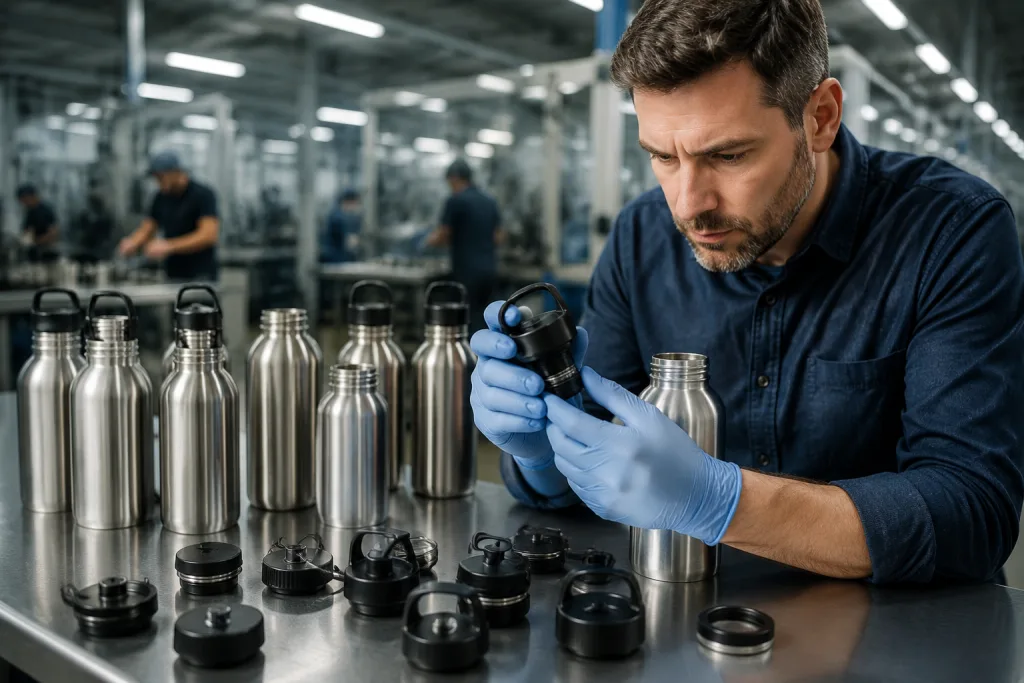
Coating chips ruin premium orders
A customized gym water bottle can pass every leak test and still feel cheap if the coating chips around the base after 7 days in use. Powder coating sells well on fitness bottles because it gives grip, hides fingerprints, and takes laser engraving cleanly. The problem usually starts before spraying. On our line, QC pulled samples with oil left near the bottom radius after the alkaline wash; poor blasting, 45-micron thin spots, or under-cured parts then turned into adhesion complaints.
Ask for coating thickness and adhesion test records, not just a nice photo. A typical powder coating thickness for stainless drinkware is 60-90 microns. Too thin, it scratches in a backpack. Too thick, threads bind, lid fit feels rough, and logo edges look fat. Cross-hatch adhesion testing, similar to ASTM D3359, is a practical factory check; we use a 1 mm cross-cut knife and 3M tape before packing approval. For higher-end custom fitness water bottle programs, add a drop test onto plywood or rubber mat from 80-100 cm, especially on the bottom edge.
Matte coatings look good in product photography, but hand oil shows fast. Gloss wipes clean. It also shows dents. Rubberized soft-touch coatings feel premium on day one and can go sticky by day 180 if the formula is poor. We have seen a buyer flag this after 300 showroom samples sat in a hot warehouse for 2 weeks, and the math does not work when the finish becomes the complaint. If your bottle will sit in gyms, cycling studios, or staff lockers, choose durability over a showroom finish.
Logo method matters too. Laser engraving is the most durable on powder-coated stainless steel because it removes the coating and exposes metal underneath. Silk screen printing costs less for multi-color graphics, but it needs the right ink and oven cure; our print room checks this with a MEK rub test after curing. Heat transfer can handle gradients, but abrasion resistance needs testing, especially around grip zones. For a custom logo shaker bottle used daily, we run laser for single-color logos and screen printing only when the artwork demands it.
For orders from China into Europe or North America, include packaging abrasion in your thinking. A bottle can leave Zhejiang looking perfect and arrive with rub marks if the individual bag is only 0.02 mm or the carton divider collapses under 18 kg. Specify polybag thickness, carton drop testing, and whether each bottle needs a paper sleeve or molded tray. We ship these weekly, and we have seen this go sideways from one small packing line change.
Capacity errors create retail problems
Capacity looks simple on a spec sheet: 500 ml, 750 ml, 1,000 ml, 24 oz, 32 oz. On the line, it is where arguments start. Factories sometimes quote brim-full capacity, buyers often think in usable fill, and end users measure under the thread line after the lid is fitted. QC pulled a 750 ml sample last month that only held 690 ml with the lid closed; the buyer flagged it because retail support was already getting “short bottle” complaints.
For a bulk sports water bottle program, define capacity as usable fill volume with the lid closed, or state brim capacity on the artwork if that is what the retail box uses. Europe needs clean milliliter claims. North America needs ounce claims that match the math. A 32 oz claim should land close to 946 ml usable volume, not come from a quick visual match with an older mold. We run this check with a 1 kg digital scale and a flat fill board before we release the PP sample.
This matters even more for a customizable shaker bottle. Protein users need headspace. If a shaker is sold as 700 ml but needs 120 ml of air space to shake without leaking, say that on the packaging or fill mark. Short sentence. Print it. We have seen this go sideways when a gym member fills to the top line, adds powder, shakes hard, then blames the cap when the vent spits foam.
Tooling changes capacity faster than people expect. Two bottles can look the same in a rendering, but a different shoulder radius or bottom dome can move usable volume by 30-60 ml; a vacuum plug change can do the same. Before mass production approval, weigh room-temperature water in the approved pre-production sample. One gram is approximately one milliliter, so the test is simple and hard to argue with. Our mold room marks this on the sample tag in black marker, because one PO typo of “750 ml” instead of “720 ml usable” is enough to create a retail mess.
For distributor fitness water bottle orders, carton dimensions matter too. A 1,000 ml bottle can push freight cost up fast if the carton count drops from 24 pcs to 12 pcs. At FOB Ningbo or FOB Shanghai, that shift can hit landed cost harder than a USD 0.20 unit price negotiation. Ask for packed carton size and gross weight before price comparison; we usually send the 5-layer carton data in mm plus kg after the packing test, not after the deposit.
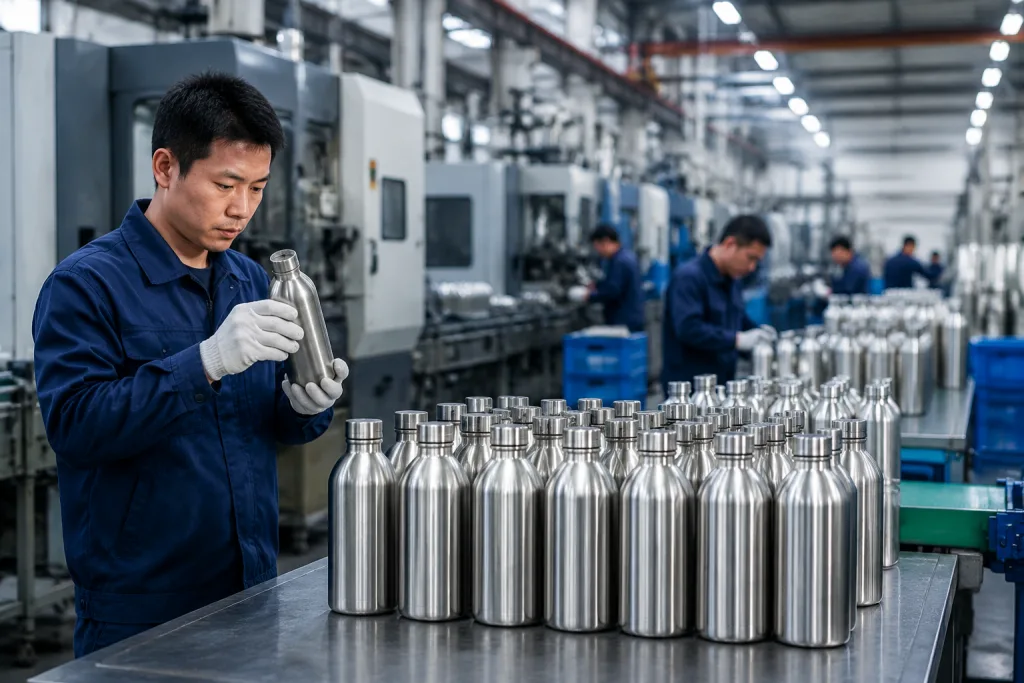
Compliance gaps show up late
Compliance feels boring until customs, Amazon, or a retail buyer asks for documents 2 days before launch. For a 316 stainless steel sports water bottle bulk project, lock the target market first. Europe and North America check different items, and gym chains often add their own supplier forms. Last month the buyer flagged a PO typo: “316 liner” written as “304 stainless” on page 2. Small line. Big problem.
For Europe, common requirements include food contact compliance, LFGB or EU food-grade testing depending on the buyer, REACH screening for coatings and components, plus packaging rules. For the United States, buyers may ask for FDA food contact statements, California Proposition 65 assessment, and sometimes ASTM-related testing if the bottle is sold for children or youth sports. Kids bottles are a different game. We run separate checks on the plastic lid, silicone straw, and printed logo ink because QC has seen ink migration questions hold a 3,000 pcs order at the carton stage.
Factory audits are separate from product tests. BSCI, Sedex, ISO 9001, or similar documents can support your vendor file, but they do not prove that the gasket in this production lot is compliant. Ask for test reports that match the material stack: stainless steel, plastic lid, silicone gasket, coating, ink, and packaging if needed. The report should show the applicant, model, material, and test date. A five-year-old generic report for “stainless bottle” is weak evidence; the math doesn't work when the lab report says PP lid but the line is packing Tritan lids measured at 28.5 mm thread diameter.
Amazon and other marketplace programs add another layer. If you are preparing a distributor shaker bottle or custom sports water bottle for FBA, you may need FNSKU labeling, suffocation warning on polybags, carton weight limits, and drop-test-ready packaging. None of this is hard. It just must be set before packing. We ship FBA cartons under the buyer’s 15 kg limit, and QC pulled the sample once because the FNSKU was 2 mm too close to the carton seam.
Our practical rule in Zhejiang is simple: freeze compliance requirements before sample approval. If a buyer adds LFGB, Prop 65, and FNSKU labeling after production, the project can lose 7-14 days. We’ve seen this go sideways: finished bottles sat in our Hangzhou warehouse for 9 days while new polybags were printed with the suffocation warning. For seasonal gym campaigns, that delay costs more than doing the paperwork correctly at the start.
How to write the PO
I’ll rewrite the section in-place, keep the HTML exactly as-is, and make the wording sound like a factory-side sales engineer wrote it.A purchase order for a customized fitness water bottle is not there for decoration. Every missing line becomes a factory choice, and the line will pick the cheapest safe option unless you stop it. We’ve seen that go sideways on a 27 mm lid gasket.
Start with the build: capacity, dimensions, wall thickness, steel grade for each part, lid material, gasket material, coating type, logo method, and packing style. Then add the checks: leak test method, coating adhesion, vacuum retention if it is insulated, drop test, dishwasher claim if you want one, and logo abrasion resistance. If you need a custom logo shaker bottle, state the shaker ball material, ball diameter, and whether it goes inside the bottle or in a separate bag.
Set the inspection rules in the PO. A normal final random inspection can use ANSI/ASQ Z1.4, general inspection level II, with AQL 2.5 for major defects and 4.0 for minor defects. For leakage, odor, sharp edges, wrong material, and wrong logo, we treat them as major or critical based on the sales channel. If the bottle is for a premium gym chain, a retail scratch is not a minor issue just because the unit price is low. QC pulled the sample last week and flagged a lid print shift of 1.5 mm; that kind of miss belongs in the PO, not in the warehouse argument later.
For timing, our China line usually needs 7-10 days for artwork and PP sample after details are locked, then 25-35 days for mass production after sample approval and deposit. MOQ is usually 1,000 pcs per color for standard molds and 3,000-5,000 pcs when you want a custom lid color, special coating, or private packaging. New mold work can add 30-45 days. The buyer often asks for 800 pcs and a new cap color at the same time; the math does not work.
Finish with Incoterms. FOB Ningbo is common for our Hangzhou factory, but DDP makes more sense for smaller gym chain buyers without an import team. Do not compare FOB and DDP as if the prices mean the same thing. A clean PO, approved sample, and a real inspection plan will not make the bottle indestructible, but it cuts the usual mistakes before they leave China.
Send your bottle spec before quoting factories
Share capacity, logo, target market, and quantity. We will check the weak points and quote a production-ready 316 sports bottle.
Frequently asked questions
Is 316 stainless steel worth the extra cost for gym bottles?
For normal water only, 304 stainless steel is often acceptable. For a 316 stainless steel sports water bottle bulk order aimed at gyms, protein shakes, electrolyte mixes, and citrus drinks, 316 is the safer specification for liquid-contact metal parts. The molybdenum content improves corrosion resistance, especially around welds and seams. Expect 316 material to add roughly USD 0.25-0.80 per unit depending on bottle size, wall thickness, and whether only the inner liner or the full body uses 316. If your bottle will be a paid retail item or member welcome kit, the upgrade is easier to justify than dealing with rust complaints later.
What MOQ should a fitness brand expect for custom sports bottles?
For standard molds, a practical MOQ is usually 1,000 pcs per color and logo. If you need a custom lid color, special powder coating, private carton, or a custom made shaker bottle component, MOQ often moves to 3,000 pcs or more. Fully new tooling is a different project and may require 5,000-10,000 pcs to make economic sense. A distributor sports water bottle buyer can reduce risk by starting with a standard 750 ml or 1,000 ml mold, then customizing coating, logo, and packaging. That gives you a branded product without locking cash into tooling before demand is proven.
Which logo method lasts longest on a bulk gym water bottle?
For stainless steel sports bottles with powder coating, laser engraving is usually the most durable option. It removes the coating and exposes the metal, so it does not peel like ink. The tradeoff is that laser is normally one color: the metal tone underneath. Silk screen printing works for one to three solid colors and can look sharp, but you should test abrasion and dishwasher exposure if you plan to make cleaning claims. Heat transfer supports complex graphics, gradients, and large wraps, but it is more sensitive to surface preparation. For daily gym use, choose laser unless brand artwork requires color.
How do we prevent leaks in a custom shaker bottle?
Treat the lid as an engineered part, not an accessory. Specify food-grade silicone gasket, lid resin, thread design, and a leak test. A good production test fills the bottle, inverts it for 10 minutes, and shakes it for 30 seconds. For a custom shaker bottle, add warm water at about 50°C because internal pressure makes weak seals show up faster. During final inspection, leakage should be a major defect with AQL 1.0 or tighter for serious programs. Also approve the pre-production sample after real shaking with protein powder, not just water, because powder residue affects closure and cleaning.
What lead time is realistic for a customized sports water bottle order?
If you use an existing mold and standard color options, plan around 7-10 days for artwork, sample arrangement, and PP sample approval, then 25-35 days for mass production after deposit. Add 5-10 days if you need special coating colors, retail packaging, or third-party lab testing. Sea freight to Europe or North America may add 25-40 days depending on route and season. For a fixed gym opening, event, or franchise campaign, work backward from the in-hand date and leave at least 10 days of buffer for inspection, repacking, or documentation issues.