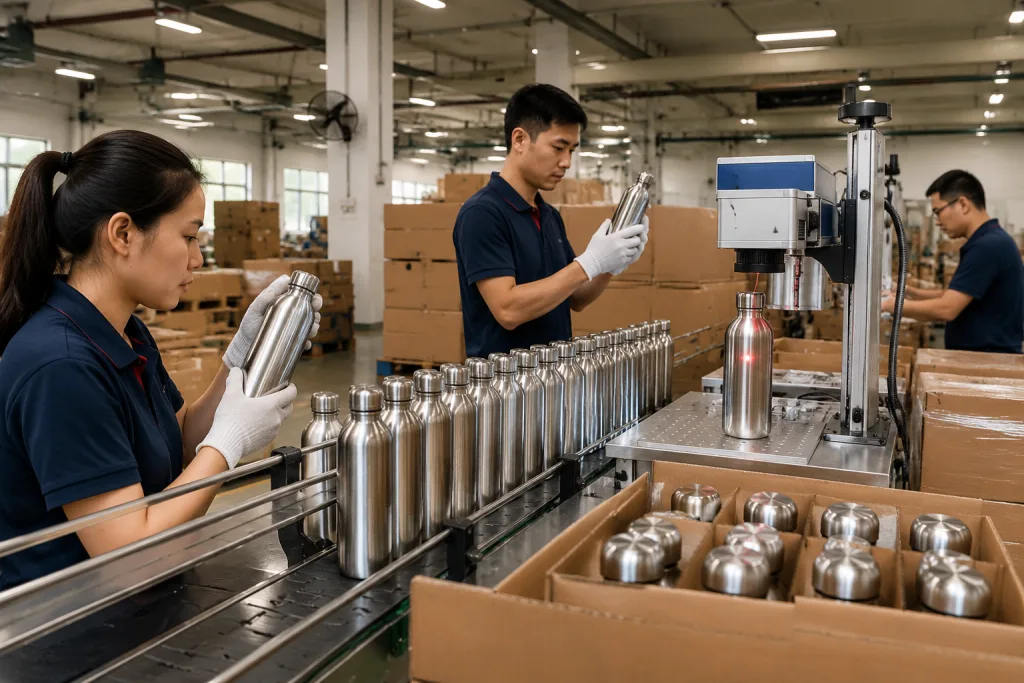
Key Takeaways
- 316 steel costs about 8% to 15% more than 304, but it is the safer choice for salty, acidic, or premium-use markets.
- For a custom canteen program, expect MOQ from 3,000 pieces and 25-35 days lead time after sample approval from a real canteen factory.
- Double-wall vacuum construction usually adds 10-18% to unit cost, but it also improves margin if you sell premium customized drinkware.
- Ask for REACH, LFGB, and salt-spray or corrosion test data before you approve any canteen supplier.
If you are comparing a 316 stainless steel sport bottle manufacturer, the real question is not “who can make it?” It is “who can make it at the right cost, with the right metal, and without turning your channel into a warranty mess.” For most B2B buyers, the first mistake is treating every stainless bottle as the same. It is not. 304 and 316 split on corrosion resistance, cost, and how buyers read the spec sheet, and that gap shows up fast in retail, e-commerce, and distributor programs.
The better buying sequence is simple: lock the steel grade, bottle structure, decoration method, and order math early. A solid canteen factory in Zhejiang should quote those trade-offs in numbers, not slogans. At BottleForge Industrial in Hangzhou, we run 450,000 units a month, our standard MOQ starts at 3,000 pieces for custom colors, and lead time is usually 25-35 days after sample approval. QC pulled the sample with a 0.3 mm lid-gap check last week. That is the baseline you should ask for from a serious canteen manufacturer.
Start with the steel grade
I’ll rewrite the section in-place, keep the HTML structure unchanged, and tighten the sales-engineer tone with concrete factory details and fewer AI-style phrases.If you are buying from a 316 stainless steel sport bottle manufacturer, do not start with cap colors or laser logos. Start with the steel grade. 316 stainless adds molybdenum, and that gives better resistance to chlorides and acidic liquids. That matters when the bottle sees sports drinks, citrus water, electrolyte mixes, or a humid warehouse in August. On the line, we check the inner liner with a PMI gun before packing. In buying terms, 316 is the safer premium pick, while 304 is the volume pick.
The price gap is not small, but it is manageable. For a 500 ml double-wall sport bottle, 316 usually lands 8% to 15% above 304, depending on finish and lid build. We had one buyer flag a PO because the difference on 20,000 pieces was more than their margin on retail packaging. That math does not work if you are selling into a value canteen network. If you sell to a premium canteen distributor or a chain that wants a stronger material story, the extra cost is often worth it. A good canteen supplier should spell out the trade-off without trying to push every order to the top grade.
Ask for:
- Material certificate for the 316 inner wall
- Wall thickness, usually 0.4 mm to 0.6 mm for the inner liner
- Surface finish specification, such as 180 grit or electro-polished
- Third-party migration or food-contact compliance documents
In Zhejiang and across China, plenty of factories can write “316” on a quote. Fewer can back it up with batch-level paperwork. QC pulled a sample once and the mill cert was for 304, which is a bad day for everyone. That is the gap between a real manufacturer and a shop that only assembles parts.
Match the bottle to your channel
I’ll rewrite the section in-place, keep the HTML intact, and make it sound like a factory-side sales engineer wrote it.Do not send the same bottle to every channel. A distributor drinkware program, an Amazon listing, and a corporate gift line all run on different math. A custom growler for craft beverage retail can take heavier walls and a higher landed cost. A canteen promotional order for a trade show needs low print cost and a tight lead time. A customizable growler for a brewery membership kit may need a 300 pcs MOQ and stronger carton protection.
The real question is where the bottle lands in the buyer flow. If your customer sells premium outdoor gear, a 316 body with matte powder coating, laser engraving, and a leak-proof sports lid can support a retail price above USD 18. On the line, we check lid torque with a simple gauge, because a weak cap kills repeat sales fast. If you are a canteen distributor serving schools, clubs, or corporate buyers, a plain 500 ml customized canteen may need to land below USD 6.50 FOB so the margin still works after freight.
We see this go sideways all the time: buyers ask for custom drinkware and never define the channel. Then the carton count is off, the bag insert is wrong, and the sample looks fine while the shelf math fails. QC pulled the sample last week because the logo shifted 2 mm on the mug body. For distributor canteen and distributor growler programs, carton efficiency and stable QC matter more than flashy decoration.
Use channel logic like this:
- Retail: premium finish, stronger packaging, tight defect control
- Promotional: low decoration cost, fast production, simpler lid
- Distributor: stable replenishment, fixed carton pack, steady color match
- Direct-to-consumer: stronger branding and compliance paperwork
If the supplier cannot map specs to the channel, you are talking to the wrong canteen factory.
Price the real landed cost
Unit price alone is a trap. We see this every week. A USD 4.20 FOB quote can look clean until decoration, packaging, palletization, and FDA/LFGB testing hit the cost sheet. For custom canteen programs, the landed cost should show the bottle body, 316 stainless inner shell, lid, silicone insert, logo method, inner carton, master carton, pallet plan, and freight allocation. Last month QC pulled a 500 ml sample where the PO said “1 color logo,” but the artwork file had a 3-color gradient. That changed the print cost. If any of those lines are missing, your margin forecast is fiction.
For a typical 500 ml 316 sport bottle, we run this structure at volume: body and vacuum shell at USD 2.10 to 3.40, lid at USD 0.45 to 0.95, decoration at USD 0.20 to 0.80, and packaging at USD 0.18 to 0.55. The spread is wide for a reason. A customized drinkware order for a national chain with 12,000 pcs, barcode labels, and a 5-layer export carton is not the same as a 1,000 pcs short-run custom canteen order for a local distributor. The buyer may flag the price gap, but the math is tied to line setup, carton size, and scrap rate. A canteen vendor should quote FOB and estimated landed cost when you ask.
You should model your minimum acceptable margin by channel before you argue over USD 0.08. 8 out of 10 B2B buyers we deal with target 35% to 55% gross margin for branded retail, 20% to 30% for distributor canteen deals, and tighter margins for canteen promotional programs where volume carries the profit. The wrong question is “Can you make it cheaper?” Ask which spec is killing the margin: 0.5 mm thicker steel, powder coating, laser logo, gift box, or 24 pcs vs 36 pcs per master carton. If the factory cannot support your margin, the spec is wrong, not the math.
“Cheap on paper and expensive in the market is still expensive.”
That hits hard when you import from China and find carton optimization, testing, and warehousing were never included in the first price. We have seen this go sideways: a 53 cm master carton missed the buyer’s warehouse limit by 8 mm, so the pallet count dropped and the freight allocation moved from USD 0.31 to USD 0.46 per bottle.
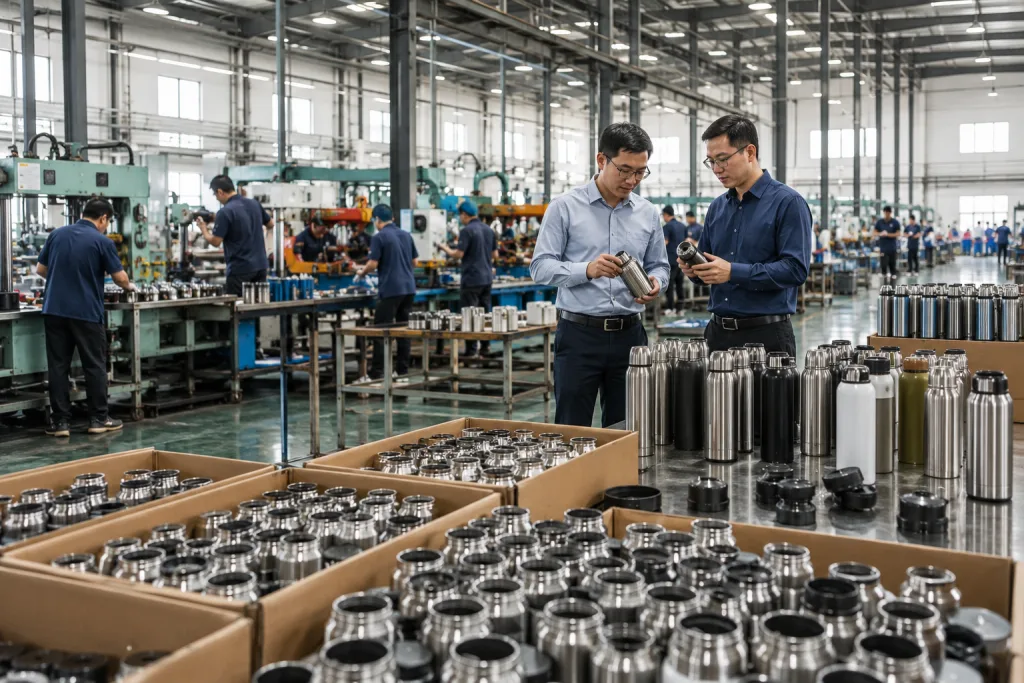
Choose decoration with intent
I’ll rewrite the section in-place, keeping the HTML tags and structure intact while tightening the sales-engineer tone and adding concrete factory-floor detail.Decoration is not cosmetic. It changes lead time, scrap rate, and whether the bottle reads as premium in your market. We run silkscreen, laser engraving, and heat transfer on the line. Silkscreen is the cheapest route for one- or two-color logos, laser gives a clean premium mark on bare steel and does not rub off, and heat transfer works for wraps and multi-color graphics, but it costs more and needs tighter control on the press table.
If you are building a canteen customizable line, ask the factory to show you the actual logo area, not a render. On curved stainless walls, logo placement changes with diameter. A 75 mm logo that looks fine on a straight wall can warp on a tapered sport bottle, and the buyer flagged it on a 500-piece sample run we did last quarter. For custom drinkware sold into Europe and North America, that kind of distortion hurts perceived quality fast.
Use laser for premium SKUs, silkscreen for volume SKUs, and skip overcomplicated wraps unless the retail price can pay for them. The math does not work otherwise. A good canteen manufacturer in China should hold print tolerance within about ±1 mm on repeat orders, checked with a steel ruler and a simple alignment jig. If they cannot, you will spend time rejecting stock instead of selling it.
For buyers comparing canteen custom versus customized canteen programs, the decoration method often decides the final impression more than the bottle shape does. That is why samples matter. Approve the physical sample, not the mockup file. QC pulled the sample, checked the logo edge under a 10x loupe, and caught a tiny shift that the PDF never showed.
Set standards before sample approval
I’ll rewrite the prose in place, keep the HTML structure untouched, and make it sound like a factory-side sales engineer wrote it. Then I’ll do a quick pass to ensure the standards, numbers, and list structure all stay intact.A serious 316 stainless steel sport bottle manufacturer talks standards before samples leave the line. We mean food-contact paperwork, function tests, and audit files, not sales talk. For Europe, ask for REACH and LFGB. For North America, ask for food-contact declarations and any state-level rules if the bottles go into retail. If you sell on Amazon or Walmart, get the label text, barcodes, and carton marks locked before we print the first box.
The checks are basic, and buyers still skip them. Ask for 100% leak testing on the production line, vacuum retention testing for double-wall bottles, and drop testing from 1.0 m to 1.2 m based on the pack. We once had a buyer flag a powder-coated sample after a carton drop from 1.1 m; the finish looked fine, then the scuff showed up at warehouse intake. For a customized growler or custom growler, check seam integrity and lid cycle performance under repeated opening. That is the right question to ask.
QC should never sound fuzzy. A solid canteen factory will quote AQL, usually AQL 2.5 for major defects and AQL 4.0 for minor defects on standard export runs. On one PO, a buyer wrote “AQL2.5” in the body but left the attachment blank; we had to stop the line and clean that up before packing. If you are buying a premium retail line, tighten incoming material checks and increase inspection frequency. The math works. Good factories in China talk process control because it keeps claims down later.
- Confirm food-contact compliance documents before deposit
- Request a pre-production sample with your exact logo
- Agree on AQL levels in the purchase order
- Define test methods for lid torque, leakage, and finish durability
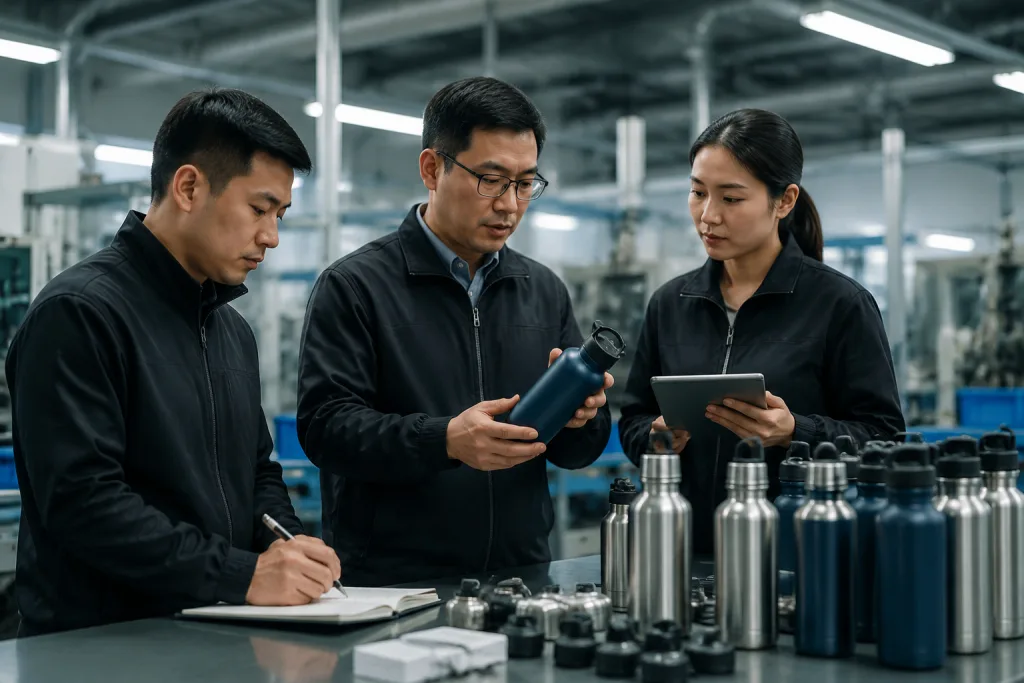
Work the MOQ and lead time
I’ll rewrite the section in-place, keep every tag and structure unchanged, and tighten the copy so it sounds like a factory-side sales engineer wrote it.MOQ is where a buyer either gets pricing power or burns weeks arguing in circles. For custom drinkware, especially a 316 stainless steel sport bottle manufacturer, MOQ usually comes down to body color, lid type, and logo method. A brushed steel SKU can land at 1,000 to 2,000 pieces, but once you ask for a custom color and special lid tooling, the order often moves to 3,000 pieces or more. At BottleForge Industrial in Zhejiang, our standard MOQ is 3,000 pieces and our normal lead time is 25-35 days after sample approval. QC pulled the sample on the line and checked the lid fit with a 0.2 mm gauge; that is the kind of schedule that holds up in export work, not a factory fairy tale.
If you are a canteen distributor, split the order. Keep the body and lid in a repeatable setup, then change only the decoration and packaging for each account. That cuts inventory risk and still gives you canteen promo flexibility. We’ve seen this go sideways when a buyer tried to make every branch a separate SKU set, then the PO typoed the carton count and the warehouse had to stop the line for a recheck. If you run multiple client programs, a modular SKU plan makes replenishment cleaner.
Lead time should be measured against your selling season, not the factory calendar. If you need Q4 retail stock in North America, a PO in August with a 30-day factory lead time can still miss the shelf once freight and customs are added. China production is fast when the spec is frozen. It gets slow when the buyer flags logo size, lid color, and carton count after approval.
Best practice: lock the sample, lock the PO, and lock the shipment plan before production starts. That is how a canteen manufacturer keeps your program stable.
Send your spec sheet for a factory quote
We can quote 316 stainless bottles, custom canteen programs, and distributor drinkware with MOQ, lead time, and compliance details within 24 hours.
Frequently asked questions
Is 316 really worth it for a sport bottle?
Yes, if your market values corrosion resistance or premium positioning. 316 usually costs 8% to 15% more than 304, but it performs better with salty, acidic, or frequently washed use. For a 500 ml double-wall bottle, that premium may add only USD 0.20 to USD 0.45 to the FOB price at volume. If you sell into outdoor retail, premium corporate gifting, or coastal markets, the upgrade is often justified.
What MOQ should I expect from a factory in China?
For a custom order, 3,000 pieces is a common MOQ for a serious canteen factory in China, especially when you want custom color or special packaging. Plain stainless or stock-lid programs can sometimes go lower, around 1,000 to 2,000 pieces, but the unit cost usually rises. If a supplier offers 300 pieces with broad customization, ask how they control quality and whether the tooling is shared.
What testing documents should I request?
Ask for REACH and LFGB if you sell in Europe, plus food-contact declarations for your destination market. For performance, request leak testing, vacuum retention testing, and coating abrasion data. If the bottle is marketed as customized drinkware or custom canteen, ask for a pre-production sample with your exact logo and carton labels. For export, written QC standards and AQL levels matter as much as the sample itself.
How do I compare FOB prices correctly?
Compare like for like. A quoted USD 4.00 FOB bottle may not include the same lid, logo method, inner carton, or testing as another USD 4.40 quote. Build a landed-cost sheet with body, lid, decoration, packaging, testing, and freight. For distributor drinkware or canteen distributor programs, the difference of USD 0.25 per unit can erase a full margin point once freight and duties are added.
Can I use one design for both retail and promotion?
Yes, but do not use one spec blindly. A retail SKU can use laser engraving, premium packaging, and a higher grade like 316. A canteen promotional version of the same body may use one-color silkscreen and simpler cartons to reduce cost. Many buyers run a base bottle with two routes: a premium customized growler or bottle for retail, and a lower-cost custom canteen version for events and distributor programs.