Key Takeaways
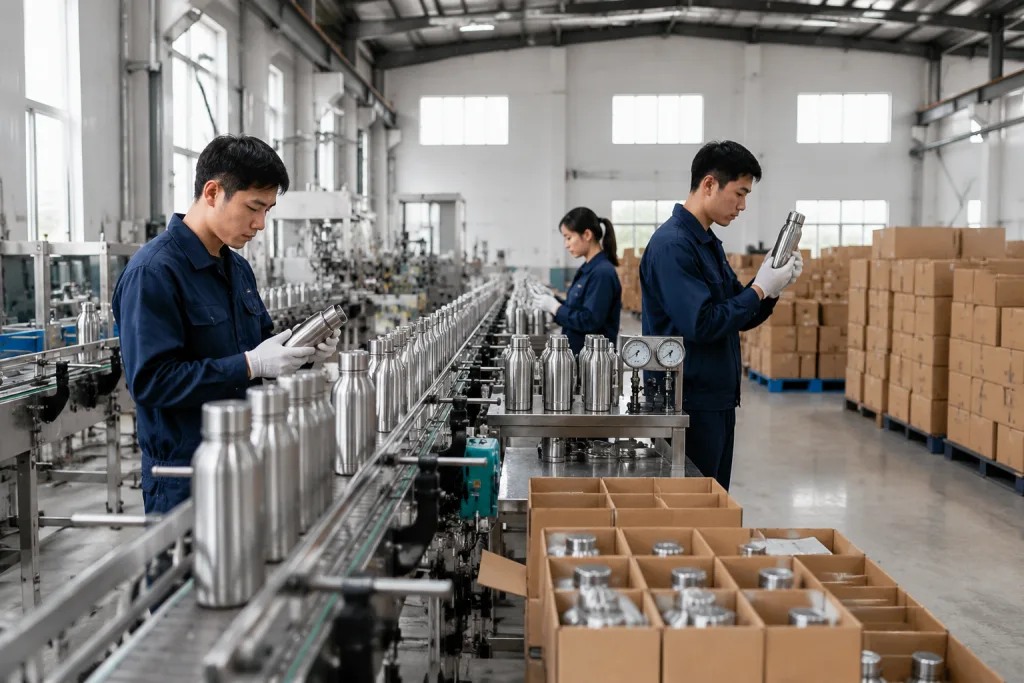
- Typical MOQ for 316 stainless steel bottle projects starts at 1,000 units, with sample lead time around 7-10 days
- FOB China pricing for standard 500-750 ml 316 bottles often lands around USD 3.20-6.80 depending on lid, finish, and decoration
- For export, ask for EN 1811, REACH, LFGB, FDA, and an internal corrosion or salt-spray protocol, not just a material claim
- A factory in Zhejiang producing 200,000+ units per month can still miss specs if it cannot show gauge, weld, and passivation control
If you are buying a 316 stainless steel reusable water bottle wholesale, the hard part is not finding a supplier. The hard part is telling real corrosion resistance from brochure talk, and deciding whether the extra cost actually pays back in your market. In Zhejiang, we run into this every week: a factory will quote 304 and 316 in the same morning, but only a few can show heat numbers, mill certs, and a sample that QC pulled after 72-hour salt spray. That is the gap.
For procurement managers and brand owners, the purchase usually comes down to three questions: do you need 316 for sweat, brine, or acidic drinks, what MOQ makes the math work, and how do you avoid a carton that passes the PO but fails dishwasher cycles or packaging inspection? We have seen buyers flag a missing `316` callout on the artwork and then the line has to stop for a reprint. Below, I’ll answer the questions buyers ask most often and give you a practical checklist you can use with any factory in China or elsewhere.
When 316 is worth paying for
I’ll rewrite the section in place, keep the HTML exactly as-is, and tighten the sales-engineer voice with concrete sourcing details.The first buyer question is plain: do you need 316, or will 304 do the job? For everyday hydration, 304 is enough. It costs less, we source it faster, and it fits most retail and corporate runs. 316 earns its keep when the bottle lives in salty air, sees sports drinks with electrolytes, gets pushed into medical-adjacent branding, or has to carry a durability story for 3 to 5 years.
316 has molybdenum, so it holds up better against chloride corrosion. That matters near the sea, with acidic drinks, and on bottles that get washed hard every day. It still fails if the seam is sloppy, the wall is too thin, or passivation is skipped. We’ve seen this go sideways on the line. If a supplier cannot tell you the body thickness, usually 0.4-0.6 mm for most premium bottles, and the lid material grade, the 316 claim is weak.
On procurement, the 316 premium over 304 is usually 10%-25% on the body, and it climbs if you add a brushed finish, powder coat, or custom box. A buyer once flagged a PO typo that turned a simple gift set into a margin mess; the math does not work if the spec drifts. For premium retail, executive gifting, and marine or outdoor channels, that extra spend is often justified. For bulk drinkware in a price-sensitive program, 304 is the cleaner commercial call.
Ask for the material proof
I’ll rewrite the section in-place, keeping the HTML structure and tightening the copy so it sounds like a factory-side sales engineer, not generic AI prose.Do not take “316 stainless steel” at face value on a quote sheet. Ask for the mill certificate, the material spec, and a photo trail of the incoming coil or sheet labels. We run this check on the line with a barcode scanner and batch card. If the seller cannot match the finished bottle to one raw-material lot, you do not control the supply chain.
For export, I ask for these papers before PO release:
- Material certificate showing 316 or 316L composition
- REACH declaration for the finished bottle and decoration inks
- Food contact declaration matched to FDA or LFGB, based on the destination
- Internal QC record for wall thickness, weld integrity, and leak test
- Salt-spray or corrosion test summary if the bottle is sold as premium outdoor drinkware
Most Zhejiang factories can send these in 2-3 working days. If the reply is slow, vague, or the batch number keeps changing, the buyer flagged it for a reason. That is usually a trading-layer quote, not a factory-backed offer, and the math does not work once the cargo is on the water.
Pricing, MOQ, and lead times
Most buyers ask for price first. Fair enough. For a standard 500-750 ml vacuum bottle in 316 stainless steel, FOB China pricing sits around USD 3.20-6.80 per unit at 1,000-3,000 pieces. Simple matte powder coat with a one-color logo lands near USD 3.20-4.10 when we run an existing body and lid set. Double-wall vacuum construction, laser engraving, premium lids, or gift-box packaging pushes the quote into the upper band. A custom-shaped cap or extra accessories can add USD 0.35-0.90, especially if the line needs a new PP injection mold or a separate silicone ring color.
A workable MOQ for a custom 316 project is 1,000 units, though 3 factories in Zhejiang might quote 500 units when the body size already matches their mold rack. Sample lead time is 7-10 days. Mass production is commonly 25-35 days after sample approval and deposit, assuming no new tooling. If the project needs new molding, add 15-25 days. For retail launch orders, add at least 7 days for carton drop tests, barcode checks, and FNSKU or SKU label validation; we had QC pull one carton last month because the PO said 7.5 cm barcode placement and the artwork showed 75 mm on the wrong panel.
Be careful with “cheap” quotes under USD 3.00 for full 316 vacuum bottles. We’ve seen this go sideways. The math does not work unless something is cut: thinner body gauge, cheaper lid parts, weaker powder coating, or a downgraded color box that looks flat under store lighting. One buyer flagged a sample at 286 g when the approved bottle was 318 g, and the difference was not magic—it was less steel.
Build the right spec sheet
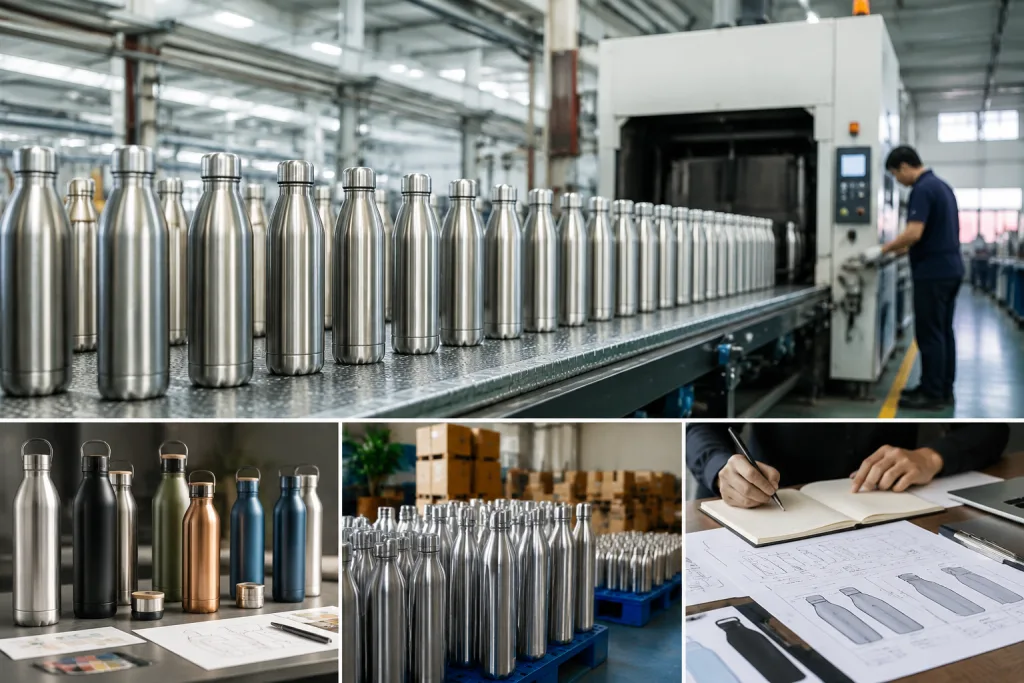
I’ll rewrite the prose in place, keep the HTML structure intact, and make it read like a factory-side sales engineer wrote it.A clean spec sheet saves more money than hard bargaining. We see it on the line all the time. A bottle should never be defined by capacity and color alone. Write it like a production engineer would: body diameter, height, neck finish, wall thickness, vacuum layer, lid type, gasket material, coating method, logo method, and packaging standard. If you order 6 SKUs under one program, this is where the buyer flags the wrong lid or the wrong carton.
Use a checklist like this:
- Capacity: 350 ml, 500 ml, 750 ml, or 1,000 ml
- Body thickness: 0.4 mm, 0.5 mm, or 0.6 mm
- Surface: brushed, mirror polished, powder coated, or color spray
- Decoration: silk screen, laser engraving, or UV print
- Lid: screw lid, carry lid, sport lid, or straw lid
- Package: retail box, mailer box, or bulk carton
If your program goes beyond bottles, keep the same discipline for bulk canteen, canteen bulk, canteen wholesale, bulk drinkware, wholesale drinkware, or bulk growler and wholesale growler orders. The category changes. The math does not. We once fixed a PO where the buyer typed 500 ml but the drawing showed 550 ml; QC pulled the sample and the mismatch was obvious. That kind of typo burns time at re-order, and it is the wrong question to ask if the spec sheet is already loose.
Quality checks that matter
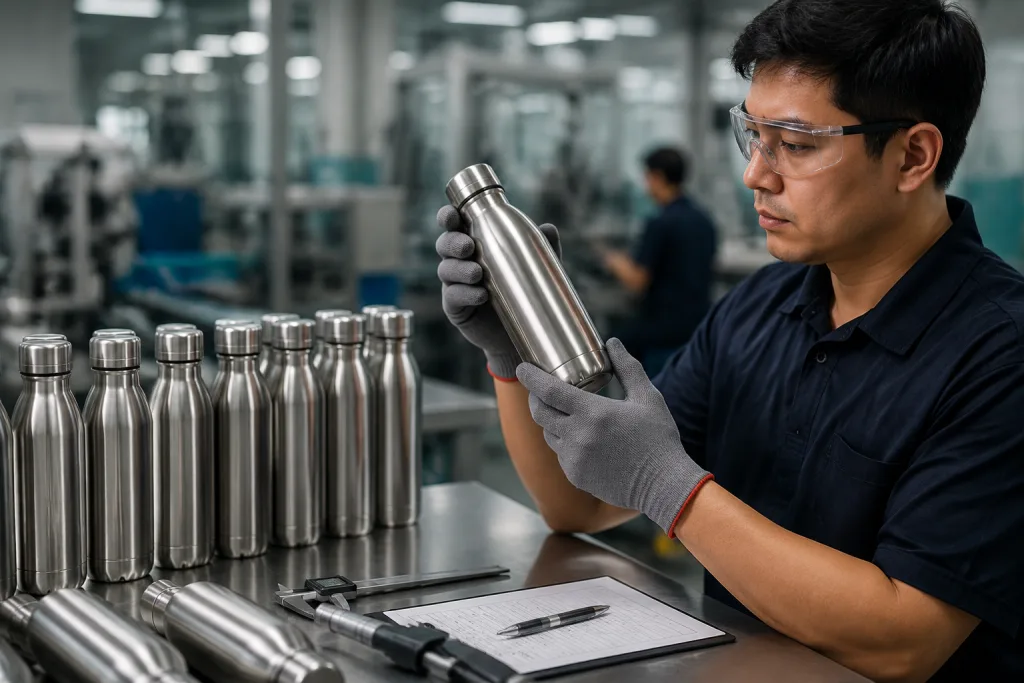
I’ll keep the HTML tags intact and rewrite the three paragraphs with more factory-floor detail, tighter language, and no AI filler.Good-looking samples can hide weak line control. For 316 stainless steel reusable water bottle wholesale runs, the checks that matter are plain and ruthless. We run a leak test on every sample, check lid torque with a torque meter, inspect weld seams under a light box, and look for pinholes after vacuum forming. QC pulled one sample last month that smelled metallic after 80°C hot water; that bottle failed before packing. If you ship to Europe or North America, add drop tests and dishwasher-cycle checks where the channel needs them.
Ask for an AQL plan from day one. For export drinkware, AQL 2.5 for major defects and 4.0 for minor defects is a common baseline. If your brand sits at the premium end, tighten it. A mirror finish that shows one scratch at 30 cm is a reject; a matte cup can take a little more cosmetic variation. This is not nitpicking. One bad carton can sink a launch, and the math does not work.
Ask about passivation after welding and how they clean the inner surface to remove oil residue. If the salesperson cannot explain the line clearly, the factory is selling a story, not a controlled run. We’ve seen that go sideways. A Hangzhou plant shipping 200,000-300,000 units a month should answer QC questions without blinking, and they should be able to show you the swab test record, not just talk about it.
Packaging, labeling, and export details
I’ll rewrite the section in-place, keeping the HTML tags and the list structure unchanged while tightening the sales tone and adding a few factory-floor specifics.Packaging mistakes get expensive because they show up late. For wholesale drinkware and drinkware bulk orders, lock carton strength, inner pack protection, and barcode placement before production starts. We had a buyer flag a 2 mm carton gap after pre-production, and the line had to rework the insert. If you sell through Amazon, ask the factory to print or apply FNSKU labels cleanly and keep polybag suffocation warnings in the right spot where required. If the bottles are retail-ready, confirm the master carton passes the drop standard your forwarder wants.
Brand owners often miss the packaging cost on a 316 bottle. A plain kraft box may add USD 0.18-0.45 per unit. A full-color retail box with insert, instruction sheet, and barcode label can add USD 0.60-1.20. The math is straightforward. If you are building a premium line, that spend is justified. If your channel is promotional or wholesale, keep the pack simple and put the money into the bottle finish instead. QC pulled one sample with a scuffed lid in a carton test, and that was the real problem.
For international shipping, confirm carton count, gross weight, and pallet pattern before booking. Mixed SKUs create more errors than the bottle itself. We ship a lot of cartons at 12.4 kg gross, and one PO typo on carton count can throw the whole booking off. If you are also sourcing complementary lines such as beer growler bulk, beer growler wholesale, beer growler wholesale bulk, beer tumbler bulk, beer tumbler wholesale, alcohol flask bulk, alcohol flask wholesale, or alcohol flask wholesale bulk, keep each SKU’s carton label format consistent. That is the easy fix. Otherwise the warehouse will mix them on arrival.
How to choose a factory partner
I’ll rewrite the section in place, keeping the HTML structure intact and tightening the language so it sounds like a factory-side sales engineer.When you compare suppliers, do not stop at unit price. A solid 316 stainless steel reusable water bottle wholesale partner answers in plain language, gives a line-by-line quote, and spells out what is included and what is not. If a factory in China gives you a low number but leaves out the lid, logo, carton, or export testing, the landed cost climbs fast. We have seen a PO show “bottle only” by mistake, and the buyer flagged it after the first sample. Ask for ex-factory photos, recent production records, and the exact monthly output they can hold for your model.
Three questions separate real suppliers from sales talk: What is your MOQ for this exact spec? What is your lead time after sample approval? What happens if the first run fails leak testing? A good supplier answers with numbers, not guesses. On our line, we track this with a 50 ml leak test setup and batch tags by shift. In Zhejiang, plenty of factories can do premium output, but not every line is built the same. The math does not work if the factory cannot repeat the same process for wholesale canteen, wholesale growler, and other bulk drinkware orders.
Good sourcing is not about chasing the cheapest quote in China. It is about finding the supplier who can repeat the same spec at the same quality on the third order and the fifth.
Send your spec sheet for a fast quote
Share capacity, finish, lid type, and target market. We’ll quote MOQ, lead time, and export-ready compliance for China supply.
Frequently asked questions
What is a normal MOQ for 316 stainless steel bottles?
For a custom 316 stainless steel reusable water bottle wholesale project, 1,000 units is the most common MOQ. Some Zhejiang factories can do 500 units if the bottle body, lid, and finish already exist. If you need new tooling, expect the MOQ to stay at 1,000-3,000 units. For sample orders, most suppliers can ship 1-5 pieces within 7-10 days. If a supplier promises 100 units with custom packaging and multi-color decoration, check the economics carefully; the setup cost usually gets buried in the unit price.
How much should I budget FOB China?
For a standard 500-750 ml 316 vacuum bottle, budget roughly USD 3.20-6.80 FOB China at 1,000-3,000 pieces. A basic logo and simple lid sit near the lower end. Powder coating, laser engraving, premium caps, and retail packaging can move the price above USD 6.00. If you are comparing offers for drinkware wholesale, make sure every supplier is quoting the same spec: wall thickness, finish, lid type, carton count, and test requirements. Otherwise the quote comparison is meaningless.
Do I need REACH, LFGB, and FDA all at once?
Not always, but for Europe and North America you should expect the supplier to support the relevant destination market requirements. REACH is important for chemical compliance in Europe. LFGB is often requested for German and EU food-contact confidence. FDA declarations are common for the US market. Ask for the finished product declaration, not just the steel certificate, because inks, coatings, gaskets, and adhesives also matter. A credible factory in China should provide these documents without drama.
How do I tell if the bottle is truly 316?
Ask for a mill certificate, material batch traceability, and incoming material photos. If possible, request a composition report showing molybdenum content consistent with 316 or 316L. You can also commission third-party verification for higher-value orders. Do not rely on a sales sheet alone. Many buyers in bulk drinkware, bulk canteen, or bulk growler sourcing have been burned by generic grade claims. The paperwork should connect the raw coil to the finished bottle and the PO number.
What lead time should I give my team?
For a standard run, plan 25-35 days after sample approval and deposit. If the order needs new tooling, add 15-25 days. If you are building a retail launch with custom cartons, FNSKU labels, and export QC, allow at least 45-60 days total from PO to ready cargo. Factories in Zhejiang can move quickly, but only if the artwork, spec sheet, and payment terms are settled early. If you are also placing beer growler wholesale bulk or alcohol flask wholesale bulk orders, consolidate schedules so the shipping plan stays efficient.