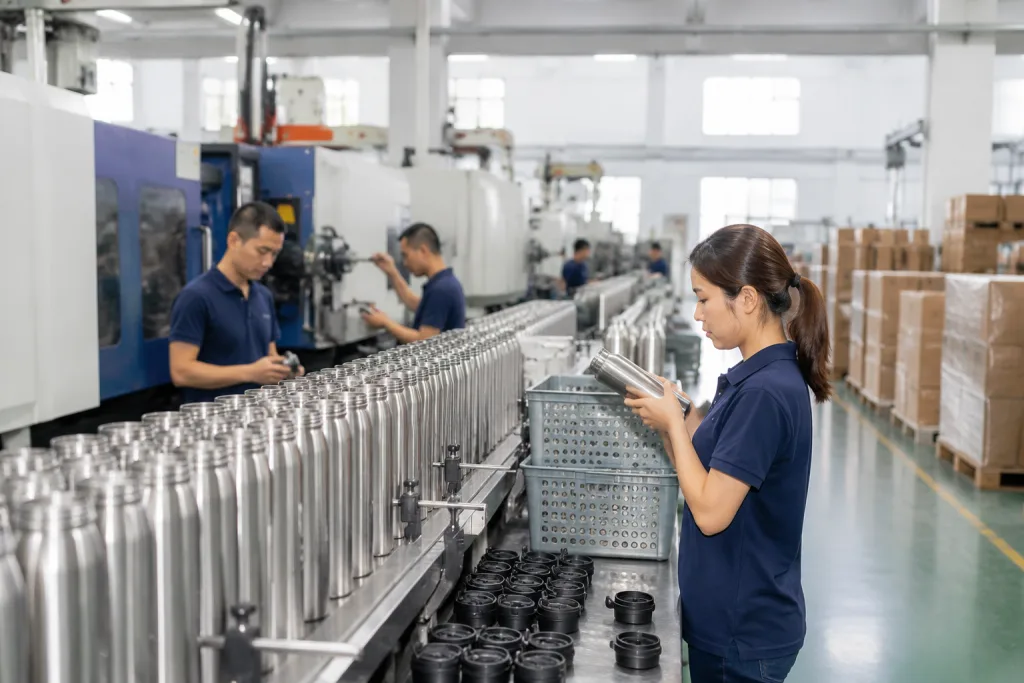
Key Takeaways
- 316 inner steel matters most on corrosion resistance; expect 0.4-0.6 mm wall thickness in a real production spec
- A practical MOQ is often 3,000 pieces per color, with 25-35 day lead time after sample approval
- For Europe and North America, ask for REACH, food-contact declarations, and an AQL 2.5/4.0 inspection plan
- A Zhejiang canteen factory should show monthly output of 300,000+ units if you need stable distributor volume
When you source from a 316 stainless steel polypropylene bottle factory, you are not buying a “bottle.” You are buying a spec stack: steel grade, plastic contact parts, sealing method, wall structure, decoration process, and whether the line can repeat the same result on 5,000 pieces without QC pulling half the sample tray. If one part slips, the bottle feels flimsy in hand, leaks in transit, or gets stuck on compliance paperwork in Europe or North America.
Smart buyers treat this as procurement, not styling. In Zhejiang, where a lot of China’s drinkware capacity sits, the numbers do the talking: MOQ at 3,000 units, sample lead time at 7 days, mass production at 25-35 days, and monthly output that can cover distributor orders without the buyer flagging shortages every week. We’ve seen this go sideways when a PO typo changed the lid color code, so if you buy custom drinkware for retail, promotions, or private label, get the spec sheet locked before you talk about artwork.
Start with the material stack
I’ll rewrite the section in-place, keep the HTML structure intact, and tighten the language so it sounds like a factory-side sales engineer wrote it.The first line on the spec sheet is material stack, not branding. A real 316 stainless steel polypropylene bottle factory should tell you what touches liquid, what forms the lid, and what sits outside for grip or impact resistance. On a true 316 build, the inner liner is 316 stainless steel, usually 0.4-0.6 mm wall. The outer shell can also be stainless, or it can switch to polypropylene in the lid, base, handle, or carry ring. Buyers mix that up all the time. They see “316 bottle” and assume every part is 316. That is not how we run the line.
You care because 316 handles chloride better than 304. If your customer drinks in coastal cities, gyms, or on the road, it takes sweat, salt, and acidic drinks with less pitting. PP is common for lids because it is light, easy to mold, and keeps tooling cost down. QC pulled the sample last week and flagged a soft lid after a 95°C hot-fill test, so PP grade matters. Ask for food-contact grade PP, heat data, and the exact resin code for the color masterbatch. If the factory cannot break out each part, the math does not work.
- 316 inner liner: a better fit for premium custom canteen programs and harsher use
- PP lid parts: common for custom drinkware, but ask for food-contact proof and heat stability data
- Wall thickness: 0.4-0.6 mm is standard; thinner walls dent faster in transit
- Finish: matte spray hides fingerprints better than bright polish on the line
Read the lid like a leak test
I’ll rewrite the prose in place, keep the tags unchanged, and tighten the language to sound like a factory-side sales engineer.The lid is where most returns start. We have seen good steel pass and still fail on the closure because the seal geometry was off by a hair. Check for a silicone gasket, a threaded finish that bites cleanly in 1.5 to 2 turns, and a cap that seats without needing extra torque. On one PO, the buyer flagged a lid typo in the drawing, and QC pulled the sample to confirm the thread matched the neck. If you are buying a canteen customizable model for retail, test the lid with wet hands, gloves, and while walking. A lid that feels fine on the shelf can be a pain on the line.
For promotional orders, buyers usually want low-cost decoration and a simple lid. For distributor drinkware or a premium custom growler program, I would push for a tighter seal, more cycle testing, and a torque spec. Ask the factory to run at least 5,000 open-close cycles on the cap assembly and a 24-hour inverted leak test. We run this kind of check with a torque meter, and the math does not work if the answer stays vague. A canteen vendor that knows its closure system should be able to explain thread pitch, gasket material, and tolerance control without reaching for a catalog.
Buyers lose more money on closures than on steel. A lid failure on 10,000 units is not a minor defect; it is a logistics problem, a claims problem, and a brand problem.
Decoration changes your cost
I’ll rewrite the two paragraphs in a more factory-side voice, keep the HTML intact, and make the cost split sound like something we actually quote on the line.Once the base build is fixed, decoration decides both landed cost and how the product sells. Screen print is still the cheapest route for a canteen promo order, especially with 1-color or 2-color artwork. Laser engraving looks cleaner and holds up better, but it costs more and works best on bare steel. Powder coating or spray coating adds color, grip, and shelf appeal, and it also changes how the artwork sits on the surface. A good canteen factory should tell you which process matches your target channel, not just which one sounds fancy.
Here is the part buyers care about: for a distributor canteen program, simple printing often sits around USD 0.20-0.60 per piece, while laser can run higher depending on coverage and setup. Mold changes, new lid tools, and custom handles are different items. Those are tooling costs, not decoration. We had a buyer flag a PO that mixed up printing and lid tooling, and the math did not work. If the customer wants retail-ready customized drinkware, finish quality and edge consistency matter more than saving a few cents. For canteen manufacturers in China, especially in Zhejiang, the cleanest quotes separate tool cost, process cost, and packaging cost line by line. That saves a week of back-and-forth.
Size and capacity drive channel fit
I’ll keep the tags and structure intact, and rewrite the prose to sound like a factory-side sales engineer. Next I’m updating the paragraph wording and tightening the list with more concrete channel detail.Capacity is not decoration. It sets the buyer, the carton count, freight math, and the shelf price. A 500 ml canteen for office programs is a different stock keeping unit from a 1,000 ml custom growler for outdoor stores or brewery channels. Smaller bottles load tighter in cartons and move well in gift sets. Bigger ones give more perceived value, but they raise freight cost and breakage risk. If your channel is Amazon or DTC, unit size also drives FNSKU labeling, master carton layout, and warehouse cube cost.
For distributors, we tell them to pick size by channel behavior, not by what looks good on a render. A 600-750 ml bottle usually sells smoother in mainstream retail. A 1,000 ml model fits sports, hiking, and campus accounts. If you are a canteen distributor, ask the factory for gross weight, net weight, unit carton dimensions, and pallet count before sample approval. We once had a buyer flag a 12 g typo on the PO, and that small miss changed the freight quote. The math does not work if the 280 g sample turns into a 410 g production item, even when the print is perfect.
- 500-600 ml: office packs, gift sets, and lighter premium pricing
- 750 ml: core retail size for canteen suppliers and distributors
- 1,000 ml: outdoor, gym, and custom growler-style programs
- Packing data: confirm unit carton, master carton, and pallet count before sample sign-off
Check compliance before price
I’ll rewrite the two paragraphs in-place style, keep the HTML untouched, and make the compliance language sound like a factory-side sales engineer.Price means nothing if the paper trail dies at customs, marketplace review, or a retailer audit. For Europe and North America, ask for food-contact declarations, REACH files, and, where the buyer needs them, FDA-related material statements from the supply chain. If the bottle uses coatings, inks, or seals, those parts need the same check as the 316 stainless steel and polypropylene body. We’ve had a PO typo on a seal spec turn into a 3-day delay at the border. A Zhejiang factory that ships every week should already have the compliance file on the desk, not “after order confirmation.”
QC needs numbers, not slogans. Ask for AQL standards, not “QC checked.” For a normal shipment, AQL 2.5 for major defects and 4.0 for minor defects is a sensible base. If you are buying customized canteen or customized drinkware at scale, ask for drop-test criteria, thermal retention data, and leak testing by sample lot. QC pulled the sample on the line last month and found one cap gasket off by 0.3 mm; that’s the kind of miss that gets a buyer flagged. BSCI or a similar social audit helps retail accounts, but it does not replace product testing. The math doesn’t work if the factory cannot show records for what it ships.
Know the factory numbers
I’ll rewrite the section in-place, keep the HTML exactly as-is, and tighten the copy so it sounds like a factory sales engineer wrote it.Good sourcing starts with numbers, not promises. Ask for monthly output, tooling cycle time, and the reorder window in writing. For a 316 stainless steel polypropylene bottle factory in Zhejiang, a solid mid-size line usually runs 300,000 to 500,000 units a month across 2 to 4 production lines. MOQ often sits at 3,000 pieces per color or per design, sample lead time is about 7 days, and mass production usually lands at 25-35 days after sample approval and deposit. If your distributor wants a canteen launch in 18 days, the math does not work.
Then check how the factory handles mixed orders. Can it pack custom drinkware SKUs into one carton plan without messing up the count sheet? Can the line repeat canteen orders without opening the mold room again? Can it hold color match on a second batch six months later, with a tolerance tight enough that QC does not pull the sample at final check? If the answer is yes, you are dealing with a practical canteen supplier. If the answer is “we can try,” we have seen that go sideways. Zhejiang factories that ship well tend to answer straight, because the buyer flagged it before and nobody wants a PO typo or a missed rework.
Match the product to the channel
I’ll rewrite the section in-place, keep the HTML structure unchanged, and tune the prose to sound like a factory-side sales engineer.Every channel needs a different spec. A promotional canteen order for an event crew usually wants a lower unit cost, 7-day print, and plain polybag packing. A retail distributor cares about color hold, shelf impact, and a defect rate that stays under AQL 2.5. An outdoor brand selling a customizable growler asks for a hard seal, cleaner finish, and packaging that looks decent when the buyer opens the carton. A corporate buyer asking for customized canteen sets often needs gift boxes, insert cards, and barcode labels more than a lower sticker price.
This is where a lot of buyers burn weeks. They send the same bottle brief and expect it to work for three channels. That math does not work. A canteen vendor should steer you toward the right structure for the channel: double-wall vacuum, single-wall with sleeve, or a hybrid PP-lid build. If you are comparing canteen manufacturers, ask for channel-fit advice by use case. On the line, we have stopped specs that looked cheap on paper but failed in the buyer’s channel. That pushback is useful. A custom canteen that matches channel economics will usually outsell a nicer bottle with the wrong spec.
- Promotional: lowest unit cost, 1-color print, simple lid and bulk pack
- Retail: tighter defect control, stable finish, stronger carton presentation
- Outdoor: better seal, stronger handle, coating that holds up in transit
- Corporate gifting: box quality, branding, and perceived value matter more than raw material cost
Send your spec sheet and get a factory quote
We can review your target capacity, lid structure, compliance needs, and artwork so you get a cleaner quote from China, not a guess.
Frequently asked questions
What is the usual MOQ for a 316 stainless steel polypropylene bottle?
For most export-ready factories, MOQ starts around 3,000 pieces per color or per design. Some canteen manufacturers will accept 1,000 pieces for stock items, but custom tooling, lid changes, or special coating usually pushes it higher. If you need mixed SKUs, ask whether they can combine designs in one order. A stable canteen factory should also tell you sample lead time, which is often 5-7 days, and mass production, which is commonly 25-35 days after approval. Lower MOQ is possible, but it usually raises unit cost by 10-25%.
Is 316 steel worth it over 304 for custom drinkware?
Yes, if your use case involves more corrosion exposure, salty environments, or premium positioning. 316 contains molybdenum, which improves resistance to chlorides and some acids. For a custom canteen or custom growler used outdoors, in coastal regions, or in fitness channels, that extra resistance is useful. If you are selling simple promotional items, 304 may be enough, but 316 gives you a stronger sales story and fewer complaints in harsh-use markets. The cost difference is usually modest relative to the total finished bottle price.
How do I check if the polypropylene parts are export safe?
Ask for the exact PP resin grade, food-contact declaration, and any additive or colorant compliance documents. A good canteen supplier should provide material specs for lids, seals, and handles, not only the steel liner. For Europe, you want REACH-aligned documentation; for North America, ask for food-contact compliance statements and test references. Also check odor, heat resistance, and dishwasher tolerance if relevant. A PP lid that warps at 80-90°C can damage the whole product even if the steel body is excellent.
What inspection level should I request?
For standard consumer orders, AQL 2.5 for major defects and 4.0 for minor defects is common. If you are buying customized drinkware for retail or distributor channels, add leak tests, drop tests, and carton compression checks. For high-risk SKUs, you can tighten the plan to AQL 1.5 on critical features like sealing and print placement. A serious canteen manufacturer should be able to share an inspection checklist, not just a pass/fail summary.
Can a Zhejiang factory handle both small and large orders?
Yes, if the factory is set up properly. In Zhejiang, many established drinkware plants run a monthly output of 300,000 units or more across multiple lines, which lets them handle distributor drinkware reorders and promotional spikes. The key is whether they separate stock items from custom orders and whether they have enough finishing and packing capacity. If you are planning a canteen distributor program, ask for live capacity, lead time by order size, and whether they can hold color consistency across repeat batches.