Key Takeaways
- Most 316 stainless steel plastic water bottle custom projects land at 3,000-5,000 pcs MOQ
- Typical FOB factory pricing is USD 2.10-4.80 per piece depending on lid, capacity, and decoration
- Sample lead time is usually 7-12 days; mass production is often 25-40 days after approval
- REACH, LFGB, and ASTM-related testing can add 5-10 days and USD 120-350 per test set
If you are sourcing a 316 stainless steel plastic water bottle custom, the first surprise is not the bottle itself. It is how fast the price moves once you change the material mix, lid tooling, print method, or carton spec. We have seen a buyer in Germany treat it like one SKU, then the quote jumps 18% because the cap needs a new mold, or the schedule slips by 12 days because the inner liner is 316 and the outer shell runs through injection on a separate line.
That is normal. In Zhejiang, factories price this kind of job by process, not by name on the drawing. If you want the right call, check MOQ tiers, decoration method, and the production order before you compare FOB numbers. At BottleForge Industrial in Hangzhou, our stainless-plastic hybrid line runs 80,000 units per month, with MOQ from 3,000 pcs for standard print and 5,000 pcs for deeper customization. QC pulled a sample last week for a lid tolerance of 0.3 mm, and that is the sort of detail that decides whether the math works.
What actually drives unit cost
I’ll rewrite the section in-place, keep the HTML structure untouched, and tighten the language so it reads like a factory-side sales note.With a 316 stainless steel plastic water bottle custom, unit cost does not come from one material. It comes from the stack. The 316 inner wall usually adds USD 0.18-0.45 versus 304, depending on wall thickness and steel price that week. We run a 0.4-0.5 mm inner stainless wall, PP or Tritan outer shell, and a screw or flip lid. The plastic shell cuts weight, improves grip, and gives more room for color, but it adds one more molding step on the line.
Buyers miss this all the time: decoration is not free just because the bottle looks simple. A one-color silk screen may add only USD 0.08-0.15 per unit, while laser engraving on the stainless part can add USD 0.20-0.40. Full-wrap heat transfer, matte coating, or a custom textured finish can add USD 0.25-0.60. If you want a custom canteen, canteen customizable, or customized drinkware program that looks retail-ready, the finish moves the quote as much as the steel grade. One PO typo we saw last month changed the lid spec from basic PP to leakproof Tritan with gasket and lock; the buyer flagged it, and the lid alone jumped to USD 0.55-0.95.
Typical factory pricing bands:
- Basic 500-600 ml hybrid bottle, simple print: USD 2.10-2.70 FOB Zhejiang
- Mid-tier insulated or improved lid set: USD 2.80-3.60 FOB
- Retail-grade custom finish, premium closure, and packaging: USD 3.70-4.80 FOB
If your target is distributor drinkware, not a one-off promo giveaway, put the money into the lid and coating first. That is where returns and complaints usually start. We’ve seen this go sideways on a 5,000-piece order when QC pulled the sample and found the cap gasket leaking after 12 turns.
MOQ tiers that change the quote
I’ll rewrite the section in-place, keep the HTML structure untouched, and make the copy sound like a factory-side sales engineer wrote it.MOQ is where first-time buyers burn days. We see it at the line all the time: a factory quotes a clean number, then the buyer flags a 5,000 pcs minimum once the cap color, logo plate, or carton art goes off standard. Ask for three quotes straight away: 3,000 pcs, 5,000 pcs, and 10,000 pcs. The gap shows where the real cost sits.
For a 316 stainless steel plastic water bottle custom order, the usual tiers look like this:
- 3,000 pcs: standard colors, 1-2 logo positions, simple PE bag or kraft box
- 5,000 pcs: custom Pantone shell color, better lid option, printed gift box
- 10,000 pcs: open packaging options, reserved mold slots, lower unit cost by 8%-15%
Do not assume a canteen distributor can mix models to hit MOQ. The math does not work that way. Factories count by SKU, not by total order value. We had a PO once with 4 colors and 2 lid types; on paper it looked like 8,000 units, but QC pulled it as four separate runs. That is why many distributors keep the first buy to 1 body color and 1 lid color, then scale after sell-through.
For promotional programs, a canteen promotional order can start at 1,000 pcs if the spec stays plain. Once you ask for custom tooling or a new lid cavity, MOQ jumps fast. In Hangzhou, we run the mold shop by slot, and a fresh cavity can add 12 to 18 days before the first samples land. Small orders pay for flexibility. Large orders pay for efficiency.
Lead time from sample to shipment
Lead time is not only production days. We count sample approval, 316 stainless sheet booking, PP/AS plastic lid parts, LFGB or REACH test slots, carton mark confirmation, and vessel space. For a standard custom drinkware project in Zhejiang, the best-case timeline is 35-45 days door to port after artwork signoff. If you add new molds or a complex flip lid with silicone stopper, plan for 50-60 days. We had one PO last month where the buyer approved the bottle color in 12 hours, then lost 4 days because the carton side mark said “stainelss.” The line waits for clean files.
A practical timeline for a 316 stainless steel plastic water bottle custom order is this:
- Sample build: 7-12 days for existing molds, 15-20 days for new components; QC checks lid fit with a 0.05 mm feeler gauge before sending photos
- Artwork and spec confirmation: 2-4 days if you respond fast; one logo size change from 32 mm to 38 mm can stop pad-print plate making
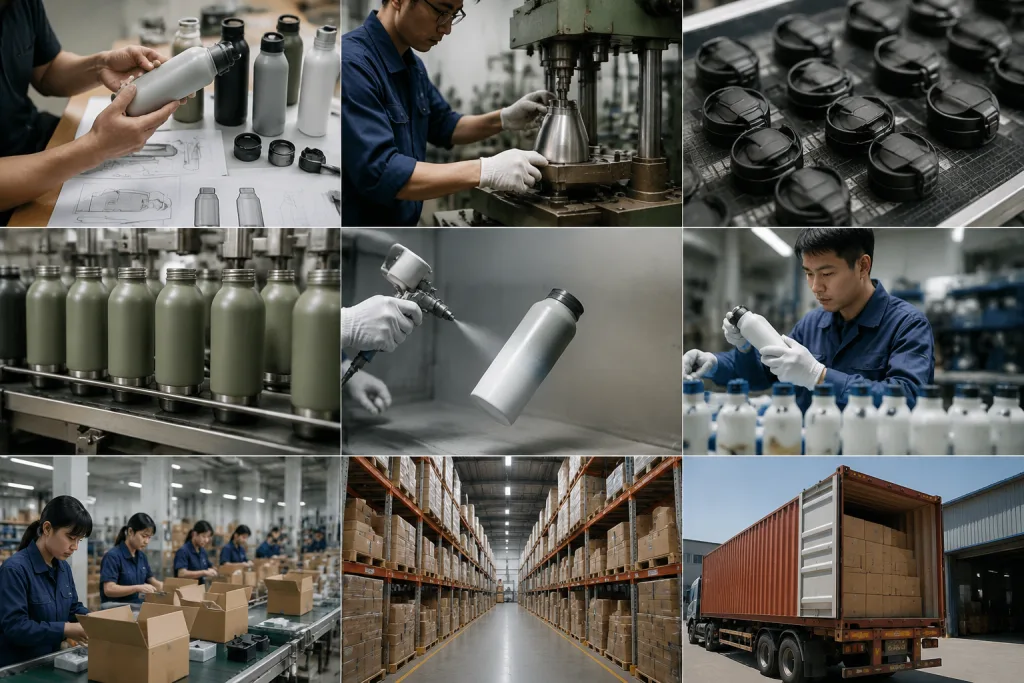
- Mass production: 25-40 days for 3,000-10,000 pcs; we run polishing, vacuum testing, plastic injection, printing, and final assembly in separate queues
- Inspection and packing: 2-5 days; AQL 2.5 checking often pulls scratches, weak laser marks, or cartons over 18 kg
Testing adds real days, not spreadsheet days. REACH and LFGB for contact materials, plus basic drop and leak checks, need 5-10 extra days when the lab schedule is full; SGS gave us 6 working days on one 316 inner bottle project, while a local lab quoted 10. If you are shipping to an Amazon prep center, ask the factory to print FNSKU and carton labels during packing, not after. That saves 2-3 days and cuts rework. We have seen this go sideways when the buyer sent FNSKU labels after cartons were sealed, and 96 cartons had to be reopened with a tape gun and relabeled by hand. A solid canteen supplier will say whether your target ship date works. If they promise 20-day production on a custom lid and custom box, the math doesn't work.
For North American and European buyers, the safe planning number is 45 days from PO to ex-factory readiness, then add ocean transit. For Ningbo to Long Beach, we normally tell buyers to budget 22-30 days on the water, not the carrier’s fastest number.
Material choices that affect performance
I’ll keep the HTML tags intact and rewrite only the prose, with tighter sales-engineer language and a few concrete factory details.316 stainless steel is not a marketing upgrade. It matters when the buyer needs corrosion resistance, salt spray tolerance, or a longer service life. The gap versus 304 shows up in harsher use, not on a showroom table. We’ve seen this play out on coastal orders and chemical-filled cleaning cycles. For a custom growler, customized growler, or distributor growler program built for outdoor, marine, or premium retail channels, 316 gives more room before pitting starts.
On a hybrid bottle, the outer plastic shell can be PP, ABS, or Tritan. PP is the low-cost pick and works for price-led canteen promotional runs. ABS gives more stiffness, but buyers push back on it for food-contact visible surfaces. Tritan costs more, usually USD 0.22-0.50 more per body than PP, and it gives a cleaner look. The line also changes with thickness: 0.4 mm stainless is common for cost-sensitive orders; 0.5 mm feels firmer in hand; 0.6 mm adds durability but the math climbs fast. Our caliper reading on one sample lot showed a 0.08 mm swing, and QC pulled it before packing.
If you want a customizable canteen for retail shelves, don’t make the steel grade the whole story. Buyers notice grip, lid security, odor, and finish before they ask about the alloy code. That is why customized canteen and customizable drinkware programs are won by samples, not by claims. Ask the canteen manufacturer to send a pre-production sample with the exact lid gasket, not a rough body-only sample. We’ve had a PO typo swap “silicone gasket” for “silicon gasket,” and that kind of slip turns into a costly back-and-forth. A body-only sample helps, but it will not tell you whether the final leak rate passes the drop test.
Decoration and packaging cost stack
I’ll rewrite this section in-place, keeping the HTML tags and list structure intact while making the prose sound like a factory-side sales engineer.Decoration is where a bottle stops being a commodity and starts carrying a brand. If you are running canteen customized or custom canteen programs for distribution, the box can matter almost as much as the bottle. Standard shrink wrap or bulk pack is the cheapest route, but it is not always the right one. We have seen buyers push for retail-ready packing and then get surprised by the math. A printed kraft box usually adds USD 0.22-0.45. A color box with insert often lands at USD 0.45-0.90. For a retail shelf, that can be money well spent; for a price-driven distributor order, it usually is not. On our packing bench, the tape gun and carton knife tell the story fast.
Logo methods behave differently on the line. Silk screen stays low cost and quick. Laser marking gives a clean finish, but it only works on suitable stainless areas and the setup runs higher. Heat transfer and UV printing make sense when the artwork carries more color. For a 316 stainless steel plastic water bottle custom order, the right method depends on the body material and the logo position. QC pulled a sample with a laser logo on a curved panel and the buyer flagged it after the first rub test. The logo looked fine in photos. The abrasion test said otherwise.
Typical adders:
- Silk screen logo: USD 0.08-0.15
- Laser logo: USD 0.20-0.40
- Printed color box: USD 0.22-0.90 depending on structure
- Individual polybag with barcode sticker: USD 0.03-0.08
Packaging also changes carton count and freight. A tighter master carton can cut shipping volume by 5%-12%, which matters on ocean freight when you are pricing FOB China and forwarding to a U.S. or EU warehouse. We had one PO with a typo on the inner pack count, and the pallets came out 18 cartons short on paper before the fix. That kind of mistake burns time. In Zhejiang, a good canteen supplier checks pack count before talking price. That is the right order.
How to quote like a serious buyer
I’ll rewrite the section in-place style, keep the HTML untouched, and make the wording sound like a buyer who has been through the line before.The fastest way to get a usable quote is to stop asking for a generic bottle and start listing the cost drivers. For a 316 stainless steel plastic water bottle custom program, send one RFQ with capacity, steel grade, plastic resin, lid type, logo method, packaging, and test requirements. We run quotes off that sheet. If you leave out sample cost, mold cost, unit price, and freight, the numbers do not mean much.
Ask the canteen factory for these four lines in writing:
- FOB Zhejiang price by MOQ tier
- Tooling cost, if any, and whether it is refundable at volume
- Sample fee and sample lead time
- Certification status for REACH, LFGB, FDA-style contact expectations, or other destination requirements
If you source from China and want repeatable supply, the gap between a canteen factory and a trading layer shows up fast. QC pulled the sample on a 0.2 mm lid gap last month, and that kind of miss is exactly why a direct maker matters. A direct canteen manufacturer can break down where the 6-8% cost swing comes from; a loose quote cannot. We’ve seen this go sideways when the buyer flagged a typo on the PO and the spec had to be rechecked line by line.
Practical rule: if two quotes are within USD 0.12 and one includes testing, printed cartons, and final assembly details, take the more complete quote. Cheap quotes look clean on paper. The math doesn’t work later.
When 316 is worth the premium
I’ll rewrite the prose in place, keep the HTML intact, and make it sound like a factory-side sales engineer wrote it.Not every bottle needs 316, and pretending otherwise is lazy sales talk. Use 316 when the job justifies it: salt air, wet storage, humid shipping lanes, premium retail, or buyers who want a longer service life. For an office desk bottle or a low-price distributor campaign, 304 does the job. For a premium custom growler or a canteen promotional launch aimed at outdoor buyers, 316 is easier to defend.
The math is simple. If 316 adds USD 0.25-0.40 to your unit cost and cuts returns, complaints, or replacements by even 2%-3%, it can pay back on a mid-scale order. Alloy talk alone is the wrong question. A canteen distributor selling into retail or corporate gifting should care about perceived value and fewer defects; a canteen vendor chasing a price-led campaign needs to hold landed cost under a hard ceiling.
In Zhejiang, we quote these jobs every day, so push for a sample that matches the exact outer plastic color, lid finish, and logo method. QC pulled the sample on a 1.2 meter drop test, and that one detail often tells you more than a glossy spec sheet. A customized growler or customized canteen that looks right and survives the drop is easier to sell than a theory on premium material. Good sourcing is boring like that: the numbers line up, the packaging closes, and the ship date holds.
Send your spec and get a real quote
We’ll price your 316 stainless steel plastic water bottle custom order with MOQ, packaging, and lead time broken out clearly.
Frequently asked questions
What is a realistic MOQ for a 316 stainless steel plastic water bottle custom order?
For most factory-direct orders in Zhejiang, a realistic MOQ is 3,000 pcs for standard print and standard colors, then 5,000 pcs if you want a custom Pantone shell, upgraded lid, or printed box. If you need a brand-new lid mold, expect 10,000 pcs or a tooling fee of roughly USD 1,500-4,500 depending on complexity. Small promotional runs below 1,000 pcs are possible, but unit cost rises fast and the design options narrow.
How much should I budget per piece?
For a 500-600 ml hybrid bottle with 316 stainless interior and plastic outer shell, budget USD 2.10-2.70 FOB for simple decoration, USD 2.80-3.60 for better lids or packaging, and USD 3.70-4.80 for retail-grade finish. The biggest cost drivers are lid type, decoration method, and packaging, not the steel grade alone. Freight, duties, and warehouse prep are extra.
How long does production take after approval?
If you approve artwork quickly and use existing molds, sample lead time is usually 7-12 days and mass production is 25-40 days. Add 5-10 days if you need REACH, LFGB, or extra leak/drop testing. If you are changing the lid structure or opening a new mold, the timeline can move to 50-60 days before shipment. Plan with a 45-day factory window to avoid surprises.
Can I order different lid colors in one run?
You can, but it usually increases complexity and may affect MOQ. A canteen manufacturer may allow multiple lid colors if each color reaches the minimum per SKU, often 1,000-2,000 pcs per color. Otherwise, the factory charges a split-run fee or asks you to keep one lid color and vary only the body print. If you want the cleanest cost structure, keep one body color and one lid color for the first order.
What compliance checks should I request for Europe and North America?
Ask for material declarations plus relevant migration or contact testing for your market. For Europe, buyers commonly request REACH and LFGB-related documentation; for the U.S., they often ask for FDA-style food-contact support and independent lab reports. If your bottle has plastic parts, make sure the resin and gasket materials are included in the test scope. A full test set can cost USD 120-350 and usually adds 5-10 days.