Key Takeaways
- 316 stainless steel glass bottle custom orders usually start at 3,000 units with 28-35 day lead time
- Borosilicate glass bottle bulk pricing often runs USD 1.20-2.80 per unit depending on cap, print, and packaging
- A 1.8 mm wall with ASTM-style drop testing is a practical baseline for retail channels
- For Amazon or DTC, leakproof cap tolerance and carton compression matter more than glass thickness alone
If you are sourcing drinkware for a wellness brand or a sustainable retail line, the real question is not whether glass looks premium. The real question is whether the bottle survives cartons, prints cleanly, clears compliance, and still leaves margin after freight. A 316 stainless steel glass water bottle custom order sounds straightforward until you start comparing cap threads, 2.0 mm wall thickness, and what happens when a 9-ounce bottle ships in a 20,000-unit container from China. We have seen the buyer flag a PO typo on the first run and it cost two days at the line.
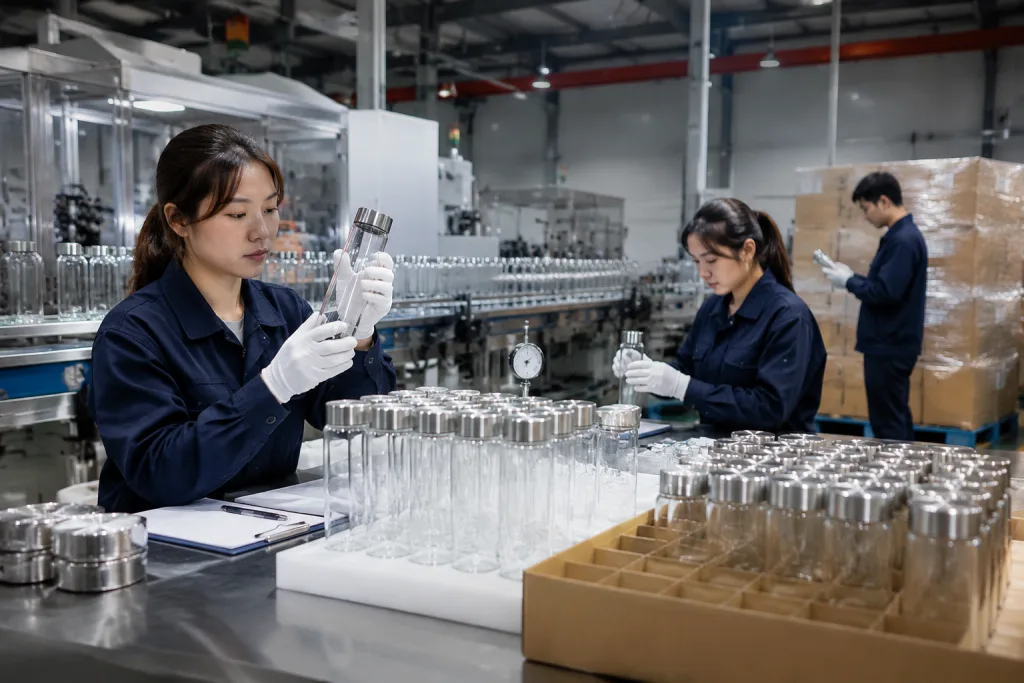
At our Hangzhou, Zhejiang factory, buyers usually fall into two groups: one wants a glass-first bottle with a 316 stainless steel component for better durability, the other wants pure borosilicate for a cleaner look and a simpler spec sheet. Both can work. The better call depends on where you sell, whether you need bulk glass water bottle pricing under FOB China, and how much breakage, lead time, and carton cost you can live with. QC pulled the sample with a chipped rim once on a 12 mm mouth finish, and that is the sort of issue that decides the program fast.
Side-by-side spec reality
I’ll rewrite the prose only, keep the HTML intact, and preserve all existing numbers and table structure.The cleanest way to compare a 316 stainless steel glass water bottle custom job with a borosilicate program is to start from the spec sheet, not brand talk. A buyer can ask for “eco” all day; the line still needs wall thickness, cap stack-up, print method, and AQL target. On our floor in Hangzhou, the smooth orders are the ones where the buyer says the end use up front: shelf retail, yoga merch, subscription box, or distributor refill. Last month QC pulled a 2.0 mm sample and the buyer flagged the cap gap, so we know this is where the deal lives.
| Spec point | 316 stainless steel glass water bottle custom | Borosilicate glass bottle custom |
|---|---|---|
| Typical capacity | 500-750 ml | 350-1000 ml |
| Glass wall thickness | 1.8-2.2 mm | 1.6-2.0 mm |
| Closure | 316 lid or 316 trim cap with silicone seal | Bamboo, PP, or stainless cap with silicone gasket |
| MOQ | 3,000-5,000 pcs | 2,000-3,000 pcs |
| Unit price FOB China | USD 1.80-4.20 | USD 1.20-3.60 |
| Lead time | 28-35 days | 25-32 days |
| Best fit | Premium wellness, gifting, cold beverage positioning | Mass retail, reusable hydration, promotional programs |
The question is not which one is “better.” That’s the wrong question to ask. A borosilicate glass bottle manufacturer can ship a clean retail piece at lower cost, and we’ve seen it go sideways when buyers ignore the closure tolerance on the first PO. A 316 stainless steel glass bottle custom line gives you a stronger hardware story, but it adds assembly steps and more hand work at the bench. If your customer wants metal detail and a heavier feel, the premium makes sense. If they want a clear bottle with custom print and a tight margin, borosilicate glass bottle wholesale is usually the smarter math.
When 316 earns its keep
I’ll rewrite this section in-place, keep the HTML structure intact, and strip the AI-ish phrasing while adding a few concrete factory details.316 stainless steel only earns its slot when the metal is doing real work. In a glass bottle, that usually means the lid, collar, infuser sleeve, or outer trim. Buyers ask for 316 because it holds up better than basic 304 in salty water, acidic drinks, and wash cycles that never stop. That is the right call for cafes, coastal markets, and wellness brands that run dishwasher tests every day.
For a custom glass water bottle program, 316 makes sense when the bottle gets opened and washed hundreds of times, or when the hardware itself is part of the brand look. We have shipped a distributor glass water bottle line with 316 metal accents because the buyer wanted a cleaner premium read without moving to full double-wall steel. On our line, the extra cost versus standard stainless trim usually lands at USD 0.18-0.45 per unit, depending on the brushed finish and the seal structure. The math does not work for every SKU.
Use 316 when:
- You need a stronger premium signal at retail
- You sell into humid or coastal regions
- You want a better story for long-life hardware
- You can support a MOQ of at least 3,000 units
Do not pay for 316 just because it sounds premium. If the part sits under a cap shroud, the buyer will not see the upgrade, but your margin will.
If you are comparing a customizable glass water bottle with a simpler borosilicate build, price the whole set. Metal trim, silicone grade, and cap assembly often cost more than the glass itself; QC pulled one sample last month because the gasket was 0.3 mm off and the lid failed the leak check.
Borosilicate still wins volume
I’ll keep the HTML structure exactly as-is and rewrite only the prose to sound like a factory-side sales engineer, with tighter sourcing language and a few concrete shop-floor details.For most wellness brands, borosilicate still takes the volume. A borosilicate glass bottle bulk order gives you solid thermal shock resistance, clear glass, and a landed cost that stays workable. That is why our buyers keep asking for it on retail, hotel, and giveaway runs. We ran a 5,000-piece lot last month, and the QC table showed only 3 chipped rims after carton drop checks.
If you need borosilicate glass bottle customizable features, the menu is familiar: silk-screen logo, frosted body, silicone sleeve, bamboo lid, tea infuser, or color spray. A borosilicate glass bottle promotional order can sit around USD 0.95-1.40 FOB China when the print is one color and the box is plain. Once the buyer flags custom molded caps, embossing, or a heavy retail carton, the math moves fast. We had a PO last quarter with “frosted leter” on it; the line caught it before tooling started.
From a sourcing angle, borosilicate is the safer call when:
- You need a lower entry cost for a 3,000-piece pilot run
- You expect repeat replenishment through a borosilicate glass bottle distributor network
- You want a bulk borosilicate glass bottle line for Q3 or holiday retail
- You want simpler paperwork and fewer hardware failure points
We also see buyers search for a borosilicate glass bottle vendor or borosilicate glass bottle manufacturer when they really need a factory that can control packaging, drop-test samples, and color matching. The title on the business card does not matter much. What matters is whether the line can hold the same neck size across 10,000 pieces and keep the cap torque within spec. We have seen this go sideways in China more than once.
Price versus margin math
I’ll rewrite just the prose inside the existing HTML, keep every tag and number structure intact, and tighten the sales-engineer tone.Wellness buyers usually stare at unit price and skip packaging, freight, and claim risk. That is how a cheap bottle turns into a return headache. A borosilicate glass bottle manufacturer in Zhejiang can quote USD 0.70-1.30 for the bare bottle, but the FOB can nearly double once you add a 316 trim cap, printed carton, insert card, and single-box pack-out. We have seen the buyer flag a PO because the cap spec was missing the gasket callout. The math does not forgive that. The same goes for a custom borosilicate glass bottle shipped as gift-ready retail.
At our Hangzhou plant, we run about 500,000 units per month across glass and steel drinkware, and we price it in three layers: bottle body, cap and seal, pack-out. Simple. Buyers ordering a customized glass water bottle for Amazon-style retail should add USD 0.25-0.60 for carton crush strength, inner tray, and barcode labels. QC pulled the sample last week and measured the outer carton at 5.2 mm board thickness; that is the kind of detail that keeps the line moving. If you need FNSKU labeling, the cost looks tiny on paper, then it starts biting at 20,000 pieces.
A custom glass water bottle with a 316 hardware story usually lands around USD 2.50-4.20 FOB China for mid-tier retail. A simpler customizable borosilicate glass bottle can stay under USD 2.00 if you keep decoration clean. We ship both, and the shelf math is plain: if your target price is USD 18-24, either build works; if you need USD 12-15, the simpler spec leaves margin. There is no magic here.
Compliance and test points
I’ll rewrite the section in place, keep the HTML exactly as-is, and tighten the compliance language with a more hands-on factory voice.Glass drinkware lives or dies on compliance and packing control. You do not need a lab degree, but you do need the right papers on the desk. For Europe and North America, the usual baseline is REACH for chemical compliance, food-contact declarations, and migration testing where needed. If the bottle has painted decoration, check the ink system and curing oven settings. If it includes a 316 part, ask for the material certificate, not just a line on the quotation.
A serious borosilicate glass bottle supplier should offer AQL inspection, usually AQL 2.5 for major defects and 4.0 for minor defects on retail orders. We run a 1-meter packaged drop test on the sample, then a carton compression check at 15 kg. If QC pulled the sample and the corner seam split, that was the end of the story. For a customized borosilicate glass bottle or customized glass water bottle, ask for:
- Material declaration for glass, silicone, and 316 metal parts
- Migration or food-contact test report if needed for your market
- Carton compression standard
- Leak test results after cap torque cycling
- Pre-production sample sign-off with photos and measurements
We work with buyers who want a borosilicate glass bottle wholesale program or a distributor borosilicate glass bottle supply chain, and the same lesson keeps coming back: catch the problem in Zhejiang, or pay for it in a U.S. warehouse when the buyer flags the damage rate. The math does not work any other way.

Choosing the right sourcing path
I’ll rewrite the section in place, keep the HTML structure unchanged, and make the copy sound like a factory-side sales engineer wrote it.If you are a brand owner, pick the sourcing path by channel math, not by mood board. A borosilicate glass bottle factory fits when you need stable volume, faster decoration turnaround, and a cost base that still works for retail or promo runs. We run this every week: one forming line, one assembly table, and a 7-day sample loop can cut the handoff when you are juggling 5 SKUs at once.
If you are a distributor, the numbers change. You care about carton count, repeat print, and whether the supplier keeps the same cap finish on the next replenishment order. That is why many borosilicate glass bottle distributors stick to one house style and one pack spec instead of re-engineering every account. The same rule applies to a distributor glass water bottle line: fewer variables, fewer claims, faster turns. QC pulled a sample once and found a 1.5 mm cap gap on the second batch; the buyer flagged it before shipment, and that saved a messy return.
Best-fit guide:
- Premium wellness brand: choose 316 trim, frosted glass, gift box
- Sustainable retailer: choose borosilicate body, simple lid, recycled carton
- Promotional program: choose low-cost custom print and basic cap
- Marketplace seller: choose tested packaging and barcode-ready pack-out
The market also uses the words borosilicate glass bottle vendor, borosilicate glass bottle suppliers, and borosilicate glass bottle manufacturers loosely. Do not get stuck on the label; ask who owns tooling, who signs off QC, and what the real MOQ is. In Zhejiang, those three answers beat a polished homepage every time. We have seen buyers accept a nice title, then lose 12 days because the PO typo said 500 pcs instead of 5,000.
Request a quote with your target spec
Send capacity, lid style, print method, and target landed cost. We will quote a practical option from Zhejiang, not a brochure fantasy.
Frequently asked questions
What MOQ should I expect for a 316 stainless steel glass water bottle custom order?
For a true 316 stainless steel glass water bottle custom program, expect 3,000-5,000 pcs per SKU. If you need multiple lid colors or separate print versions, the real MOQ can rise to 6,000 pcs because each variation adds assembly and packing cost. For a simple borosilicate glass bottle custom project, 2,000-3,000 pcs is more realistic. At our Hangzhou, Zhejiang plant, sample lead time is usually 7-10 days and mass production takes 28-35 days after deposit and artwork approval.
Is borosilicate safer than regular glass for water bottles?
Yes, borosilicate is the better choice for reusable drinkware because it has stronger thermal shock resistance than soda-lime glass. It handles hot-and-cold swings better and is the standard material for a bulk borosilicate glass bottle program. That said, safety in practice depends more on design and QC than on material alone. A 1.8 mm wall, proper annealing, and AQL inspection matter. If the bottle has a metal lid, check the silicone seal and leak test as well.
How much does a custom borosilicate glass bottle cost FOB China?
A basic custom borosilicate glass bottle can start around USD 1.20-1.80 FOB China for 3,000 pcs. Add frosting, print, bamboo lid, or premium packaging, and you can move into USD 2.20-3.60. A 316-style hardware upgrade usually adds another USD 0.18-0.45 depending on the metal part and finish. Freight, labeling, and import duty are separate, so you should build margin using landed cost, not just factory price.
What tests should I ask a borosilicate glass bottle manufacturer for?
Ask for food-contact declarations, material confirmation for all components, leak testing, and packaged drop testing. For retail programs, request AQL 2.5 for major defects and 4.0 for minor defects. If the bottle includes decoration, ask for abrasion resistance or dishwasher-cycle validation if your market requires it. For North America and Europe, keep REACH and migration documentation ready where applicable. A sample passed in hand does not mean it will survive container shipping.
Can one factory handle both custom glass water bottle and distributor orders?
Yes, if the factory has enough line capacity and a stable QA process. A good borosilicate glass bottle factory in China should handle both custom glass water bottle development and repeat distributor replenishment. The difference is in documentation and packing discipline. Custom brand projects need artwork control, prototype approval, and tighter style changes. Distributor orders need consistency, carton packing accuracy, and on-time replenishment. If the plant cannot hold the same print and cap finish across 10,000 pieces, it is not ready for either job.