Key Takeaways
- Typical MOQ starts at 500-1,000 pcs per SKU, with FOB pricing often at USD 4.20-9.80 depending on 316 stainless steel, glass, and finish.
- Sample development usually takes 7-12 days, mass production 25-40 days, and export transit 20-35 days from Zhejiang ports.
- Logo method changes unit cost by 3%-18%; laser engraving is usually cheaper to run, while full-color print adds more setup risk.
- A factory with 120,000 units/month can handle distributor drinkware programs, but only if your artwork, carton spec, and test requirements are final early.
If you are buying a 316 stainless steel glass bottle private label program, the first mistake is treating the bottle unit price as the full bill. It is not. The landed number moves with the 316 inner wall, the glass body thickness, cap type, print method, carton spec, and how fast you want the first shipment. We run quotes that differ by 8% to 15% on the same-looking bottle because one factory folds tooling into the price and another leaves it out; QC pulled a sample last week and the wall gauge read 0.4 mm off, which changed the whole cost stack.
You also need to price the job in lead-time blocks, not one clean delivery date. A private-label order from a canteen factory in Zhejiang usually goes from artwork sign-off to mass production in 35-55 days, then 20-35 days for ocean freight to North America or Europe. That is the math, and it does not care about your launch calendar. The buyer flagged a PO typo on our side once—`316` was written as `304`—and that one line would have sent the wrong stock into the line, so the smarter buyer checks MOQ tiers, packing details, and test timing before asking for the cheapest FOB number.
What You Pay For
I’ll keep the HTML structure intact and rewrite the prose to sound like a factory-side sales engineer, with concrete pricing details and a few line-floor touches.The base material stack drives most of the price. A true 316 stainless steel liner costs more than 304 because the alloy content is higher and the corrosion spec is tougher. For a 500 ml 316 stainless steel glass bottle private label model, the inner steel part usually adds USD 0.35-0.90 over a 304 version. We run that comparison on the line with a 0.4 mm thickness check, and the math does not lie. Once you add a borosilicate or soda-lime glass body, unit cost moves again with wall thickness, breakage rate, and whether it is single-wall or double-wall.
This is where buyers get caught out: the cap system and surface treatment can cost as much as the steel upgrade. A PP cap with a silicone seal may add only USD 0.18-0.35, while a 316 cap with a bamboo lid, powder coat, or vacuum seal can add USD 0.60-1.50. QC pulled the sample last week because the powder coat had a 2 mm scuff near the shoulder, and the buyer flagged it before packing. If you want a premium shelf look for a customized drinkware launch, decoration matters too. Laser logo, one-color silkscreen, and four-color wrap are priced differently, with a 5%-15% gap on a 1,000-piece order.
- 316 inner steel: usually +USD 0.35-0.90 versus 304
- Glass body and breakage allowance: +USD 0.40-1.20
- Cap and seal: +USD 0.18-1.50
- Logo decoration: +USD 0.05-0.60
If you are comparing canteen customizable quotes from different canteen suppliers, ask for a split on body, lid, logo, and packaging. We have seen buyers compare a Zhejiang canteen vendor against another factory on a single lump-sum quote, and that always goes sideways. One PO typo can even blur the gap: 1,000 pcs turned into 10,000 pcs on the draft, and nobody noticed until the carton label proof came back. That is the wrong question to ask if you want a clean canteen manufacturer comparison.
MOQ Tiers That Actually Matter
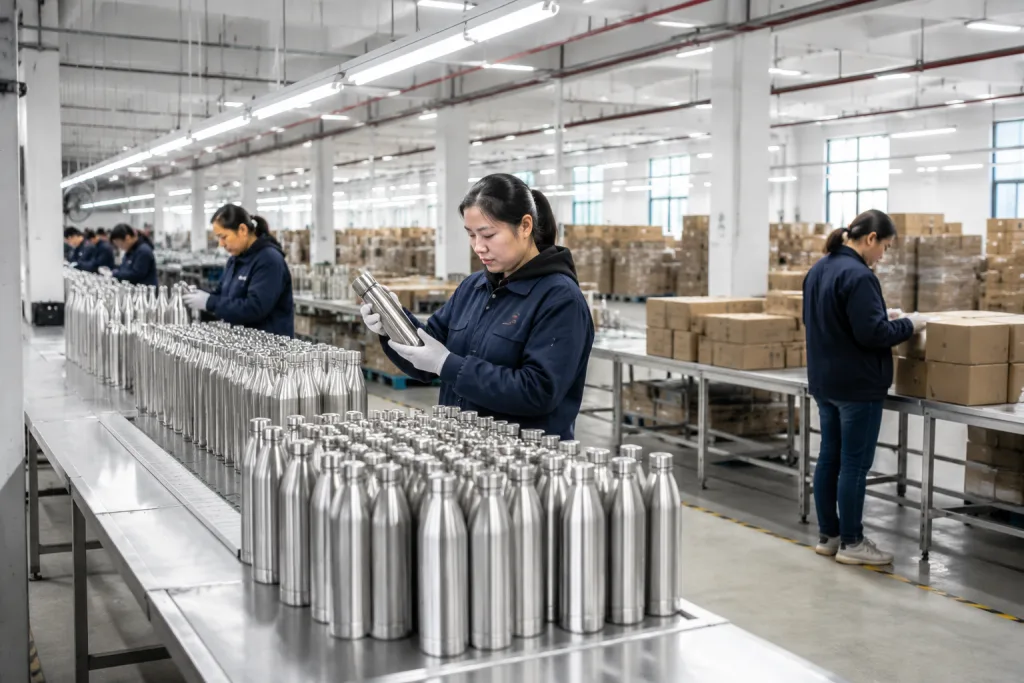
MOQ is not a decoration on a quote sheet. It is the point where we run the line without wasting setup time, cartons, and QC hours. For private label drinkware, a common MOQ is 500 pcs for stock-color bodies and simple logo work, 1,000 pcs for custom packaging, and 3,000 pcs or more if you want special glass tint, unique cap tooling, or a molded gift box. On a 316 stainless steel glass bottle private label order, the MOQ often sits a bit higher than a standard custom canteen because the material stack and inspection steps are tighter; QC pulled the sample twice on a 0.2 mm seal gap before we released the batch.
For distributors, the MOQ tier should match your channel, not your ambition. If you are testing one region, 500-800 pcs gives you enough stock to check sell-through. If you are a canteen distributor or distributor drinkware buyer placing a retailer-ready program, 1,000-2,000 pcs per SKU is the practical floor. Below that, the unit cost can jump 12%-25% because setup and inspection get spread over too few pieces; the math does not work, and we have seen it go sideways when a buyer tried to force 300 pcs with three box versions.
Common MOQ ranges
- 500 pcs: stock body, one-color logo, kraft carton
- 1,000 pcs: custom print, retail box, mixed carton markings
- 3,000 pcs: special finish, custom mold elements, bundled accessories
In Zhejiang, some canteen factories quote a low sample MOQ but push the real economics at 1,000 pcs. That is normal. The right move is to ask for a tiered quote: 500, 1,000, and 3,000 pcs. Then you can see whether your customized canteen program can scale or whether a simpler customized drinkware spec is the better call; we once caught a PO typo that turned “single-color” into “single-carton,” and that kind of mistake changes the whole cost line.
Lead Time From Sample To Ship
Lead time is where projects slip. A private label bottle schedule runs in this order: artwork sign-off, sample approval, pilot run, full production, packing, then export booking. For a 316 stainless steel glass bottle private label job, we usually see 7-12 days for sampling, 15-25 days for the first order if the parts are stock-based, and 25-40 days if you change the cap or the gift box. If the line is full, add 5-10 days. That is the math.
Shipping time counts just as much as production time. From Ningbo or Shanghai in Zhejiang, ocean freight to the US West Coast is often 18-25 days port-to-port, and 28-35 days to Northern Europe, depending on carrier space. Air freight moves faster, but a heavy bottle can add USD 3-8 per unit, and we have seen buyers kill margin chasing a launch date they should have planned around. Book backward from the sales calendar, not forward from the PO date.
Sample approval to ETD in under 45 days is realistic if your artwork is final, your carton spec is fixed, and payment does not stall the job.
A canteen supplier in Zhejiang running 120,000 units per month can still miss your ship date if you revise art twice, change lid color once, and ask for new compliance tests at the end. QC pulled the sample, the buyer flagged a carton typo, and the whole schedule slid. Keep the scope stable. That is how distributor programs stay on time.
How Materials Change Price
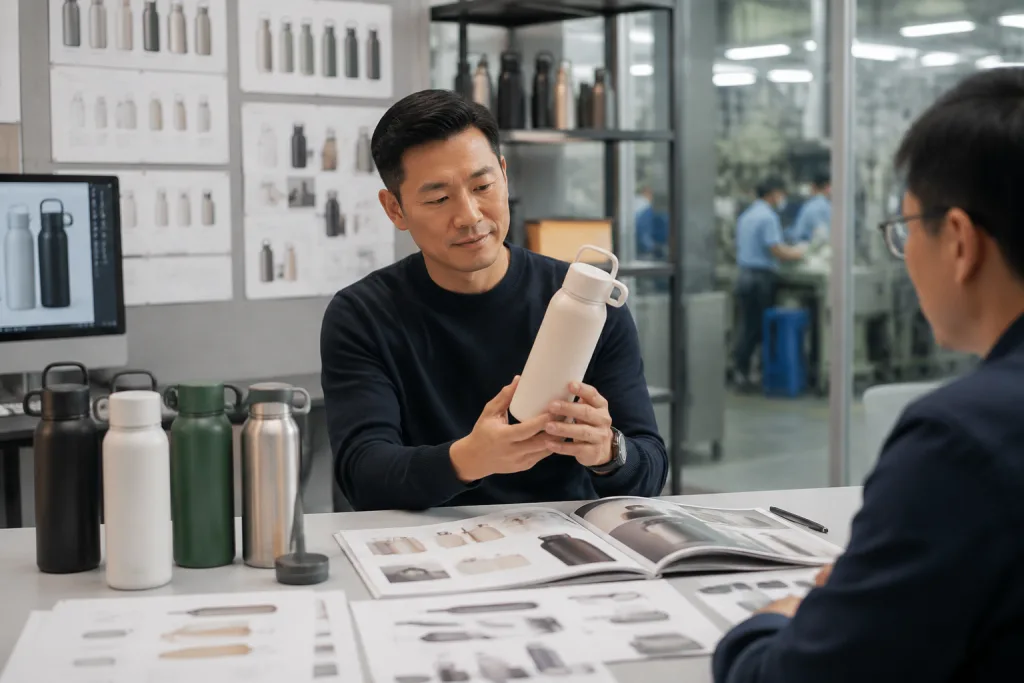
Material choice moves the quote fastest. A 316 stainless steel liner costs more because it holds up better against salt, acid, and mineral-heavy liquids. That is the right call for a custom growler, a canteen promo piece, or a reusable bottle that will see rough daily use. For normal still water in a retail channel, 304 is often enough. We run that check on the line every week. Pay for 316 when the use case earns it.
Glass changes the math too. A thicker wall gives a better hand feel and fewer breakages, but it adds weight, freight, and scrap. On a 500 ml bottle, moving from 1.5 mm to 2.2 mm glass can add 30-60 g per piece, and on 10,000 pieces that turns into real freight money. QC pulled the sample last month and the 2.2 mm version survived the drop test, while the thinner one chipped at the shoulder. The same logic applies to lids, gaskets, and sleeves. Silicone gaskets hold up; low-grade rubber saves pennies and brings claims later.
- 316 liner: better corrosion resistance, higher cost
- Glass thickness: changes breakage rate, freight, and hand feel
- Lid material: changes leakage risk and shelf appeal
- Packaging: affects damage rate and carton density
If you are building a customizable growler or customized growler line, do not let the quote bury wall thickness. Ask for measured specs in millimeters, not “standard.” We’ve seen POs come in with that word and the buyer flagged it only after the sample was signed. The math does not work when China and Europe use different retail standards and nobody pins down the numbers.
Decoration Choices That Protect Margin
Decoration is a margin call, not a branding afterthought. Laser engraving keeps running cost low and holds up in use, so we run it on a lot of premium-but-simple orders. Silkscreen works when the logo is one color and the buyer wants shelf pop. Heat transfer and wrap print bring more visual impact, but the line sees more setup time and a higher reject count. On a 316 stainless steel bottle order, decoration can move the unit price by USD 0.05-0.60, and complex art pushes it further.
Buyers running marketplace or retail programs need to price in FNSKU labels, hangtags, and carton marks from day one. If the packaging file is not set for the channel, the warehouse does the rework later, and the math does not work. We ship a lot of custom drinkware with individual polybags, barcode labels, and master carton counts matched to the fulfillment flow. QC pulled the sample on one Amazon order because the carton mark was one digit off; that typo cost a day.
The rule is simple. Use laser engraving for durable, low-risk branding; use silkscreen when color matters; use full-wrap graphics only when the margin can take the waste. A supplier can always make a prettier sample on a 5 kg test run. The real question is whether the mass run stays profitable after 5% rejects, freight, and carton labor.
How To Buy Smart From Zhejiang
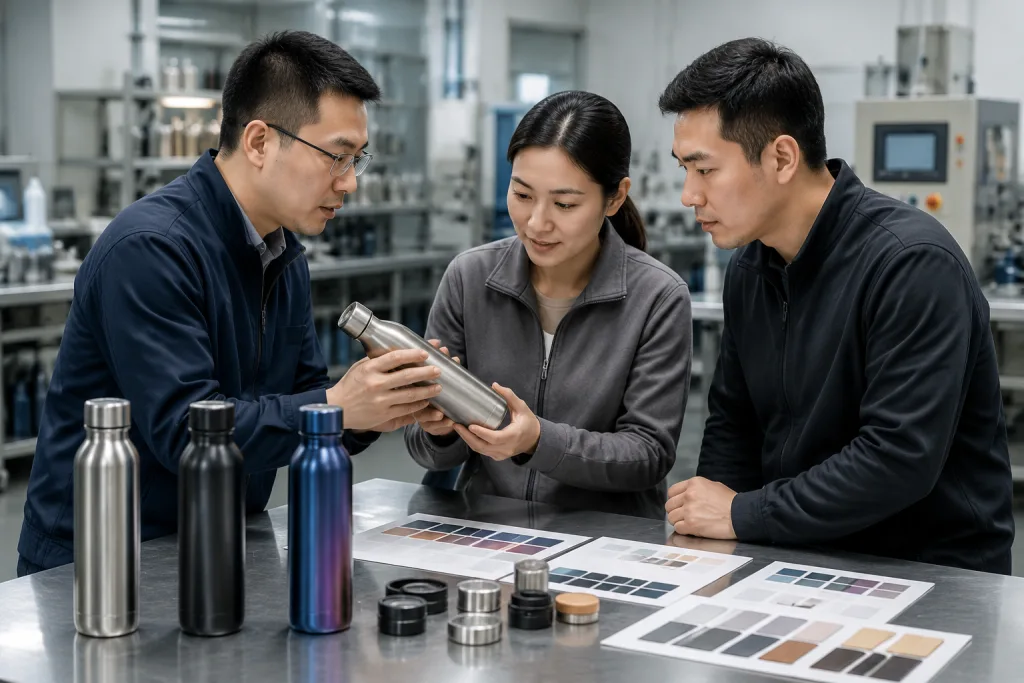
Buying from Zhejiang goes smoothly when you control the details. The province has metal forming, glass processing, printing, and export packing in one radius, so we can source the body, lid, and carton from the same cluster without wasting a week on handoffs. That is why a Zhejiang canteen factory usually quotes faster than a split-supply setup. Speed still needs discipline. You need a clear spec sheet, a compliance target, and an inspection standard before we run the line.
Send a formal RFQ with FOB price, MOQ, sample lead time, mass production lead time, packaging format, and test reports. State whether you need REACH, food contact compliance, or ASTM-related testing based on your market. For Europe, ask for material declarations and traceability codes. For North America, ask for food-grade contact compliance and carton labeling. A serious factory will answer with documents, not sales talk. We’ve seen buyers skip the paperwork and then chase a missing SGS report for 12 days.
Use AQL 2.5 for major defects and AQL 4.0 for minor defects unless your program needs a tighter limit. Ask for pre-shipment photos, carton count checks, and spare parts if the lid set has extras. QC pulled the sample once and found a 2 mm print shift that the buyer flagged on the first PO. That is the real line between a clean private label launch and a pile of claims. Buy this way, and the factory learns your standard before the reorder.
When Private Label Becomes Distributor Scale
A private label program turns into a distributor program the moment the same SKU starts moving through three channels. Then pricing, cartons, and lead time have to run like a system, not a one-off PO. If you source as a canteen distributor, distributor growler buyer, or distributor drinkware importer, ask for a factory roadmap with sample timing, repeat-order timing, and spare-cap stock. One extra cent on the first quote is the wrong question to ask.
For repeat business, a good canteen factory should keep your artwork files, confirm Pantone codes, and record lid molds and print plates. We’ve seen that shave 3-7 days off a repeat order. QC pulled the sample on a 500 ml run once because the cap color drifted by 2 mm under the lamp, and the buyer flagged it. If the line can do 120,000 units per month, lock the SKU before it falls out of that slot. Late changes stack up fast.
Whether you call it canteen custom, canteen promotional, or customizable canteen, the commercial logic stays the same: stable specs, clear QC, and a launch calendar the line can actually hit. A canteen supplier that gets those three points is worth more than a vendor chasing the lowest FOB line item. In China, especially in Zhejiang, we run better when the factory is treated like a production partner, not a quote engine. The math works.
Get a Zhejiang quote with real cost breakdown
Send your artwork, target MOQ, and market. We will price body, lid, logo, and packaging separately with a realistic lead-time plan.
Frequently asked questions
What is a realistic FOB price for a 316 stainless steel glass bottle private label order?
For a 500 ml bottle with 316 stainless steel liner, glass body, one-color logo, and basic retail box, realistic FOB pricing is usually USD 4.20-6.80 at 1,000 pcs. If you add premium cap finishes, thicker glass, or full-color packaging, the range often moves to USD 6.90-9.80. Below 500 pcs, expect higher unit cost because setup is spread across fewer bottles.
How long does sampling take in a Zhejiang canteen factory?
Sampling usually takes 7-12 days if the design uses existing molds and standard colors. If you need a new lid style, special glass tint, or printed gift box, allow 12-18 days. A good canteen manufacturer in Zhejiang should confirm sample timing before you pay, then give a photo checkpoint before shipping the sample.
What MOQ should I plan for custom drinkware?
For most custom drinkware programs, 500 pcs is the low entry point, 1,000 pcs is the normal commercial MOQ, and 3,000 pcs is where special customization becomes more efficient. If you want a customized growler or a more complex canteen customized design, the MOQ can rise because the packaging and decoration setup cost is higher.
Do I need REACH or food-contact documentation?
If you sell into Europe, yes, you should ask for REACH-related material declarations and food-contact documentation. For North America, request food-safe contact confirmation and any relevant test reports. A responsible canteen supplier should be able to provide these before mass production, not after shipment. If they cannot, treat that as a risk, not a paperwork issue.
What affects breakage and claim rates the most?
Glass thickness, carton design, and pallet loading matter most. Moving from 1.5 mm to 2.2 mm wall thickness can reduce damage but raises freight weight. Individual inner packaging, divider strength, and drop-test performance also matter. In practice, a well-packed order often cuts claims by 30%-50% versus loose or under-tested packing, which is why packaging should be part of the quote from day one.