Key Takeaways
- A workable MOQ for custom drinkware is often 500-1,000 pcs per SKU, with 25-35 day lead time after sample approval.
- For 316 stainless steel, ask for material traceability and thickness specs such as 0.5-0.8 mm; do not buy on grade name alone.
- Use AQL 2.5 for critical inspection, and require REACH, LFGB, or FDA-friendly documentation when your market needs it.
- A factory with 200,000+ units/month capacity is useful only if it can keep print, coating, and assembly stable across repeat orders.
If you are sourcing a 316 stainless steel glass bottle manufacturer, the real question is not “who can make it?” It is “who can keep the same wall gauge, the same weld line, and the same finish on 5,000 pieces after the first sample gets approved.” Buyers in Europe and North America ask for coating thickness, lid seal pull force, and compliance files before they talk price. We run that check at the line, because one PO typo on the cap code can turn into a week of rework.
The safer way to buy custom drinkware is to treat it like a factory audit, not a catalog search. You need a supplier that can hold tolerances, pass REACH or food-contact testing, and ship on time; the math does not work any other way. In Zhejiang, China, we quote MOQ, lead time, and monthly output from the actual shift plan, not from brochure copy. QC pulled the sample, checked the 0.3 mm seam, and that is the number that matters.
Start with the use case
The first decision is not decoration. It is the use case. A custom canteen for a hiking brand needs different wall thickness than a corporate gifting order, and both sit apart from a customized growler for a beer program. Skip that step and you pay for features nobody values. We’ve seen a cold brew bottle need a different lid seal and neck finish from a canteen promo item handed out at an expo.
Ask three questions before you talk color or logo: what liquid goes in, how often will it be washed, and how will the end user carry it? A canteen made for gym use should survive repeated drops and dishwasher cycles. A distributor drinkware program for retail shelves may care more about carton size and print consistency. A custom growler for hospitality may need a heavier base and higher closure torque. If the buyer profile changes, the spec changes with it.
This keeps you from over-specifying. A 316 stainless steel liner makes sense when corrosion resistance matters, but it does not fix a weak design. You still need the right body shape, lid type, and insulation structure. On the line, QC pulled a sample with a 0.3 mm gap at the cap seat, and the buyer flagged it before tooling. A canteen manufacturer in Zhejiang should push back on that kind of mismatch, because correcting a bad spec after tooling costs more than the bottle.
Choose material for the margin
Material choice sets cost and complaint rate. The phrase 316 stainless steel glass bottle manufacturer matters because a lot of buyers compare 304 and 316 without checking the failure mode first. 316 adds molybdenum, so it holds up better against chlorides and harsher wash cycles. We see that pay off in coastal sales, gym bottles, and SKUs that get hit with strong sanitizers. It does not fix a bad weld. QC pulled a seam crack on one lot at 3000 cycles, and the buyer flagged it fast.
For glass-lined or glass-accented builds, the joint between metal and glass is the spot to watch. Thermal shock, drop resistance, and seal compression all matter. On the line, we ask for wall thickness, vacuum data, and the internal coating spec before we quote. A normal premium body sits around 0.5-0.8 mm, depending on size and structure. If the supplier cannot state the gauge, the math does not work. We have seen that turn into a PO typo and a late sample dispute.
Price has a floor. 316 stainless usually costs more than 304, often 8-20% based on volume and finish. That extra spend only makes sense when the channel can carry it. For customized drinkware sold into coastal retail, higher-end gifting, or accounts that care about staining and corrosion, the upgrade earns its keep. For a cheap giveaway, it is the wrong question to ask. A 5000-piece MOQ on a promo run can swallow the margin fast, and we ship that lesson more than once.
Buy the grade that matches the failure mode you are trying to avoid, not the grade that sounds better in a catalog.
Judge factory capability, not claims
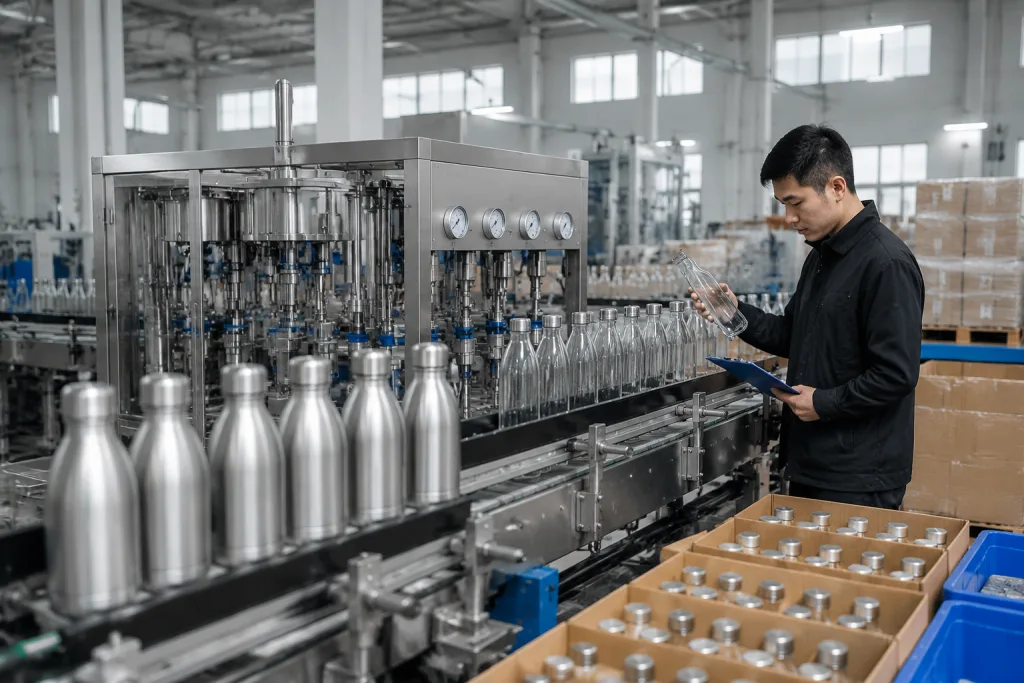
Many canteen suppliers can sample a bottle. Far fewer can repeat the same bottle across 10,000 units without print drift, weld discoloration, or loose cap fit. That is the test here: factory capability. Ask how many units they ship each month, how many lines they run, and what stays in-house. A real Zhejiang factory should answer with a number, not a speech. We hear 200,000-300,000 units/month from serious plants, and the line can usually prove it.
Check the control points. Is laser engraving done in-house? Is silk screen curing controlled? Are lid assemblies torque-tested on a bench gauge? If the answer is “outsourced nearby,” the risk goes up fast. A factory that owns the process keeps color closer and cuts rework. A trader can move cartons. That is not the same thing as repeatable custom drinkware.
Sampling discipline tells you more than the brochure. You should get a pre-production sample, not a random stock bottle with your logo slapped on. Demand written sign-off on dimensions, finish, and packaging. We’ve seen PO files with the carton spec typed as “1 pcs/box” when the buyer meant 12 pcs; that kind of typo turns into chargebacks. For distributor drinkware programs, ask for golden sample retention and batch photo records.
Good factories in China are blunt about limits. They will tell you a coating needs 18 days, not 12, that a lid style needs a higher MOQ, or that a custom growler needs a heavier carton because breakage showed up in drop testing. That honesty saves money. The wrong question is “who is cheapest?” Ask what they can hold steady on the floor, and listen for the answer.
Treat compliance as a buying filter
Compliance is not paperwork for after the order. It is a supplier filter. If you sell into the EU or North America, ask which standards the factory can support before you talk price. For this kind of 316 stainless steel glass bottle program, that usually means REACH, LFGB, FDA-related food-contact declarations, or migration testing tied to local rules. We run this check before sampling. The sample bottle, the test piece, and the shipped bottle need the same wall thickness, cap structure, and liner spec.
A good custom canteen or customizable growler program also has to lock down AQL inspection. On export drinkware, AQL 2.5 for major defects is common on critical orders, and we usually write tighter leak-test and decoration limits into the PO. For premium retail, cosmetic limits need their own line item, especially on powder-coated or polished finishes. QC pulled the sample on a 500 ml bottle last week and found a pinhole at the weld seam; that is the kind of miss you want caught at the line, not at your warehouse. A solid canteen supplier will not push back on inspection logic. They help set it.
Packaging matters too. Retail buyers care about carton strength, barcode placement, and insert cards. Amazon sellers need FNSKU compliance and master cartons that survive rough handling. Distributors want fewer breakages and lower freight per unit. If you are buying a custom growler or custom drinkware mix for different channels, ask the factory to quote two packing levels: bulk export and shelf-ready retail. The buyer flagged a PO typo on carton marks once, and that one extra zero turned into a 12 kg overpack. Small mistake, big bill.
The practical rule is simple: if a canteen manufacturer cannot show the testing path from raw material to finished carton, they are not lowering your risk. They are putting it on your receiving dock.
Compare price by landed value
The fourth decision is landed value. Factory price matters, but it is one line in the spreadsheet. Add sampling, tooling, in-house QC, packaging, export cartons, freight, duties, and defect cost. We ran one canteen job at $2.40 FOB, then the buyer flagged broken cartons and the real cost jumped fast. Same story with a custom growler: a low quote means nothing if the breakage rate runs 3% or 5%.
Ask for price breaks by quantity and by process. Screen printing, laser engraving, and full-color wrapping do not cost the same, and they do not fail the same way. If your program covers two channels, use one base customized drinkware design and change only the decoration by channel. That keeps the canteen promotional version lean while the retail version gets a cleaner finish. The best canteen manufacturers show a matrix, not a single number.
Freight changes the real cost. A heavier 316 stainless bottle can push up volumetric and weight charges, especially on air freight. We ship a lot from Zhejiang, and on urgent replenishment the math often favors sea freight on a larger batch over air on a small top-up. One 20GP filled with 18,000 pcs can beat three split air shipments. Fewer defects and fewer split shipments usually save more than fighting over 10 cents.
Use this test: would you still place the order if the factory price rose 7%? If the answer is no, the spec is too thin or the margin is too tight. That is the wrong question to answer after tooling. QC pulled the sample, the wall was 0.35 mm off, and the whole quote stopped making sense.
Lock the repeat order process
The last decision is not the first shipment. It is the repeat order. Custom drinkware programs fall apart when batch two misses batch one, and we have seen that go sideways on the line more than once. Many canteen vendors quote clean, sample clean, then drift in production. The buyer flags it fast. Your process needs batch records, retained samples, and a written change-control rule. No material swap, no lid swap, no finish swap without sign-off.
If you are building a canteen promotional line or a distributor canteen program, repeatability beats a small price cut. We run reorder codes for this reason. You need a final artwork archive and a packaging spec sheet, not a loose PDF in somebody's inbox. If you are importing from a canteen factory in Zhejiang, ask how they hold PMS color matching over time and whether ink batches stay separated. QC pulled the sample and found a 1.2 mm print shift once; that kind of miss turns into refund claims.
For buyers managing multiple SKU families, the same process should cover custom canteen, customizable canteen, and customized canteen projects. It also fits custom growler and distributor growler orders. One PO typo can create a mess, so lock the re-order code and keep the carton spec tied to it. The wrong question to ask is whether the factory can improvise later. Ask whether they can repeat the same build in six months.
The best supplier relationship is boring in the right way. The bottles arrive the same, the cartons arrive clean, and your customer has nothing to complain about. That is the whole game. In this category, boring is profit.
Send your spec and get a factory quote
Share your target size, material grade, logo method, MOQ, and market. We’ll reply with a practical B2B quote and production timeline.
Frequently asked questions
What MOQ should I expect from a 316 stainless steel glass bottle manufacturer?
For most custom drinkware programs, a practical MOQ is 500-1,000 pcs per SKU and per decoration method. If you want multiple lid colors, mixed packaging, or a special coating, the MOQ may rise to 2,000 pcs. A factory in Zhejiang that runs export work should tell you the MOQ by process, not give one vague number. For repeat orders, the MOQ may drop if the tooling is already approved and the artwork is unchanged.
Is 316 always better than 304 for custom canteen orders?
No. 316 is better when corrosion resistance matters more, such as coastal retail, harsher cleaning, or premium positioning. It usually costs 8-20% more than 304, so you should only choose it when the market can pay for the upgrade. If your bottle is a canteen promotional item or a low-cost custom canteen for mass gifting, 304 may be the more sensible spec. The right choice depends on use case, not status.
What lead time is realistic for customized drinkware from China?
For a standard order with approved artwork, 25-35 days after sample approval is common. If you need new tooling, special lids, or complex coating, plan on 40-50 days. A canteen manufacturer in China that ships consistently should also give you a sample timeline, often 7-12 days for basic samples and longer for multi-process samples. Always separate sampling time from mass-production time in the PO.
How do I inspect quality on arrival?
Use an AQL plan, often AQL 2.5 for major defects, and add targeted tests for leakage, lid fit, logo accuracy, and carton damage. For premium orders, inspect at least 100-200 pcs from the first lot depending on size. Ask for retained samples, batch photos, and carton marks before shipping. If you are selling as distributor drinkware, make sure the outer cartons match your retail or fulfillment requirements.
Can I mix custom canteen and custom growler programs with one supplier?
Yes, if the factory has the right tooling and process control. Many canteen manufacturers can also support custom growler or customizable growler lines, but you should confirm body forming, lid sourcing, and coating capability separately. One supplier can be efficient for multiple SKUs, especially if you need canteen distributors-style replenishment and branded gift sets. The key is to verify whether they are a real canteen factory or just a trading company managing outside production.