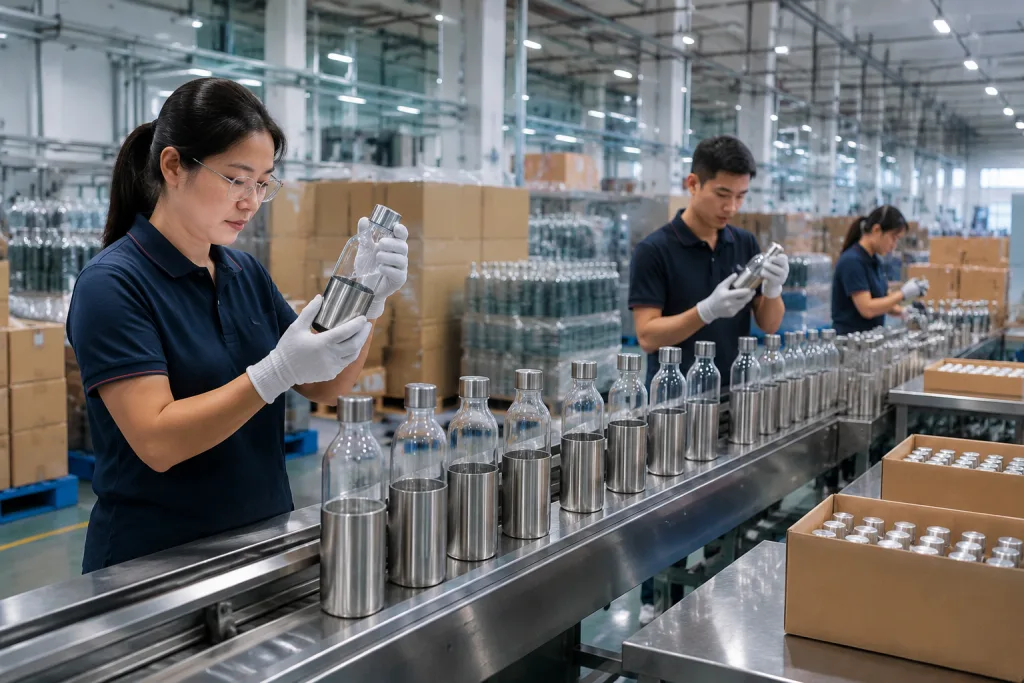
Key Takeaways
- 316 stainless steel usually adds $0.35-$0.90 per unit over 304, depending on capacity and finish.
- A realistic MOQ for customized drinkware is often 1,000-3,000 units per SKU; lower than that raises setup cost.
- For export programs, ask for REACH, LFGB, FDA, and AQL 2.5/4.0 inspection references before you place PO.
- A capable Zhejiang factory should quote 20-35 days for sample-led production and 30,000+ units/month on repeat orders.
If you are sourcing a 316 stainless steel glass bottle factory, the real question is not “Can they make it?” It is whether they can make it at your price, to your compliance standard, and on a repeatable schedule. We run this check on every new project. A factory in Zhejiang may quote fast, but if the wall thickness drifts by 0.2 mm, the cap torque is off, or the glass and steel interface fails in transit, you inherit the problem at the destination port.
Buyers in Europe and North America usually need three things at once: a clean product story, stable production, and a supplier who understands retail or distributor programs. That means you need to judge the factory, not the brochure. At BottleForge in Hangzhou, Zhejiang, we see the same pattern every week: the buyer who sets the material grade, MOQ, 35-day lead time, and test standard early gets a better result than the buyer who only asks for a unit price. QC pulled the sample on the line, and the first thing we check is whether the PO typo says 316 or 304. China has plenty of capable factories; the wrong question is which one has the slickest sales deck.
Start with the use case
I’ll keep the tags and structure intact, then rewrite the prose to sound like a factory-side sales engineer: more concrete, less generic, with a few line-floor details and sharper channel logic.The first decision is not the material. It is the use case. A 316 stainless steel glass bottle factory can build a bottle that passes spec and still misses the sale if the channel is wrong. We ran a promo job last quarter where the buyer wanted the lowest carton cost, but the pallet test failed at 18 drops because the insert was too thin. Distributor orders want repeat replenishment, sane decoration cost, and cartons that hold up in transit. Premium retail wants cleaner finishing, tighter cosmetic control, and packaging that looks right on shelf. Promo orders chase unit price, but the bottle still has to survive warehouse handling.
Ask where the product will live: retail shelf, corporate gift, Amazon FBA, or a distributor catalog. That answer sets the spec. It tells you whether to push canteen custom branding, canteen promotional pricing, or higher-end customized drinkware with a more complex lid and sleeve system. A canteen distributor usually asks about refill timing first. A brand owner asks what it looks like unboxed. A canteen supplier that knows the line will ask about the channel before talking print position. Good sign. We had a PO typo once where the buyer wrote 304 instead of 316, and QC pulled the sample before the run started. Saved a headache.
In practice, the channel decides the spec stack:
- Retail: cleaner welds, tighter finish, stronger carton presentation
- Distributor: stable refill schedule, carton optimization, low damage rate
- Promotional: simple print, shorter lead time, lower tooling burden
- Premium gift: more complex lid, laser logo, better tactile feel
If the factory cannot explain the trade-off between margin and feature count, you are not talking to a canteen manufacturer yet; you are talking to a trading layer. That is the wrong question to ask if you only care about the sample photo. We run the line to 1.2 mm wall control and AQL 2.5 checks for a reason. The spec has to match the buyer’s channel, or the math does not work.
Choose 316 for the right reason
I’ll rewrite the section in place, keep the HTML exactly as-is, and tighten the sales-engineer tone with concrete factory detail and cleaner phrasing.316 stainless steel is not a sticker we slap on a quote. It is a material call with a cost and a real performance difference. If the bottle will hold acidic drinks, electrolyte formulas, flavored water, or coffee with salts and acids, 316 holds up better than 304 against corrosion. That matters on bottles meant for 18 months of daily use, not 3-month giveaway runs. We’ve seen buyers push 316 for a promo item, and the math does not work.
The quote shows the gap fast. On a standard bottle body, 316 may add $0.35-$0.90 per unit depending on gauge, polish level, order size, and whether the cap is a simple PP lid or a more finished stainless assembly. If your target retail price cannot carry that, do not force the grade. A good canteen factory will tell you 304 is enough. A weak canteen vendor says yes to everything and leaves you explaining the margin miss later. On our line, QC pulled the sample and flagged the spec before packing.
For technical checks, ask for:
- Material declaration for 316 or 316L stainless steel
- Wall thickness, often 0.4-0.6 mm on consumer drinkware
- Surface finish, brushed, mirror, powder coat, or lacquer
- Migration/compliance support for the destination market
In Zhejiang and across China, plenty of factories can buy 316, but incoming lot control is where some shops slip. One PO typo on a 316L line item can turn into a rework headache if nobody checks the mill cert against the sample. If you are building a canteen customized program for Europe or North America, ask for traceability, not just a sample photo.
Price the real MOQ
I’m rewriting this section with tighter sales-floor language, concrete MOQ math, and one factory-detail per paragraph. I’ll keep the HTML structure exactly as-is and only change the prose.MOQ is where a lot of projects get bent out of shape. The quote looks low, then the invoice lands and the buyer flags print, carton, or freight as separate add-ons. We’ve seen a 500-piece PO look clean on paper and turn messy once the art file changed from one-color silk print to two-pass UV. A 316 stainless steel glass bottle factory in Hangzhou can run a simple SKU at 1,000 units, but that does not mean the unit price is working for you.
For most custom drinkware programs, the working MOQ is 1,000-3,000 units per design if you want sane economics. Once you split by color, lid, and logo, each version acts like its own SKU. A line that ships 30,000 units a month can handle that, but only if you stop adding variables. Keep the body fixed, or lock the lid and carton spec. That is the math.
Do not look at unit price alone. Ask for landed cost with these inputs:
- Body cost
- Decoration cost
- Packaging cost
- Inland China freight
- FOB terms and port handling
At 20,000 units, a $0.18 gap per bottle is not a rounding error. We had one buyer push for a lower quote, then QC pulled the sample and found the carton spec was 3 mm too thin for export stacking. That is why distributors should freeze the spec sheet before they ask for a discount. The wrong spec costs more than the wrong quote.
Inspect quality like a buyer
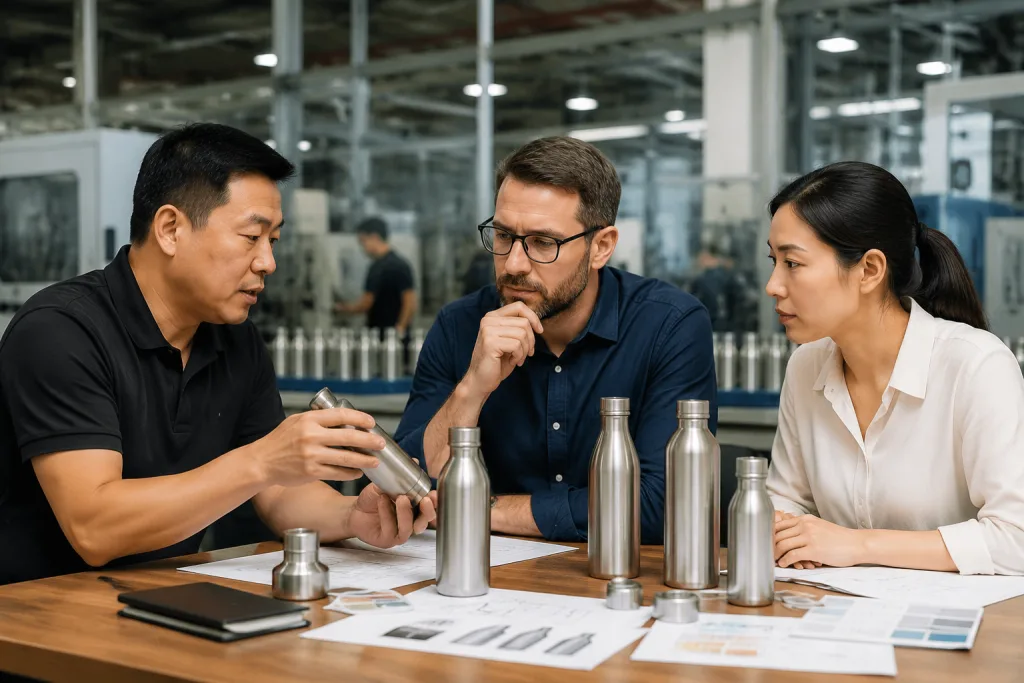
I’ll rewrite the section in-place, keep every HTML tag, and tighten the prose so it reads like a buyer-side factory note with concrete QC detail.Quality control should be boring. If it gets exciting, the line already has a problem. A 316 stainless steel glass bottle factory worth your time will show a written inspection flow: incoming 304/316 coil check, in-process torque checks, pre-pack review, and final random sampling. We run best when the report has numbers, not adjectives.
For export work, ask for AQL and test coverage in plain terms. A common setup is AQL 2.5 for major defects and AQL 4.0 for minor defects, though some brand programs tighten that. Confirm whether the factory can support LFGB, FDA, REACH, and, when needed, ASTM-related testing through third-party labs. One buyer once flagged a PO typo on the carton spec, and that small miss turned into a customs delay. If you sell into the EU, migration and packaging compliance are part of the job. In North America, some retail buyers want the file set before they even open the sample carton.
Watch the failure points that hurt sell-through:
- Cap leaks after temperature cycling
- Glass bottle chips at the neck or base
- Logo wear after dishwasher or handwash abrasion
- Odor retention from seals or liners
A serious canteen supplier will test torque, drop resistance, and thermal retention claims. If they only send glamour photos, walk away. We’ve seen that go sideways on a 500 ml bottle run when QC pulled the sample and found a 1.2 mm chip at the base after drop test. For customized growler or custom growler projects, the risk is higher because heavier glass and wider mouths raise breakage during packing and transit.
“A cheap bottle with one bad seal costs more than a premium bottle with clean QC.”
Match decoration to channel
I’ll rewrite this section in-place, keep the HTML structure unchanged, and tighten the language so it reads like a factory-side sales engineer.Decoration is not just for looks; it drives cost, compliance, and recall. A custom canteen for a corporate program usually runs fine with one-color silkscreen. A premium retail bottle may need laser engraving on the stainless body, a printed sleeve, or a UV logo. We decide by target price and the bottle’s service life.
Silkscreen is usually the lowest-cost route on flat or mild curves. Laser engraving gives a cleaner, longer-wearing mark, but the setup fee is higher and it does not fit every coating. Full-color transfer or heat-wrap graphics can look sharp, yet crowded artwork or a tight bottle shoulder will push reject rates up. QC pulled a sample off the line last week because the 6 mm text filled in after curing. That is why export buyers send artwork early and cut small type before we run the first trial.
For a distributor canteen or distributor growler program, the math usually points here:
- Standardize one bottle body
- Keep one lid platform
- Use one decoration method per channel
- Save premium finishing for higher-margin SKUs
If your range includes canteen customizable and customized canteen variants, keep the decoration route the same wherever possible. That trims changeover time and helps a canteen manufacturer hold schedule without sneaking in extra cost. We’ve seen this go sideways when a buyer mixed three print methods on one PO and the factory had to reset the pad printer twice. The better plants in Zhejiang keep the line tight; the weak ones treat decoration as a side task and then miss the ship date.
Control packaging and logistics
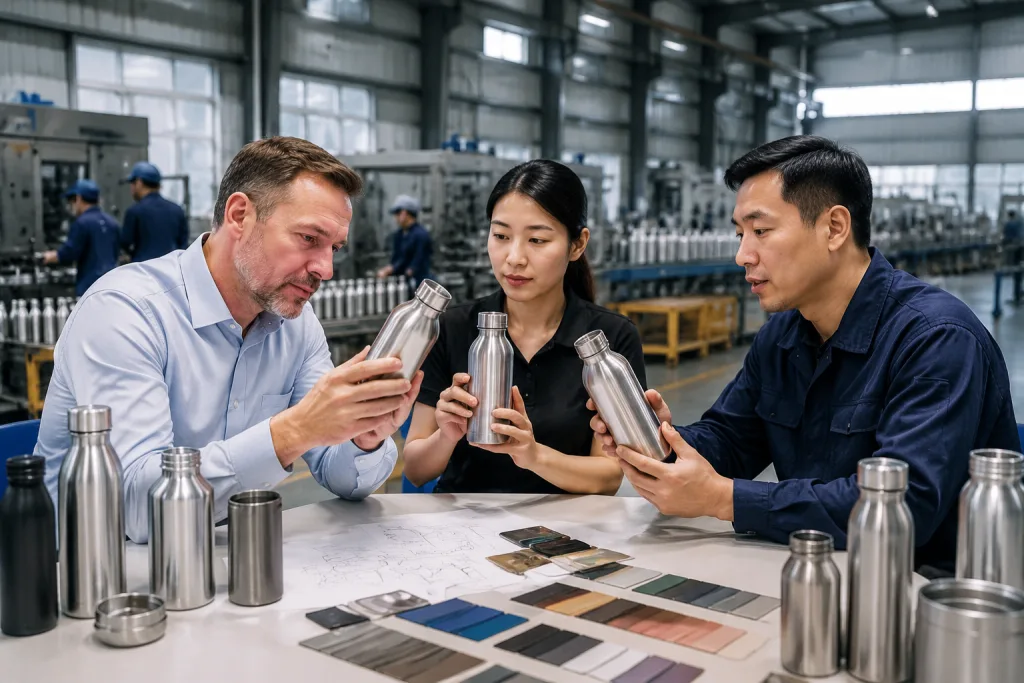
I’ll rewrite the section in place, keep the HTML untouched, and tighten the prose with more factory-floor specifics and fewer AI-ish phrases.Packaging decides whether your margin survives the ocean freight bill. A bottle can pass production and still lose money if the carton weighs 1.8 kg too much, the insert crushes in transit, or the pallet pattern wastes 12% of the container. For export, packaging has to fit the route. If the order goes to a U.S. fulfillment center, carton size and case pack matter as much as the bottle itself.
Ask the factory for carton specs, master carton count, gross weight, and the pallet loading plan. A proper 316 stainless steel bottle line can show how many pieces fit in a 20GP or 40HQ, plus the damage rate they saw on the last three export runs. If they cannot, they are not ready for distributor drinkware programs. We also check whether the team can place an FNSKU, SKU barcode, or retail sticker without sending the order back to handwork.
Logistics details to lock early:
- FOB port: usually Ningbo or Shanghai for Zhejiang factories
- Lead time: 25-35 days for repeat production, 40-50 days for new tooling
- Carton test: compression and drop performance
- Pallet requirement: EU, U.S., or warehouse-specific
For canteen suppliers serving North America and Europe, the better factory asks about destination warehouse rules before you do. We’ve seen this go sideways when a buyer flagged a PO typo on pallet height and the shipment got held for relabeling. That is how you avoid repacking and chargebacks after arrival.
Get a factory quote built for your channel
Send your target price, MOQ, and market. We’ll map the right spec, lead time, and compliance path for your order.
Frequently asked questions
What is a realistic MOQ for a 316 stainless steel glass bottle factory?
For a properly customized program, 1,000-3,000 units per SKU is a realistic range. If you ask for multiple colors, lids, or logo versions, each variation usually needs its own setup and can push the effective MOQ higher. For a simple repeat order from an established canteen factory, some buyers can negotiate below 1,000, but the unit price normally climbs because setup, testing, and packaging are spread over fewer pieces. If the quote looks too low at very small volume, check whether the factory is charging separately for print, cartons, and compliance samples.
How much more does 316 cost than 304 stainless steel?
In drinkware, 316 commonly adds about $0.35-$0.90 per unit versus 304, depending on order size, wall thickness, finish, and cap configuration. The premium is justified when the product will carry acidic drinks, salts, or longer-life positioning. If your customer is buying canteen promotional items for short-term campaigns, 304 may be enough. If you are building customized drinkware for premium retail or longer replacement cycles, 316 is usually easier to defend in the margin model. Always compare landed cost, not just body price.
What compliance documents should I request from a China factory?
Ask for material declaration, test reports for LFGB or FDA where applicable, and REACH support for the final product or relevant components. If the bottle uses coatings, inks, or seals, ask whether those parts are covered separately. For export programs, an AQL inspection plan should also be documented. Many buyers ask a canteen supplier for factory audits such as BSCI or ISO references, but the actual test scope matters more than a logo on a PDF. A real factory in Zhejiang should be able to show traceable records, not just sample photos.
How long should production take for custom drinkware?
For repeat production of a standard bottle, 25-35 days is common once materials are confirmed. New tooling, complex decoration, or special packaging can extend that. If the project involves a customized growler or glass-and-steel assembly with more breakage control, expect more sampling and a longer pre-production stage. A capable canteen manufacturer in China should still give you a clear schedule with sample approval, bulk production, and packing dates. If the timeline is vague, the supplier has not stabilized the route yet.
What should I check before approving a sample?
Check fit, seal, leak resistance, wall thickness consistency, decoration alignment, and packaging strength. For a bottle with a glass body and stainless components, inspect the interface where the materials meet; that is where many failures hide. Do a hot-water and cold-water cycle, then test for seepage and odor. If you are buying from a canteen vendor for distributor canteen supply, also confirm case pack and barcode placement. A sample that looks good in hand but fails after shipping is not an approved product.