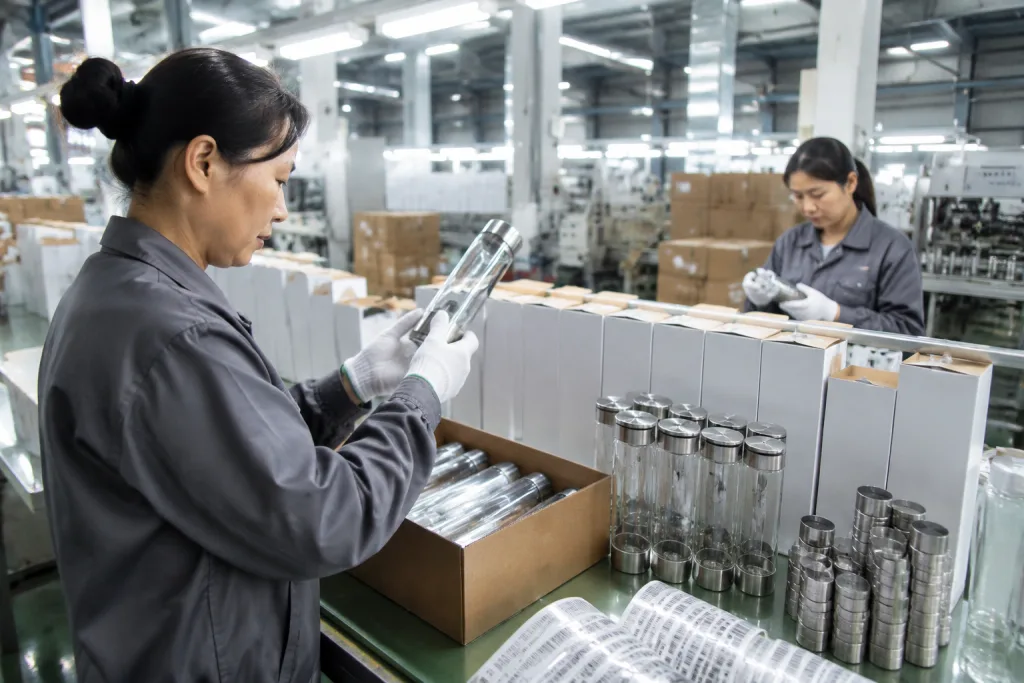
Key Takeaways
- 316 stainless steel usually adds 20-35% cost over 304, but it makes more sense for acidic or premium-use drinkware
- A practical MOQ for a custom glass bottle is often 1,000-3,000 units; sampling usually takes 7-12 days
- Expect FOB China pricing to vary by 12-28% depending on glass wall thickness, lid build, and decoration method
- For Europe and North America, ask for REACH, food-contact declarations, and AQL 2.5/4.0 inspection terms before PO release
If you are buying a 316 stainless steel glass bottle custom, the real question is not “can you make it?” The real question is whether the bottle will hold up in your market, protect your margin, and pass claims review. We run this check on the line before we quote. Decide on steel grade, glass type, closure system, and decoration first. If you skip that step, you pay for remakes, delayed artwork, or a design that looks clean and still cracks in drop testing.
From our factory in Zhejiang, we see the same pattern every week: buyers want a premium look, but they also need MOQ that does not choke cash flow, FOB pricing that stays stable, and a lead time that fits the launch calendar. QC pulled one sample last month with a 0.8 mm wall mismatch, and the buyer flagged it before the PO moved. This is the wrong question to ask: “Can you make it by Friday?” The better sequence is use case, material stack, compliance file, then production cost. That is how we ship custom drinkware without guessing.
Start With the Use Case
Before you compare quotes, pin down where the bottle will live. A 316 stainless steel glass bottle custom for premium cold brew, infused water, or corporate gifting is not the same part as a gym bottle or a retail shelf item. If the target is custom drinkware for an upscale brand program, the bottle has to sit steady in hand, hold flavor cleanly, and pass a real drop test. If the order is promotional volume, the design stays simpler and the unit cost has to stay in line.
We ask buyers three things first: daily use or occasional use, hot fill or cold fill, and retail packaging or bulk packing. Basic question? Sure. The spec changes fast. A 500 ml bottle with a 1.2 mm glass wall, 316 inner component, and bamboo lid is a premium SKU. A 650 ml bottle with a 1.5 mm wall and a simpler lid may ship cheaper, but it also weighs more and can push freight up 8-15% on a container basis. We run this split every week in Zhejiang, and QC pulled the sample on the bench if the buyer skipped the use case and sent a vague PO.
- Retail brand: prioritize finish, lot-to-lot consistency, and carton presentation.
- Distributor canteen: prioritize MOQ, repeatability, and stable lead time.
- Canteen promotional: prioritize decoration area and low landed cost.
Do not let a supplier sell you features you will not use. If you only need a cold-fill lifestyle bottle, a complex lid assembly adds cost and no extra sell-through. The math does not work.
Choose the Material Stack
The phrase 316 stainless steel glass bottle custom matters because it puts two specs in the same build: 316 stainless steel for chemical resistance and glass for shelf appeal. 316 earns its keep when the drink is acidic, salty, or sits against metal for 18 days instead of 12. It is not magic. It is not needed for every SKU. For a lot of bottles, 304 does the job. If your buyer wants a premium line, 316 gives you a cleaner spec sheet and fewer pushbacks when the sample goes to QC.
Glass choice carries its own weight. Soda-lime glass is cheaper, standard, and fine for controlled use. Borosilicate handles thermal shock better, which is why we push it for a custom canteen or customized drinkware program that will see hot water, tea, or repeated washing on the line. We ran one project where the buyer flagged a 1.2 mm wall as too light after the first drop test, so we moved to 1.6 mm. Wall thickness usually sits between 1.0 mm and 1.8 mm, depending on diameter, target weight, and how much breakage the buyer will accept.
If you are comparing a canteen factory quotation from China, ask for the exact steel grade on the component, not just “stainless steel.” Ask for the glass type, wall thickness, and lid finish spec. One PO typo can change the whole order: “316” becomes “316L,” or the cap color moves from matte black to gloss, and the buyer comes back at the last minute. A serious canteen manufacturer should give material declarations, batch traceability, and a sample made by the same process we run in Zhejiang, not a hand-finished one-off that cannot be repeated.
“Premium” is not a buzzword here. It is a stack of small decisions: 316 where it matters, the right glass, and a closure that still seals after 50 open-close cycles.
Lock the Closure and Seal
Most bottle failures are not dramatic. They are annoying: a cap that loosens in transit, a gasket that smells after one wash, a lid that looks elegant but is hard to clean. For a custom drinkware program, the closure system is a technical part, not decoration. If the bottle is for cold drinks, the seal can be simpler. If you expect hot fill, carbonation, or repeat travel use, the cap design needs to be conservative. We had a buyer flag a 0.3 mm gap on the first pilot run, and that small gap turned into a leak claim after carton drop testing.
There are four practical choices. A screw cap is the simplest and usually the cheapest. A flip-top is convenient but adds moving parts. A bamboo or wood-look lid improves shelf appeal, but humidity and coating quality can change the result. A full 316 internal component on the seal side costs more, and it makes sense when the customer cares about corrosion resistance and repeated washing. For customizable canteen and customized canteen orders, we run a removable silicone gasket so QC can pull the sample, check the groove, and inspect it under AQL without tearing the whole lid apart.
Ask the supplier for torque range, leak test method, and dishwasher tolerance if you need it. A closure that survives 30-50 drop-and-shake cycles in internal testing is a safer bet than a fancy lid with no test data. The math does not work the other way. One PO typo on the closure code can still send the wrong liner, so we always cross-check the thread spec and gasket drawing before mass production. That is the difference between a decent canteen supplier and a factory that only knows how to make samples.
- Request gasket material: silicone, TPE, or EPDM.
- Confirm seal method: thread, insert, or press-fit.
- Define leak test: inverted hold, pressure shake, or shipping simulation.
Balance Decoration and Margin
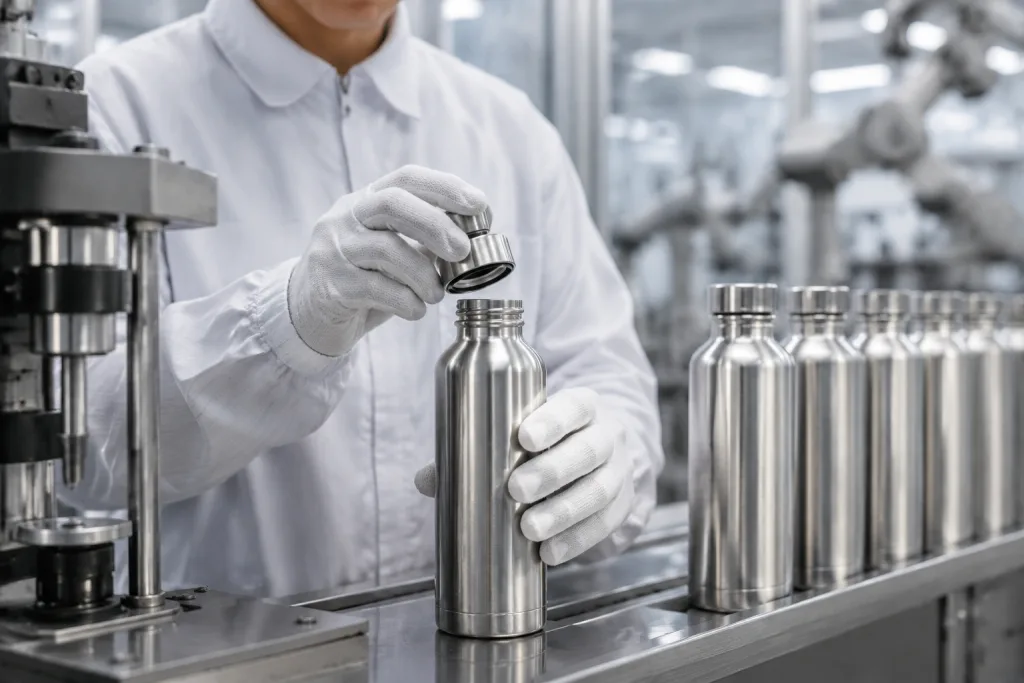
Decoration is where a lot of buyers give away margin. The bottle can pass every spec check and still miss target cost because the logo method was wrong. For a canteen customized or canteen customizable project, pick the method by run size, logo detail, and sales channel. We run laser engraving on metal caps with a 0.2 mm depth on the line; it holds up and reads premium. Silkscreen is better on larger flat areas. UV print carries more color, but it is pickier on curing and surface prep.
On a 316 stainless steel glass bottle custom order, the body usually gives fewer decoration options than a full-metal product, so use the lid, sleeve, carton, or insert card with intent. The buyer flagged it when the artwork crowding made the front panel unreadable at 1 meter. If the product goes through a canteen distributor or distributor drinkware channel, the mark needs to pop fast and stay consistent on repeat PO cycles. For a brand campaign, the unboxing matters more than one extra print color. That is the right trade.
Cost impact is easy to map. One-color silkscreen adds a small unit cost, laser engraving brings a modest setup fee with low repeat cost, and full-color packaging changes can move price harder than the decoration itself. The math does not work if you chase every surface. Keep the bottle clean, put the brand on one strong spot, and let packaging carry the story. We have seen that go sideways on custom canteen and custom growler orders, where freight and warehousing already eat into margin.
Check Compliance Before You Quote
If your target market is Europe or North America, compliance is the first gate, not a footnote. Ask for the papers before the first serious quote. A factory in China should be able to show food-contact declarations, REACH support, and audit records on request. If the order is going to retail or Amazon, the buyer will also ask about carton labels, barcode placement, and case-pack counts. A proper canteen manufacturer treats that as standard export work. We run that paperwork all the time.
For quality control, put the AQL level into the PO. We usually see AQL 2.5 for major defects and 4.0 for minor ones, but the right call depends on your margin and how much risk you can carry. Confirm whether the line uses ISO-style process control, batch traceability, and incoming inspection for glass and closures. QC pulled the sample, found a 1.2 mm cap gap, and that is the kind of miss you want caught before shipment. If you do not ask, the factory may still ship a decent lot, but the math does not work in your favor when a problem shows up.
When we work with a canteen supplier or canteen vendors network, we also push for a plain claim review. Do not print “unbreakable,” “100% leakproof,” or “medical-grade” unless the file can back it up. A usable export pack should include specs, carton size, gross weight, drop test notes, and approved artwork files. The buyer flagged a PO typo on the case count once, and we caught it before the pallets left; that is why clean docs matter. In Zhejiang and across China, the factories that ship smoothly are the ones that document well, not the ones that talk loudest.
Read the Factory Like a Buyer
I’ll rewrite this section in-place, keep the HTML structure intact, and tune the copy to sound like a factory-side sales engineer with specific numbers and buyer-floor details.You do not need a factory tour to judge whether a supplier can ship. Ask for three numbers: monthly capacity, standard MOQ, and lead time by product type. On our line in Zhejiang, a 316 stainless steel bottle program can run 300,000 to 800,000 units per month across multiple lines, but that only counts if the spec holds when QC pulls samples during peak season. For a custom bottle job, 1,000 units works for a plain decoration package, while 3,000 units is more realistic once you add special coating, boxed sets, or mixed accessories.
Lead time is the number buyers miss. Sampling usually takes 7-12 days. Mass production sits around 25-40 days after sample approval and deposit, depending on tooling, artwork, and packaging. If a supplier quotes 12 days for a fully custom bottle, ask what is actually being made; we have seen that pitch turn into a stock lid with a new carton. Good canteen manufacturers and canteen distributors spell out the critical path instead of overpromising and blowing up the PO.
When you compare suppliers, ask who owns the tooling, what happens on a reorder, and how they hold color from one batch to the next. That matters for customizable drinkware, customized growler, and distributor canteen programs because repeat business lives or dies on consistency. The buyer flagged a 2 mm logo shift on one run, and the math did not work; a factory that quotes fast but misses the second order is handing you a future claim, not a solution.
Ask for spare parts before you place the order. If the bottle uses a gasket, strainer, or replacement lid component, price those items and list the part numbers on the PO. We once caught a typo where a lid code changed from L-04 to L-40, and that small error would have stalled shipment for a week. That is how a real canteen factory runs.
Build the Order Around Landing Cost
I’ll rewrite just the prose inside the existing HTML, keep every tag and number intact, and tighten it to sound like a buyer-side sales engineer wrote it.Do not buy on unit price alone. For imported drinkware, the number that matters is landed cost. That covers FOB China price, freight, duty, brokerage, and any relabeling or prep work. A bottle at USD 2.10 FOB can turn into a different deal once you add carton changes and inland trucking. If you are a brand owner or distributor, you need margin left for returns, promos, and channel squeeze.
For a canteen promotional project, keep the build simple and repeatable. For a premium retail bottle, spend on the parts the shopper sees: closure fit, finish consistency, and carton presentation. For a custom growler or customized growler program, look at how it ships and stacks, because bulky packs can wreck the math even when the bottle price looks good. We see North American buyers miss carton density all the time; one extra foam layer can cut pallet efficiency by 10-18%. The line has to run clean.
When you negotiate with a supplier in China, ask for three quote levels: sample-level finish, standard production, and upgraded packaging. Compare each one against your sell price and channel. We had a buyer flag a PO typo on packaging count, and the landed cost changed by more than the unit delta. If the margin only works at the cheapest spec, the project is weak. If it still works with better decoration or thicker glass, you have a SKU worth pushing.
Request your custom bottle spec sheet today
Send your target price, MOQ, and market. We will check the material stack, compliance needs, and production path before you waste time on weak samples.
Frequently asked questions
What MOQ should I expect for a 316 stainless steel glass bottle custom order?
For a normal export order, a practical MOQ is often 1,000 to 3,000 units depending on lid complexity, print colors, and packaging. If the bottle uses a stock mold and standard decoration, some factories in Zhejiang can start lower. If you need a new glass shape, special lid tooling, or custom carton art, expect the MOQ to move up. Sampling usually takes 7-12 days, and production lead time is often 25-40 days after approval and deposit. Always confirm whether the MOQ is per color, per size, or per artwork version.
Is 316 always better than 304 for custom drinkware?
No. 316 is stronger on corrosion resistance, especially for acidic, salty, or premium-use applications, but it usually adds about 20-35% to the stainless component cost. If your bottle is mostly for water or dry storage, 304 may be enough. If your customer expects a premium specification, or if the metal part will see harsher conditions, 316 is worth the upgrade. Ask your canteen manufacturer to show exactly where 316 is used, because sometimes the claim applies only to one insert or one inner component, not the entire assembly.
How do I compare suppliers in China fairly?
Compare them on the same spec sheet. Ask each canteen supplier for material grade, glass type, wall thickness, closure spec, decoration method, MOQ, lead time, and test documents. Then compare FOB China pricing, not only unit price, because freight and packaging can change the final cost. A factory that can quote in 24 hours but cannot explain AQL, REACH support, or batch traceability is less reliable than a slower, more disciplined supplier. In Zhejiang and across China, the best factories tend to ask detailed questions before they quote.
What quality tests should I require?
At minimum, ask for leak testing, visual inspection under AQL 2.5/4.0, carton drop testing, and material support for food-contact compliance. If the bottle will ship long distance, ask for simulated transit testing or a drop-and-shake protocol. For a glass bottle with metal parts, check fit, gasket compression, and whether the closure loosens after repeated cycles. If you are selling into Europe or North America, make sure the compliance file covers REACH-related material support and any market-specific food-contact requirements.
Can I use this bottle for retail, promo, and distributor channels at the same time?
Yes, but only if you plan the spec correctly. For retail, the bottle must look premium and stay consistent across batches. For canteen promotional use, the logo area and low cost matter more. For distributor drinkware programs, packaging and repeatability matter most. A distributor canteen program usually fails when the lid quality or carton spec changes between reorders. If you want one SKU to serve all three channels, keep the bottle design clean, avoid fragile extras, and choose packaging that can scale from sample to container load.