Key Takeaways
- For 316 stainless sports bottles, realistic MOQ starts at 1,000 pcs per color and 3,000 pcs for custom lid tooling
- Use 316 stainless steel for the inner wall and 304 for the outer wall when you need cost control and corrosion resistance
- Plan 7-10 days for samples, 30-40 days for mass production, and 3-5 days for final AQL inspection
- Laser engraving lasts longer than silk screen on powder coating, but it costs about USD 0.12-0.35 more per unit
You are not just buying a bottle. You are putting your gym chain or fitness brand name on something customers grip, drop, wash, and carry five days a week. A cheap bulk fitness water bottle can look fine in a catalog, then fail at the lid gasket, sweat through the coating, or arrive with weak laser engraving.
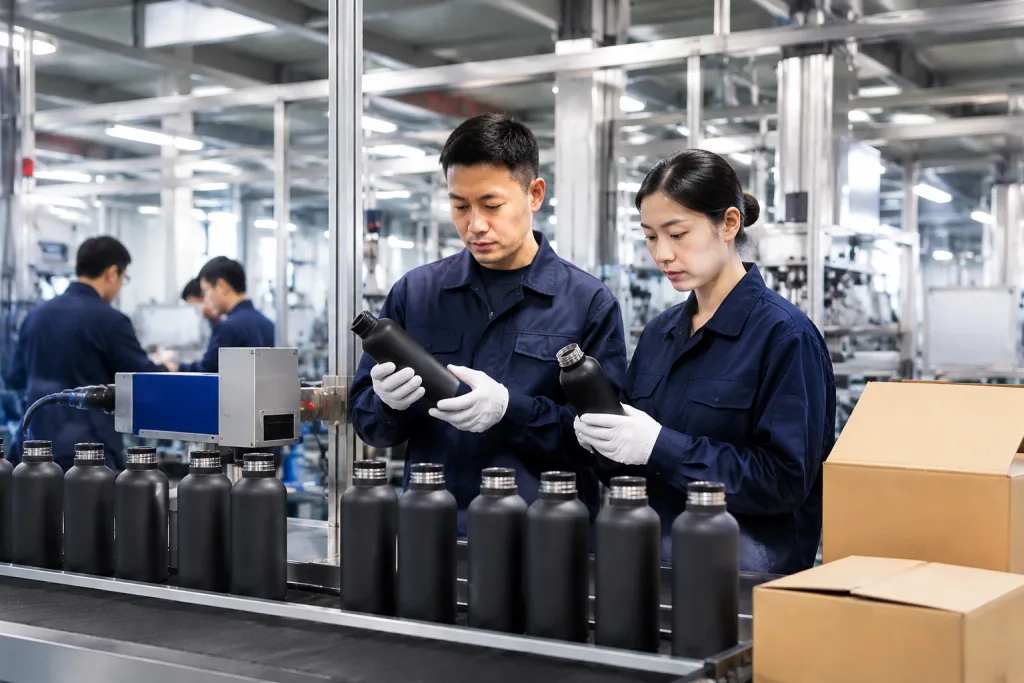
For a 316 stainless steel fitness water bottle private label order, the hard work happens before mass production. You need to define steel grade, capacity, lid type, logo method, packaging, AQL limits, and shipment terms. From Zhejiang, China, our factory normally runs 450,000 stainless bottles per month, with MOQ from 1,000 pcs per color for standard sports bottle molds.
Start with the actual gym use
Let’s start with a real gym order. You handle procurement for an 80-location chain in Germany, Canada, or the United States. Marketing wants a premium custom sports water bottle for member welcome kits, retail shelves, and trainer merch. They say “316 stainless, matte black, logo on front, maybe a shaker option.” That is a direction, not a spec. On the line, we need a use case before we quote.
The first call is the job the bottle has to do. A bulk gym water bottle for treadmill users is not the same as a bulk shaker bottle for protein powder. For gym-floor carry, 600 ml and 750 ml move fastest. They fit most cup holders, bags, and display trays. For lifting or outdoor training, 900 ml or 1,000 ml sells better, but the carton gets heavier and the shipping cube jumps. A 750 ml double-wall bottle usually weighs 310-380 g before packaging, depending on wall thickness and cap structure. QC pulled the sample, and that number changed by 18 g between two lid builds.
For a 316 stainless steel fitness water bottle private label order, I would write the first spec like this: 750 ml, vacuum insulated, 316 stainless steel inner wall, 304 stainless steel outer wall, food-grade PP lid, silicone sealing ring, powder coating, laser logo, individual kraft box, 24 pcs per master carton. That gives us a clean costing sheet and a sample route. The buyer once sent a PO with “mat black” instead of “matte black”; the line caught it before print, but the math does not work if the color call is loose.
If you want a custom shaker bottle, say which build you mean: a stainless bottle with a mixing ball, a removable agitator, or a full shaker lid with flip spout. The third one needs the most testing because protein residue sits around the hinge and gasket. A custom logo shaker bottle also leaks more often than a plain screw-cap sports bottle. We have seen that go sideways in returns. The buyer flagged it after a hinge test at 5,000 opens, so this is the wrong question to ask unless the use case is already locked.
Specify 316 without overpaying
316 stainless steel gets requested for a reason: it carries more molybdenum than 304, so it holds up better against chloride, acids, and salty drinks. That matters when users fill the bottle with electrolyte mixes, BCAA drinks, lemon water, or diluted sports powder. You do not need 316 on every metal part. For most private label fitness bottles, we run 316 for the inner liner and 304 for the outer shell, and that is the right split for cost and function.
Put the grade on the quotation and on the pre-production sample report. A solid China supplier should give raw material declarations, plus third-party reports when the buyer asks for LFGB, FDA food contact, or REACH coating checks. In Europe, LFGB migration testing comes up often. In North America, FDA food contact paperwork is the usual ask. If the bottle is for a kids’ program, ASTM review may also enter the file, depending on the cap and any small parts.
Wall thickness is where quotes get slippery. A bottle can say 316 on the spec sheet and still arrive with thin stock. On an insulated custom fitness water bottle, we usually see the inner wall at 0.4 mm and the outer wall at 0.5 mm before forming. Drop it thinner and you save a few cents, but the bottle dents faster on the line, in cartons, and in gym bags. That is the wrong place to cut cost.
Price follows steel cost, finish, lid structure, and packing. From Zhejiang, a 750 ml 316 inner / 304 outer vacuum bottle with powder coating and laser logo is often FOB Ningbo around USD 4.20-6.80 at 3,000 pcs. A single-wall 316 bottle can land lower, but it will not keep drinks cold, and retail buyers usually flag it as less premium. We ship both types, and the math does not work if you try to force vacuum performance into a bare-bones build.
Do not approve a quote that says only “stainless steel bottle.” Put grade, capacity tolerance, coating type, logo method, packing, and testing scope in writing.
Build the private label package
Private label is not just putting a logo on the bottle. For a fitness chain, the bottle has to look right in the club, on the online store, and in the wholesale catalog. A private label fitness water bottle package usually covers bottle color, logo, lid color, insert card, barcode sticker, carton mark, and sometimes a retail sleeve. If you sell through distributors on fitness water bottle programs, carton labeling matters even more because warehouse teams need to spot SKUs fast. We run this on the line every week, and the buyer usually flags the carton mark before they care about the sleeve.
For logo decoration, pick it based on the surface and the life you expect. Laser engraving is my default for powder-coated stainless bottles. It cuts through the coating and exposes the metal below, so it does not peel like ink. For a clean gym brand logo, laser usually costs USD 0.12-0.35 per unit, depending on logo size. Silk screen is cheaper for one-color logos, around USD 0.05-0.15 per unit, but it needs abrasion testing and can fail on textured coatings if the ink system is wrong. QC pulled the sample after 200 rub strokes on a 45 mm logo panel, and that is where the weak ink showed up.
Full-color graphics work with heat transfer or UV print, but the math has to be honest. A customized gym water bottle with a large wrap print looks sharp in photos, yet it scratches faster in daily gym bags. If your brand lives on a simple mark, use laser. If you need a campaign design for a limited drop, use print and accept a shorter cosmetic life. We have seen this go sideways when a buyer wanted “premium” print on a bottle that was supposed to survive locker-room use.
Packaging changes both cost and damage rate. A white box is cheaper, but a kraft box with black printing usually fits fitness branding better. For Amazon or DTC orders, add FNSKU or UPC labels at factory level. For wholesale, use export cartons with SKU, quantity, gross weight, net weight, carton size, and “Made in China” marking where required. A typical 750 ml bottle carton packed 24 pcs may be around 54 x 37 x 30 cm, but confirm after sample packing. The buyer once sent a PO with “24pcs/carton” typed as “42pcs/carton”; that kind of typo breaks the pallet math fast.
Sample like you mean it
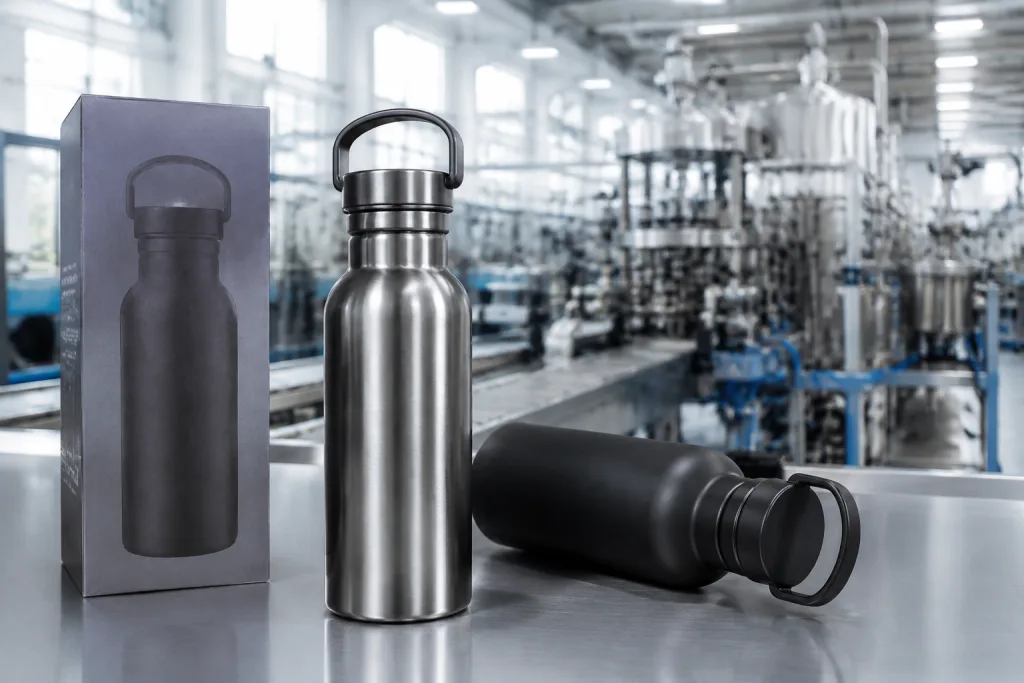
A sample is not a souvenir. It is the physical contract for your bulk sports water bottle order. For standard molds, we run 7-10 days for a plain sample and 10-14 days for a branded pre-production sample. If you need a new lid, custom carry loop, silicone boot, or a custom made shaker bottle agitator, add 20-30 days for tooling and the first trial on the line.
When the sample lands, test it the way your buyers will use it. Fill it with cold water and ice, leave it sideways for 8 hours, shake it 30 times, and check the lid, spout, and silicone ring for seepage. Put a protein drink inside if it is a customizable shaker bottle. If the lid still holds odor after one wash, the buyer will flag it and your service inbox will feel it.
Vacuum performance has to pass before mass production. A normal double-wall vacuum bottle should keep cold water cold for 12-24 hours, depending on capacity and ambient temperature. No lab setup is needed for first screening: fill it with boiling water for 10 minutes and touch the outside. If the body gets hot, the vacuum is bad. On QC, we pull the sample, do hot water vacuum detection, then a visual check before packing.
Check the practical numbers too. Does it fit a standard car cup holder? Is the mouth wide enough for ice cubes? Is the lid easy to clean? A distributor gym water bottle that looks premium but needs a brush for every groove will come back with complaints. For gym chains, I ask for a mouth diameter of 45-55 mm and a cap with a removable gasket. That one choice cuts odor and mold issues over time.
Lock the order before production
After the pre-production sample is approved, freeze the spec. This is where buyers get burned. Marketing asks for a bigger logo, purchasing wants a packaging swap, and the distributor changes the barcode after the cartons are already printed. One typo on the PO, one line of artwork, and the schedule slips.
A clean purchase order for a custom gym water bottle should list SKU, capacity, material structure, Pantone color, coating finish, logo artwork file version, logo size and position, lid color, packaging, barcode, carton mark, inspection standard, shipment term, and delivery date. If you are buying for multiple locations, split quantities by SKU in the PO. Do not scatter this across six emails. We have seen that go sideways on the line, and the buyer flagged it only after QC pulled the sample.
For standard sports bottle molds in our Zhejiang facility, MOQ is usually 1,000 pcs per color. For a custom lid, silicone mold, or proprietary shaker insert, MOQ is more often 3,000-5,000 pcs because tooling and line setup take longer. Mass production lead time is normally 30-40 days after deposit and sample approval. In peak season before summer, add 7-15 days. The math does not work any other way: stainless forming, welding, vacuuming, coating, logo work, and packing all need line time, and a laser engraving shift does not fix a missing mold.
Payment terms for new buyers are often 30% deposit and 70% before shipment after inspection. FOB Ningbo or FOB Shanghai are common for exports from Zhejiang, China. If you are new to importing, ask for carton dimensions early so your forwarder can calculate freight. Stainless bottles are not extremely heavy, but they take volume. A 3,000 pc order may need several cubic meters, and air freight can wipe out margin unless the launch date is on fire.
QC the bottle, not the catalog
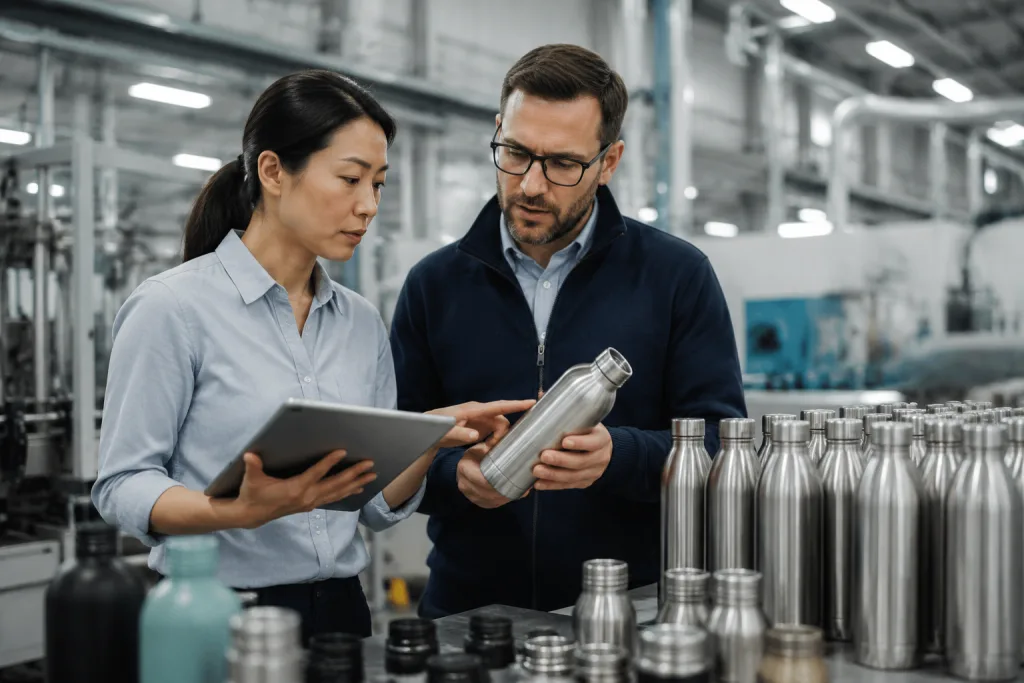
Final inspection starts when at least 80% of the order is packed and 100% is finished. Use AQL, not “please check quality.” For drinkware, buyers here usually run AQL 2.5 for major defects and AQL 4.0 for minor defects. Critical defects stay zero tolerance: sharp edges, leaking, wrong material, contamination, broken glass parts if any, or unsafe packaging.
For a customized fitness water bottle, the checklist has to cover capacity, weight, height, diameter, mouth size, logo position, color match, coating adhesion, leakage, vacuum performance, odor, lid function, gasket fit, barcode scan, carton mark, and packing quantity. QC pulled the sample at 312 mm height and 286 g, and that kind of hard number beats a catalog claim. For coating adhesion, a cross-hatch tape test gives useful data. For printing, rub testing with dry and wet cloth shows weak ink fast. For laser engraving, check line consistency and burn marks around thin logo strokes.
Leakage testing is not “turn one bottle upside down and call it done.” We run a simple check: fill selected bottles to 80-90%, close the lid, shake 10-20 times, lay them horizontally for 30 minutes, then inspect. On a bulk shaker bottle or distributor shaker bottle program, test with water and a slightly thicker liquid if the lid is sold for protein mixing. The buyer flagged it once on a 20 oz shaker cap because powder residue changed how people cleaned and closed the lid. That pushback was fair.
Packaging inspection matters. Crushed retail boxes can make a good bottle unsellable. Master cartons need enough burst strength, and heavier insulated bottles usually go in a 5-ply export carton. If you ship to distributors gym water bottle warehouses, carton labels must match the packing list exactly. One wrong digit on a SKU creates chargebacks or delayed receiving, and the math does not work in your favor.
Plan replenishment and SKU control
The first order tells you whether the bottle fits your members and your channel. The second order tells you whether the SKU setup makes money or burns cash. I’ve seen brands launch matte black, white, navy, olive, pink, silver, plus two lid types; the presentation looks clean, but MOQ gets split six ways and dead stock piles up fast.
For a new custom sports water bottle program, start with 2-3 colors and one capacity. That is the right question to ask. If you need both retail and giveaway versions, keep the bottle body unchanged and switch the packaging: retail gets a printed box and barcode, while gym member kits get a kraft box or bulk inner carton. We run this setup on the line all the time because it keeps the filling and packing rhythm steady and shortens reorder lead time.
Track defect feedback by issue type: leakage, coating scratch, odor, dent, logo wear, missing accessory, and carton damage. After 60-90 days of sales, you will know whether the next order should add a 1,000 ml size, a straw lid, or a custom shaker bottle version. QC pulled a sample last month and found a gasket hardness drift of 3 Shore A; that is the kind of detail that tells us whether to adjust gasket spec, coating thickness, carton packing, or spare-part supply.
If you are a distributor sports water bottle buyer, ask your factory to hold approved color panels, logo position drawings, and golden samples. At BottleForge Industrial in Hangzhou, Zhejiang, we keep retained samples for repeat private label programs so your reorder does not drift from the approved version. We’ve seen this go sideways when a buyer flagged a PO typo on the logo width, then the second shipment came in 2 mm off and sat next to last season’s stock on the same gym retail wall.
Send your bottle spec for a factory quote
Share capacity, logo, quantity, lid style, and target market. We will reply with MOQ, FOB pricing, sample timing, and QC options.
Frequently asked questions
Is 316 stainless steel necessary for every fitness bottle order?
Not always. For plain water use, 304 stainless steel is usually acceptable and cheaper. For a 316 stainless steel fitness water bottle private label program, I recommend 316 on the inner wall when users may add electrolytes, lemon, salt tablets, or sports supplements. A common cost-balanced structure is 316 inner wall plus 304 outer wall. At 3,000 pcs, this may add roughly USD 0.25-0.60 per bottle versus a full 304 construction, depending on steel price and capacity. If your brand sells the bottle as premium gym equipment, the upgrade is easier to justify.
What MOQ should a gym chain expect for custom bottles?
For standard stainless sports bottle molds, a realistic MOQ is 1,000 pcs per color. If you want a fully custom gym water bottle color with powder coating, laser logo, and retail box, 1,000-3,000 pcs is a practical starting range. For a custom lid, custom made shaker bottle insert, silicone boot, or new mold, expect 3,000-5,000 pcs minimum. Tooling cost can range from a few hundred dollars for simple silicone parts to several thousand dollars for complex plastic lids. Smaller test runs are possible, but unit price rises quickly.
How long does private label production take after sample approval?
For a standard customizable sports water bottle, plan 30-40 days for mass production after deposit and signed sample approval. Branded samples normally take 10-14 days if the mold exists. If you need custom tooling, add 20-30 days before production. Final inspection usually needs 1 day on site, but allow 3-5 days in your schedule for booking, reporting, and any rework. Before summer and Q4 gift season, China factories get full, so adding 7-15 days of buffer is sensible.
Which logo method is best for a fitness brand bottle?
For powder-coated stainless bottles, laser engraving is usually the safest choice. It does not peel, handles sweat and washing better, and looks premium on matte finishes. Expect around USD 0.12-0.35 per unit depending on logo size and complexity. Silk screen is cheaper, often USD 0.05-0.15 per unit for one color, but it needs adhesion and rub testing. For full-color campaign graphics, UV print or heat transfer can work, but you should approve abrasion samples before ordering 3,000 pcs or more.
Can one factory supply both sports bottles and shaker bottles?
Yes, but check capability carefully. A bulk sports water bottle uses different risk controls than a customized shaker bottle. Shaker lids need better hinge, spout, and gasket testing because users shake liquid under pressure. Ask for leakage tests, dishwasher guidance if claimed, food-contact material reports, and spare gasket availability. If you need a distributor shaker bottle line and a stainless sports bottle line together, keep artwork, packaging, and carton marks consistent, but inspect each product type separately under AQL 2.5 major and 4.0 minor.