Key Takeaways
- True 316 inner liners should be verified by PMI or XRF testing, not only supplier paperwork
- For custom sports water bottle orders, 3,000 pcs is a realistic MOQ for stable pricing and color control
- Powder coating needs 60-90 μm thickness plus cross-cut adhesion testing before mass shipment
- AQL 2.5/4.0 inspection should include leak, torque, logo abrasion, and carton drop tests
A fitness bottle looks simple until the first container lands and your gym members complain about metallic taste, shaker lids dripping in the car, powder coat chipping at the base, or logos rubbing off after 2 dishwasher cycles. QC pulled a 750 ml sample last month with a 0.35 mm gap under the flip cap seal. Small gap. Big headache. By then, the FOB price you negotiated is no longer the real cost.
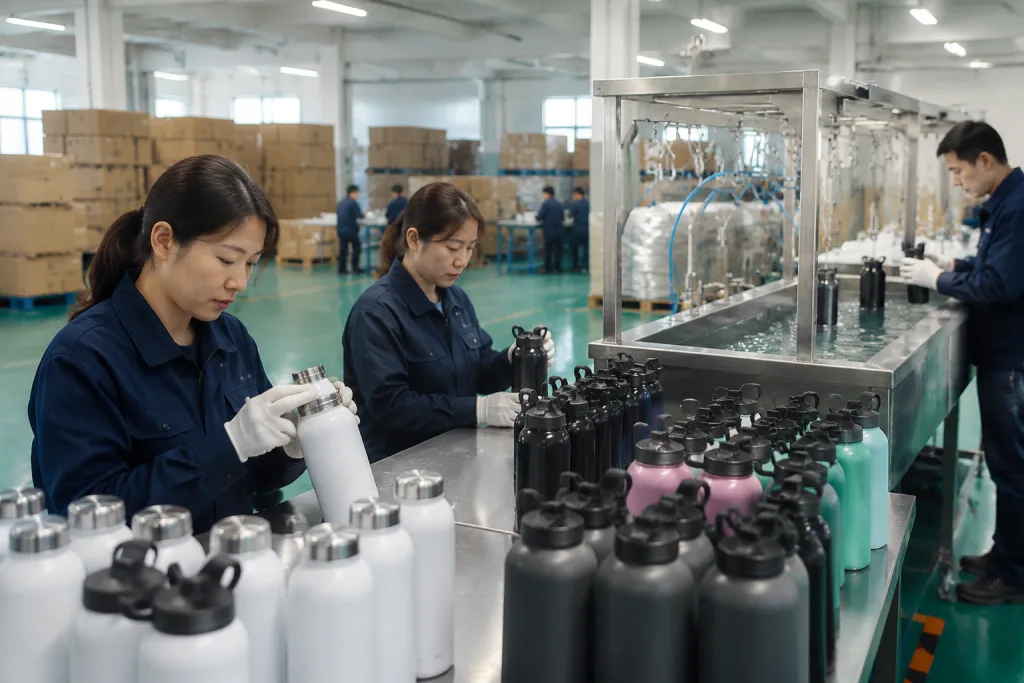
If you are sourcing from a 316 stainless steel fitness water bottle manufacturer in China, “750 ml, black, logo printed” is the wrong spec to send. You need to lock the steel grade, forming tolerance, weld seam, cap structure, coating thickness, logo method, carton drop test, and AQL inspection. We ship about 650,000 stainless bottles per month from our Zhejiang factory, and we run into the same 6 failure points again and again on the line.
When 316 Becomes Just a Claim
The first failure mode is boring but expensive: the bottle is sold as 316 stainless steel, but only part of the build earns that label. We see this on about 6 out of 10 RFQs that say “316 stainless” in the subject line. The buyer asks for 316, so some factories quote the whole bottle that way while the body, cap insert, tea filter, or shaker ball is 304, sometimes 201. Bad shortcut. For a premium custom fitness water bottle, that small wording gap becomes a claim risk. Fitness users fill bottles with electrolyte tablets, lemon water, amino acid mixes, and protein residue; on the line, QC has pulled samples with white deposits around the inner weld after a 24-hour lemon-water soak, and plain water never shows that mark.
For gym chains and sports nutrition brands, the clean spec is 316 stainless steel on the inner contact wall and 304 stainless steel on the outer shell for a double-wall vacuum bottle. This keeps cost under control and protects the surface touching the drink. If you want a single-wall bulk gym water bottle, write 316 for the full body, 0.6-0.7 mm sheet thickness, and food-contact silicone parts meeting LFGB or FDA requirements. Put it on the PO, not only in the chat history. We had one buyer flag a “316 bottle” after the cap tea strainer failed XRF; the PO line only said “SS bottle,” so the math did not work in their favor during the claim review.
Do not rely on a material declaration alone. Ask for PMI or XRF test photos from incoming steel coil inspection, then require one random sample from pre-production and one from mass production. A proper Zhejiang supplier should show coil batch numbers, not just a polished certificate PDF. We run incoming checks with a handheld XRF gun before cutting the coil, and the coil tag must match the production traveler; if the tag says 0.65 mm 304 while the spec says 316 inner, QC stops the line. For EU programs, add REACH and LFGB food-contact migration testing. For North America, request FDA food-contact compliance and, for kids or youth fitness campaigns, check whether ASTM or CPSIA rules apply to painted coatings.
My practical rule: if the supplier cannot explain which components are 316 and which are 304, the quote is not mature enough for a distributor sports water bottle program.
Bodies Deform Before Buyers Notice
The second failure is body inconsistency. The approved sample looks clean, then the bulk sports water bottle shipment lands with uneven shoulders, wavy walls, shallow dents, or a base that rocks on a 600 mm inspection plate. We see this from thin coil, worn expansion molds, over-polishing on the line, or poor control during drawing. QC pulled the sample too late once, and the buyer flagged 37 pcs with visible shoulder waves after retail packing. Bad timing.
For 316 stainless steel fitness bottles, lock the wall thickness before pricing. Asking only for the lowest quote is the wrong question to ask. A low-cost 600 ml single-wall bottle may use 0.45 mm steel, but it dents fast in gym bags next to keys and shaker balls. For a better custom gym water bottle, 0.55-0.60 mm is more realistic. For large 1,000 ml models, 0.60-0.70 mm helps keep the body stable. Double-wall vacuum bottles often use 0.4-0.5 mm inner and outer walls, but we still test the base and shoulder with drop checks before mass production. The caliper does not lie.
Capacity needs a tolerance on the PO, not a chat message buried in WeChat. If you sell 750 ml, define whether that means brimful capacity or practical filling capacity below the thread. We normally quote brimful tolerance at ±3%, and mark the retail capacity based on usable fill. One buyer once typed “750ML brim” in artwork but “700 ml usable” on the PO, and the carton label became the argument. This avoids angry reviews from customers measuring at home with a kitchen jug.
During pilot production, inspect height, diameter, mouth opening, weight, and base flatness on at least 20 pcs. We run this with a digital caliper, height gauge, scale, and flat glass plate before the line moves to full speed. For a bulk fitness water bottle order of 5,000 pcs, do not wait until final inspection to discover the bottle is 8 mm too tall for your gym vending machine or retail shelf tray. We’ve seen this go sideways. If your program includes bottle cages, cup holders, or fitness equipment docks, send the exact dimensional limits before tooling is confirmed.
Lids Leak for Several Reasons
Most quality claims on sports bottles are lid claims. The bottle body can pass, then one loose silicone ring creates the complaint. We see it on the line. A custom shaker bottle, custom logo shaker bottle, or straw-lid sports bottle carries more leak risk than a plain screw cap because there are 7 leak paths to control: thread engagement, gasket seat, flip closure latch, spout plug fit, hinge pin gap, vent hole size, plus the mixing ball or internal agitator hitting the lid during shaking.
The common failure is not always bad design. Sometimes the cap mold is fine, but the gasket hardness is off by 5 Shore points. Food-grade silicone around Shore A 50-60 works for most sports lids, while a narrow spout plug often needs a softer or tighter compound so it seals without making the customer fight the flip tab. We check thread engagement by turns with a torque tester, not by eye. If the cap only catches 1.2 turns, it can pass a 2-minute bench test and still leak after 12 days in gym bags.
For any customizable shaker bottle, put the leak test in the purchase order. We run 100% in-line water leak testing for vacuum and screw-lid models, then AQL sampling at final QC. A practical test is filling to 90%, tightening to specified torque, placing the bottle upside down for 30 minutes, then shaking 20 times. QC pulled one sample last season where the PO said “sport lid” but the artwork file named “straw lid”; that typo changed the gasket set. For shaker models, test with water and with a mildly foaming protein mix, because bubbles show vent weakness faster than clean water.
Replacement lids belong in the sourcing plan. Gym chains skip this, then the math doesn't work at rollout. If you buy 10,000 customized gym water bottle units for member kits, set aside 1-2% spare lids and gaskets in the same carton plan, marked by lid type and color. The extra cost during production is small; shipping 180 spare lids by air later costs more than the parts. We’ve seen this go sideways at the front desk when a buyer flagged 37 missing replacements after launch week.
Coatings Fail at the Gym
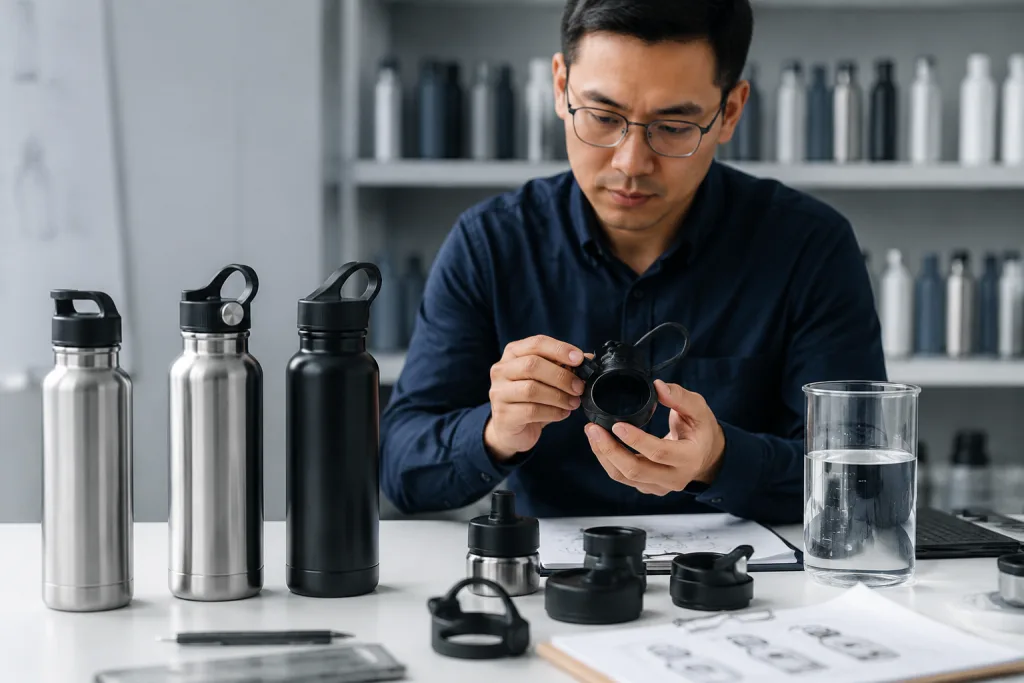
Fitness bottles take more abuse than office tumblers. They bang against squat racks, roll around car cup holders, sit wet in locker rooms, and get scrubbed with alkaline detergent. We have seen a coating pass carton inspection, then chip around the bottom ring after 3 weeks in a gym promo order. QC pulled the sample, checked the worn edge with a 10x loupe, and the problem was obvious. A customized sports water bottle should not be approved by color appearance alone. Bad shortcut.
For powder coating, specify coating thickness at 60-90 μm. Below 60 μm, edge coverage gets weak; above 90 μm, the surface can orange-peel or chip at the threads after cap torque testing. We run a cross-cut adhesion test, 3M tape pull, and alcohol rub test on the pre-production sample. For matte finishes, add a scratch comparison panel using the same coin rub or 500 g load test each time, because matte black hides early defects but shows hand oil and abrasion later. If your gym chain asks for soft-touch coating, push back a little. It feels premium, but sunscreen and sharp keys in a gym bag can make the math fail.
Color matching causes another round of arguments. A distributor gym water bottle order usually starts with Pantone colors, but 316 stainless steel bodies and plastic caps do not reflect color the same way. Approve color under D65 light and ask for a signed golden sample, not a WeChat photo taken beside the packing table. For repeat orders, keep one golden sample at your office and one at the Zhejiang factory. We had one PO where “Pantone Black C” was typed with a double space, and the buyer flagged the cap shade only after 2,400 pcs were packed. Physical reference saves time.
Decoration depends on surface and budget. Laser engraving is durable and clean for stainless logos, but it may look dull on powder coat unless the coating formula and laser power are set on the same line. Silkscreen works for one-color logos at MOQ 1,000-3,000 pcs, while heat transfer or UV printing is the better choice for full-color fitness graphics with gradients or small text under 1.5 mm. For a custom made shaker bottle with measurement marks, use molded marks, laser marks, or high-adhesion ink tested for 50 dishwasher cycles if dishwasher-safe claims are needed. We ship samples only after the logo survives a fingernail scrape and a wet cloth rub. Simple test. Fewer claims.
Shaker Parts Create Hidden Costs
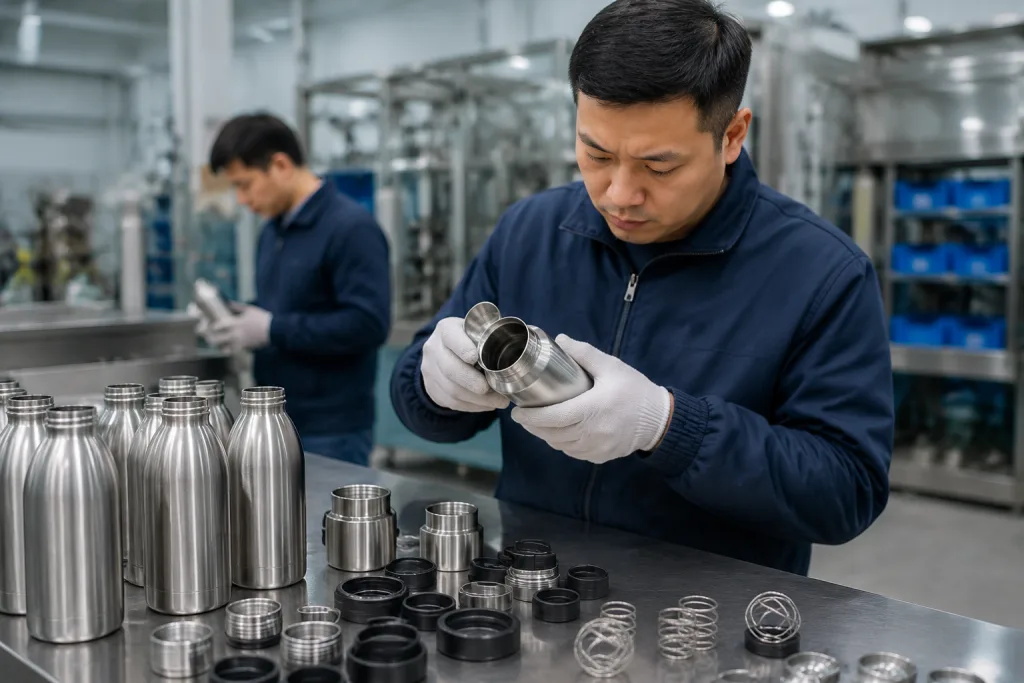
A bulk shaker bottle program is not one bottle body. On the line we may handle a stainless mixing ball, internal mesh, powder compartment, carrying loop, straw, flip lid, silicone boot, retail sleeve, and barcode label, all against the same PO. Each part changes MOQ, tooling, lead time, and inspection hours. QC pulled one sample last month where the quote said 316 contact parts, but the accessory kit used a generic PP mixer and a 304 spring ball. The buyer had compared only two FOB prices. Bad comparison.
For a customizable gym water bottle or distributor shaker bottle, decide early if the bottle is for protein powder, pre-workout, plain hydration, or retail gifting, because the mouth size and lid structure change fast. Protein use needs a wider mouth, normally 55-65 mm, so users can add powder and clean residue with a sponge brush. A narrow 38 mm mouth looks clean in photos, but we have seen this go sideways after delivery when users complain about powder stuck under the thread. If you need a custom shaker bottle with internal agitator, confirm whether the agitator is 304, 316, PP, or Tritan, and whether we pack it inside the bottle or separately in a 0.03 mm polybag.
Tooling is the hidden cost buyers miss. A new plastic lid mold may cost USD 3,000-8,000 depending on sliders, hinge design, and cavity count; our mold room will ask for a 2D drawing before quoting the hinge pin position. A silicone boot mold may be USD 600-1,500. If you want an exclusive lid shape for a customized shaker bottle, the tooling cost makes sense for a 10,000 pcs program. If your order is only 2,000 pcs, the math does not work. Use an existing cap and put the budget into coating, logo, and packaging.
Our normal MOQ in Zhejiang is 3,000 pcs per color for custom coating, 1,000 pcs for laser logo on stocked bodies, and 5,000 pcs when a new cap color must be injection molded. Standard lead time is 30-40 days after deposit and artwork approval; new lid tooling can add 20-25 days. We run the schedule from approved artwork, not from the first inquiry, and the buyer flagged this once because their PO had “mat black” instead of “matte black.” Small typo. Big delay.
Packaging Breaks the Margin
Packaging is where a profitable bulk fitness water bottle order can lose margin without warning. The bottle passes QC, then arrives with rubbed surfaces, crushed gift boxes, missing instruction sheets, wrong FNSKU labels, or cartons too soft for warehouse handling. We’ve seen this go sideways on a 2,000-piece run for a gym chain: the product was fine, the pack-out was not. Fitness brands selling through gyms, e-commerce, and distributors need packaging built for the route, not the cheapest carton on paper.
For export cartons, specify 5-ply corrugated board for heavy stainless bottles and confirm gross weight. I like to keep master cartons under 15 kg when we can; once you push past that, warehouse damage climbs fast. Each bottle should get a polybag or tissue wrap, plus divider protection if the surface is powder coated. A silicone boot improves impact resistance, but it also grabs dust, so the packing team has to bag it cleanly if you want the set to look premium at arrival.
If you sell through online channels, test the unit pack. A mailer box or color box should survive a 76 cm drop test on edges, corners, and faces. If Amazon FBA is in the plan, lock down FNSKU placement, the suffocation warning for polybags over 5 inches opening, carton labels, and barcode scan grade. A factory can apply labels; that is not the issue. The issue is a packing SOP with photos, because the line will follow a picture faster than a spreadsheet.
For distributor sports water bottle programs, outer carton markings matter. Include item number, color, quantity, net weight, gross weight, carton size, and country of origin. If your distributor gym water bottle shipment has mixed colors, require a carton-by-carton color assortment list. That saves hours at receiving and cuts claims that are really sorting mistakes. On one PO, the buyer flagged a typo in the carton mark before shipment, and that saved a full reprint of 480 outer cartons.
Inspection Must Match the Risk
Final inspection is not a beauty contest. The QC checklist for a 316 stainless steel fitness water bottle manufacturer has to track the real failure modes: material mix-up, dents, coating adhesion, leaking, odor, logo durability, accessory shortages, and packaging errors. AQL helps only when the defect definitions are written tight. On our line, a missed 0.3 mm burr can turn into a claim fast.
For most custom sports water bottle orders, use AQL 2.5 for major defects and 4.0 for minor defects. Critical defects stay at zero tolerance. Critical means sharp burrs, rust inside the liquid-contact area, unsafe plastic odor, broken glass-like parts, or failed leak performance. Major defects cover wrong logo position, visible dents, cap leakage, mismatched color, missing accessories, and coating peel. Minor defects cover tiny dust specks, slight print offset within tolerance, or small carton scuffs. The buyer flagged it once on a PO typo: “navy” turned into “nave,” and the carton mark mismatch wasted half a day.
Inspection should include a functional sample set, not just visual checks. Ask QC to run leak tests, cap torque checks, capacity measurement, coating thickness measurement, cross-cut adhesion, logo rub testing with 70% alcohol for 50 cycles, barcode scanning, and carton drop testing. For vacuum sports bottles, add hot water retention testing and vacuum noise checks. For shaker bottles, assemble every accessory from sampled units and confirm the user can open, close, shake, and clean the product without tools. We ship this way because a glossy sample means nothing if the lid pops at 12 N·m.
A pre-shipment inspection normally happens when production is 100% finished and at least 80% packed. For higher-risk orders above 20,000 pcs, add an during-production inspection at 20-30% completion. It is cheaper to stop a bad coating batch after 3,000 pcs than after a full container is sealed in Ningbo or Shanghai. QC pulled the sample at 18% once and found peel on the first tray; that saved the order.
Send your bottle spec before you request pricing
We will review material, lid, coating, logo, MOQ, and QC risks before quoting your custom fitness bottle program.
Frequently asked questions
Is 316 stainless steel necessary for a fitness water bottle?
It is not necessary for every bottle, but it is a strong upgrade for fitness use. Plain water is fine in 304 stainless steel, but gym users often add electrolytes, lemon, amino acids, or protein residue. These can be more corrosive over time. A practical premium spec is 316 stainless steel for the inner liquid-contact wall and 304 for the outer wall on double-wall bottles. For a single-wall custom fitness water bottle, you can request full 316 body construction. Ask for XRF or PMI material verification on random mass production samples, not only a supplier certificate.
What is the MOQ for a custom logo sports bottle?
For stocked bottle shapes, laser engraving or one-color silkscreen can usually start at 1,000 pcs. For custom powder coating, Pantone color matching, or a private color cap, 3,000 pcs per color is more realistic. If you need a custom made shaker bottle with a new plastic lid mold, plan for 5,000-10,000 pcs to make the tooling cost sensible. At our Zhejiang facility, standard custom sports water bottle lead time is 30-40 days after deposit, artwork approval, and golden sample sign-off.
Can you make a stainless steel shaker bottle for protein powder?
Yes, but it should be designed as a shaker from the start. A protein shaker needs a wide mouth, usually 55-65 mm, so users can add powder and clean the inside. The lid must pass shake testing with liquid and mild foam, not only a static water leak test. For a customized shaker bottle, confirm the agitator material, gasket design, vent sealing, and whether measurement marks are laser engraved, printed, or formed in the body. If you want a custom logo shaker bottle for gyms, also budget 1-2% spare lids.
What tests should I require before shipping bulk gym water bottles?
Use AQL 2.5 for major defects and 4.0 for minor defects, with zero tolerance for critical safety issues. The inspection should include visual defects, capacity, dimensions, weight, leak testing, cap torque, coating thickness, cross-cut adhesion, alcohol rub testing for the logo, barcode scanning, accessory count, and carton drop testing. For vacuum models, include heat retention checks. For a bulk gym water bottle order above 20,000 pcs, add a during-production inspection at 20-30% completion so coating or lid problems are caught before final packing.
What information do you need to quote distributor fitness water bottle orders?
Send capacity, bottle type, single-wall or vacuum, 316 inner or full 316 body, lid style, coating color, logo method, packaging, target market, and order quantity. If you need EU compliance, say whether REACH, LFGB, or food-contact testing is required. For North America, tell us if you need FDA food-contact documentation, FNSKU labeling, or retail drop-test packaging. A clear RFQ for distributor fitness water bottle programs should also include delivery term, usually FOB Ningbo or FOB Shanghai, and expected shipment date.