Key Takeaways
- 316 stainless steel drinkware wholesale usually starts at 2,000 pcs MOQ and 25-35 days lead time in Zhejiang production
- Expect a 12-25% material cost premium over 304, depending on gauge, finish, and lid set
- For acidic drinks and salt exposure, 316 is the safer call; for basic water bottles, it may be overkill
- Use AQL 2.5 for major defects, REACH paperwork for Europe, and full carton-drop testing before booking FOB
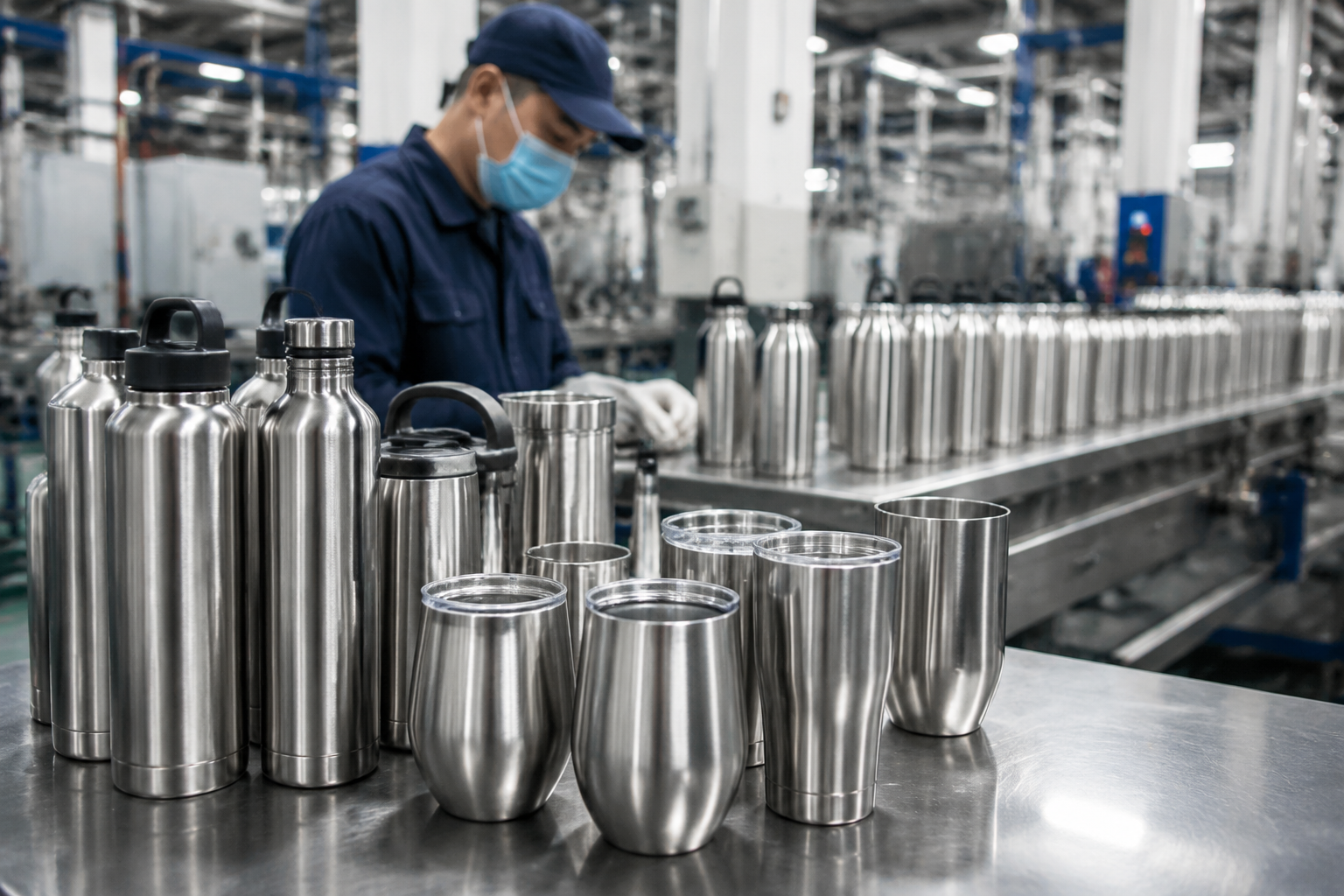
You’re not buying “stainless steel.” You’re buying corrosion resistance, margin, and fewer complaints after the first salty electrolyte drink, sour cocktail, or 40% ABV fill. This is why 316 stainless steel drinkware wholesale keeps appearing in RFQs from Germany, France, the U.S., and Canada when the buyer wants a premium line for wine, beer, spirits, sports hydration, and dishwasher cycles. We’ve seen this go sideways: QC pulled a tumbler sample after a 24-hour salt-water soak and found early pin-point pitting near the inner weld.
At our Zhejiang factory, we run these programs as production orders, not catalog guesses. A typical MOQ starts at 2,000 pcs per SKU, monthly output reaches 120,000 units, and normal lead time is 25-35 days after sample approval. If you are sourcing from China, “Is 316 better than 304?” is the wrong question to ask. The real question is whether your margin, certification needs, and use case can pay for the upgrade, then whether the line controls wall thickness, weld quality, passivation, and packaging before the first shipment becomes a claims file. On one 316 wine tumbler order, the buyer flagged a PO typo calling for 0.45 mm inner wall while the approved sample was 0.50 mm; that 0.05 mm gap sounds small, but the math doesn’t work once you add polishing loss and vacuum testing.
The order you should picture
Let’s keep this concrete. A brand owner in Germany wants a 500 ml 316 stainless steel bottle and a 20 oz tumbler for premium retail and Amazon. The buyer asks for 316 stainless steel drinkware wholesale, matte powder coat, laser logo, and a gift box that looks premium without blowing up landed cost. Normal brief. The real work starts when the spec sheet hits the line and we map it to cartons, not catalog photos.
We lock the use case first. If the bottle will carry citrus water, kombucha, or low-pH sports drinks, 316 makes sense. If it is plain water for office use, 304 usually does the job and saves money. For beer growler bulk programs, alcohol flask wholesale bulk, or coastal and boat retail, 316 is the cleaner call because chloride resistance is doing the heavy lifting. For each SKU, define capacity tolerance, wall thickness, finish gloss, lid material, and whether the inside needs electro-polish or standard passivation. One sample last month came back with a 1.2 mm wall on the drawing but 1.0 mm on the pilot; QC pulled the sample before it left the bench. In Zhejiang, a supplier worth your time gives you a drawing, not just a quote, and confirms tooling status before you wire the deposit.
What you should ask first:
- Is the body 316L or generic 316, and what is the wall thickness in mm?
- Can you hold capacity within ±5%?
- What is the MOQ per color and per logo method?
- Do you have BSCI, REACH, and food-contact test files ready?
That is the starting point for wholesale drinkware. Not the finish. Not the photo.
Why 316 changes the economics
316 costs more than 304 because of molybdenum and tighter raw material pricing. On our last coil buy, the 316 surcharge ran 12-25% on the metal side; once you add tooling, polishing, and lid parts, the finished bottle usually lands 8-18% higher. That is the math. If your channel is price-sensitive, you need a hard reason. Coastal retail, high-acid drinks, and gift sets usually give you one.
What 316 gives you is better resistance to pitting and crevice corrosion. That matters when the inside sees salt, vinegar, carbonation, or aggressive dishwashing. We saw this on a 500 ml tumbler run: QC pulled the sample after a 72-hour salt-spray check and the 304 panel showed pin dots near the weld. For a beer growler wholesale program, 316 fits brewery accounts, sailing shops, and premium outdoor retail. For alcohol flask bulk orders, the gain is long-term finish stability and fewer aftertaste complaints. For a canteen wholesale program, 316 only makes sense when the brand wants medical-grade positioning or acidic-content use.
Do not overbuy material grade because “premium” sounds good. If the target retail price is $14.99, 316 can crush gross margin unless you hold the line on finish, accessory count, and packaging. We had a buyer flag a PO typo on lid spec once, and the unit cost jumped on rework alone. If your wholesale drinkware line sells at $22-35 retail, the upgrade usually holds up. But if the quote starts low and then drifts on lids, coatings, and carton damage, the math does not work. Ask for a landed-cost model before you approve samples.
Spec the SKU like a buyer
Once you lock 316, the next step is to pin down the spec so the line does not “improve” it on its own. Give the supplier one clean order sheet: capacity, top diameter, body height, base diameter, wall thickness, finish, logo method, and packing standard. On a 500 ml bottle, we usually run 0.4-0.5 mm wall thickness. For tumblers and growlers, 0.5-0.7 mm is the range we see when the buyer wants a firmer hand feel. Go thinner than that and you start seeing dent marks, weaker vacuum stability, and that hollow sound buyers flag in QC.
Here is the kind of detail that keeps a shipment from going sideways:
- Finish: satin, matte powder coat, or brushed steel; call out gloss level if color match matters.
- Logo: laser engraving for wear resistance, silkscreen for color, or wrap printing if you need a wider print panel.
- Lid: PP, Tritan, stainless, or bamboo-look lid with silicone seal.
- Performance: hot retention target, cold retention target, and leak test standard.
- Compliance: LFGB for Germany, FDA for the US, REACH for EU chemistry.
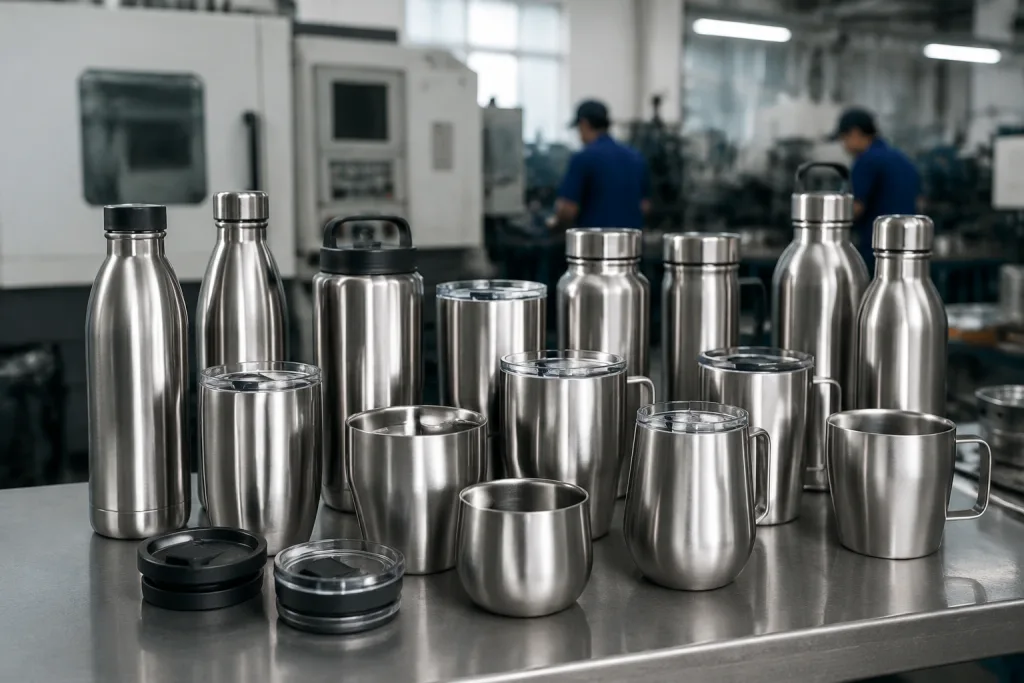
For beer tumbler bulk or beer tumbler wholesale bulk, the lid and finish drive the sale as much as the cup body. For bulk canteen or canteen bulk programs, ask whether the handle is welded or molded; that changes the weld point, the break risk, and the unit cost. If you want a best wholesale drink bottle for a private label launch, ask for samples from the same tooling that will run mass production. We have seen a hand-made sample look spotless and still miss the real line output by 2 mm on the seam.
What the factory should show you
In Zhejiang, a real stainless drinkware factory does not hide behind vague claims. Ask for the process flow on the floor: tube cutting, deep drawing, welding, trim, polishing, vacuum sealing, leak test, surface treatment, logo application, and final packing. If a supplier cannot point to where the weld seam sits or explain how the vacuum gap is checked with a gauge, they are not ready for wholesale buyers. On a 120,000-unit monthly line, that is the whole game.
Ask for a sample approval set, too. We run it in three steps: first sample, pre-production sample, then a golden sample with a signed seal before mass production starts. Slow? Yes. Cheap? Also yes. A buyer in North America once approved a metallic blue finish without a carton rub test; 14% of the cases landed with scuff marks. The QC pulled the sample, and the fault was obvious. Missing test, missing margin.
Minimum factory evidence worth requesting:
- Material certificate for 316/316L
- Food-contact test report and REACH file
- Vacuum insulation test or leak test log
- Carton drop test result
- BSCI or similar social compliance file if your retailer asks for it
For wholesale canteen or wholesale growler orders, check seam polish and cap torque as well. A cap that comes in under spec by 2 N·m can make a bottle feel cheap fast. We have seen that go sideways. China has the capacity for this category, but only if you make the factory prove consistency before the PO turns into production.
QC checkpoints that actually catch problems
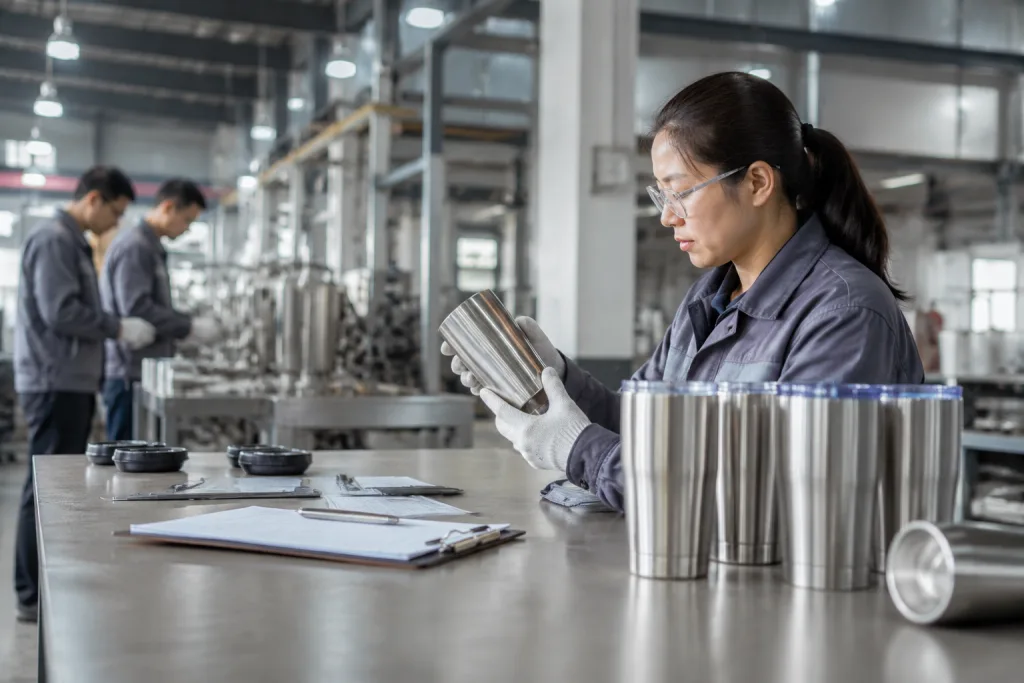
Quality control has to follow failure modes, not a generic checklist. On 316 stainless steel drinkware wholesale orders, we see five repeat problems: surface contamination, weld defects, vacuum loss, lid leaks, and decoration mismatch. Incoming inspection starts with the raw material grade, finish uniformity, and a fast check for oil spots or grinding marks under the light table. On the line, QC pulls the sample, checks seam smoothness, body roundness, and coating thickness with a gauge. Before shipment, we run random tests at AQL 2.5 for major defects and 4.0 for minor defects if the channel is retail or Amazon.
For a 2,000-piece order, inspect 80-125 units, depending on the AQL plan. The math does not work if you sample too light. Common tests include:
- Fill-and-invert leak test for 3-5 minutes
- Hot water hold test at 90°C
- Cold retention test with 0-4°C water
- Dishwasher cycle check if the customer will wash in machine
- Rub test for print adhesion and scratch resistance
For beer growler in bulk or beer growler wholesale programs, smell retention and lid seal decide whether the buyer reorders or sends a complaint after the first pallet. For alcohol flask wholesale or alcohol flask wholesale bulk, check internal cleaning and odor neutrality because spirits buyers catch taint fast, and we have seen this go sideways on a 0.3 mm polishing gap near the rim. For canteen wholesale, pay attention to the lid thread and straw interface if it is a sports style bottle. A 1 mm error in the lid groove creates the kind of leak that turns into a repeat claim, and that costs more than the inspection fee.
Pricing, terms, and shipping realities
Buyers ask for one number, but wholesale drinkware pricing moves with grade, finish, logo, and packaging. On our line, a basic 316 stainless bottle at 2,000 pcs usually sits around $4.20-$6.80 FOB Ningbo or Shanghai; a better vacuum tumbler or growler can land at $5.50-$9.50 FOB, with the lid style and coating doing most of the damage to cost. QC pulled the sample on a 0.6 mm wall and the buyer flagged it immediately when the finish spec was loose. These are planning ranges, not promises. If a quote comes in far below that, ask which material, which wall thickness, and which tests got cut.
FOB is still the cleanest way to compare suppliers in China. If you need door delivery, ask for DDP only after you understand the duty code and destination handling fees; otherwise the math doesn't work. For Amazon sellers, FNSKU labeling, carton marks, and case pack count should be locked before packing starts, not after the cartons are sealed. We once shipped a PO with a typo on the carton count, and the whole booking got pushed back two days. For bulk growler, growler bulk, or beer growler wholesale bulk orders, pallet height and carton compression matter because heavy stainless units can crush weak outer cartons. A 5-ply export carton with proper dividers usually saves more money than a fancy insert that looks good and fails in transit.
Payment terms usually start at 30% deposit and 70% before shipment. For an established Zhejiang factory and repeat orders, 20%/80% or LC terms may be possible, but this is not where buyers usually win. The real leverage is precise specs: 304 stainless vs 316 stainless, finish code, lid assembly, and print position in mm. That is what keeps your wholesale drinkware margin intact.
How this plays out at reorder stage
The first order tells you whether the supplier can run the line. The reorder tells you whether they can repeat it. If a 2,000-piece trial ships with stable color, clean welds, and zero leak returns, the second PO turns into a straight talk on speed and margin. We have asked for 8 mm carton cuts, combined packing, and a simpler lid at that stage. For private label buyers, this is also where we lock the logo position and the packing sequence so the factory stops “improving” the job on its own.
For canteen wholesale, wholesale canteen, and drinkware wholesale programs, reorders decide who makes money and who gets stuck. A supplier in Zhejiang that holds the same finish across two runs six months apart is worth more than a rock-bottom first quote. If they cannot hold it, the price was fake from day one. The same goes for alcohol flask in bulk, beer tumbler wholesale, and best wholesale drink bottle programs where three SKUs share one color system. Keep one golden sample, one signed spec sheet, and one approved carton sample in the file. QC pulled the sample on a Friday shift and found a 1.5 mm print drift once; that tiny miss became a 12-day delay on the next order.
“The cheapest quote is usually the most expensive shipment you haven’t inspected yet.”
If you need one rule for 316 stainless steel drinkware wholesale, pay for the grade when the market calls for it, then control the rest with documents, AQL, and repeatable production discipline. A buyer once flagged a PO typo on the lid code and we had to recheck the whole batch; the math does not forgive sloppy paperwork. That is how serious buyers source from China without gambling on the next container.
Request a 316 wholesale quote today
Send your target capacity, logo method, and annual volume. We’ll price the order, confirm MOQ, and map QC before production starts.
Frequently asked questions
Is 316 stainless steel worth it for wholesale drinkware?
Yes, when the use case justifies it. If the product will see salt, citrus, vinegar, carbonated drinks, or coastal outdoor use, 316 is a safer choice than 304. Expect about a 12-25% raw material premium and roughly 8-18% finished-goods premium depending on wall thickness, coating, and lid complexity. For plain water bottles in office channels, 304 may be enough. For premium retail, beer growler wholesale, or alcohol flask wholesale bulk, 316 helps reduce corrosion risk and supports a stronger story to buyers and consumers. Always compare landed cost, not just FOB.
What MOQ should I expect for a custom order?
For most 316 stainless steel drinkware wholesale programs in Zhejiang, a practical MOQ is 2,000 pcs per SKU and sometimes 3,000 pcs if you need special color matching or custom tooling. If you combine a bottle and tumbler in one order, the factory may accept smaller per-SKU quantities if the total order is larger. Expect 25-35 days after sample approval for standard runs. If you need a special cap, bamboo lid, or custom mold, add 10-15 days. Smaller trial orders are possible, but the unit price usually rises fast.
What certifications do European and North American buyers ask for?
For Europe, REACH and food-contact compliance are the usual starting point, and Germany buyers often ask for LFGB. For the US, FDA food-contact declarations are common. Many retailers also request BSCI or another social compliance audit, especially for larger wholesale drinkware programs. For Amazon-linked shipments, you may also need carton labeling, barcode compliance, and FNSKU application. Ask for test reports tied to the exact material grade, finish, and ink used. A generic report on a different SKU is not enough for serious procurement.
How do you inspect a shipment before paying the balance?
Use a pre-shipment inspection based on AQL 2.5 for major defects and a tighter check if your market is retail-sensitive. For a 2,000-piece lot, inspect roughly 80-125 units depending on your sampling plan. Check leak resistance, lid fit, coating rub, capacity tolerance, weld smoothness, and carton drop strength. If the product is vacuum insulated, confirm hot and cold retention tests. For beer tumbler bulk, growler bulk, and canteen bulk orders, also inspect the outer carton compression and divider quality because heavy stainless units can shift in transit.
What price range is realistic for FOB China?
For planning, a basic 316 bottle may land around $4.20-$6.80 FOB, while a better vacuum tumbler or growler can range from $5.50-$9.50 FOB depending on size, finish, and lid. Custom printing, gift boxes, and premium coatings can add materially to cost. These are working ranges, not fixed quotes. If a supplier offers a much lower number, check wall thickness, grade, coating type, and testing scope. A cheap quote that removes inspections or downgrades materials is not a real saving.