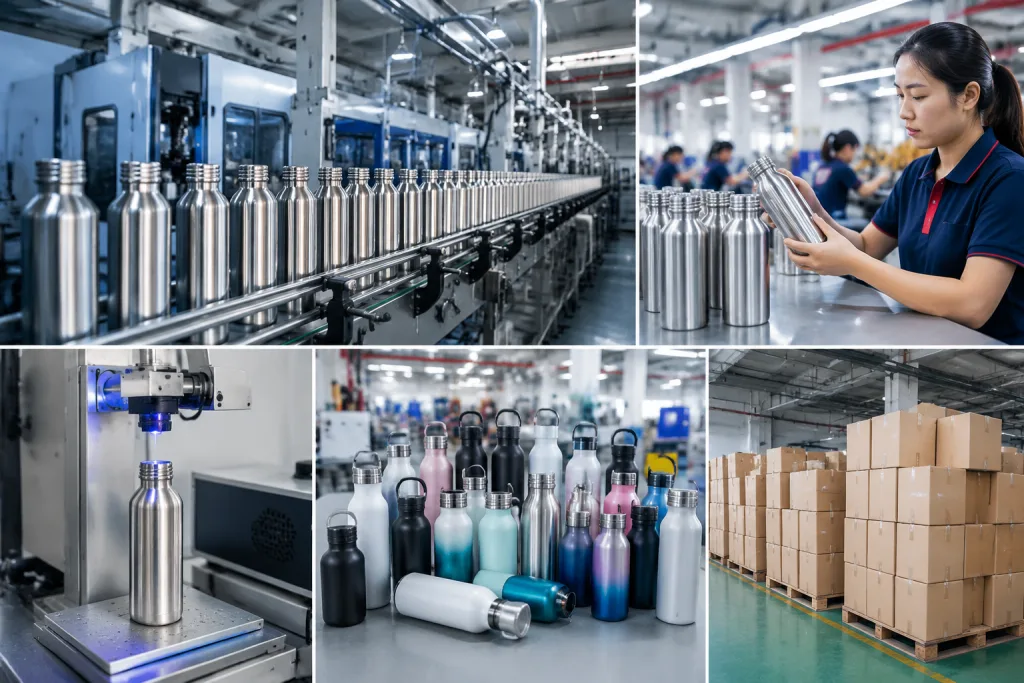
Key Takeaways
- 316 stainless steel usually adds 15-30% to material cost versus 304
- A practical MOQ for a custom canteen program is often 500-1,000 units
- Typical production lead time from a canteen factory is 25-40 days after sample approval
- For export buyers, ask for REACH, food-contact, and AQL 2.5 inspection documents
If you are sourcing premium insulated bottles, tumblers, or a custom growler line, 316 stainless steel is where the conversation gets serious. It costs more than 304, but if you sell into coastal markets, sports accounts, medical-adjacent channels, or high-acid beverage use, the corrosion margin pays for itself. A proper 316 stainless steel drinkware supplier should quote more than a unit price; they should walk you through wall construction, passivation, test reports, and the exact use cases where 316 changes performance. We run this discussion a lot, and the buyer usually asks for a salt-spray number or a 12 oz sample first.
That is the part many buyers miss. In Zhejiang and across China, plenty of factories can print “316” on a spec sheet; fewer can keep material control steady, pass AQL inspection, and hold a lead time that matches the PO. The math does not work if the margin looks good but the line starts slipping on QC or the buyer flags a typo in the carton mark. If you are comparing canteen manufacturer options, distributor drinkware programs, or canteen promotional SKUs, the right supplier choice comes down to fit, compliance, and whether the factory can ship the same spec on the next 5,000 pieces.
316 vs 304: what changes
Buyers ask for 316 when they mean “better corrosion resistance.” Fair ask. The molybdenum in 316 gives better resistance to chlorides, salt spray, acidic drinks, and stronger wash chemistry. We’ve run side-by-side salt-spray checks on 304 and 316 tubes; the 316 sample held its finish cleaner after 48 hours. For marine programs, premium outdoor retail, and flavored drinks left in the bottle for 8–12 hours, 316 is the safer call. For plain water, coffee, and office use, 304 usually does the job at a lower cost.
Here is the part buyers feel on the PO. If the bottle sits in gym bags, on travel routes, or in humid coastal warehouses, 316 resists surface staining and pitting better. If you are building a custom drinkware range for mass retail, 304 gives better landed cost and protects margin. We had one buyer flag a PO typo on the grade line, and that saved a whole carton from being built wrong. A real 316 stainless steel drinkware supplier should say that upfront instead of selling the highest grade into every SKU. That is the wrong question to ask.
| Spec | 304 | 316 |
|---|---|---|
| Corrosion resistance | Good | Better in salt/chloride exposure |
| Typical use | General drinkware | Premium, harsher environments |
| Cost impact | Lower | About 15-30% higher material cost |
| Buyer fit | Volume canteen supplier programs | Premium canteen customized lines |
Spec table: choose by channel
When you compare a canteen supplier, canteen vendor, or canteen factory, start with the channel, then check the material. The Amazon spec is not the distributor spec, and a promo bundle has its own math. We run that split every week on the line. It saves samples and avoids dead stock.
| Channel | Best fit | Why it works | Watch-outs |
|---|---|---|---|
| Outdoor retail | Custom canteen, custom growler | Premium hand feel, stronger corrosion resistance in wet use | Keep wall thickness at 0.5-0.7 mm; 0.8 mm adds weight fast |
| Corporate gifting | Canteen customizable, customized drinkware | Laser logo, color finishes, gift-box packing that looks clean on receipt | QC pulled the sample after a scratch test on powder coat |
| Distribution | Distributor drinkware, distributor canteen | Repeat orders stay stable when the SKU range stays tight | Demand one lid spec and one gasket spec; mixed sourcing gets messy |
| Promotional | Canteen promotional, custom drinkware | Lower unit cost and clear brand exposure | Do not over-spec 316 if the bottle sits on a desk all day |
For most distributors, a canteen distributor program should center on one body shape and two lid options. Tooling stays lean. Reorders move faster. If a buyer pushes for five lids, we say the math does not work. For canteen distributors in Europe or North America, ask for a spec sheet with metal grade, capacity, coating type, and carton count before you talk artwork; one PO typo on the lid code can delay the whole shipment.
How to judge factory capability
The label “canteen manufacturer” is easy to print. Repeatable goods are the real test. In Zhejiang and other coastal hubs, a solid drinkware plant talks in numbers, not studio photos. Ask for monthly output, sample lead time, and the QC flow on the first call. A mid-sized Hangzhou line can sit at 200,000 to 500,000 units per month across several bottle models, with 7-10 days for samples and 25-40 days for bulk after approval.
Ask for these points in writing:
- Material traceability: 316 sheet or liner source, batch control, and incoming inspection with mill certs and lot numbers
- Testing: salt spray, thermal retention, leak testing, and coating adhesion on the same sample set
- Compliance: REACH, food-contact declaration, BPA-free components where applicable
- Inspection: AQL 2.5 for major defects on export orders
If a canteen supplier cannot walk through those items, you are probably dealing with a trading layer, not a production partner. That is fine in some deals, but the math changes. We have seen buyers treat both as the same and then get burned on lead time, warranty claims, and MOQ control.
Pricing logic and MOQ reality
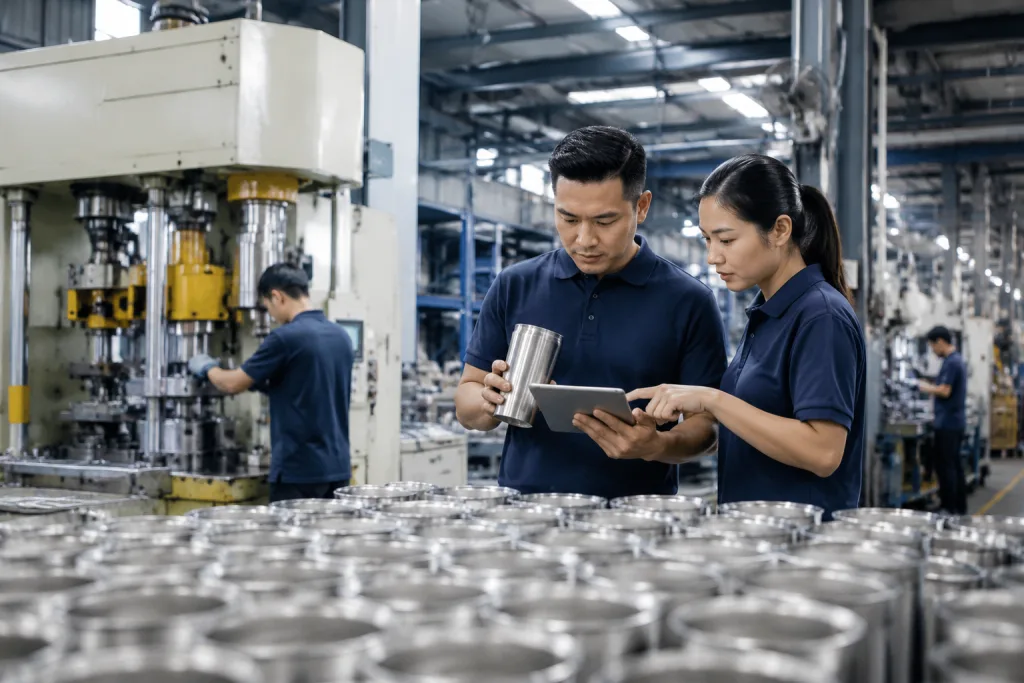
Price shopping on 316 drinkware goes wrong fast. A low quote can hide thin steel, weak vacuum retention, or a lid bought from the cheapest sub-supplier. We run into this on the line all the time: the buyer flags a 0.3 mm wall, then the sample still looks fine until QC pulls the bottle after the hot-water test. Compare body cost, decoration, packaging, and freight as separate lines. On a plain 316 vacuum bottle at 500-unit MOQ, FOB China usually sits around USD 4.80-7.50 depending on size, finish, and lid. Add pad print, gift box packaging, and accessory parts, and the number climbs quickly.
For a canteen custom or customizable canteen program, a lot of China factories want 500 units for a stock shape and 1,000 units once you ask for new tooling, special lids, or customized canteen embossing. That is not the wrong answer; it is the math. If you are a distributor canteen buyer, keep the order tight: one size, one finish, one closure, one carton spec. We have seen this go sideways when the PO had two spellings for the same lid code, and the rework ate the margin. For canteen manufacturers, cost control comes from fewer changeovers, not from chasing the last cent in the steel sheet.
Good sourcing is not asking for the cheapest stainless bottle. It is asking for a stable spec that can be reordered three times without rework.
Custom branding that sells
Branding has to match the sales channel. Retail buyers usually want a laser logo on brushed steel; it looks clean and holds up. Promo agencies often push for a full-color wrap on a canteen promotional SKU. We run both on the line. A canteen customizable range should offer at least two decoration methods, or you end up reworking the body for every account.
For custom drinkware, the usual picks are screen print, laser engraving, UV print, and powder coat with a debossed logo. Laser engraving gives the cleanest long-life mark on 316 steel. Screen print wins when the buyer is chasing a sharper FOB price. We had a brewery buyer flag a cap leak after three wash cycles, and the fix was not the logo; it was gasket fit and cap torque on the customized growler. That is the wrong question to ask if the lid fails.
Keep artwork zones wide. Avoid edge-to-edge wraps on curved bottles. Ask for a 1:1 digital proof before sampling. QC pulled the sample at 48 hours once because the artwork sat 2 mm too close to the shoulder, and the buyer caught the same issue on the PO copy. A solid canteen vendor should also talk through logo wear after dishwasher cycles and carton rub. That is what turns a one-off order into a repeat program.
Use-case fit by buyer type
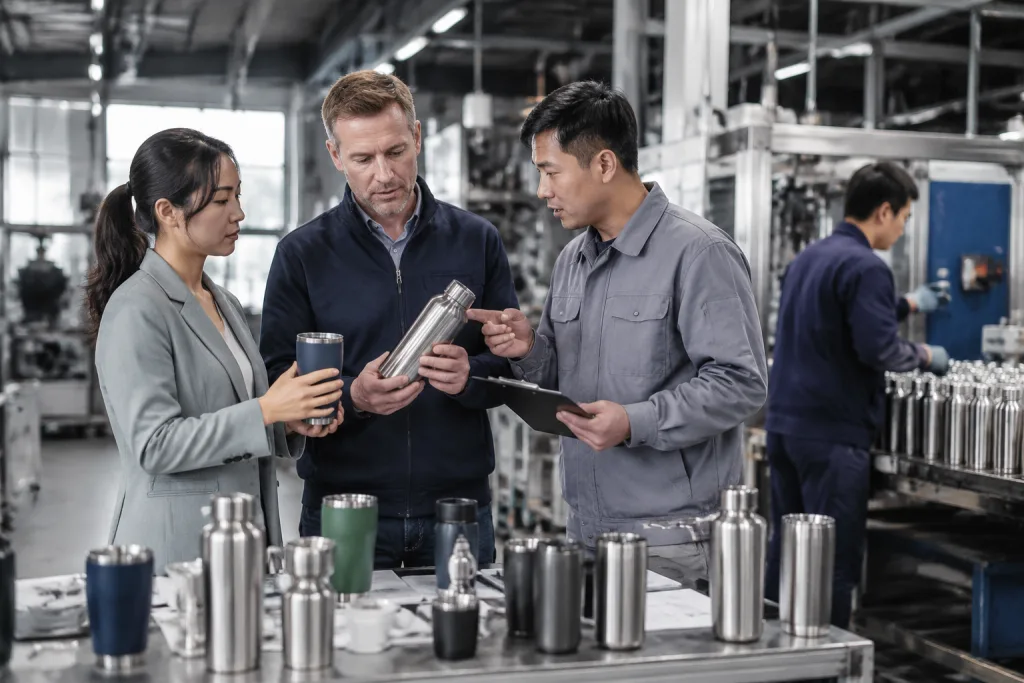
Different buyers need different answers from the same supplier. A brand owner wants a shelf story and margin. A distributor wants the same reorder to land at 2,000 pcs in January and again in March. A procurement manager wants fewer defects, AQL 2.5 on paper, and a clean compliance file. That is why head-to-head sourcing beats a generic product pitch.
| Buyer type | Best product direction | Why |
|---|---|---|
| Brand owner | Customized drinkware with premium finish | Higher perceived value and a stronger shelf story |
| Distributor | Distributor growler or distributor drinkware line | Easier replenishment and simpler SKU management |
| Retail buyer | Customizable drinkware with one hero SKU | Fast assortment testing and controlled inventory |
| Promotional buyer | Canteen promotional pack with standard lid | Low complexity, fast turn, lower unit cost |
If you are checking canteen manufacturers in China, the right one asks about your channel before quoting. We run that question first on the line, because a stock quote and a market-fit quote are not the same thing. The buyer flagged it on a 500 pcs sample once: the logo looked fine, but the gift box missed the retail brief. That matters more when you sell premium 316 stainless steel drinkware supplier programs into North America or Europe, where finish, packaging, and stainless authenticity get checked fast.
Request a spec-driven quote today
Send your target capacity, finish, and MOQ. We will match the right 316 stainless steel drinkware supplier setup to your channel and margin.
Frequently asked questions
Is 316 stainless steel worth it for drinkware orders?
Yes, if your use case involves salt, acidity, or long retention in harsh environments. For standard water bottles, the upgrade often adds 15-30% to material cost without a big consumer-facing change. For coastal retail, outdoor sports, and premium custom growler programs, 316 is easier to justify. If you want a canteen distributor line for mass retail, 304 may be the better margin choice.
What MOQ should I expect from a canteen factory in China?
For a stock body with custom logo, 500 units is common. For a new mold, special lid, or canteen customized shape, 1,000 units is more realistic. Some canteen manufacturers will accept 300 units, but unit pricing usually jumps 10-20% and lead time can slip. In Zhejiang, better factories will quote MOQ by decoration method, not just by model.
How long does production usually take?
A normal timeline is 7-10 days for samples and 25-40 days for bulk production after sample approval and deposit. If you add color coating, new packaging, or accessory sourcing, plan another 5-10 days. For a custom drinkware launch, ask the canteen supplier to confirm whether the lead time includes testing and carton drop checks, not just assembly.
What compliance documents should I request?
At minimum, ask for REACH, food-contact declarations, and a QC report using AQL 2.5 for export lots. If you sell into retail or marketplace channels, ask for material composition details and test records for the lid, gasket, and coating. A serious canteen vendor in China should provide these without hesitation, especially for North America and Europe.
Can one supplier handle both custom canteen and custom growler programs?
Yes, if the factory has enough line flexibility and packaging control. The better canteen suppliers can run a canteen promotional item, a custom canteen, and a custom growler with the same core quality system. What matters is whether they can control wall thickness, vacuum performance, and decoration consistency across all SKUs. Ask for monthly output, sample lead time, and defect rate before you commit.