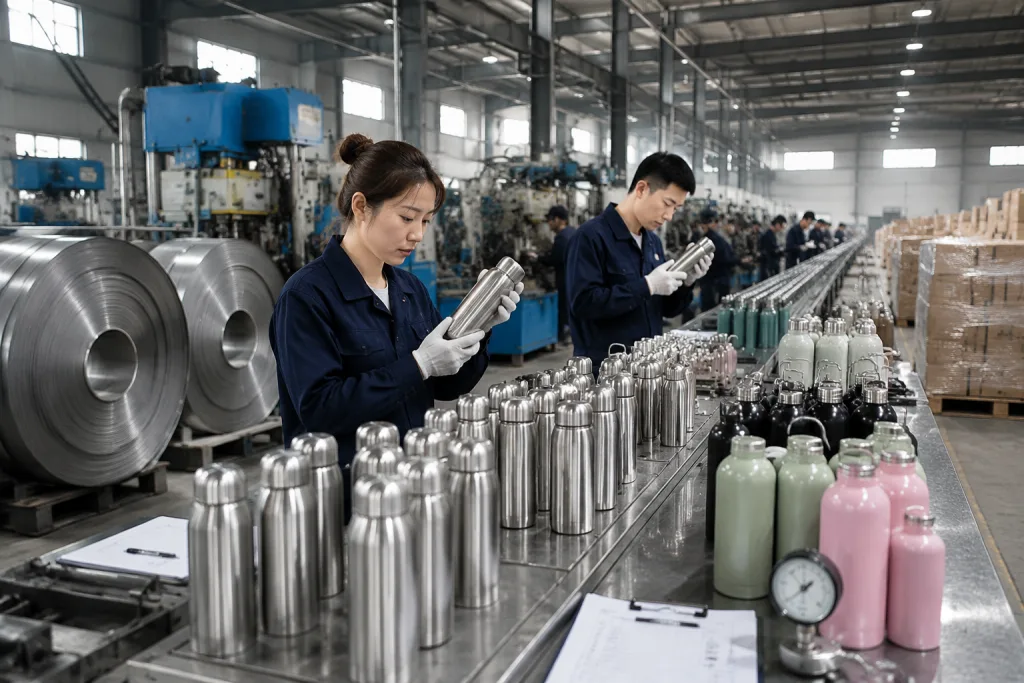
Key Takeaways
- Use 316 stainless steel for the inner wall at 0.40-0.50 mm, with 304 acceptable for outer shells when clearly specified
- Set AQL before production: commonly 2.5 for major defects and 4.0 for minor cosmetic defects
- Private label MOQ usually starts at 1,000-3,000 units per shape, with 35-50 days lead time after sample approval
- Salt spray, leak, vacuum, adhesion, and migration tests catch failures before a container leaves China
316 stainless steel drinkware private label sounds simple until a carton lands with tea staining, weak vacuum retention, leaking lids, or logo color drift. The material upgrade does not protect your margin by itself. If your PO only says “316 stainless steel bottle, matte black, logo printed,” you have left too many calls to the canteen factory.
From Hangzhou, Zhejiang, we see the same failures repeat with buyers in Europe and North America: unclear steel grade placement, vague coating specs, and no AQL plan. QC pulled a sample last week and the wall thickness was off by 0.3 mm; that is the kind of miss that turns into a claim. A good China canteen manufacturer can stop most of this, but only if you write the spec like a production sheet, not a catalog ask.
Wrong steel in the wrong place
The first failure mode is not “fake 316” in a dramatic sense. It is usually a loose bill of materials. We see buyers ask for 316 stainless steel drinkware private label and assume every metal part is 316. On the line, that is rarely how it runs. A vacuum bottle may use 316 for the inner liner, 304 for the outer shell, 201 for a decorative bottom plate, and stainless hardware inside the lid. That can be fine, if the spec says so.
For most custom drinkware used for coffee, tea, sports hydration, or outdoor retail, the smart upgrade is 316 on the liquid-contact inner wall. It handles chloride and acid better than 304, which matters for electrolyte drinks, lemon water, and coastal buyers. We normally quote 316 inner wall at 0.40-0.50 mm and 304 outer wall at 0.45-0.55 mm. If you want full 316 inside and out, the math changes fast: material cost rises, and price room gets tight.
Ask your canteen supplier for a material declaration that breaks out the inner wall, outer wall, lid metal parts, infuser, straw, and bottom plate. QC pulled the sample on one order because the PO had “316” in the notes but no component split. For EU buyers, pair it with LFGB or EU 1935/2004 food-contact testing. For North America, request FDA food-contact compliance and, when relevant, California Proposition 65 screening. A serious canteen manufacturer in Zhejiang should also keep coil batch records and support PMI or lab verification on pre-shipment samples.
Do not accept “316 grade” as a single-line answer. Write the grade by component. The buyer flagged it late once, and we had to redo the quote after tooling. This is the wrong question to ask if you want clean sampling, clean pricing, and fewer surprises.
Vacuum claims that collapse later
A second failure is overpromised insulation. A custom canteen may pass a 20-minute desk check and still fail after ocean freight, retail handling, or Amazon returns. Vacuum drinkware lives or dies on the weld seam, evacuation level, copper plating or reflective treatment, and the base plug. One pinhole is enough. One weak bottom seal turns a premium 316 bottle into a single-wall bottle with a fancy price tag.
Put the numbers in the spec. For a 500 ml bottle, a workable hot-retention claim is water at 95°C, ambient 20°C, measured after 6 hours, with at least 60°C left. If you want a 12-hour claim, set a lower threshold and say so plainly. Cold-retention needs the ice ratio, start temperature, ambient temperature, and test time. Without that, every supplier runs its own method, and the buyer flagged it for a reason.
At BottleForge Industrial in Hangzhou, Zhejiang, we run 100% vacuum screening at line level, then batch retention checks with a calibrated probe. Our monthly drinkware capacity is about 300,000 units, but we still slow the line on new private-label SKUs because first production shows where a leak starts. QC pulled the sample, found a weak bottom plug on one run, and that saved a return headache. For distributor drinkware programs, a pilot order of 1,000-2,000 units is the right move before a seasonal roll-out.
The spec should also name the process: copper plating, vacuum annealing, or another method. Copper plating can improve heat retention, but only if coverage stays even across the body. If your custom growler is 1.9 L or larger, check weld length and base impact testing. Big bottles fail differently from 500 ml bottles because the body flexes more during drop tests and shipping compression. We’ve seen this go sideways on a PO that called for “same as sample” and skipped the base test.
Lids leak before customers forgive
Most bad reviews on customizable drinkware are not about steel grade. They are about leaking caps, loose straws, cracked flip lids, and silicone gaskets that smell after 12 days in transit. The lid is where a canteen customized for retail turns into a return problem. It has more parts, more plastic grades, and more tolerance stack-up than the metal body, and QC pulled the sample apart on the line to check that last point.
Your RFQ should name the lid material with no wiggle room: PP, Tritan, ABS, stainless, silicone, or TPE. For food contact, ask for FDA or LFGB testing on every mouth-contact and liquid-contact part, not just the bottle body. For kids or sports lines, check whether your market requires ASTM, CPSIA, EN 14350, or small-parts review. This is the wrong question to ask if you only look at the canteen promotional order size; a leaking lid with a logo still hurts the brand owner, and the buyer flagged it on the first sample.
Leak testing belongs in the QC plan. We run a simple check: fill to 90-95%, tighten the lid to the approved torque, lay it horizontal for 30 minutes, then invert and shake for 10-20 cycles. For straw lids, test both open and closed positions. For carbonated beverages, do not promise compatibility unless the design is built for pressure; most vacuum canteen makers will exclude carbonated drinks on standard lids, and the math does not work otherwise.
Specify spare gaskets, too. For distributor canteen programs, we usually suggest 1% spare silicone rings packed in bulk cartons. The cost stays low, and it lets your service team clear small claims without swapping a full bottle. If the lid is unique, lock the mold ownership and replacement part supply terms before the first order goes to the line.

Coatings look good, then scratch
Surface finish is where buyers save USD 0.20 and lose the account later. Powder coating, spray painting, electroplating, PVD, rubberized paint, and raw brushed stainless all behave differently on the line. A matte black customized growler can pass the sample-room test and still fail after 48 hours in a warehouse stack or when a buyer clips it to a backpack.
For powder coating, specify color by Pantone or RAL, gloss level, texture, and adhesion requirement. We run cross-hatch tape testing, ASTM D3359 style, and agree the acceptance level before production starts. For abrasion, ask for a rub test: 500 cycles, fixed load, fixed cloth. Salt spray matters on exposed metal; 24-48 hours will show weak coverage around the rim, base, and handle welds.
Logo method has to match the surface. Laser engraving holds up on coated stainless because it cuts through the coating and exposes metal, but it cannot do fine gradients. Silkscreen works for one to three colors, though curved bodies and textured powder cut precision fast. Heat-transfer and water-transfer decals handle larger artwork, but they need adhesion and dishwasher-condition checks if you claim dishwasher safe. On canteen promotional orders, many buyers still choose hand-wash-only. For retail private label, that warning can hurt conversion, and this is the wrong question to ask after artwork approval.
Do not approve color from a PDF. Ask for a physical color chip or a pre-production sample; we have seen a buyer flag a PO typo on the shade code and it cost a week. On repeat distributor growler orders, set an allowed color tolerance, such as ΔE under 1.5 or 2.0 if your brand system requires it. China factories can hold tight color, but only when the target is measurable.
Packaging fails the freight test
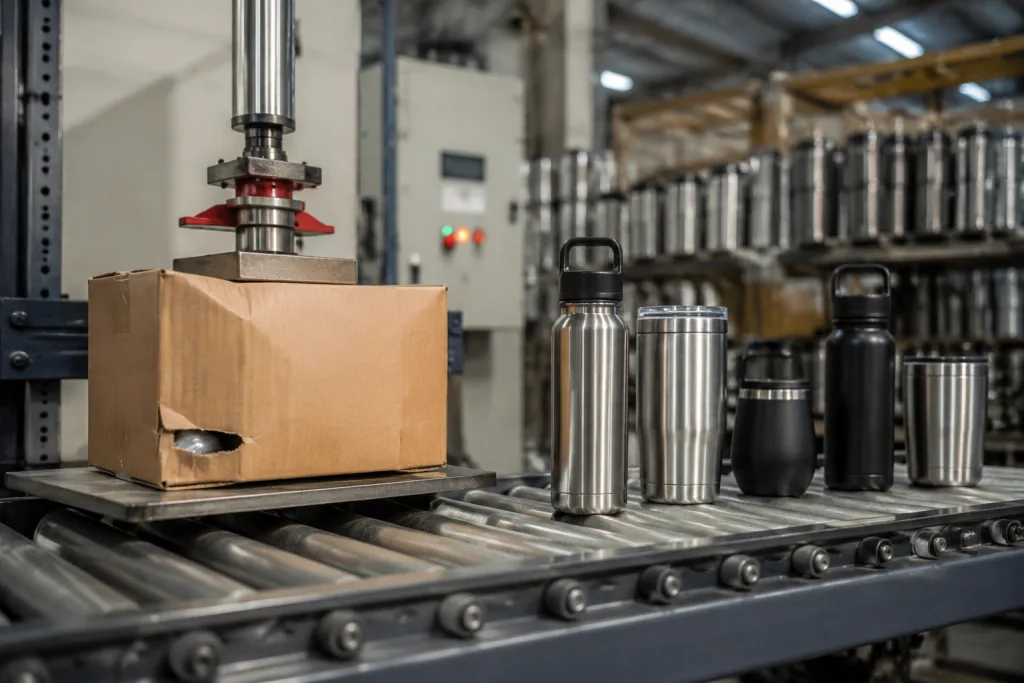
A bottle can pass factory QC and still arrive damaged because the packing was treated like decoration, not engineering. Private-label canteen vendors often quote a white box first and add retail packing later. That is backward. Packing changes carton size, pallet count, freight cost, FBA compliance, and damage rate.
Start with the sales channel. If you sell through retail distributors, the color box needs barcode position, country of origin, recycling marks, importer details, and language rules. If you sell through Amazon FBA, ask for FNSKU labeling, suffocation warning on polybags where required, carton weight under the platform limit, and drop-test proof. For wholesale distributor drinkware, master cartons need to hold up under mixed pallet handling, not just stack neatly on the line.
We usually run a 5-ply export carton for vacuum drinkware, with individual box protection or honeycomb dividers depending on finish. For heavy custom growler sizes, test 1 corner, 3 edges, and 6 faces from 76 cm, or use your retailer’s ISTA-based requirement if stricter. Carton burst strength, edge crush test, and gross weight should go on the packing spec. A carton above 18-20 kg is a bad trade for European warehouses; we’ve seen buyers reject it on the first inbound.
Also confirm whether the bottle ships with lid attached, gasket installed, straw inside, instruction sheet inserted, and desiccant included. Small packing choices turn into big QC arguments later. One PO typo on the insert quantity can stall a shipment for a week. A good canteen supplier will photograph the approved packing method and attach it to the golden sample file, so line workers in Zhejiang are not guessing on the night shift.
Inspection plans written too late
The last failure mode is treating inspection as a last-day task. By the time a third-party inspector shows up, 500 cartons can already be sealed and stacked on the pallet. For 316 stainless steel drinkware private label, we run inspection from sample approval through incoming materials, welding, polishing, coating, assembly, and packing.
Put the AQL levels in the purchase order. A common plan is AQL 0 for critical defects, 2.5 for major defects, and 4.0 for minor defects under ANSI/ASQ Z1.4 or ISO 2859-1. Critical defects cover sharp edges, contamination, unsafe lid failure, or the wrong food-contact material. Major defects cover leakage, failed vacuum, wrong logo, severe dents, and wrong capacity. Minor defects cover small cosmetic marks within an agreed viewing distance, often 30-45 cm under normal light.
For first orders, ask the factory for an inline inspection report at 20-30% production, not only a final inspection. QC pulled the sample at the line, and that is where coating color, logo position, and lid fit get caught before the batch is finished. Our normal MOQ for a private-label vacuum bottle is 1,000 units per color, while complex custom canteen tooling may need 3,000 units or a mold charge. Standard lead time is 35-50 days after deposit and sample approval, plus sea or air freight.
Payment terms should back up quality control. For new canteen distributors, 30% deposit and 70% after passed inspection before shipment is common. If a supplier asks for full payment before inspection, slow down. We’ve seen that go sideways. You are not buying a catalog photo; you are buying controlled production in China, with your logo and your liability attached.
Send your 316 drinkware spec for a factory review
We will check steel grade, lid risk, coating, packaging, MOQ, and lead time before you commit to tooling or mass production.
Frequently asked questions
Is 316 stainless steel necessary for private label drinkware?
Not always. For standard coffee tumblers and water bottles, 304 stainless steel is often acceptable and cheaper. 316 stainless steel is worth specifying when the product will contact acidic drinks, electrolyte mixes, lemon water, or coastal outdoor users. A practical compromise is 316 for the inner wall and 304 for the outer wall. This often adds about USD 0.30-0.80 per unit depending on capacity, wall thickness, and market steel price. If your positioning is premium, marine, wellness, or long-life outdoor gear, 316 gives your sales team a real material story. Just make sure the factory declares which parts are actually 316.
What MOQ should I expect for 316 stainless steel drinkware private label?
For an existing bottle shape with your logo and standard color, a realistic MOQ is 1,000-3,000 units per SKU. If you need a custom canteen shape, exclusive lid, special handle, or custom growler tooling, the practical MOQ may rise to 3,000-5,000 units, plus tooling cost. Color also matters: one shared color across 3,000 units is easier than six colors at 500 units each. For first-time buyers, we suggest starting with one or two proven capacities, such as 500 ml and 750 ml, then adding sizes after sell-through data. Low MOQ is possible, but the unit price and QC flexibility usually suffer.
How do I verify the bottle is really 316 stainless steel?
Start with a component-level material declaration from the canteen manufacturer, then add testing. For higher-risk orders, request PMI testing or a third-party lab test on production samples, not only the sales sample. The report should identify chromium, nickel, and molybdenum content consistent with 316 stainless steel. Keep one sealed golden sample and one tested production sample in your file. Also check the invoice and packing list description so customs and internal records match. If your spec says only “stainless steel,” you have little leverage. Write “316 stainless steel inner liner” or “316 inner and outer wall” directly into the PO.
What certifications should canteen suppliers provide for Europe and North America?
For Europe, ask for food-contact testing under EU 1935/2004 and, where appropriate, LFGB for Germany. REACH screening is useful for coatings, paints, and plastic parts. For North America, request FDA food-contact compliance and consider Proposition 65 screening if selling into California. If the product is for children, you may need CPSIA and relevant ASTM checks. Factory-level audits such as BSCI, Sedex, or ISO 9001 help assess management systems, but they do not replace product testing. A good canteen supplier should separate test reports by stainless steel, plastic lid, silicone gasket, coating, and printing ink.
What price range is realistic for a private-label 316 bottle?
For an existing 500-750 ml vacuum bottle with 316 inner wall, expect roughly USD 4.20-8.50 FOB China depending on lid design, coating, packaging, logo method, and order volume. Full 316 construction, premium powder coating, retail color box, and complex lids push the price upward. A 1.9 L customized growler can sit much higher because of steel weight, welding time, and packaging volume. Be careful with quotes that are USD 1.00 below the market. The savings often come from thinner walls, weaker lids, cheaper coating, or unclear steel grade. Ask for a costed specification, not just a low number.