Key Takeaways
- 316 stainless steel is worth the premium when chloride resistance or acid exposure matters, usually at 8-20% higher unit cost than 304.
- A serious canteen factory should quote MOQ, lead time, and monthly output; 3,000 pcs MOQ and 25-35 days is common for custom runs.
- For decoration, laser engraving is durable, while silkscreen is cheaper for canteen promotional orders above 5,000 pcs.
- Ask for REACH, food-contact declarations, and AQL 2.5/4.0 inspection terms before you approve mass production.
If you are buying stainless steel drinkware for retail, promotions, or private label, 316 is a deliberate call, not the default. You pay more than for 304, but you get better chloride resistance, stronger performance with acidic drinks, and fewer complaints when the product sits in harsh use. That matters for outdoor channels, marine buyers, gyms, and premium gifting. It also matters when you compare canteen manufacturer quotes from China and try to judge whether the upgrade is real or just sales talk.
The right buying method is simple: check material grade, insulation structure, customization method, compliance package, and supplier capability. A real 316 stainless steel drinkware manufacturer in Zhejiang or anywhere else in China should show wall thickness, 18/8 or 18/10 outer specs, test data, MOQ, and a production calendar. On our line, we ship samples with a 0.7 mm body and the buyer flags the missing data fast; if a supplier cannot quote those numbers quickly, they are not set up for B2B work.
Start with the use case
Start with where the bottle will be used. Do not lead with steel grade. If the buyer is spec'ing a custom canteen for hiking, cycling, or marine travel, 316 earns its keep because it stands up to chlorides and salt spray better than standard 304. For office desks or broad retail, 304 is usually enough and the unit cost stays lower. That is the mistake we see all the time: the distributor specs premium steel, then the channel never pays for it. QC pulled a salt-spray sample on the line at 48 hours, and the 304 panel showed the kind of spotty finish the buyer will notice fast.
Match the product to the channel. A hardware-chain canteen needs rugged cartons, plain artwork, and steady replenishment; a DTC drinkware program wants more colorways, smaller MOQs, and a cleaner finish; a trade-show promo order cares about print area and landed cost. If the customer wants a premium hand feel, we run 0.5 mm or 0.6 mm stainless wall thickness, 18/10 interior grade where it fits, and lids that survive 3,000 open-close cycles. If the use case does not call for that, do not burn margin just because the sample feels nice in hand. We once caught a PO typo that pushed the lid test from 1,000 to 10,000 cycles. The math did not work.
For acidic drinks, salted beverages, or long dwell time, 316 is the safer call. For plain water, coffee, or short-cycle retail, 304 often wins on cost. The wrong question is “which grade is best?” The better question is “what will the buyer notice after six months?” A good canteen supplier will give you that answer straight, not pad the spec sheet.
Check the steel, not the sales pitch
The biggest mistake is treating all stainless steel as the same. It is not. 316 has molybdenum, and that gives better corrosion resistance in salt water, sports drinks, and humid storage. On a real PO, that difference should show up in the paperwork, not just the sample room. Ask the canteen manufacturer for material certificates, grade declarations, and a component list that shows exactly which parts are 316 and which are not. We’ve seen buyers get burned here: the liner was 316, the spring was 304, and the straw was 201. That mix can be fine, but only if you price it with open eyes.
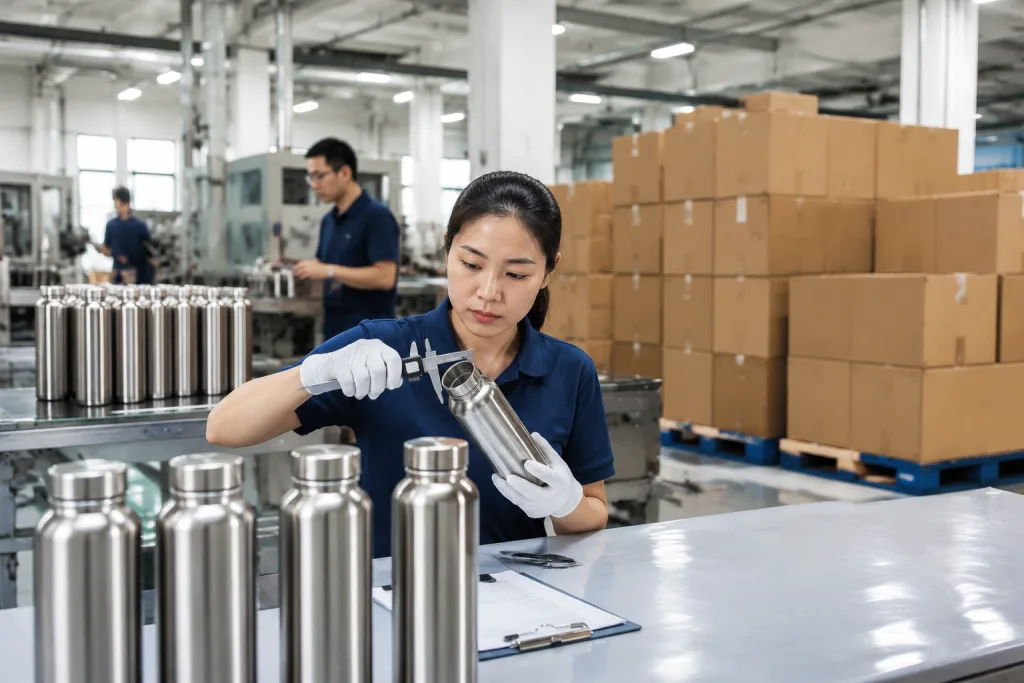
If you are sourcing from Zhejiang or another industrial cluster in China, ask for the exact spec sheet: body grade, lid material, gasket type, and surface finish. We run these checks on the line with calipers and a spec card, because “stainless” alone tells you nothing. For food-contact projects, you want consistency with REACH and, where relevant, FDA or LFGB expectations. The supplier should also state whether the outer shell is 304, 201, or powder-coated over stainless substrate. A buyer once flagged a “316 tumbler” where only the inner cup was 316; the math didn’t work, and the quote was built on a shortcut.
“316 is a material decision, not a branding word. If the supplier cannot break down the assembly by component, they are not giving you a procurement answer.”
For a premium custom growler or customizable growler, the inner surface finish matters too. A smoother finish cuts residue and makes cleaning easier; on one 0.4 mm liner, QC pulled the sample and found swirl marks that held coffee stain after one wash. For a customized canteen sold into outdoor channels, ask for passivation details and salt-spray test references. If the factory can talk through ASTM or ISO test methods without looking for a script, you are talking to a real manufacturer, not a trading desk.
Decide how you will customize
Custom decoration moves both margin and risk. For a simple logo, silkscreen still wins on cost, especially on canteen custom orders above 3,000 pcs. We run that line a lot. It suits flat artwork and hard color blocks, but it wears faster than engraving. Laser engraving costs more up front, yet it holds up better on premium custom drinkware when the buyer wants abrasion resistance and a cleaner look.
Powder coating changes the call. It improves grip and cuts visible fingerprints, but it adds one process step and one more QC check. On a customizable canteen program, ask whether the logo goes before or after coating, because that changes wear life and lead time. We’ve seen this go sideways when the buyer flagged a PO typo on the logo placement note. For a canteen customized in multiple SKUs, color drift becomes the issue. The supplier should state Pantone tolerance, usually within a tight delta, and say if they match with wet paint, powder, or UV print.
- Silkscreen: lower cost, good for canteen promotional campaigns.
- Laser engraving: better for premium distributor drinkware and long-term wear.
- Embossed or debossed tooling: useful for high-volume canteen vendors, but requires tooling approval.
- Full-color wrap: strong shelf impact, but more sensitive to scuffs and MOQ.
For a distributor canteen or distributor growler line, do not overcomplicate decoration if sell-through depends on price. QC pulled the sample, checked the 0.3 mm edge lift, and that was enough to show where the risk sits. For a customized growler in specialty retail, the finish can justify a higher ticket. This is the wrong question to ask if you start with preference. Channel decides.
Price the real landed cost
FOB price is one line on the sheet. That is not the landed number. For imported drinkware, you still pay for cartons, inserts, freight, duty, inland delivery, and FNSKU labeling if the goods go into Amazon. We once saw a buyer focus on a USD 3.20 FOB Ningbo quote for a 500 ml stainless bottle, then the real delivered cost moved to about USD 5.10 after packaging upgrade, logo printing, carton testing, and ocean freight. The math does not work if you approve artwork too early.
Ask for one quote broken into base product, decoration, packaging, and test fees. Make every supplier quote the same spec: same wall thickness, same lid, same box count, same carton drop test. A 5% gap on the bottle can disappear fast when one factory charges separately for sample molds and the other rolls them into tooling. We run into this on the line all the time. In Zhejiang, some factories quote the blank body hard and take the margin back on packaging or color matching, and the buyer flagged it only after the PO typo showed the wrong carton count.
Monthly output needs to be stated in plain numbers. A factory that ships 300,000 units a month can support a distributor program better than a workshop with uneven capacity, especially when the buyer wants 12 days for samples and 18 days for mass production on the same order. If your launch date is fixed, ask for a production calendar with dates, not promises. Ten days on a fully customized order is the wrong question to ask. QC pulled the sample, checked the lid fit at 0.3 mm, and that is the kind of detail that tells you whether the line can hit the schedule.
Verify compliance before you scale
Compliance is not paperwork on the side. It defines the product. Before mass production, ask for declarations on food-contact safety, REACH, and the market rules your buyer actually needs. For Europe, LFGB testing is often the first line item on premium customized drinkware. For North America, buyers usually want FDA-related documents plus material traceability. You do not need every certificate under the sun. You need the right set for the route to market.
Inspection terms matter too. A canteen factory should accept pre-shipment inspection to AQL 2.5 for major defects and 4.0 for minor defects, or the standard you put on the PO. On our line, QC pulled a leaking sample once because the seam showed a 0.3 mm offset, and that is the kind of miss you want caught before the carton leaves. Ask who handles carton drop tests, coating adhesion, thermal retention claims, and leak testing. For a custom growler or customizable growler, pressure and seal performance deserve extra attention. Cap failure creates returns fast.
Traceability is the part buyers skip until there is a complaint. Batch codes, production dates, and material lot references let you pin down one bad run instead of arguing over the whole shipment. We ship this way because export buyers push for it, and the math works. A canteen manufacturer that can show traceability, test reports, and inspection records is safer than one sending only pretty photos. If the PO has a typo on the model code, a clean batch record still saves the job.
Choose a supplier you can scale with
Once the spec is locked, the real question is whether the supplier can repeat the order without drift. A canteen supplier that nails one sample and slips at 20,000 pcs is not a partner you can scale with. We look for steady monthly output, a dedicated QC desk, and the ability to rerun the same SKU without changing the gasket, coating, or print registration. On the line, that usually shows up in the first 50 pieces.
Ask whether they serve canteen distributors, private label brands, and promotional programs at the same time. Good factories split those jobs cleanly. A canteen distributor wants stable reorders and carton efficiency; a branded retailer wants tighter color control on custom drinkware; a promotional buyer wants a faster lead time and a lower decoration cost. The wrong question is “can you do all three?” The right one is “how do you keep the jobs from crossing?”
For long-term programs, ask for the defect correction policy, spare lid availability, and replacement parts. If a customizable canteen line is meant to run for 12 months or more, the math does not work if every refill order forces a new mold check. We have seen this go sideways when a buyer flagged a 1.5 mm gasket shift after the PO typo changed the lid code. The best China suppliers quote clearly, call out the tight margins, and tell you where the risk sits. That kind of straight talk saves money later.
Use samples as a stress test
Samples are for breaking, not admiring. Before you sign off a canteen custom order, run the sample through the same abuse your buyer will put on it: fill it with hot water, shake it hard, toss it in a bag, leave it overnight, then check the lid seal again. Rub the finish on a rough board. Measure the weight, wall thickness, and actual capacity with the same gauge we run on the line. The sales sheet must match the sample, not the render.
If you are buying from a canteen factory in China, ask for pre-production samples and signed approval photos. Keep that approved sample against the PO; I have seen a PO typo turn `500 ml` into `550 ml` and nobody caught it until packing. If you are ordering a customized canteen or customized drinkware in several colors, approve each color on its own. Slow? Yes. Cheaper than a remake. The math does not work any other way.
For large launches, request a gold sample, packing sample, and label sample. If the product will be sold as distributor drinkware, check the master carton count and barcode placement; QC pulled the sample once and found the barcode 8 mm too low for scan speed. If it is a canteen promotional project, verify the imprint size on the formed body, not on a flat mock-up. That is the mistake that sends good-looking cartons straight back from the warehouse.
Request a factory quote with real specs
Send your target volume, finish, and compliance needs. We’ll quote MOQ, lead time, and landed-cost options from China.
Frequently asked questions
Why pay for 316 instead of 304 stainless steel?
Pay for 316 when corrosion resistance matters in real use, not just in the brochure. It performs better with salt, sweat, acidic drinks, and harsh outdoor conditions. In many B2B programs, 316 costs about 8-20% more than 304, depending on diameter, finish, and order volume. If you are selling a premium custom canteen, marine bottle, or outdoor growler, that premium is usually justified. If the customer mainly needs office hydration or giveaway stock, 304 may be the smarter commercial choice. A good 316 stainless steel drinkware manufacturer should explain where the grade is used in the product, because partial 316 builds are common.
What MOQ should I expect from a canteen factory?
For a serious export canteen factory, MOQ often starts around 3,000 pcs per SKU for custom color or custom logo work, and 5,000 pcs or more for complex decoration or special lids. Some canteen manufacturers will go lower, but pricing usually rises fast below that threshold. If you need multiple colors, each color may carry its own MOQ. Ask whether the factory can combine styles into one carton program or one production run. That is common in China and can save you money. Always check whether samples, tooling, and packaging are included in the quoted MOQ economics.
How long does production usually take in China?
For custom drinkware from China, sample lead time is often 7-12 days if no new mold is needed. Mass production is commonly 25-35 days after sample approval and deposit, depending on coating, printing, and packaging. If you add a new lid mold or special box insert, add another 15-25 days for tooling and validation. Zhejiang factories with stable capacity can sometimes move faster, but only if the spec is simple and artwork is ready. If your launch date is fixed, build in buffer time for inspection, sea freight, and possible rework.
What compliance documents should I request?
At minimum, ask for food-contact material declarations, REACH-related documentation for Europe, and any market-specific test reports your buyer requires. For Europe, many buyers also ask for LFGB; for North America, they often want FDA-related support documents. If the product uses coatings, inks, or silicone parts, request those component details too. A proper canteen supplier should also accept AQL inspection terms and provide batch traceability. For premium programs, ask for salt-spray, leak, and thermal retention data if the claims will appear on the pack. Do not rely on a certificate photo alone; request the full report.
How do I choose between silkscreen and laser engraving?
Use silkscreen when price is the priority and the artwork is simple. It works well for canteen promotional orders and distributor drinkware where the logo is large and the order is above 3,000 to 5,000 pcs. Use laser engraving when you want a premium finish and better abrasion resistance. It is the safer option for long-life retail, executive gifts, and customized growler programs. Laser is usually more expensive per unit, but it reduces visual wear and can improve perceived value. Ask the supplier for both options on one sample if possible, because the final decision is easier when you see the actual surface finish.