Key Takeaways
- 316 stainless steel usually adds USD 0.35-1.20 per unit versus 304, depending on capacity and wall thickness
- For salty, acidic, or outdoor use, 316 gives better corrosion resistance because of 2.0-3.0% molybdenum
- A realistic China factory MOQ is 1,000-3,000 pcs per SKU for customized drinkware with private mold-free branding
- Lead time is typically 30-45 days after artwork approval, plus 7-12 days for pre-production samples
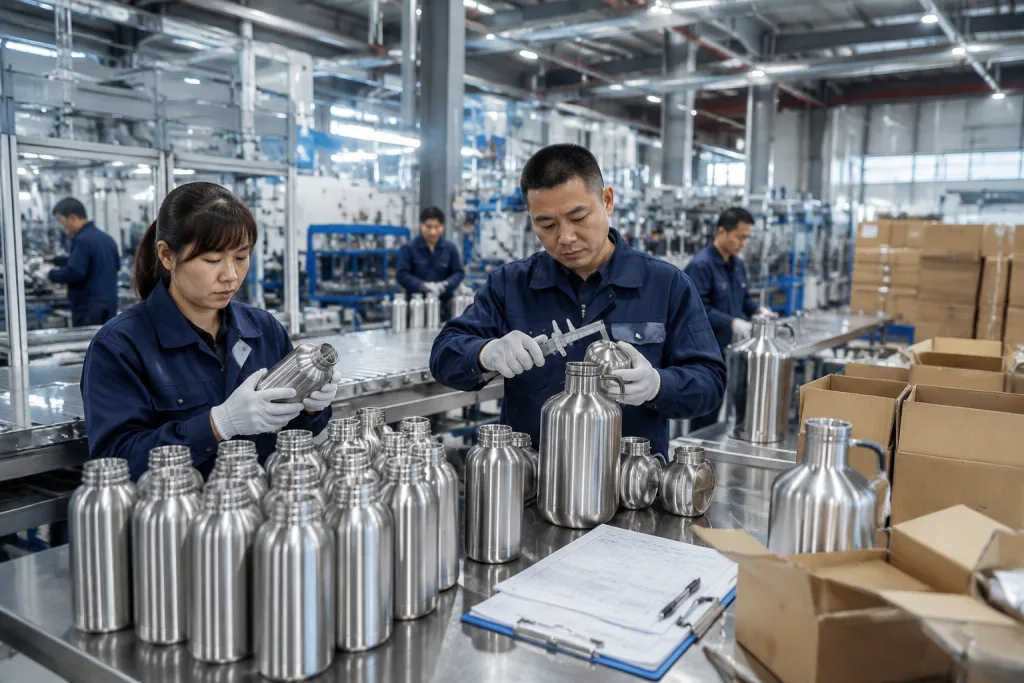
If you are sourcing from a 316 stainless steel drinkware factory, you already know the material costs more than standard 304. The harder question is simple: will your buyer, retail channel, or distributor account pay for that upgrade? For a canteen custom project in outdoor, marine, wellness, or premium corporate programs, 316 can make sense. For a basic promo bottle, the math often does not work. On our line, the quote gap is not just the coil price; 316 can add 12 days vs 18 days lead time when the polishing room is full, and QC pulled one recent sample for a 0.3 mm lip burr after passivation.
Our Hangzhou, Zhejiang team sees this 6 or 7 times a month: a buyer asks for “best stainless steel,” but the real use case is a school canteen, distributor drinkware line, or Amazon FBA tumbler where weight, lead time, logo durability, and test compliance can decide the order before alloy grade does. “Best stainless steel” is the wrong question to ask. We run the comparison below for practical sourcing decisions, with details like 0.6 mm inner wall thickness, laser logo abrasion, carton drop-test findings, and the PO typo we still see too often: 316 written on the artwork file but 304 listed on the carton mark.
316 versus 304 at the factory gate
For most B2B buyers, the factory gate comparison is 316 stainless steel against 304 stainless steel. Both are food-contact austenitic stainless steels. We run both on the same bottle lines in Hangzhou: custom drinkware, vacuum bottles, custom canteen programs, and distributor growler runs. 304 is not “bad,” and 316 is not magic. The real difference is corrosion margin, and QC usually sees it first around the weld seam, the threaded mouth, or a 0.3 mm scratch inside the liner.
316 stainless steel contains molybdenum, commonly around 2.0-3.0%, so it stands up better to chlorides and acidic liquids. Salt is the troublemaker. If the bottle will sit in a beach bag, fishing boat, hiking pack, gym locker, or get filled with electrolyte drinks, that extra margin earns its cost. For water and coffee in office gifting, 304 usually does the job and keeps the landed cost lower. We had one buyer ask for full 316 on a 10,000 pcs promo order; the math didn’t work, because their end user was drinking black coffee at a desk.
| Spec point | 316 stainless steel | 304 stainless steel |
|---|---|---|
| Typical use fit | Marine and fishing orders, outdoor retail, premium wellness bottles, acidic drink programs | General retail shelves, promo campaigns, office gifting, school bottle orders |
| Corrosion resistance | Higher against salt, chloride, sweat, and electrolyte residue | Good for daily drinking water, tea, coffee, and standard wash cycles |
| Material premium | Usually +8-18% on steel part cost | Lower baseline cost |
| Buyer message | Premium, durable, outdoor-grade | Reliable and cost-efficient for mainstream volume |
As a Zhejiang canteen manufacturer, we usually recommend 316 for the inner liner first, not full-body 316 by default. A double-wall vacuum bottle can use 316 inside and 304 outside, which controls cost while improving liquid-contact performance. On a 750 ml sample last month, QC pulled the sample after salt-spray checking and the buyer flagged the cost, not the finish; that told us 316 inner plus 304 outer was the cleaner spec.
Where 316 actually earns its cost
I’ll rewrite the section in-place, keep the HTML structure unchanged, and tune the prose for a factory-side sales voice with concrete shop-floor detail.316 belongs on the spec sheet when the end user’s environment is harsher than a normal retail use case. We see it land in coastal markets, sailing clubs, fishing merch, camping retail, sports bottles filled with electrolyte powder, and premium corporate gifts where “316 inner liner” is part of the sales pitch. For a canteen giveaway handed out at a one-day event, that math does not work.
The cleanest use cases are easy to map on the line. A custom growler for craft beverage retail benefits from 316 because beer, kombucha, and acidic drinks stay in contact with the inner wall for hours, and QC pulled the sample after a 48-hour soak test with no rust spots. A customized growler for outdoor clubs also has a stronger durability claim. A customizable canteen for military-style outdoor retail, scout programs, or marine tourism can justify 316 too, as long as the cap hardware and weld bead are specified right.
- Best fit: 316 inner wall, 304 outer wall, 0.45-0.55 mm inner thickness, copper-coated vacuum insulation.
- Acceptable value fit: 304 inner and outer walls, 0.40-0.50 mm thickness, used for water, tea, coffee, and normal retail.
- Usually not worth it: single-use event giveaways where the target FOB is below USD 3.00.
For canteen distributors, the better pitch is lower corrosion complaints, stronger outdoor positioning, and fewer returns from buyers who leave sports drinks inside overnight. We’ve seen this go sideways when the PO says “316” but the buyer skips the cap spec and the 1.0 mm gasket, then blames the bottle. That is the wrong question to ask. In B2B, that is the language that moves orders.
Spec table for buyer briefs
A weak RFQ gives weak quotes. If you send “quote 316 bottle with logo” only, a factory in China has to guess the capacity, lid structure, coating, carton pack, test standard, and order volume. The prices will not line up. Lock these points before you ask for FOB Ningbo or FOB Shanghai pricing.
| Item | Economy custom canteen | Premium 316 canteen customized |
|---|---|---|
| Capacity | 500 ml / 750 ml | 750 ml / 1,000 ml / 64 oz growler |
| Steel | 304 inner + 304 outer | 316 inner + 304 outer, or full 316 on request |
| Wall thickness | 0.38-0.45 mm | 0.45-0.55 mm |
| Insulation | Vacuum, no copper coating | Vacuum with copper coating option |
| Surface | Powder coating or spray paint | Powder coating, ceramic coating, brushed steel |
| Logo | 1-color silk screen | Laser engraving, emboss, full-wrap print |
| Typical FOB | USD 3.20-5.80 | USD 4.60-8.90 |
For custom drinkware, we quote two lines side by side: 304 base and 316 upgrade. That is the cleaner way to get approval. The buyer sees the delta fast, and the math is easy to defend. We run this on the line all the time, and a 316 claim only makes sense when the channel can carry the extra cost. A distributor program often takes both versions: 304 for entry pricing, 316 for retail or corporate orders.
Branding choices affect durability
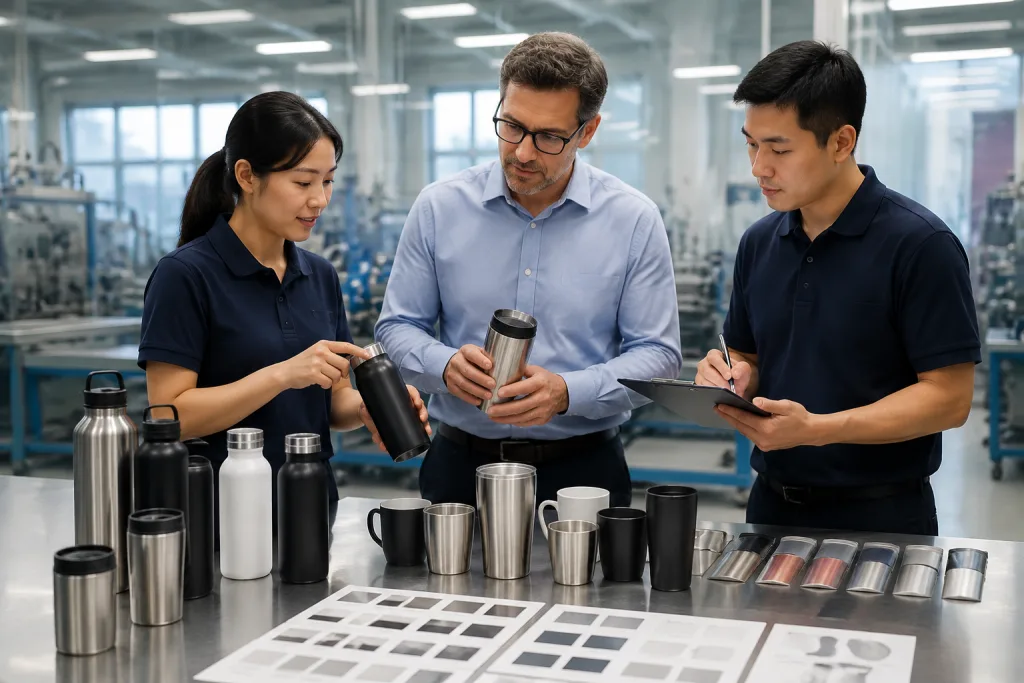
The alloy does not save a weak logo. We see most custom drinkware complaints from coating scratches, peeling print, or a Pantone miss, not from stainless corrosion. If the bottle gets handled every day, rides in retail cartons, or goes through canteen distribution, the decoration method needs the same discipline as the steel grade.
Laser engraving is the safest long-run choice on powder coat or bare stainless steel. It cuts through the top layer and exposes metal, so there is no ink to rub off. On a canteen line, we run 1,000-5,000 pcs cleanly for mixed logos, and the buyer usually stops arguing once QC pulled the sample and showed no rub-off after tape pull. Silk screen costs less for a simple one-color mark, but the PO should call out 3M tape test, alcohol rub test, and cross-hatch adhesion test on coated surfaces.
Full-wrap heat transfer and UV print give stronger shelf impact, but setup cost goes up and artwork control gets tighter. For a customized canteen with gradient art, plan on 5-7 days more for sampling and ask for a pre-production sample before mass production starts. On a custom growler, the curve can distort the print, so we ship with a dieline and print tolerance of ±1.5 mm, which is where the math either works or it does not.
Practical rule: if the buyer expects the bottle to last 2 years, do not pick the cheapest logo method just to save USD 0.08.
Compliance and inspection checkpoints
For Europe and North America, 316 stainless steel still needs test papers. We ship plenty of cups, and the first question is always food-contact proof, not the metal grade alone. For EU programs, buyers usually ask for LFGB or EU 1935/2004 food-contact compliance, plus REACH for coatings and inks. For the U.S., FDA food-contact requirements and California Prop 65 review may apply. Kids products may also need CPSIA or ASTM checks, depending on the design and age grading.
At factory level, ask for the steel grade declaration, incoming material records, and finished goods test reports. A serious canteen factory will not push back on third-party inspection under AQL. On the line, QC pulled the sample and checked vacuum performance, leakage, coating adhesion, color variance, odor, burrs at the mouth, lid thread fit, and carton drop test. We run AQL 2.5 for major defects and AQL 4.0 for minor defects unless the buyer specifies stricter terms. This is the wrong question to ask if someone says 316 alone is enough.
Buyers miss the lid and seal. A 316 stainless body with a low-grade silicone ring or a poor polypropylene lid is not a premium cup. Ask whether the silicone is food-grade, whether spare gaskets are available, and whether the cap passes 24-hour inverted leak testing. We once saw a PO with a lid color typo and the buyer flagged it before packing started. For Amazon FBA, add FNSKU labeling, master carton weight under the target handling limit, and ISTA-style packaging review. In China, those details decide whether the shipment moves cleanly or gets stuck at the dock.
MOQ, pricing, and lead time reality
For Zhejiang factories we run with private-label 316 drinkware, a workable MOQ is usually 1,000 pcs per color and size when the body comes from an existing mold. If the buyer wants custom color coating, 2,000-3,000 pcs makes more sense; the spray booth setup and color scrap eat margin fast. New mold work for a customized canteen shape usually needs USD 1,500-6,000 tooling and 35-55 days before the line can even start trial shots.
For stock models, sample lead time is usually 7-12 days after artwork confirmation. Mass production normally takes 30-45 days after sample approval and deposit. August to October is the busy stretch, and we see another 7-15 days slip on powder coating and gift box packing; one buyer once flagged a PO typo on the carton count and we still had to stop the line to fix it. Our combined capacity is about 600,000 units per month across stainless bottles, tumblers, canteens, and growlers, but that number does not buy you rush space on demand.
For price planning, a 750 ml 316 inner/304 outer vacuum canteen with powder coating and laser logo often lands around FOB USD 4.80-6.80 at 3,000 pcs, depending on lid type and packaging. A 64 oz customized growler with handle lid may sit at USD 7.20-10.50. If a quote is 25% below market, the math does not work; check wall thickness, vacuum testing, coating grade, and whether the supplier quietly swapped 316 for 304. QC pulled the sample on a 0.35 mm wall once, and the buyer rejected it on the spot.
Choosing the right supplier type
You will see three supplier types in China: trading companies, light-assembly vendors, and real factories with forming, welding, polishing, vacuuming, coating, and in-line inspection. A trading company can work for mixed small orders, but for 316 stainless steel drinkware factory projects, you need straight answers on material grade, weld quality, vacuum rate, and how they handle defects. We run into this every week. The buyer flags it fast when the answer stays generic.
Ask direct questions. What is the monthly capacity for this exact model? Is 316 used on the inner wall only, or on both walls? Can they show batch material certificates? What is the normal vacuum failure rate after 24-hour testing? How do they handle color deviation above ΔE 1.5? Can they support BSCI audit documents if a European retailer asks? QC pulled the sample, and a 0.3 mm weld bead gap showed up on the line. If the answers are fuzzy, this is the wrong question to soften.
For canteen distributors and distributor growler programs, supplier stability matters more than saving the last USD 0.10. You need repeatable colors, spare lids, barcode control, carton markings, and reorder continuity. A good canteen supplier keeps production records so your reorder in six months does not turn into a slightly different bottle. We’ve seen this go sideways when a PO had one typo on the lid code and the buyer had to recheck 3,000 units. That is how a customizable drinkware line becomes a reliable SKU family instead of a one-time import headache.
Send your 316 drinkware brief for a factory quote
Share capacity, steel grade, logo method, quantity, and target market. We will return a practical FOB quote and production timeline.
Frequently asked questions
Is 316 stainless steel always better for custom drinkware?
316 is better for corrosion resistance, but not always better for your margin. It contains about 2.0-3.0% molybdenum, which helps against salt, chloride, and acidic drinks. For marine, outdoor, electrolyte, or premium retail use, 316 inner wall is worth considering. For basic office gifts, school bottles, or low-cost canteen promotional orders, 304 stainless steel usually performs well and saves around USD 0.35-1.20 per unit depending on size. Many B2B buyers choose 316 for the inner liner and 304 for the outer wall. That gives the main food-contact benefit without making the full bottle unnecessarily expensive.
What MOQ should I expect from a 316 stainless steel drinkware factory?
For existing molds, expect 1,000 pcs per SKU as a starting MOQ for simple laser logo or one-color print. If you need custom powder coating, special packaging, or multiple Pantone colors, 2,000-3,000 pcs per color is more realistic. For a new custom canteen shape, tooling can cost USD 1,500-6,000 and the factory may ask for 5,000 pcs or more. Small trial orders are possible, but the unit price will rise because coating setup, printing fixtures, inspection, and export packing do not scale down neatly.
How do I prove the factory really used 316 stainless steel?
Ask for a material declaration, steel batch certificate, and permission for third-party material verification. For higher-value customized drinkware orders, you can add random XRF testing during inspection. XRF is not perfect for every element, but it can help identify whether molybdenum is present, which is the key difference between 316 and 304. Put the requirement in the purchase order: “316 stainless steel inner liner, 304 outer wall, no substitution without written approval.” Also keep a sealed pre-production sample. If there is a dispute, the approved sample and PO wording matter more than chat messages.
Which logo method is best for a customized canteen?
For durability, laser engraving is usually the safest choice, especially on powder-coated stainless steel. It costs more than basic silk screen, often by USD 0.05-0.18 per unit, but it will not peel like ink. Silk screen works for simple promotional orders if you specify adhesion and rub tests. Full-wrap print is better for retail artwork, but sampling may take 10-15 days and artwork tolerance should be controlled around ±1.5 mm. If your canteen distributors sell to outdoor or corporate premium accounts, laser or etched branding is usually the cleaner long-term option.
What lead time should I plan for distributor drinkware orders?
For an existing 316 inner-wall bottle with standard packaging, plan 7-12 days for samples and 30-45 days for mass production after approval and deposit. Add 7-15 days during peak season or if you require custom gift boxes, full-wrap printing, or several coating colors. Sea freight to Europe or North America can add roughly 25-40 days depending on port and routing. If you are launching a distributor drinkware program, approve the pre-production sample before opening preorders. It is safer to build your sales calendar around 60-90 days total from artwork approval to warehouse arrival.