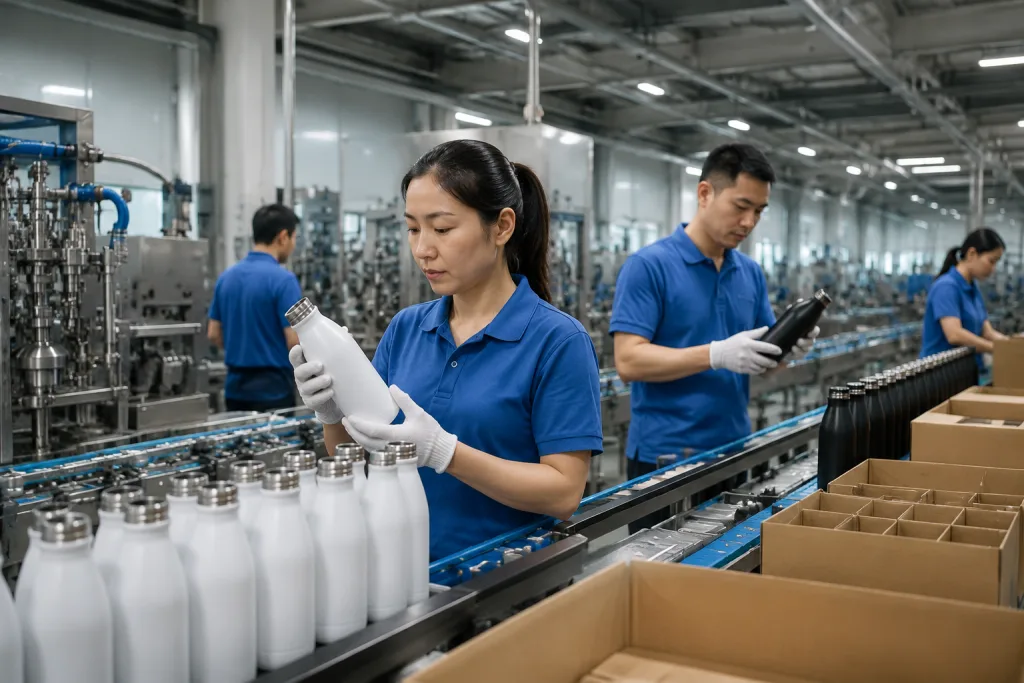
Key Takeaways
- A usable 316 stainless steel drink bottle wholesale spec usually starts at 18/8 outer shell with 0.5-0.6 mm wall and 0.4-0.5 mm inner liner
- Most failures come from weld burn marks, poor passivation, weak lid sealing, and inconsistent powder coating, not from the steel grade itself
- A real factory in Zhejiang or China should offer MOQ 3,000 pcs, 35-45 day lead time, and monthly capacity above 200,000 units
- For export, insist on REACH, LFGB, food-contact compliance, AQL 2.5 sampling, and clear carton-drop packaging tests
Buyers usually start with the wrong question: not “is 316 better?”, but “where does it fail in production?” In 316 stainless steel drink bottle wholesale, the risk shows up in welds, lining thickness, lids, passivation, and packaging, not on the sample sitting on your desk. We had one buyer flag a 0.3 mm liner variance after QC pulled the sample at the line, and that batch would have turned into refunds fast. If you are buying for retail, Amazon, or distribution, one bad batch can mean chargebacks and a messy reorder cycle.
We build and export drinkware from Zhejiang, China, and the pattern is consistent: the suppliers that quote the lowest FOB often hide the biggest process gaps. A serious factory should hold MOQ at 3,000 pcs, run 35-45 days lead time after approval, and show monthly output above 200,000 units. We ship with laser weld checks, and the math does not work if a factory cannot explain AQL 2.5, REACH, LFGB, and the difference between 304 and 316 grade control. This is the wrong question to ask if the seller only talks sample looks; wholesale drinkware lives or dies on process control.
Where 316 bottles actually fail
316 stainless steel sounds safe, but the bottle can still fail in five places: forming, welding, cleaning, insulation, and closure. The steel grade helps with corrosion resistance, especially if your buyers use acidic drinks, sports mixes, or salty environments, but it does not save a weak line. We have seen this go sideways after 30-60 days in the field, when a lid seal starts weeping, the coating chips at the base, or the vacuum layer drops off. One bad PO typo on `MOQ 5000` versus `MOQ 500` has caused more pain than the grade itself.
Here is what we see on the floor. A body pressed too fast leaves micro-wrinkles that show up under powder coating. A laser-welded seam with poor heat control leaves blue marks and a rough band. An uncleaned interior holds oil or polishing residue, and QC pulled the sample for odor issues. For bulk drinkware, this is the wrong question to ask if you only ask for `316` on paper; ask how they run process control.
- Body forming: look for consistent roundness and no shoulder collapse.
- Weld zone: demand smooth joints and no blue heat marks.
- Vacuum retention: verify 12-24 hour temperature performance, not a verbal promise.
- Lid seal: test inverted leak resistance under hot and cold fill.
If you are comparing a best wholesale drink bottle for retail, the real difference is not marketing copy. It is whether the factory can hold the same spec across 5,000 units and 50,000 units, with the same `AQL 2.5` result and no drift at the seam.
Steel grade mismatch costs money
One common failure mode is not a broken bottle. It is a bad claim on the quote. A supplier writes 316, then swaps in mixed materials or downgrades hidden parts. We have seen it on lid springs, filters, handle hardware, and decorative clips. One PO even had “316 cup body” typed in, while the lid BOM never got checked. For beverage packaging, especially premium canteen wholesale or wholesale drinkware, the cost is plain: returns, lost trust, and compliance trouble in some markets.
Do not spec the bottle as “316 stainless” and stop there. Name the parts. State which parts must be 316, which can be 304, and which cannot use nickel-plated steel. If the bottle has a straw lid, call out the straw, spring, and sealing ring. If it is a thermal bulk canteen or canteen bulk program, separate the inner liner from the outer shell. The wrong question to ask is “is it 316?” The right one is “where is 316 required, and where is it not?” On our line, QC pulled the sample and checked the weld seam at 0.4 mm; that is where weak specs usually show up. The factories in Zhejiang that ship clean export files map the BOM clearly. The weak ones hide behind “food grade stainless.”
What to put on the PO
- Inner liner: 316 stainless steel, thickness 0.4-0.5 mm.
- Outer shell: 304 or 201 only if approved in writing.
- Cap hardware: corrosion-resistant, salt-spray tested if relevant.
- Contact surfaces: no exposed plating on wetted parts.
For buyers sourcing alcohol flask wholesale bulk or alcohol flask in bulk, the same rule applies. Alcohol and acidic liquids are unforgiving. A vague spec goes sideways fast, and the math does not work when a customer rejects a 5,000-piece lot over one plated hinge.
Welds and seams ruin premium feel
Most bottle defects that make a product feel cheap start at the weld. A seam can be closed and still look rough, and basic function checks will miss it. That kills shelf appeal fast. We see it on the line with mirror polish: waviness, pinholes, and burn-through show up the moment light hits the body.
Ask for a seam inspection standard before the run starts. On insulated bottles, the neck weld and base weld need to stay clean after polishing, without pulling the wall down too thin. We normally ask buyers to lock the visible weld limit against a signed sample and require first article approval from pre-production pieces. That means the factory sends a part from the same tooling run, not a hand-finished showroom sample. The buyer flagged it once on a 0.3 mm seam; they were right.
“If the weld looks good on one sample and bad on the first production carton, the supplier never controlled the process. They only selected the best piece.”
In wholesale canteen programs, this is where margin disappears. A weak seam creates scrap, slows packing, and sends parts back for rework. For growler wholesale or beer growler wholesale bulk orders, the math gets worse because a large body exposes every line defect. QC pulled the sample, and the flaw was visible from 30 cm away.
Lids leak when tolerances drift
The lid is where complaints start, and it is rarely the customer’s fault. Rubber compression, thread depth, gasket hardness, and cap torque all have to line up. We’ve seen a bottle pass a simple inversion test on the line and still leak after shipping vibration, heat cycling, or a few rounds of hand washing. If you buy drinkware wholesale, do not approve the order without a lid-cycle test.
Call out the closure by function, not by looks. For travel retail or promo runs, ask for 3,000 open-close cycles on the main cap and at least 500 cycles on moving buttons or flip tops. Hot-fill needs a gasket that keeps its shape after thermal aging. If you are buying beer tumbler bulk or beer tumbler wholesale, pressure changes matter too; carbonation, foam, and cold condensation expose weak seals faster than still water. The buyer flagged one thin gasket at 1.8 mm, and the math did not work.
- Thread fit: no cross-threading after 10 consecutive openings.
- Seal compression: no leak after 2-hour inversion at room temperature.
- Drop test: cap remains functional after 1.2 m carton drop.
- Heat test: no deformation after hot-fill and cooling cycle.
For canteen wholesale and wholesale canteen programs, this is the failure mode that drives the most customer-service noise, because buyers blame the bottle when the lid design or gasket spec was the real issue. QC pulled the sample, checked the gasket shore hardness, and the leak disappeared once the cap torque was corrected.
Surface finishes chip faster than you think
Coating failure is brutal. It shows up fast and looks sloppy. Powder coat, spray paint, UV print, and silk screen all fail in different ways under abrasion and dishwasher cycles. A proper 316 stainless steel drink bottle wholesale program needs surface durability written in numbers, not color chips. If you sign off by swatch alone, you are guessing.
For matte powder coating, ask for cross-hatch adhesion and rub tests. For laser engraving, confirm depth and contrast on curved walls. For printed logos, state whether you want one-color silkscreen, multi-color printing, or laser only. We had a buyer flag a PO typo once—“silk screen” on the sample sheet, “laser” on the carton mark—and the line stopped for half a day. If the buyer side is launching bulk growler, growler bulk, or beer growler in bulk programs for breweries, the finish has to survive cooler condensation, crate stacking, and the kind of handoff abuse distributors give at 18 kg carton weight. In our Zhejiang factory workflow, this is where rushed orders slip, because drying time gets cut and QC gets told to “move it along.”
Do not forget the bottom ring and bottle shoulder. Those spots take the hits in carton packing. A bottle can look clean on the body and still chip at the base after two weeks in a warehouse. We check that area with a simple drop fixture and a 1.2 mm wear line; that small detail saves a lot of argument later. If you need alcohol flask bulk or alcohol flask wholesale bulk, the cosmetic load is higher because the surface area is small and every scratch shows.
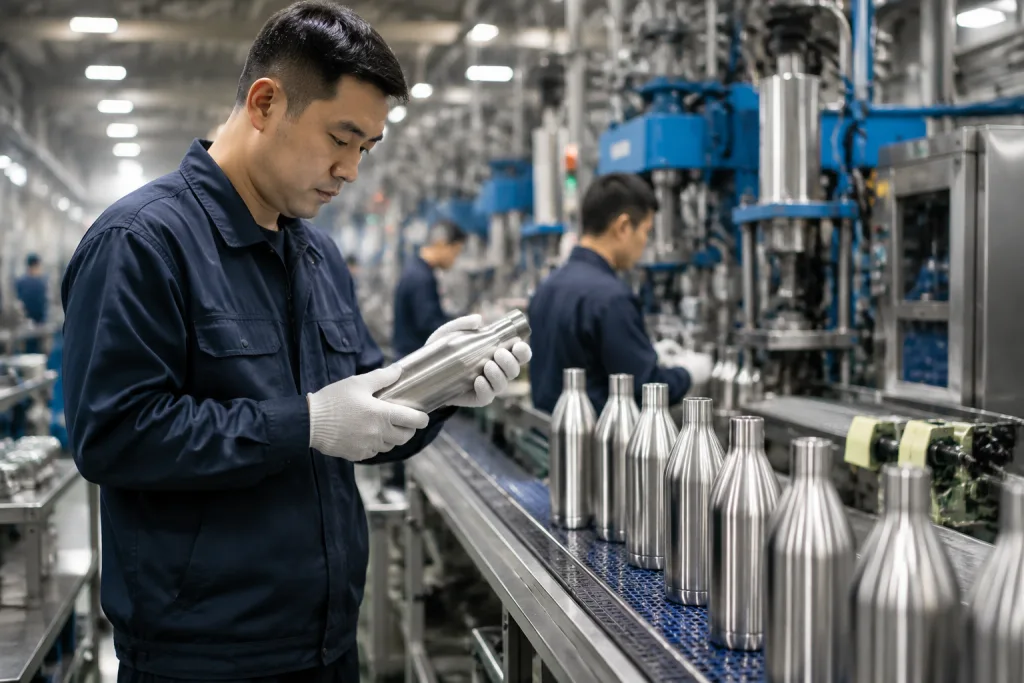
Compliance is not a checkbox
I’ll rewrite the section in place, keeping the HTML structure intact and tightening the sales-engineer tone.How to spec the order correctly
The cleanest way to stop a production mess is a purchase spec the line can follow without guessing. Keep it short. Keep it measurable. Tie every point to inspection. Write down product type, capacity, material grade, wall thickness, finish, lid type, and packing method, then lock the commercial terms: MOQ, lead time, sample approval, and defect handling. A 0.05 mm wall callout is useful; “good quality” is not.
For a standard 316 stainless steel drink bottle wholesale order, a spec like this works: 500 ml, 316 inner liner, 304 outer shell, 0.45 mm inner / 0.5 mm outer wall, powder-coated finish, PP lid with silicone gasket, 100% leak test before carton packing, AQL 2.5 on appearance and 4.0 on function, 3,000 pcs MOQ, 35-45 days after pre-production approval. If the buyer wants canteen bulk or canteen wholesale formats, widen the capacity range and add handle or strap pull-test requirements. We’ve seen this go sideways when the PO says “with lid” and nothing else.
At BottleForge in Zhejiang, China, the orders that run smooth are the boring ones: stable tooling, stable coating, stable inspection. QC pulled the sample, checked the cap torque, and the order moved. That is the kind of discipline you want at wholesale scale. If a supplier cannot quote 10,000 units with a fixed FOB and a repeatable QC plan, the math does not work, and the risk is already in the unit price.
Get a clean 316 bottle spec
Send your target size, finish, and lid style. We’ll map the production risks, MOQ, and compliance checks before you place the order.
Frequently asked questions
Is 316 stainless steel worth it for drink bottles?
Yes, when your use case has acids, salt exposure, or premium positioning. 316 resists corrosion better than 304, especially in tough environments, but it does not fix bad welding or weak lids. For wholesale buyers, the cost premium is usually around 8-15% over a comparable 304 build, depending on capacity, finish, and lid complexity. If your customers want a best wholesale drink bottle for daily hydration, 316 is usually justified for brand story and lower complaint risk. If you are sourcing bulk drinkware for a low-margin promo run, 304 may be enough.
What MOQ should I expect for 316 bottle wholesale?
A practical MOQ is 3,000 pcs per SKU for a custom 316 stainless steel drink bottle wholesale program. If you need custom color, logo printing, or special packaging, some factories will push that to 5,000 pcs. For canteen wholesale or wholesale canteen orders with multiple lid options, the MOQ can split by component. A capable factory in Zhejiang or elsewhere in China should also tell you the monthly output, and 200,000 units/month is a good sign for stable supply on drinkware bulk programs.
How do I check if the bottle is really 316?
Do not rely on a verbal claim. Ask for the material declaration, mill certificate for the wetted steel, and third-party lab reports if available. For export, the factory should identify which parts are 316 and which are 304 or PP. If they cannot separate the BOM, be cautious. You can also use spot testing on incoming goods, but that is a screening tool, not a substitute for documentation. On serious wholesale drinkware orders, I would always require batch traceability and a signed material spec before production starts.
What QC tests matter most for these bottles?
Start with leak testing, vacuum retention, coating adhesion, and carton-drop performance. For insulated bottles, verify hot and cold hold time on a sample set, not just one hero piece. AQL 2.5 is common for appearance, while function can be tightened if the product is for premium retail. For beer tumbler wholesale bulk or growler wholesale shipments, pay extra attention to lid sealing and finish abrasion because warehouse handling is rough. A bottle that passes appearance but fails function is a returns problem, not a QC win.
Can I mix 316 bottles with other drinkware in one order?
Yes, but only if you control each SKU separately. Do not bundle 316 bottles with bulk canteen, bulk growler, or alcohol flask wholesale bulk items unless the BOM, carton spec, and compliance file are clear for each item. Mixed orders can help freight efficiency, but they also increase labeling and inspection mistakes. If you are selling on Amazon, define FNSKU placement per SKU. For retail distribution, separate carton markings and master carton counts reduce warehouse errors and chargebacks.