Key Takeaways
- Specify 316 inner liner, 304 outer shell, 0.45-0.55 mm wall thickness, and material test reports before deposit
- Leak testing should cover 100% of bottles, not only AQL carton inspection
- For custom canteen orders, logo artwork needs a physical sample before 1,000+ unit mass production
- FOB China pricing for 316 vacuum bottles often sits 8-18% above comparable 304 designs
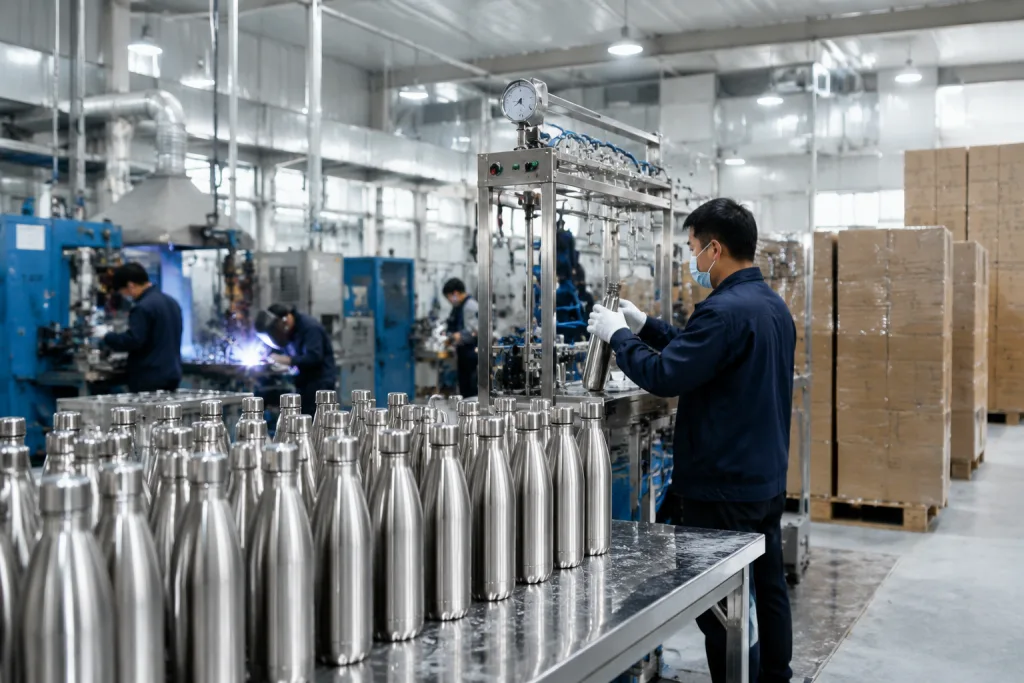
Buying from a 316 stainless steel drink bottle supplier looks easy until 3,000 bottles land with rusty tea stains, lids that back off after two turns, laser logos that look grey instead of black, or 5-ply cartons crushed in a damp warehouse. We see the same causes on the line: specs written as “premium stainless,” sampling approved too fast, 316 bodies mixed with 304 lids, and QC checking scratches while nobody runs a 24-hour leak test at 45°C.
If you are building custom drinkware for retail, promotion, or distributor canteen programs, control the ugly details before mass production. This is where the math doesn’t work if you chase the cheapest quote and fix problems after shipment. BottleForge Industrial in Hangzhou, Zhejiang, works with B2B buyers who need repeatable China output, not sample-room shine; QC pulled one sample last month because the PO said “matte black” but the artwork file read “satin black.” Our practical baseline is MOQ 1,000 units per SKU, 25-35 day production after deposit and sample approval, and up to 450,000 stainless units/month across bottle and tumbler lines.
Failure one: 316 only on paper
The costly mistake is assuming every metal part that touches liquid is real 316 stainless steel. We have seen cheaper canteen suppliers quote 316, then run 304 for the inner liner, save 316 for a small tea filter, or switch to mixed coil stock after lot one. Incoming inspection often misses it. QC may only see a clean 0.6 mm liner and a pass on appearance. The trouble arrives 3-6 months later: rust claims from salty drinks, lemon tea, hard mineral water, or daily dishwasher cycles.
A workable spec separates each metal component: inner liner 316, outer shell 304 or 316 if required, lid insert 304 or PP/Tritan, infuser 316, handle pin 304. For most B2B custom drinkware, 316 inner plus 304 outer is the smart balance. Full 316 construction can be done, but the FOB China cost usually increases another 6-12% depending on bottle shape and order volume. The math often does not work for promo channels. On a 750 ml bottle, the buyer may accept a USD 0.18 increase for a 316 liner, then reject USD 0.42 more for a 316 outer shell.
Ask the canteen factory for mill certificates and incoming material records by coil batch. For larger orders, use PMI testing by XRF on random semi-finished parts before polishing. We run this check before the line moves to sanding, because after polishing the batch is harder to isolate. If you are a distributor drinkware buyer placing 5,000-20,000 units, this extra check costs less than one EU recall notice and a pile of rejected cartons. Do not trust a single lab report from last year. The report must match the current production batch and show chromium, nickel, and molybdenum content consistent with 316 stainless steel.
Practical spec line: “Food-contact metal inner vessel must be SUS316, verified by batch material certificate and random XRF test before assembly.”
Failure two: vacuum loss after shipment
I’m pulling the section into a tighter, factory-side voice and keeping the HTML exactly as-is. Next I’ll rewrite each paragraph with specific test details, shipping failure language, and fewer stock phrases.Failure three: lids leak, sweat, or smell
I’ll rewrite the prose in place, keep the HTML exactly as-is, and make the section sound like a factory-side sales engineer wrote it.Most complaints land on the lid, not the steel. That is where custom canteen jobs get messy: straw lids, screw caps, flip tops, carry handles, spout covers, silicone gaskets, and inner threads each add a leak point. We run ten lid options on some bottle bodies, but in repeat B2B supply only three usually stay stable after MOQ pushback and sample feedback.
Leaks usually come from gasket hardness, thread tolerance, cap shrinkage, or weak torque control on the line. Specify food-contact silicone, usually 50-60 Shore A for bottle gaskets, and ask for removable gaskets so the buyer can clean them. For plastic parts, ask for LFGB or FDA-grade paperwork as needed, plus REACH compliance for EU orders. If your customized drinkware goes to children, bring up ASTM or CPSIA requirements before mold approval; fixing that after toolmaking is the wrong question to ask.
A basic lid test plan should include inverted leak testing for 30 minutes, horizontal rolling for 5 minutes, and repeated open-close cycling. For sport lids, we test at least 300 cycles during sample validation. For mass production, 100% air-pressure or water leak testing works for screw-top bottles, while flip lids often need fixture testing by batch. If the bottle is meant for carbonation, say so clearly. Many standard vacuum bottles are not built for soda, beer, or fermentation pressure, and the buyer flagged that after one carton bloated in transit.
Odor is the other easy miss. Cheap silicone can hold a chemical smell, especially inside a sealed hot container during shipping from China. Before you approve a canteen customizable lid, fill it with 80°C water for 2 hours, then smell the water and the gasket. That is not a lab method. Still, QC pulled the sample this way before cartons left Zhejiang, and it saves a lot of back-and-forth.
Failure four: logos that look cheap
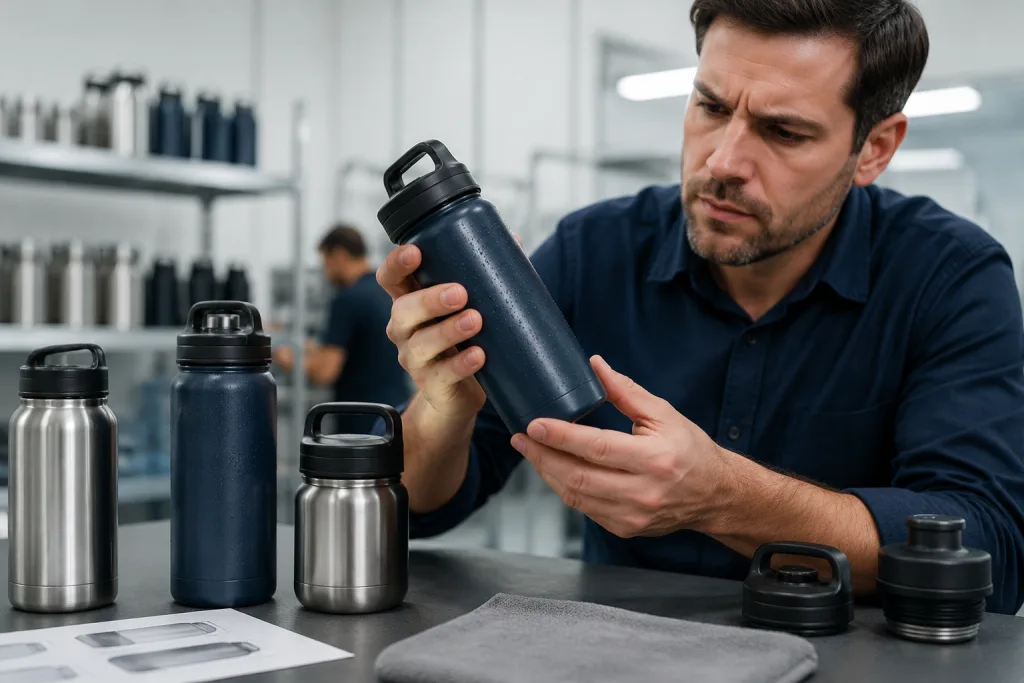
Custom drinkware wins or loses on decoration. The bottle can be right on paper, but if the logo sits 3 mm off, the powder coat bleeds, or laser engraving comes out brown instead of silver, retail value drops fast. We see this when a buyer signs off a mockup and skips a physical pre-production sample. The math does not work.
Match the decoration to the surface and the use case. Laser engraving holds up on powder-coated stainless bottles and fits distributor growlers and corporate gift runs. Silkscreen printing is cost-effective for a simple one- or two-color logo, but curved bodies make registration harder. Heat transfer can handle multi-color artwork, yet we still test edge lifting on the line. Full-wrap printing needs tighter artwork control and a fixed seam position. For canteen promotional orders, ask whether the logo should face opposite the lid hinge, line up with the handle, or sit centered on the front. “Front” is not a factory term.
Artwork files should come as AI, EPS, or high-resolution PDF with Pantone codes. Set the acceptance limits early: logo position ±1.5 mm for premium retail bottles, ±2.0 mm for promotional canteen orders, and color tolerance against Pantone under D65 lighting when color matters. For laser engraving, approve depth and contrast on the actual coating color. Black, navy, and dark green coatings usually engrave cleanly; light colors can look flat. QC pulled a sample at 500 pieces once, and the buyer flagged the mismatch before the run kept going.
Do not move to mass production from a photo alone if the order is more than 1,000 units. A physical golden sample should lock down coating texture, logo size, placement, lid fit, barcode, polybag warning, and carton marks. Good canteen manufacturers keep that sample at the line for operator comparison. Without it, QC debates turn subjective and expensive. We have seen a PO typo on the logo size turn into a whole carton of rejects.
Failure five: coating chips too easily
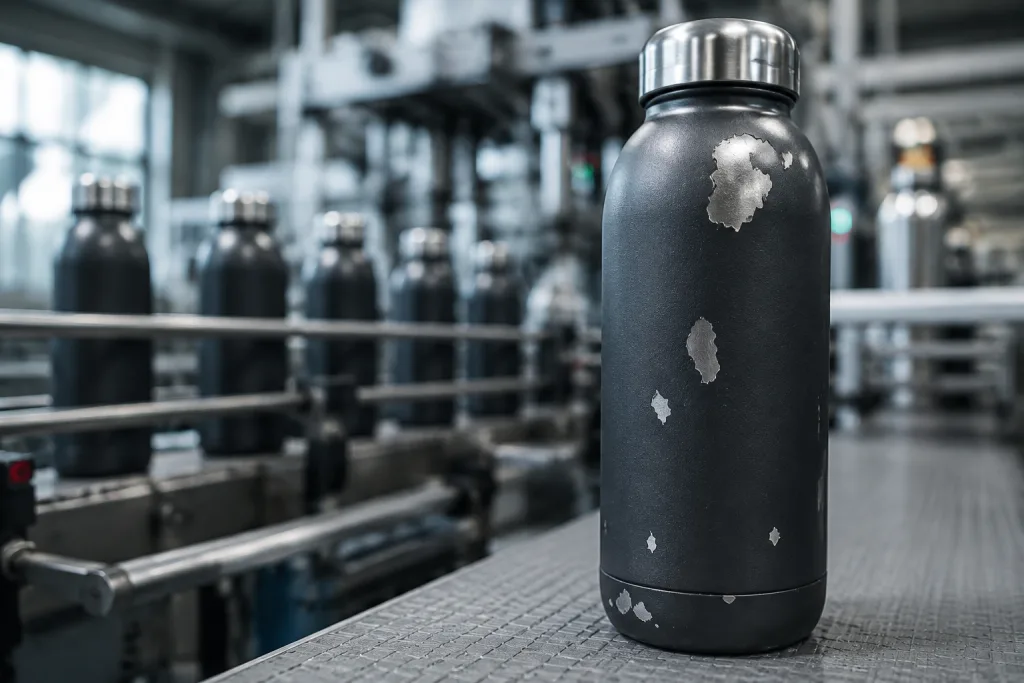
Powder coating complaints usually get blamed on “rough use,” but the line often started wrong. We run stainless through degreasing, grit prep, coating thickness control, and curing temp checks first. If oil is left from forming or polishing, the bottle can pass a visual check and still chip at the base after three days in a backpack.
For most custom drinkware, 60-90 microns is a workable powder coat range. Go thinner and coverage drops; go thicker and thread fit, seams, or lid alignment starts to move. Ask your 316 stainless steel drink bottle supplier for cross-hatch adhesion testing on coated samples. QC pulled the sample, taped it with 3M after the cross-cut, and that tells you more than a pretty photo. For retail or outdoor channels, add abrasion rub testing and a drop test from 1.0 m onto plywood or a defined surface. Concrete sounds tougher, but that is the wrong question to ask; it weeds out good factories and tells you little about daily use.
Color consistency matters when distributors reorder the same canteen month after month. A matte black from March should not drift from a July reorder. Keep one master color plaque or an approved coated bottle on the shelf. If you buy several SKUs, state whether the same black must match across a 500 ml bottle, a 750 ml canteen customized version, and a 1.9 L custom growler. Different spray booths and oven loads can shift tone by a few points, and the buyer flagged it fast on a 200-piece repeat order with a bad PO color code.
For EU buyers, we talk REACH and food-contact expectations even when the coating sits outside the liquid path. For North American buyers, check that packaging and label claims do not promise dishwasher safety unless the coating and logo have passed repeated dishwasher runs. Many powder-coated bottles should be sold as hand-wash recommended, and the math does not work if you claim more than the testing supports.
Failure six: packaging fails the channel
A canteen supplier can build a solid bottle and still cut into your margin with weak packaging. We see this on the line all the time. B2B buyers fixate on unit price and forget that cartons take compression, humidity, pallet movement, FBA receiving rules, and distributor warehouse handling. A dented retail box is a defect if you sell through ecommerce or gift channels.
Start with the sales channel. For distributor canteen shipments to wholesale warehouses, a plain white box plus master carton is usually enough. For retail shelves, specify color box material, flute type, varnish, barcode size, warning labels, and language. For marketplace fulfillment, confirm FNSKU labeling, suffocation warning on polybags when required, master carton weight limits, and carton dimensions. A 24-piece carton of 1 L stainless bottles can pass 18 kg fast; we’ve had buyers push back and switch to 12-piece cartons because the warehouse team refused the lift.
Run a carton drop test before mass packing, especially for custom growler and large-capacity designs. Inner dividers should stop bottle-to-bottle impact. Silicone boots help, but they do not replace proper packaging. If your order ships LCL from China, ask for stronger outer cartons and palletization. Zhejiang humidity in summer and sea freight condensation can soften low-grade cartons, so specify 5-ply export carton for heavy bottles and include moisture-control planning when transit exceeds 30 days.
Marking is part of packaging QC. Cartons should show SKU, quantity, gross weight, net weight, carton size, PO number, and country of origin where required. QC pulled the sample and found a PO typo on the master carton: the warehouse code was off by one digit. For mixed canteen customized orders, poor carton marks cause warehouse chargebacks and picking errors. That is not a small issue when you have 8 colors and 3 lid types in one shipment.
Failure seven: price hides missing controls
When quotes differ by USD 0.40-0.90 per bottle, the cheaper offer is often missing controls. We have seen it on the line: no 316 material check, no 100% leak test, thin cartons, no logo sample, or plastic parts that do not match the compliance file. A serious canteen manufacturer should spell out the bottle body, lid type, coating, decoration, packaging, test items, spare parts, and Incoterm. FOB Ningbo or FOB Shanghai is normal for Zhejiang production; EXW can make the unit price look lower on paper and wrong in the real margin math.
For a 500-750 ml 316 inner liner vacuum bottle with powder coating and one-position laser logo, a rough FOB China range is USD 4.20-7.80, depending on shape, lid, wall thickness, and order size. A buyer once flagged a PO typo on “500ML” versus “550ML”; that 50 ml changed the mold plan and the carton size. A customized growler costs more because of steel weight, wider mouth tooling, and the extra carton volume in transit. New lid or body tooling usually runs USD 1,200 to over USD 8,000, and it adds 20-45 days before mass production.
Ask every canteen vendor the same questions: MOQ by color, MOQ by logo method, sample cost, sample lead time, mass production lead time, AQL level, testing included, spare gasket percentage, and payment terms. Our normal start is 1,000 units per color for standard models, 7-10 days for decorated samples, and 25-35 days for production after approval. QC pulled the sample on a 1.2 mm wall bottle and found a pinhole at the weld seam; that is why rush orders need caution. You can push for speed, but rushing welding, coating, or curing is how defects get into the shipment.
A reliable 316 stainless steel drink bottle supplier will push back on bad specs. If you ask for a low price, full dishwasher safety, six-color artwork, a retail gift box, and a 15-day lead time at 500 units, the factory should tell you which part does not add up. We have seen this go sideways more than once. That answer is worth more than a fast yes.
Send your 316 bottle spec for a factory review
We will check material, lid, logo, packaging, MOQ, and lead time before you commit to tooling or mass production.
Frequently asked questions
Is 316 stainless steel always necessary for drink bottles?
No. For plain water, coffee, and normal daily use, 304 stainless steel is already common and safe when properly made. 316 becomes useful when your buyers use salty drinks, acidic fruit infusions, outdoor gear, marine environments, or premium positioning. A practical B2B spec is 316 for the inner liner and 304 for the outer shell. This controls cost while improving corrosion resistance where liquid contacts metal. Expect an 8-18% FOB China price increase versus a similar 304 inner liner bottle, depending on capacity and lid design. If your program is price-sensitive promotional drinkware, 304 may be enough. If you are selling premium custom canteen or distributor drinkware, 316 is easier to defend.
What MOQ should I expect from a 316 stainless steel drink bottle supplier?
For existing bottle molds, a realistic MOQ is usually 1,000 units per SKU or per color for powder-coated products. Some canteen vendors accept 500 units, but the unit price rises and decoration choices may be limited. If you need a custom lid, unique bottle body, or private mold, MOQ often moves to 3,000-5,000 units because tooling, setup, and material planning are heavier. At BottleForge in Zhejiang, standard custom drinkware projects normally start at 1,000 units per color, with sample lead time of 7-10 days after artwork confirmation. Mass production is usually 25-35 days after deposit and golden sample approval, excluding sea freight.
How do I verify the bottle is really SUS316?
Start by writing the material requirement into the purchase order, not only the email thread. Ask for mill certificates for the stainless steel coil used in your batch, then request random XRF testing on semi-finished inner liners before assembly. XRF can confirm the presence of molybdenum, which helps distinguish 316 from 304. For high-value orders, appoint a third-party inspector to test 3-5 random units from production and compare results with the certificate. Also specify which parts must be 316. If you only write “316 bottle,” a canteen factory may interpret that differently. Use clear wording such as “SUS316 inner vessel and SUS316 infuser, SUS304 outer shell acceptable.”
Which logo method is best for customized drinkware?
For powder-coated stainless bottles, laser engraving is usually the safest for durability and repeat orders. It has no ink to peel and works well for corporate, outdoor, and distributor canteen programs. Silkscreen printing is cheaper for simple artwork and large runs, but it needs adhesion testing and careful registration on curved surfaces. Heat transfer is better for multi-color designs, although edge durability must be checked. For orders above 1,000 units, always approve a physical sample. Set logo placement tolerance, for example ±1.5 mm for retail and ±2.0 mm for promotional canteen orders. A digital mockup is useful for layout, but it cannot prove coating contrast, ink adhesion, or curved-body distortion.
What QC inspection should I use before shipment?
Use a mix of factory 100% tests and third-party AQL inspection. Leak testing and vacuum screening should be done by the factory on every unit because random sampling alone may miss functional failures. Final inspection should check appearance, dimensions, lid fit, logo position, barcode, packaging, carton marks, and thermal retention samples. A common level is AQL 1.5 for major defects and AQL 4.0 for minor defects, but retail buyers may require stricter limits. Add carton drop testing for ecommerce or distributor drinkware shipments. For 316 projects, include material verification by document review and random XRF if the order value justifies it. QC must be planned before production, not after cartons are packed.