Key Takeaways
- 316 stainless steel costs about 15-25% more than 304, but it matters when you need better pitting resistance in salty or acidic use cases.
- A realistic private-label MOQ is usually 3,000 units, with 35-45 day lead times after sample approval in Zhejiang factories.
- Leak testing should target at least 8 hours inverted and 3,000 open-close cycles for lids in custom drinkware programs.
- For EU and US shipments, ask for REACH, food-contact declarations, and AQL 2.5 major / 4.0 minor inspection records.
Most private-label bottle programs do not fail because the concept is weak. They fail because the buyer asks for “premium” and the factory fills in the blanks. With a 316 stainless steel drink bottle private label, the problems show up fast: weak corrosion resistance, a logo that sits 2 mm off center, lids that start leaking after 3,000 cycles, or a finish that looks clean on a sample and turns patchy on a full pallet. If you buy for Europe or North America, that is not a cosmetic miss. It becomes a chargeback, a delay, or a recall.
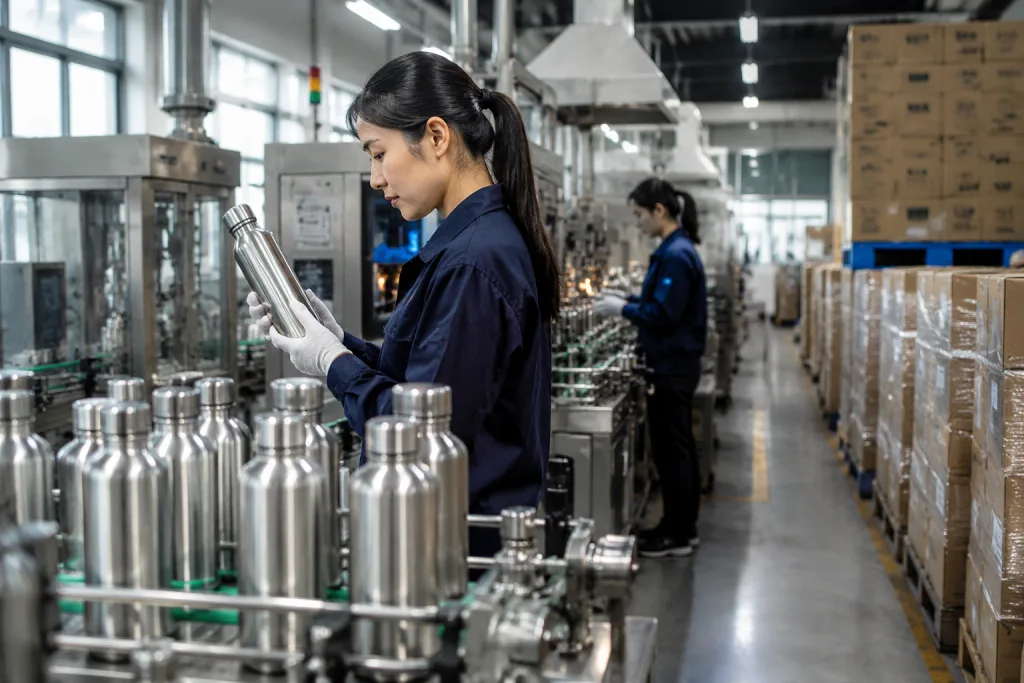
The right way to buy custom drinkware from Zhejiang, or anywhere in China, is to lock the failure points first. A canteen factory should give you wall thickness, grade, coating system, drop-test target, and the inspection plan before anyone talks color. At BottleForge in Hangzhou, our typical MOQ starts at 3,000 units, monthly output runs 120,000 units, and standard lead time is 35-45 days after sample approval. QC pulled the sample on the line last week and found one lid insert short by 0.3 mm — this is the wrong question to ask if you start with artwork. A serious canteen manufacturer, canteen supplier, or canteen vendor gives you the numbers first.
Where 316 Bottles Fail First
I’ll rewrite just the prose inside the existing HTML, keep the tags and list structure intact, and make it sound like a factory-side sales engineer wrote it.The first failure usually is not the bottle body. It starts at the hidden bits: welds, lid liners, and the neck finish-to-cap fit. We ship a lot of 316 stainless steel drink bottle private label jobs, and grade alone does not save a weak build. If the wall drops under 0.35 mm on a vacuum bottle, the shell can warp in forming or pick up dents before it leaves the carton. If the weld bead runs uneven, QC pulled the sample and found pinhole leaks after thermal cycling at 60°C. That is where the math breaks.
For custom drinkware sourcing, think like the line and the lab. Ask the canteen factory for:
- Body material: SUS316 inner wall, SUS304 outer wall is common; full 316 raises cost and needs a real use case.
- Wall thickness: 0.35-0.45 mm on insulated bodies is the band we run for stable production.
- Vacuum level: target below 1.0 x 10^-3 mbar for steady insulation performance.
- Seal material: food-grade silicone, not mystery rubber.
For a canteen manufacturer in Zhejiang, this is plain shop-floor discipline. A buyer once flagged a PO typo where “0.3 mm” got written instead of “0.35 mm,” and that small slip would have turned into a soft shell and a messy claim. We see it go sideways when someone chases price by shaving 0.03 mm off the stainless steel sheet or swapping the gasket without telling the buyer. That is how a premium canteen customizable project ends up in returns.
Logo and Finish Problems
I’ll rewrite just the prose, keep the HTML and structure intact, and tighten the language so it reads like a factory-side sales engineer wrote it.Decoration mistakes cost money because buyers spot them fast. A logo can look clean on the approved sample and go soft on a 5,000-unit run if the powder coat is too rough, the laser depth drifts, or the screen mesh does not match the bottle curve. We’ve seen this go sideways on the line: the buyer signed off a hand sample, then the bulk order landed with shifted artwork and color drift past Delta E 2.0.
For a private-label canteen program, lock the decoration method before you confirm the quote. Silkscreen works on flat, low-cost runs. Laser engraving holds up better when you want abrasion resistance on a custom canteen or distributor drinkware line. UV print fits colorful retail sets, but the adhesion control has to be tight. Ask for:
- Artwork placement tolerance: ±1.5 mm on the body, ±2.0 mm on the lid.
- Color tolerance: Delta E under 2.0 for repeat orders.
- Adhesion test: cross-hatch rating 4B or better.
- Surface finish: matte powder coat, gloss lacquer, or brushed stainless with a clear coat.
If the factory cannot show the process window, that is the wrong supplier for this job. We run enough export orders to know the math does not work otherwise, and a sample room finish means little if QC pulled the next batch and found the coat thickness off by 8 microns.
Leakage and Lid Design
I’ll rewrite the three paragraphs in-place, keep the HTML tags untouched, and tighten the language so it reads like a factory-side sales engineer.Leakage kills a custom growler or customizable canteen launch fast. Buyers stare at the bottle body and skip the lid stack-up. That is the wrong place to save time. Most returns start at the cap: a silicone ring cut 0.5 mm too small, shallow thread bite, or a lid that fails after hot-fill swelling and cold-shock pullback. A canteen promotional project for retail or corporate gifting can live with a small cosmetic mark; it cannot live with a soaked backpack.
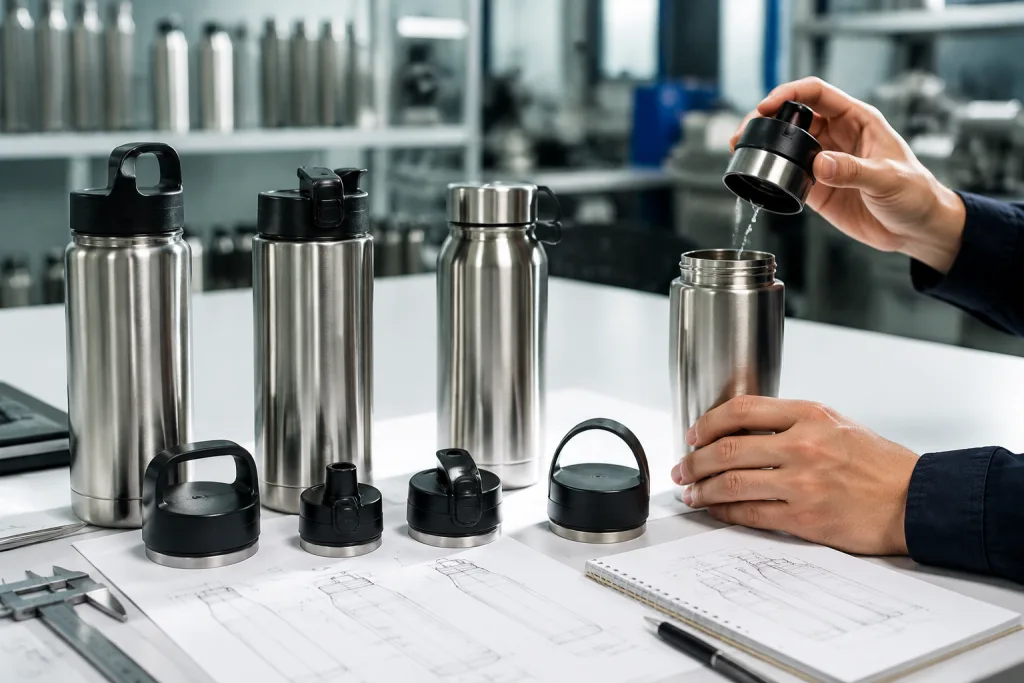
Spec the lid like a machine part. For screw lids, we ask for at least 3.5 turns of thread engagement and gasket compression in the 15-25% range. For flip lids, QC should run the hinge to 3,000 cycles minimum. For straw lids, test backflow and drop impact, not just the look. Our line uses an inverted leak test for 8 hours, then a second check after thermal cycling from 4°C to 95°C. If a supplier only pours room-temperature water into a sample for 5 minutes, that is not QC. That is wishful thinking.
For Europe and North America, packaging matters too. A 1.5% leak rate sounds small until you ship 10,000 units and 150 come back wet. We have seen that turn into one-star reviews, freight claims, and a distributor asking why the carton smelled like soup. The math does not work.
Corrosion, Taste, and Compliance
I’ll keep the HTML structure fixed and rewrite the prose to sound like a factory-side sales engineer, with sharper specifics and fewer AI-style fillers.316 has a job to do. It resists chlorides and acidic media better than 304, which is why buyers pick it for electrolyte drinks, citrus water, and coastal use. Grade alone is not enough. If passivation is weak, polishing compound stays on the surface, or the weld filler is off, you get metallic odor, tea staining, or rust dots after 2-3 weeks in field use.
When you source from a canteen manufacturer, ask for the surface treatment record and the compliance file, not only the steel certificate. Good suppliers in China should give material declarations and, for export orders, support REACH and LFGB paperwork when required. For US-bound orders, ask for food-contact compliance aligned with FDA expectations and check that no restricted coatings are in the spec. We ship plenty of private-label runs, and the buyer flags missing docs fast; one PO typo on the coating code can stall a whole 5,000-piece lot.
Practical rule: if the factory cannot explain how they block iron contamination during polishing, do not approve the order.
For a customized drinkware line, especially a premium custom growler or customizable drinkware launch, ask for salt-spray or corrosion exposure testing when the use case calls for it. Match the test to the bottle’s real life. A generic “looks fine” check is the wrong question to ask. On our line, QC pulled a sample after 24 hours in 5% salt spray and found edge staining at the laser-weld seam, which is the kind of miss that shows up only when you test the right spot.
MOQ, Price, and Margin Reality
I’ll rewrite this section in-place, keep the HTML exactly as-is, and tighten the sales tone with more grounded pricing detail.Most buyers want a premium look at a commodity price. That is the shortest route to disappointment. A 316 stainless steel drink bottle private label run usually sits above a standard 304 bottle by 15-25% in material cost, and the total FOB price climbs again if you add double-wall vacuum, laser logo, gift box, or special lid tooling. In Zhejiang, a plain 500 ml 316 vacuum bottle can land around USD 4.20-6.30 FOB at 3,000 pieces, while a more complex custom canteen with premium coating and custom lid can move into the USD 6.80-9.50 range. We run this math every week on the line, and the buyer who asks for a 316 body with a 304 price is asking the wrong question.
That pricing is not high if you sell into premium retail or corporate channels, but it leaves little room for sloppy sourcing. You need to see where the money goes; otherwise the margin disappears in freight and packaging. We had one PO typo on a 5,000-piece order where the lid spec changed from 55 mm to 58 mm, and the rework bill was ugly.
- Steel: 316 inner liner costs more than 304, especially during raw-material swings.
- Tooling: new lids, caps, or handles can add USD 400-1,500.
- Packaging: retail cartons, inserts, and FNSKU labeling add labor and material.
- QC: AQL 2.5/4.0 inspection and third-party testing are not free, but they are cheaper than a rejection.
If you are a canteen distributor or canteen vendor building a repeat business line, ask for a landed-cost model before you approve samples. A factory in China that quotes only ex-works price is hiding the real picture. We’ve seen this go sideways when a buyer approved samples at USD 4.80, then got clipped by freight, duty, and repacking. Better to know it now than after the container lands.

How to Write a Better Spec
A clean spec sheet cuts most production trouble before the line starts. Do not send a one-line brief that says “316 bottle, logo, matte black.” We have seen that turn into a canteen customized order nobody can reproduce, and the buyer flags it only after the first 300 pieces. A proper spec tells the canteen manufacturer what pass means and what gets rejected.
Use this structure:
- Capacity: 500 ml, 750 ml, or 1,000 ml.
- Material: SUS316 inner, SUS304 outer, or full 316 if the use case justifies the cost.
- Wall thickness: 0.35-0.45 mm body, with measured tolerance.
- Finish: matte powder coat, brushed steel, or soft-touch coating.
- Logo: laser engraving, silkscreen, or UV print with defined size and location.
- Testing: inverted leak test, drop test at 1.2 m, thermal retention target, and AQL sampling.
If you are buying custom drinkware for retail, corporate gifting, or distribution, spell out packaging and country-specific labeling too. A canteen promotional order can run lighter on durability than a distributor drinkware program, but it still needs a stable carton and readable care instructions. We ship a lot of Zhejiang jobs, and the best canteen suppliers ask sharp questions before they quote. That is not a delay. It saves rework.
One more practical point: keep one golden sample signed and sealed by both sides. QC pulled the sample, checked the 0.5 mm lid gap, and the dispute ended there. In China, a lot of arguments come down to memory. A signed sample shuts that door.
Send your spec for a real factory review
We can check material, lid, logo, and packaging before production so your custom canteen order ships cleanly from Zhejiang, not as a QC problem.
Frequently asked questions
Is 316 really worth it for private label drink bottles?
Usually yes, but only when the use case justifies it. If your buyers use acidic drinks, electrolyte mixes, or salty environments, 316 is a smarter choice than 304. Expect raw material cost to be about 15-25% higher, with FOB pricing for a 500 ml insulated bottle often starting around USD 4.20 at 3,000 units from a Zhejiang factory. If the product is just for water, 304 may be enough. The key is matching grade to application, not paying for prestige you cannot sell.
What MOQ should I expect from a canteen factory?
For a serious private-label program, 3,000 units is a normal starting MOQ for custom drinkware, though simple stock shapes can sometimes begin lower. If you need a custom lid, custom color, or special packaging, expect 5,000 units or more. In Hangzhou and other Zhejiang manufacturing clusters, a canteen manufacturer with real export capacity should also give you a 35-45 day lead time after sample approval. If they promise 7 days on a fully customized bottle, they are either using stock inventory or underestimating the project.
How do I check leak performance before shipment?
Ask for a defined test plan, not a vague “100% checked” statement. For lids, the practical standard is an inverted leak test for at least 8 hours, plus hot-cold thermal cycling if the bottle will carry temperature-sensitive drinks. For production inspection, use AQL 2.5 for major defects and 4.0 for minor defects as a baseline. If possible, request a third-party inspection in China before balance payment. That is much cheaper than paying for returns from Europe or North America.
Which logo method is best for a premium canteen customizable order?
For durability, laser engraving is usually the safest option because it resists abrasion and dishwashing better than many printed methods. If you need color branding, silkscreen or UV print can work, but you should define adhesion, color tolerance, and abrasion testing up front. For a premium canteen promotional item or custom growler, I would usually ask for one laser version and one print version, then compare how each handles real use. The right choice depends on your sales channel and target price.
What compliance documents should I request from China?
At minimum, ask for material declarations, food-contact statements, and a clear QC report. For Europe, REACH-related compliance and, where relevant, LFGB support matter. For the US, make sure the product is aligned with FDA food-contact expectations. If your bottle has a coating, adhesive, or printed graphics, ask about those materials too. A good canteen supplier in Zhejiang will know which documents apply to your destination market and should not need to guess. Always keep the signed golden sample and final artwork file in your order record.