Key Takeaways
- 316 stainless steel drink bottle bulk usually adds 8-18% over 304, depending on wall thickness and finish
- A realistic MOQ for custom bulk drinkware is 3,000 pcs; sample lead time is typically 7-10 days
- Insist on material traceability, REACH-compliant coatings, and AQL 2.5 inspection for critical defects
- For export buyers, FOB Ningbo or FOB Shanghai pricing is more useful than vague ex-factory quotes
If you are buying 316 stainless steel drink bottle bulk, the first issue is not the print or the shape. It is chemistry, compliance, and whether the supplier can hold spec on a 20,000-piece order without blowing up your margin. A lot of factories in China will write “316” on the quote, but you still need the mill cert, weld finish, lid seal, and test reports before you sign the PO. We have seen the buyer flag a 0.2 mm gap at the cap thread and the whole shipment gets stuck.
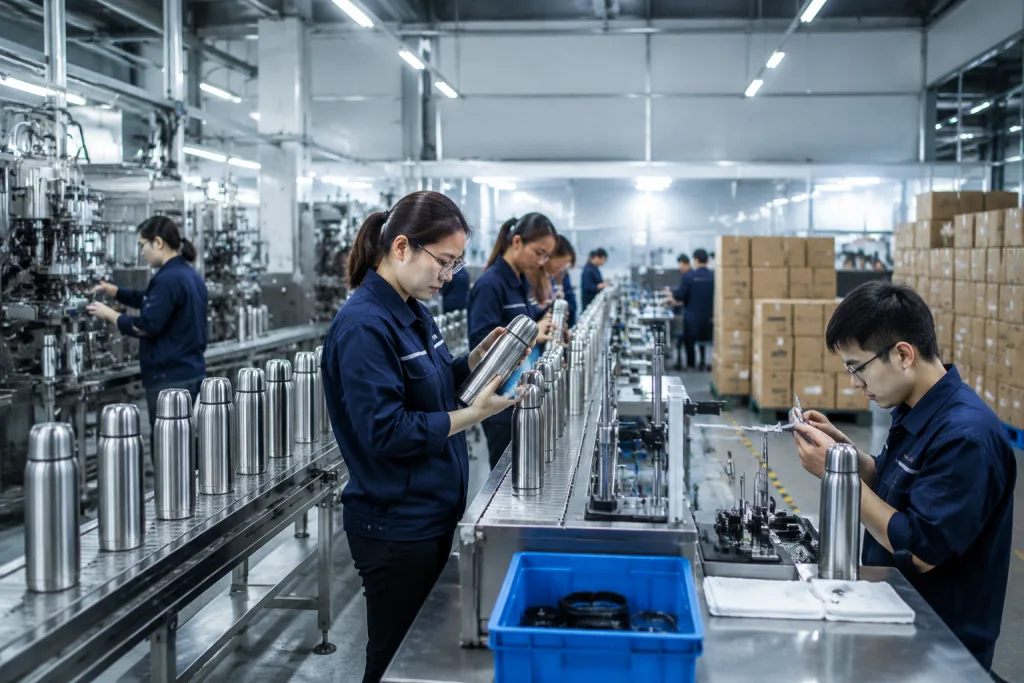
For procurement managers and brand owners, the real question is simple: does 316 earn its premium over 304, and can the factory in Zhejiang prove it with material certs, AQL inspection records, and a lead time that matches the line schedule? At BottleForge in Hangzhou, Zhejiang, we run about 120,000 units a month, with MOQ from 3,000 pcs for standard vacuum bottles and 25-35 days for first-order bulk drinkware after sample approval. QC pulled the sample on the line last week and checked the laser weld seam again. That is the level of detail you should ask for from any China supplier.
What you should verify first
Before you compare prices, check the basics first. That is where margin gets protected. For a 316 stainless steel drink bottle bulk program, ask for the steel grade, inner liner thickness, cap material, and whether the bottle is single-wall or double-wall vacuum. If the supplier cannot show mill certs or cannot explain the difference between 304 and 316 in plain terms, you are not dealing with a serious factory. We run this check on the line with a caliper and a magnet test before we even quote.
For export sourcing, a workable starting spec is clear: inner body 0.40-0.50 mm 316 stainless steel, outer shell 0.35-0.45 mm 304 or 201 based on target price, vacuum gap 0.3-0.5 mm, and powder coating thickness around 60-80 microns. The math works. Anything thinner starts to get shaky in transit, and we have seen that go sideways after 5,000 units. For bulk drinkware, also confirm whether the lid uses PP, Tritan, or a stainless insert. QC pulled the sample on a failed lid drop test at 1.2 m, and the cap was the part that cracked, not the bottle.
- Ask for steel grade proof, not marketing copy
- Confirm wall thickness and vacuum structure
- Check lid material and gasket compound
- Request export carton spec for 12/24 pcs per case
My rule: if the supplier dodges one technical question, they will dodge five more after the deposit.
316 versus 304 in practice
People ask if 316 is “better.” It is, but only when the use case pays for it. 316 adds molybdenum, and that gives better resistance to chloride corrosion. We see that matter when a buyer fills bottles with electrolyte mixes, sports drinks, or keeps stock near salt air. It also helps on shelf. “316” is easy to sell in listings, and that matters in best wholesale drink bottle programs.
On sourcing, 316 stainless steel usually costs more because the raw material runs higher and not every factory keeps it in steady stock. For canteen wholesale or wholesale canteen orders tied to outdoor, marine, or fitness channels, 316 is the safer premium spec. For plain water in dry markets, 304 is often enough. The bulk canteen gap is usually USD 0.45-1.20 per unit, depending on capacity, finish, and print method. We had a buyer flag a PO once because the grade was typed as “305”; QC caught it before the line started. On beer growler bulk or growler wholesale jobs, 316 also helps with odor control after repeat use across different beverages.
Do not buy the grade by itself. A rough weld on a 316 bottle with a weak lid still fails. We have seen this go sideways: the body passed, then the cap leaked at the 30-minute shake test. The steel matters, but the closure and gasket decide whether the customer gets returns.
Checklist for supplier audits
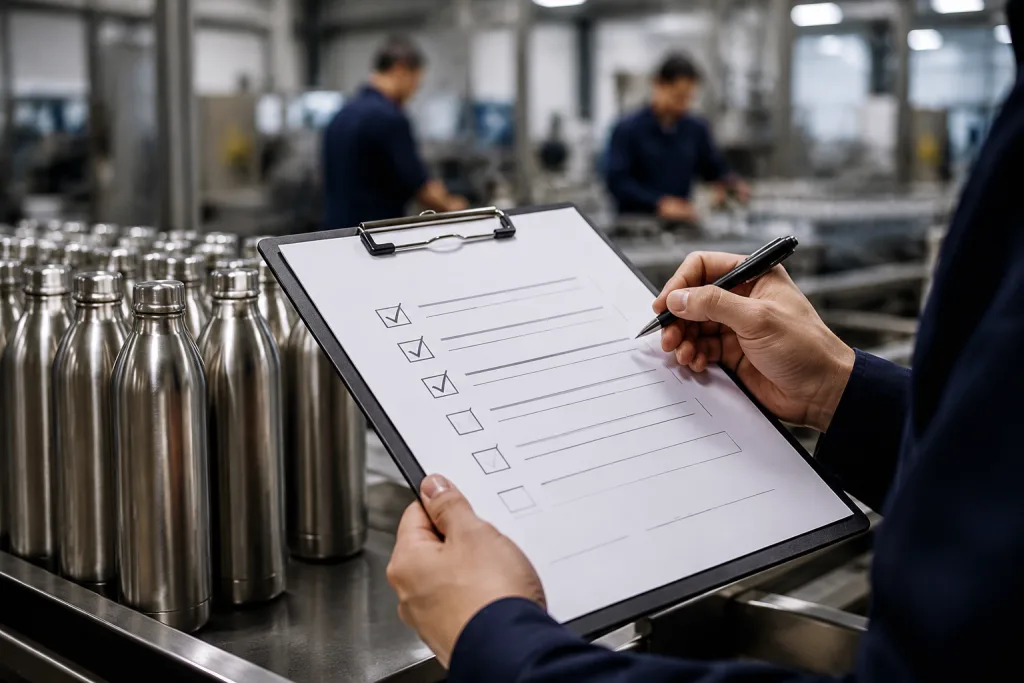
Audit a China supplier like you are checking whether the numbers work. If the factory cannot show process control, test records, and order tracking on the spot, we walk. In Zhejiang, the stronger plants keep incoming coil checks, semi-finished leak tests, and final random inspection sheets within arm’s reach. That is the level you want for drinkware wholesale.
Use this checklist
- Factory scale: 80,000-150,000 units/month for steady bulk orders
- MOQ: 3,000 pcs for standard items; 5,000-10,000 pcs for custom tooling-heavy projects
- Testing: leak test, drop test, dishwasher cycle test, and thermal retention verification
- Compliance: REACH, food-contact declaration, and if needed LFGB or FDA-related documentation
- Quality system: AQL 2.5 for major defects, AQL 4.0 for minor defects
- Packing: polybag, molded pulp, or color box based on retail channel
If you are buying alcohol flask bulk or alcohol flask wholesale bulk, use the same audit logic, but pay closer attention to lid seal and surface finish. The buyer flagged one 0.3 mm gap on a cap once, and that tiny miss turned into a return issue. For beer tumbler bulk or beer tumbler wholesale bulk programs, check whether the interior passivation is clean enough for odor-sensitive beverages. QC pulled the sample, and the smell test told the story. That is the difference between a repeat order and a slow return pile.
Pricing that makes sense
Procurement teams get stuck on unit price. Fair. It is still the wrong number to judge first. For 316 stainless steel drink bottle bulk, the landed cost should cover bottle cost, print cost, carton cost, freight, duty, and scrap from failures. We once saw a buyer flag a PO typo on carton count, and the math blew up before QC even touched the line. A bottle that is USD 0.35 cheaper but leaks 2% of the time is not cheaper. It lands on your ledger.
From China, a 500 ml double-wall 316 bottle with standard powder coating usually sits around USD 3.20-5.10 FOB, depending on quantity and decoration. Laser engraving is usually lighter on cost than full-color wrap printing, while multi-color silk print can add USD 0.08-0.25 per unit. On the line, we run 18/8 and 316 side by side; the 316 wall thickness and the extra polishing step are where the cost moves. If you are comparing growler wholesale or wholesale growler offers, 1,000 ml and 1,500 ml sizes push price up fast because of material weight and packing size. Beer growler wholesale bulk orders are freight-sensitive, and a 10% carton-volume jump can change your ocean cost enough to matter.
Ask the factory to quote three ways: FOB Ningbo, FOB Shanghai, and door-to-door if they can do it. Then compare the same spec, same carton count, same carton size. That is the only clean comparison. In Zhejiang, experienced exporters know the freight game and will help you pick the right port instead of hiding cost in the unit price.
Custom branding without trouble
Most buyers do not need flashy decoration. They need branding that holds up through use, washing, and retail handling. For bulk drinkware, we run laser engraving, one- or two-color silk screen, and powder coat with tone-on-tone print. If the design sits in a premium channel, laser engraving on 316 steel usually looks sharp and wears well after 12 months on shelf. If you need a bright retail display, use screen print or UV print, and ask for an adhesion test on the actual finish, not a sample card.
For alcohol flask in bulk or alcohol flask wholesale projects, the branding area is small, so the artwork has to be stripped down. For beer tumbler in bulk or beer tumbler wholesale, wrap graphics work better because the cylinder gives you more print space. A factory that knows the job should send the artwork template, the print tolerance, and a pre-production sample; we once saw a buyer flag a 2 mm logo shift on a PO, and that typo cost a week. If you are sourcing wholesale drinkware with mixed SKUs, keep the decoration method steady across the line so QC does not chase three different setups.
One practical point: ask whether decoration happens before or after passivation and polishing. That choice changes scratch resistance and how the logo looks after handling. On a 20,000-piece run, one bad mask or pad alignment can turn into a stack of visible defects, and the math does not work.
How to reduce order risk
I’ll rewrite the section in-place, keeping the HTML tags and the original structure intact while stripping the AI-ish phrasing and adding more factory-floor detail.Send your spec for a real bulk quote
We will price your 316 steel bottle by MOQ, finish, and packing, then tell you what is realistic before you spend time on samples.
Frequently asked questions
What is a normal MOQ for 316 stainless steel drink bottle bulk?
For standard shapes, a normal MOQ is 3,000 pcs per color or print version. If you need new tooling, unusual lid systems, or multiple finishes, 5,000-10,000 pcs is more realistic. In Zhejiang and other export hubs in China, the exact MOQ depends on whether the factory already has molds, cap stock, and coating lines ready. For a first order, ask whether the MOQ changes after the sample is approved and whether mixed SKUs can be combined to reach the threshold.
How much more does 316 cost than 304?
In bulk drinkware, 316 typically costs 8-18% more than 304. On a 500 ml double-wall bottle, that might be about USD 0.45-1.20 extra per unit depending on order size, finish, and decoration. The premium can be justified for premium retail, coastal markets, sports drinks, or any use case where corrosion resistance matters. If the product is basic water bottle volume play, 304 is often enough and easier to source at scale from China.
What documents should I ask from a China supplier?
Ask for material certificates, food-contact declaration, REACH compliance, and factory audit evidence such as BSCI if your channel requires it. You should also request leak-test records, AQL inspection reports, and carton packing details. For wholesale drinkware shipped into Europe or North America, this paperwork matters more than a polished sales deck. If the supplier cannot provide traceable documentation from Zhejiang or elsewhere in China, treat that as a risk signal.
Is 316 worth it for growler wholesale or beer growler bulk?
Usually yes, if you are selling a premium product or dealing with acidic drinks, chilled beverages, or repeat-use customers. For beer growler bulk, 316 helps with corrosion resistance and long-term appearance, especially in humid environments. The bottle still needs a good lid and gasket. A cheap closure can ruin the entire order. Expect larger 1,000 ml or 1,500 ml units to raise freight and carton costs, so price the landed cost, not just the bottle.
How do I compare supplier quotes properly?
Put every quote into the same format: steel grade, capacity, wall thickness, finish, print method, carton quantity, MOQ, lead time, and trade term. Compare FOB Ningbo or FOB Shanghai, not vague factory-door pricing. Then add freight, duty, and labeling costs. For drinkware wholesale, a quote that is USD 0.20 lower but lacks testing or uses weak packaging is usually more expensive after claims and replacements.