Key Takeaways
- 316 inner wall usually adds USD 0.35-0.90 per bottle versus standard 304, depending on capacity and lid type
- A realistic MOQ for customized drinkware is 1,000-3,000 units per color when powder coating is involved
- Double wall vacuum bottles should hold hot water above 55°C after 12 hours in a controlled retention test
- For EU and North America, confirm LFGB, FDA, REACH coating, AQL inspection, and carton drop-test requirements before deposit
If you are searching for a 316 stainless steel double walled bottle supplier, you are not buying a cute bottle for a 1,000 pcs giveaway. You are checking food-contact safety, gross margin, carton drop risk, logo sharpness after 3M tape testing, and whether the canteen manufacturer can repeat the same sandblasted finish on the next reorder.
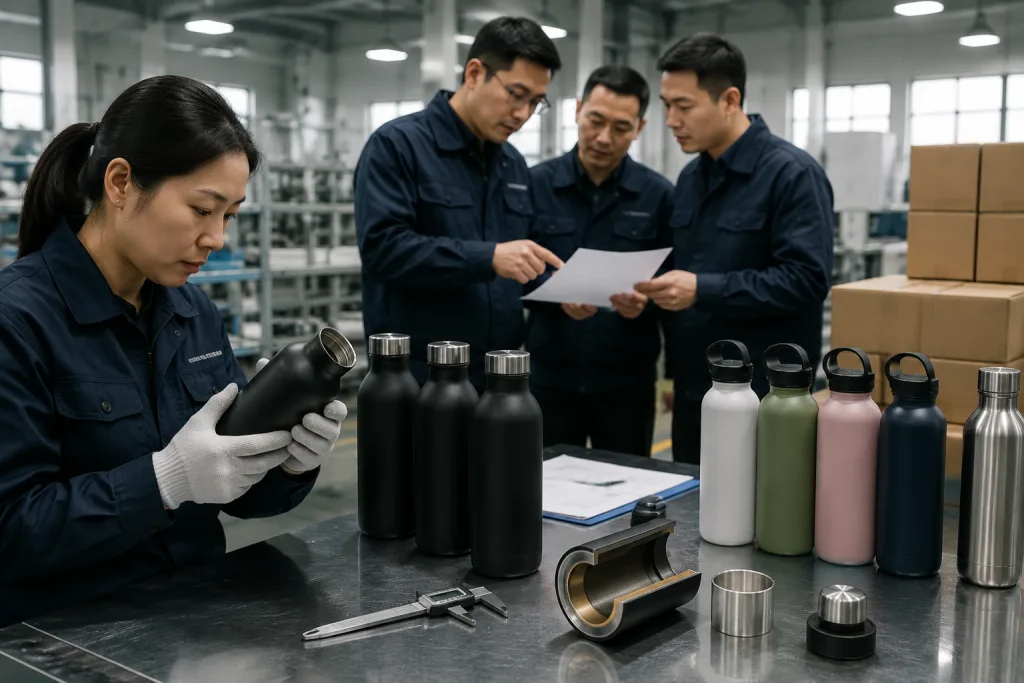
From Hangzhou, Zhejiang, we see this mistake about 6 times a month: buyers ask for 316 stainless steel, then compare the quote with 304 models using 0.40 mm thinner walls, lighter PP lids, and lower-cost powder coating. The math doesn't work. China can make both well, but they are different bottles; we run calipers on the mouth diameter and body thickness before we trust the catalog photo.
316 Versus 304 At The Buying Desk
The real question is not whether 316 stainless steel is “better.” It is whether your buyer, channel, and target margin justify it. For a school canteen order, 304 stainless steel is usually fine for water, coffee, tea, and normal daily use. On our line, we see 304 pass the job without drama. 316 earns its keep when the bottle will see chloride, acidic drinks, or harsh outdoor use—marine kits, gym packs, camping sets, and premium corporate canteen programs.
A common build is 316 stainless steel for the inner wall and 304 stainless steel for the outer wall. Full 316 is doable, but the math does not work for many B2B programs. On a 750 ml double walled bottle, the 316 inner plus 304 outer structure usually adds about USD 0.35-0.90 FOB Ningbo or Shanghai versus a similar 304/304 bottle. Full 316 can add more than USD 1.20, and a 0.6 mm wall gauge pushes it up fast. QC pulled the sample last month and the buyer flagged the price before they even asked about print.
Ask your canteen supplier to state the material by part: inner shell, outer shell, lid insert, tea filter, handle pin, and screws. “Stainless steel bottle” is too loose for a distributor drinkware program. We have seen POs with a missing “316” on the inner wall line, and that typo turns into a claim later. If you sell to outdoor retailers or hospitality buyers, the material declaration has to match the tested sample and the mass production batch.
Spec Table For Real Comparison
For procurement, the quote should read like a spec sheet, not a catalog page. We run this table with buyers before samples leave the line, because the wrong comparison burns time. One PO typo on wall thickness can change the whole cost stack.
| Item | 316 inner bottle | 304 standard bottle | Buyer note |
|---|---|---|---|
| Inner wall | 316, 0.40-0.50 mm | 304, 0.38-0.45 mm | 316 fits acidic drinks, salt water, and sports use better |
| Outer wall | 304, 0.45-0.55 mm | 304, 0.40-0.50 mm | Outer wall thickness drives dent rate in transit |
| Vacuum | Copper plated or standard vacuum | Standard vacuum | Copper plating lifts heat retention, but the math adds cost fast |
| Finish | Powder coat, spray, brushed, mirror | Same | EU orders need a REACH coating report |
| Logo | Laser, silkscreen, UV, emboss | Same | Laser holds up best after months of washing |
| Typical MOQ | 1,000-3,000 pcs | 500-3,000 pcs | Custom color usually pushes MOQ up |
This is the wrong question to ask: “Which supplier is cheaper?” We saw one buyer flag a 0.05 mm wall difference after QC pulled the sample and the weight was off by 18 g. For distributor canteen sales, ask for capacity tolerance, empty weight, lid leak test pressure, coating adhesion test, and carton packing method. Freight, returns, and retail complaints eat margin faster than people expect.
Use Case Fit By Channel
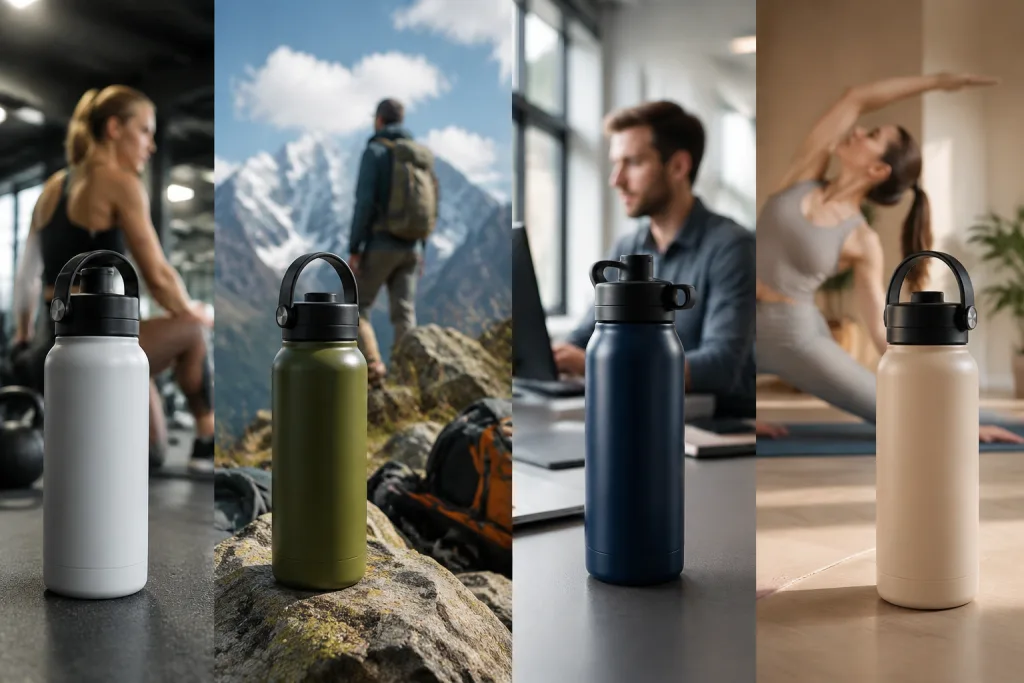
A 316 stainless steel double walled bottle supplier should match the bottle to the channel, not dump one SKU on every buyer. For outdoor and camping lines, a 316 inner wall, 750 ml or 1,000 ml capacity, leakproof screw lid, silicone boot, and laser logo usually fit the brief. We run these packs with a 48-hour leak test on the line, because a cap that looks fine on paper can still sweat at the neck. If you are building a custom growler or customizable growler range for beer, kombucha, or cold brew, 316 is the cleaner call; acidic liquids, hot wash cycles, and repeat refills are part of the job.
For canteen promotional programs, the math changes fast. A 500 ml or 600 ml canteen customized with one-color silkscreen may need to land at USD 3.20-4.80 FOB, depending on lid and finish. We had one buyer flag a PO typo on the artwork file, and the sampling round slipped three days because the quote did not match the print area. In that case, 304 is often the honest recommendation unless your brand story truly needs 316. Over-specifying material kills deals before samples are even approved.
For premium corporate gifts, hotel retail, marine clubs, and distributor growler programs, 316 helps defend a higher selling price. Say the material advantage plainly. No drama. For kids, school, or mass event projects, impact resistance, coating safety, straw lid design, ASTM or CPSIA relevance, and bite-valve quality matter more than 316. QC pulled the sample, checked the lid torque at 0.8 N·m, and the weak point was the straw cap, not the steel. A good canteen factory in Zhejiang should tell you where 316 is worth paying for and where it is just an expensive line on the quote.
Customization That Survives Reorders
Custom drinkware looks straightforward until the reorder lands six months later and the blue is off by one shade. For powder coated bottles, we lock Pantone, gloss level, orange peel limit, and whether the factory keeps a retained sample from the approved run. On repeat orders, we check against the signed production sample under D65 lighting. A phone photo from shipment one is not the standard.
Decoration follows the surface and the use case. Laser engraving holds up on outdoor, gym, and dishwasher-exposed bottles because it cuts through the coating instead of sitting on top of it. Silkscreen is the low-cost route for canteen promo jobs with simple logos, usually 1 to 3 colors. UV print works for full-color artwork, but we still run abrasion testing on curved bottles. Embossed or debossed stainless badges look premium, yet they add tooling and an extra assembly step. The math does not work for every order.
For a custom canteen or customized growler, the lid matters. Buyers spend three weeks on the body logo and then miss the cap insert, carry loop, gasket color, and instruction leaflet. We have seen that go sideways on two 10,000-piece orders. For Amazon, retail, or distributor drinkware sales, packaging is part of the spec: color box, barcode, FNSKU label, warning text, polybag restriction, and master carton marks. A serious canteen manufacturer will do a pre-production sample with all of it before bulk production starts.
Factory Numbers Behind The Quote
At BottleForge Industrial in Hangzhou, Zhejiang, we run partner lines that land around 280,000-350,000 stainless steel vacuum units a month, and the number moves with season, capacity mix, and finish complexity. For 316 inner wall double walled bottles, the working MOQ is usually 1,000 pieces for an existing shape with laser logo, and 3,000 pieces per color for custom powder coating. New mold or private shape programs normally start at 10,000-20,000 pieces because tooling, fixtures, and testing have to be spread out. QC pulled the sample on a 1.0 mm wall check last week, and the buyer flagged the carton insert before we ever loaded a truck.
Lead time needs to be broken into stages. Sampling is normally 7-12 days for stock shape with logo, 15-25 days for custom color or new lid combination, and 35-50 days for mass production after deposit and approved sample. If your canteen distributors need delivery before a retail reset date, you have to add time for lab testing and ocean freight. The math does not work any other way. China production speed means little if the REACH report or LFGB migration test starts too late; we have seen that go sideways on a PO with the lid color typed as “sliver” instead of “silver.”
Price needs structure too. A 600 ml 316 inner double wall bottle may quote around USD 4.20-6.80 FOB, while a 1,000 ml heavy outdoor bottle can run USD 6.50-9.80 depending on lid, coating, carton, and logo. Extreme low quotes often remove something: wall thickness, vacuum stability, gasket quality, inspection, or packaging strength. Ask the canteen vendor what changed to hit the lower price. We ship enough to know this is the wrong question to skip.
Testing, Compliance, And Inspection
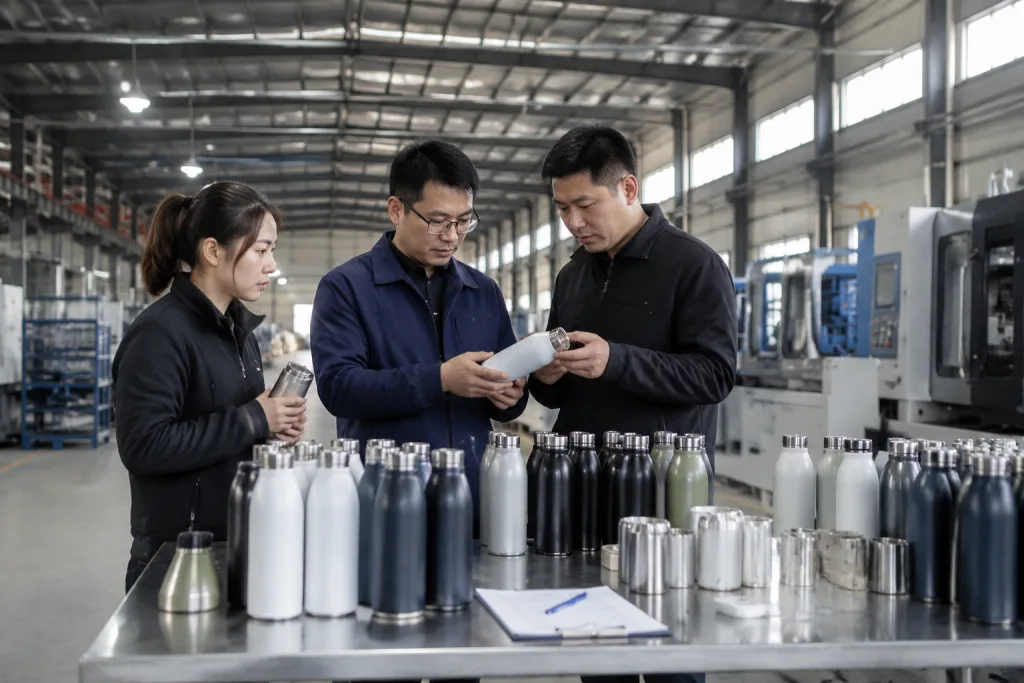
I’ll rewrite the section in place, keep the HTML tags intact, and tighten the prose so it sounds like a buyer-facing factory note with concrete QC detail.For Europe and North America, compliance is not something to push down the road. We keep stainless steel composition records on file, and if the buyer asks, we can send third-party test reports with the PO. Food-contact work usually covers FDA for the US, LFGB for Germany and broader EU checks, plus migration testing for lids, gaskets, coatings, straws, and plastic parts. On painted bottles, REACH and heavy metal screening come up fast once the buyer is a chain store or a serious importer.
Vacuum performance is a separate check. We run a retention test by filling the bottle with hot water, recording the start temperature with a probe thermometer, closing the lid, and checking again after 6, 12, or 24 hours in a controlled room. For a retail-grade double walled bottle, we expect hot water to stay above about 55°C after 12 hours, depending on capacity and mouth diameter. The wide mouth usually loses heat faster than the narrow mouth, so this is the wrong question to ask without the bottle size in hand.
Inspection belongs on the purchase order. We normally write AQL as Critical 0, Major 2.5, Minor 4.0 unless the buyer wants tighter limits. QC pulled the sample on one 500ml lot and found a lid torque miss plus a small logo shift, which is the kind of thing that turns into a claim later. Check vacuum failure, leakage, coating scratches, logo position, color variance, lid torque, odor, welding marks, and carton drop resistance. If you work with multiple canteen vendors in China, give each supplier the same checklist. Otherwise the math does not work; you are comparing different standards, not different factories.
How To Choose Your Supplier
I’ll keep the HTML tags exactly as-is and rewrite only the prose, tightening the supplier advice with concrete factory-floor details and fewer generic phrases.A solid 316 stainless steel double walled bottle supplier answers technical questions before asking for sample payment. Ask for the exact material build, wall thickness in mm, empty weight in g, test reports on file, MOQ by finish, packing spec, and lead time that matches the line. If the sales rep cannot tell 316 inner wall from full 316 construction, stop there.
For a canteen distributor, the best supplier is not the cheapest canteen factory. You need repeat production, straight talk on decoration risk, and clean support for your buyer’s paperwork. Brand owners need NDAs, private packaging control, and reorders that match the first run. Promotional buyers need fast sampling, carton counts that do not change, and no surprise upcharges after artwork approval. We have seen PO typos on carton quantity turn into a messy week.
My advice is to shortlist two or three canteen manufacturers, then compare the same 750 ml or 1,000 ml model with the same finish, same logo method, same carton packing, and the same inspection standard. Pay for samples if the project deserves it. Cut one open if the order is big enough. QC pulled a sample on our side once and found a 0.3 mm gap in the wall spec; that is the kind of miss you want to catch early. Zhejiang and the wider China supply base can ship excellent custom drinkware, but only when the spec is tight enough for the factory to build the product you actually meant to buy.
Send Us Your 316 Bottle Specification
We will review material, MOQ, decoration, testing, and FOB pricing before you commit to sampling or tooling.
Frequently asked questions
Is 316 stainless steel necessary for every double walled bottle order?
No. For standard water, coffee, and office use, 304 stainless steel is often acceptable and more cost-efficient. 316 is worth considering when the bottle is positioned as premium, outdoor, marine, fitness, or used with acidic drinks. Many buyers choose 316 for the inner wall and 304 for the outer wall to balance performance and price. On a 750 ml bottle, that structure may add USD 0.35-0.90 FOB compared with 304/304. If your retail claim depends on 316, make sure the material declaration and test sample match the production order.
What MOQ should I expect for a customized canteen project?
For an existing bottle shape with laser logo, 1,000 pieces is a realistic starting MOQ for many stainless steel programs. If you need a custom powder coated color, expect 3,000 pieces per color because coating lines have setup loss and color change time. For a new lid, private mold, or fully custom canteen body, MOQ can rise to 10,000-20,000 pieces. Promotional canteen orders sometimes start lower, but the trade-off is usually limited color choice, stock packaging, and fewer inspection controls.
Which logo method is best for distributor drinkware?
Laser engraving is the safest default for distributor drinkware because it is durable, clean, and works well on powder coated or brushed stainless surfaces. Silkscreen is cheaper for simple one-color promotional logos, but abrasion and dishwasher exposure can reduce life. UV printing is useful for full-color designs, though it should pass tape, rub, and scratch tests before approval. For a 3,000 piece order, the logo cost difference may be only USD 0.10-0.35 per unit, so choose based on return risk, not only unit price.
How long does production take from a China canteen supplier?
For a stock shape with a simple logo, sample time is usually 7-12 days. Custom color, special lid combinations, or retail packaging normally need 15-25 days for proper pre-production samples. Mass production commonly takes 35-50 days after deposit and approved sample, depending on season and order size. Add 5-10 days if third-party testing is required before shipment. If your launch date is fixed, confirm the schedule from artwork approval through AQL inspection, not only the factory production days.
What should I check before paying a deposit?
Confirm the bill of materials, 316 or 304 structure by component, wall thickness, capacity, finish, logo method, packaging, carton quantity, test requirements, and AQL inspection level. Ask for FOB port, payment terms, sample approval process, and what happens if mass production fails a leak or vacuum test. For EU orders, check LFGB and REACH needs early. For US orders, review FDA food-contact expectations and any retailer-specific labeling. A clear purchase specification saves more money than negotiating another USD 0.05 off the bottle.