Key Takeaways
- Typical MOQ for a 316 stainless steel double walled bottle private label run is 3,000 units, with 25-35 day lead time after sample approval.
- A real export-ready spec usually starts at 18/8 outer shell, 316 inner shell, 0.4-0.5 mm wall thickness, and AQL 2.5/4.0 inspection.
- For private label branding, laser engraving adds about USD 0.20-0.45 per unit, while one-color silkscreen is often USD 0.08-0.18.
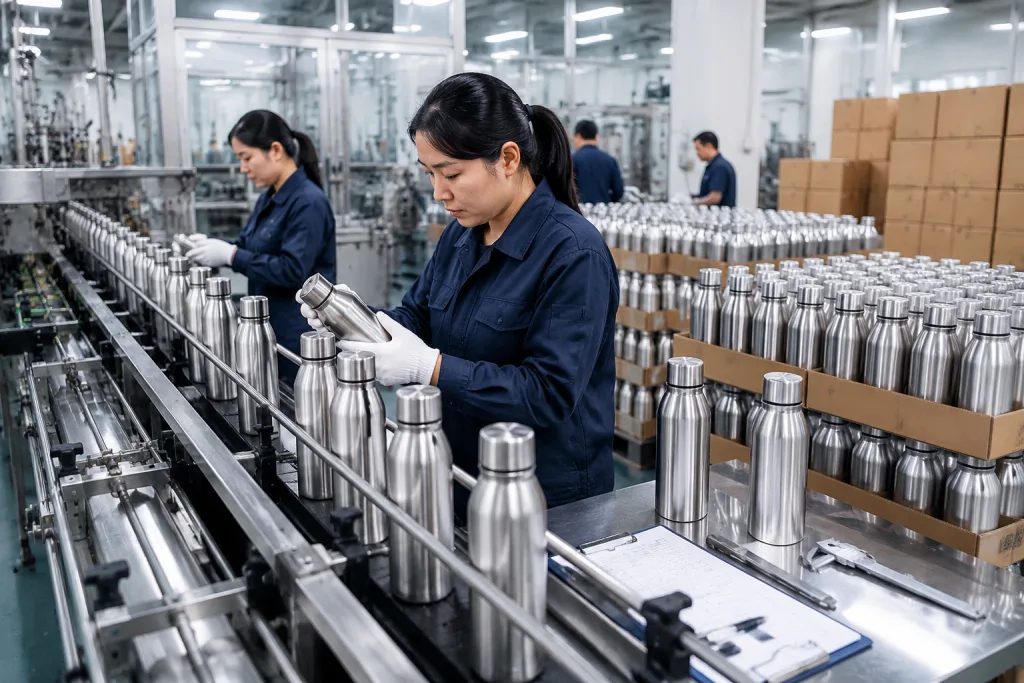
- A Zhejiang canteen factory with 120,000 units/month output can support distributors, but only if packaging, cartons, and test reports are locked early.
If you are sourcing a 316 stainless steel double walled bottle private label line, the real question is not whether the bottle looks good on a sample table. It is whether the spec, the factory, and the branding method hold up when you order 3,000 units, ship FOB Ningbo or Shanghai, and then sell into Europe or North America without returns.
That is where most buyers get burned. We have seen a buyer flag a PO typo on the carton size, then the whole run had to be rechecked at the packing table. A Zhejiang canteen factory can show clean samples, but the details decide margin: 0.5 mm inner wall versus 0.4 mm, vacuum retention after 24 hours, cap torque, laser mark wear, and whether the line can really support your MOQ without turning a 35-day lead time into 60 days.
What 316 Really Buys You
I’ll rewrite just the HTML prose, keep the tags and list structure intact, and make it sound like a factory-side sales engineer wrote it.Buyers ask for 316 because they want better resistance to salty drinks, sports mixes, and a longer shelf life in storage. Fair enough. 316 stainless steel adds molybdenum, so it stands up better to chlorides than 304. If the bottle will sit in coastal markets, gym bags, or carry acidic drinks, 316 is the cleaner call. For plain water, 304 usually does the job, but private label buyers still pick 316 because it is easier to explain at retail and in distributor catalogs. We had one buyer flag a PO typo on “316L” versus “316,” and QC pulled the sample before the line moved forward.
Do not mix up material claims with product quality. That is the wrong question to ask. A solid canteen supplier should show material certs, not just print “food grade” on the spec sheet. Ask for the inner wall grade, outer wall grade, and whether the vacuum chamber uses full seam welding or spot welding. On our line, a 0.5 mm 316 inner liner with a copper-coated vacuum layer can keep hot water above 60°C after 12 hours, but only when the weld bead stays even and the vacuum leak test passes. We have seen this go sideways when a factory skips the vacuum gauge check.
- Inner liner: 316 for premium positioning and salt-resistant use
- Outer shell: usually 304 unless the buyer pays for full 316
- Wall thickness: 0.4-0.5 mm is standard for export canteen customized orders
- Use case: premium retail, sports nutrition, travel, and reusable corporate gifts
Sizing the MOQ and Price
I’ll rewrite the prose only, keep the HTML intact, and tune it to sound like a factory-side sales engineer.Procurement goes sideways at the price line because the buyer looks only at the bottle and ignores the full stack behind it. For a standard 500 ml private label bottle, our Zhejiang canteen factory usually lands in the USD 2.20-4.80 range, depending on brushed or powder coat finish, lid structure, and print method. Step up to 750 ml or 1,000 ml and you add another USD 0.25-0.70. If you want a growler style with a wider mouth and a heavier cap, the math moves fast; the lid assembly can cost more than the shell.
MOQ is a setup issue, not a mood issue. We run tooling, vacuum line scheduling, coating batch minimums, and carton fit before the first clean unit ships. A normal private label MOQ is 3,000 units per color per model. We have seen factories quote 1,000 units, then hit the buyer with a unit price 15-30% higher and extra packaging charges on top. If you are a canteen distributor or distributor canteen buyer, ask for tiered pricing at 3,000, 5,000, and 10,000 units. That is the clean way to see whether the supplier can actually run the order or is just chasing a sample win. QC pulled a carton test at 600 mm drop height last week; that kind of detail tells you more than a cheap quote.
Practical rule: if the quoted unit price looks too low for 316 plus double wall plus branded lid, check whether the supplier quietly switched to 304, trimmed wall thickness, or left packaging out of the quote.
Branding Choices That Survive Shipping
I’ll rewrite the section in-place, keep the HTML intact, and tune the copy to sound like a factory-side sales engineer. Then I’ll return only the rewritten HTML.Private label buyers usually stare at the logo and miss the part that gets beaten up in cartons, on pallets, and in Amazon fulfillment. For a 316 stainless steel double walled bottle private label run, laser engraving is the safest call for wear. It stays sharp, cuts clean, and usually runs USD 0.20-0.45 per unit, depending on logo size and whether you engrave one side or two. Silkscreen is cheaper, often USD 0.08-0.18, but it only makes sense when the artwork is simple and the buyer is not sending the bottle through rough washing.
We have seen powder coating, UV print, and wrapped labels all work, but each one brings its own failure point. If you need a canteen promotional item, speed on the line matters. If you need a premium customized canteen for retail, durability wins. Ask for a sample that has survived 50 dishwasher cycles, or at least a proper abrasion test. QC pulled one sample here with a 3M tape pull test at 90 degrees, and the weak print lifted fast. If a vendor cannot give you that result, they are not export-ready.
- Laser engraving: best for premium customized drinkware and long wear
- Silkscreen: best for simple logos and lower unit cost
- UV print: good for color branding, but check scratch resistance
- Packaging print: important if you sell through distributors or retail boxes
Checklist Before You Approve Samples
I’ll rewrite the section in-place, keep the HTML structure unchanged, and tune the prose to sound like a factory-side sales engineer.Samples can mislead you if you test them differently from how you will sell them. Before I sign off on a private label order, I want five checks on the sheet: capacity tolerance within ±5%, lid seal test, vacuum retention test, salt spray for outdoor use, and a carton drop test. QC pulled one sample last month at 518 ml against a 500 ml spec, and the buyer flagged it on the spot. If the supplier says “premium quality” but cannot show a simple test report, the math does not work.
For Europe and North America, ask for REACH, LFGB for contact materials where relevant, and BPA-free lids if the cap has plastic parts. The packaging can be plain for a promotional run, but the bottle still has to clear the same compliance bar. We ship plenty of those jobs, and the factory report should show the inspection method, usually AQL 2.5 for major defects and 4.0 for minor defects. Check that the sample carries the final artwork too; a blank body is not a sample, it is a placeholder with a nicer name.
Buyer checklist
- Confirm inner liner material: 316, not “stainless steel” only
- Check capacity and weight against the approved drawing
- Request AQL inspection standard in writing
- Verify carton count, carton strength, and master carton dimensions
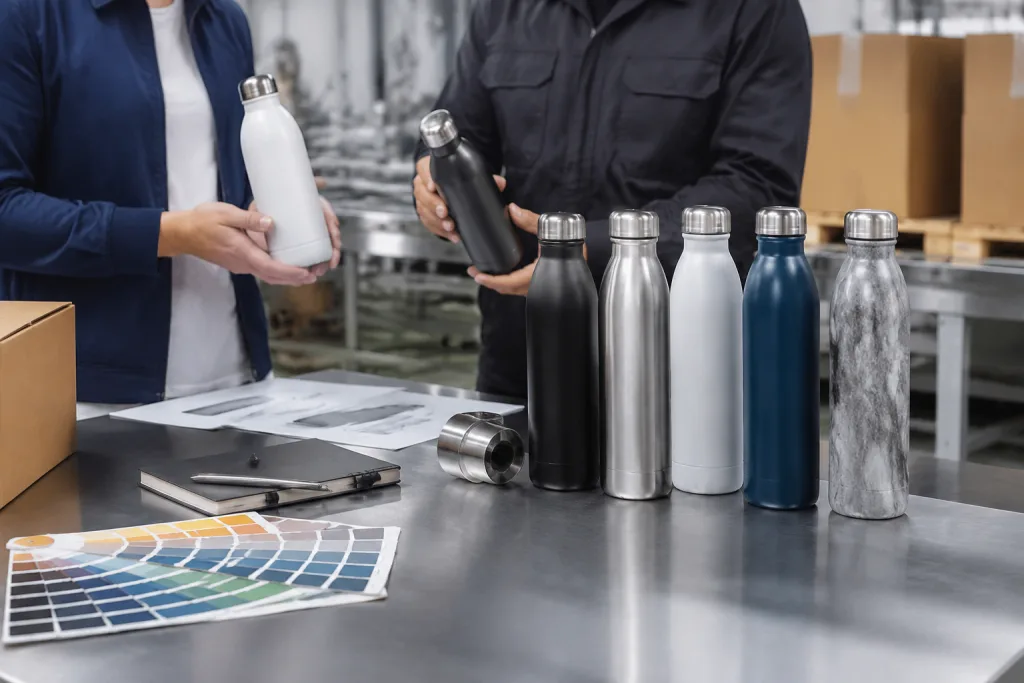
- Approve cap color, logo placement, and pantone references before mass production
How Factories in Zhejiang Operate
I’ll rewrite the two paragraphs in-place, keeping the HTML exactly as-is and tightening the language so it sounds like a Zhejiang factory sales engineer.When you buy from a canteen factory in Zhejiang, you are buying into a line built for volume. That is the upside. A mature canteen manufacturer here may run 80,000 to 120,000 units a month across 4 lines, so they can handle distributor drinkware programs, seasonal drops, and rolling replenishment without drama. The catch is simple: they want your artwork, carton spec, and test standard locked early. If QC is still waiting on sample sign-off while the PO already says ship in 25 days, your lead time will blow out.
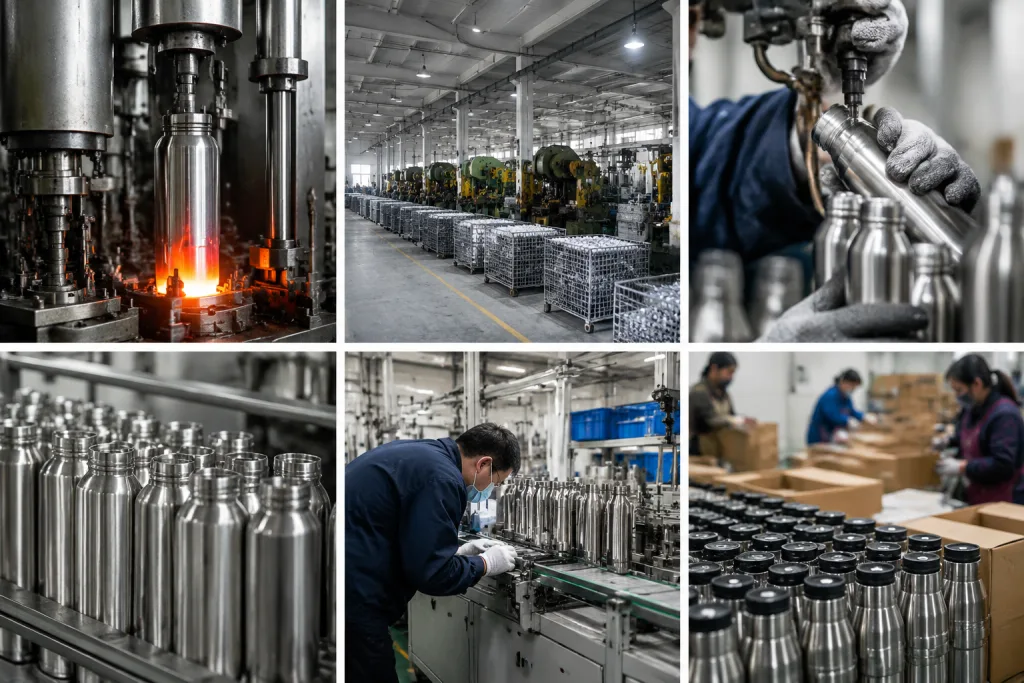
In China, and especially in Zhejiang, the better suppliers keep development, production, and export paperwork on separate desks. That is how we run it. A solid canteen supplier should send you the production schedule, one in-line QC point, and a packing photo set before shipment; we usually check this against a 0.5 mm lid gap and carton drop test notes. For canteen distributors, that keeps a reorder steady. For a custom canteen or customizable canteen project, it lets you move from 3,000 units to 20,000 units without reworking the whole bottle. If a vendor cannot tell you their line capacity, the math does not work—they are probably a trading layer, not the factory.
What to Ask Before You Order
I’ll rewrite the section in place, keep the HTML exactly as-is, and tighten the sales-engineer tone while preserving the list structure and all original technical specifics.Ask straight questions. Vague questions get vague quotes. Ask the canteen vendor whether the lid is injection-molded in-house or bought in, whether the vacuum bottle body is drawn on their own line, and whether the coating line runs powder or paint. Ask for FOB price by quantity and what sits inside that number. Inner tray packaging? Barcode labels? FNSKU stickers for Amazon stock? The headline number can fool you.
Ask for defect history on the same model, too. A serious canteen factory can name the usual trouble spots: cap leakage, logo misalignment, powder coating specks, denting during carton packing, or loose thread fit. We’ve seen this go sideways on a custom growler order when the lid seal looked fine on the first sample but failed after 200 open-close cycles. If you are buying a distributor canteen or distributor growler order, that kind of consistency protects margin. For canteen custom work, give the tolerance, not just the look.
- What is the exact MOQ by color and logo?
- Which tests are included before shipment?
- What is the real lead time after sample approval?
- Which parts are made in-house versus outsourced?
- Can you supply carton specs and shipping marks in English?
Request a factory quote with real specs
Send your capacity, logo method, and carton requirements. We will match a Zhejiang production plan with MOQ, test data, and FOB pricing.
Frequently asked questions
Is 316 worth it for a private label bottle?
Yes, if your buyers care about corrosion resistance, premium positioning, or harsher beverage use. For a 500 ml 316 stainless steel double walled bottle private label project, the upgrade from 304 usually adds about USD 0.18-0.45 per unit, depending on wall thickness and finish. That is not trivial, but it is manageable for retail or corporate gifting. If your target is general water use only, 304 may be enough. For coastal markets, sports nutrition, or higher-end custom drinkware, 316 gives you a stronger story and fewer complaints about staining or odor retention.
What MOQ should I expect from a canteen manufacturer in China?
For most private label bottle projects, the normal MOQ is 3,000 units per design and color. Some canteen manufacturers in Zhejiang will accept 1,000 units for simple models, but unit cost may rise 15-30%. If you need multiple logos, special caps, or unique packaging, the MOQ can climb to 5,000 units. The practical question is not only MOQ, but whether the factory can hold the same spec on a repeat order. A good canteen factory will quote the same artwork, carton size, and test standard every time.
How long is the lead time for custom drinkware?
For a standard customized drinkware order, expect 25-35 days after sample approval and deposit. If the model needs a new cap, new mold, or special coating, add 10-20 days. In Zhejiang, a mature factory can sometimes move faster if the production line is free, but do not plan your launch on best-case timing. If you need export carton printing, barcode labels, or FNSKU prep, leave another 3-5 days for packing. Reliable lead time beats rushed production every time.
Which branding method lasts longest on stainless bottles?
Laser engraving is usually the longest-lasting option. It does not peel, and it resists friction better than silkscreen on a canteen customized project. Expect about USD 0.20-0.45 per unit for a standard logo, depending on size and location. Silkscreen is cheaper and works well for promotional runs, but it is more vulnerable to wear. If your client is a canteen distributor or retailer selling premium private label stock, laser engraving is the safer choice. For low-cost canteen promotional campaigns, silkscreen can still be acceptable.
What should I verify before shipping to Europe or North America?
Check material declarations, REACH-related compliance documents, and any food-contact requirements relevant to your market. If plastic components are present, confirm BPA-free claims in writing. Ask for AQL inspection records, carton drop test results, and final artwork approval. For Amazon or retail fulfillment, confirm carton labels, barcode placement, and whether FNSKU stickers are applied at the factory. A strong canteen supplier in China should also provide packing photos and a loading report. Those details save claims later, especially when you are handling distributor drinkware programs across multiple warehouses.