Key Takeaways
- 316 inner steel usually adds 10%–20% to unit cost versus standard 304 builds
- Typical MOQ starts at 300–500 pcs for stock-style customization and 1,000 pcs for full canteen custom work
- Sample lead time is often 7–15 days; bulk production is commonly 25–40 days after approval
- FOB Zhejiang pricing for a 500 ml customized drinkware bottle often falls in the USD 4.20–8.80 range before freight
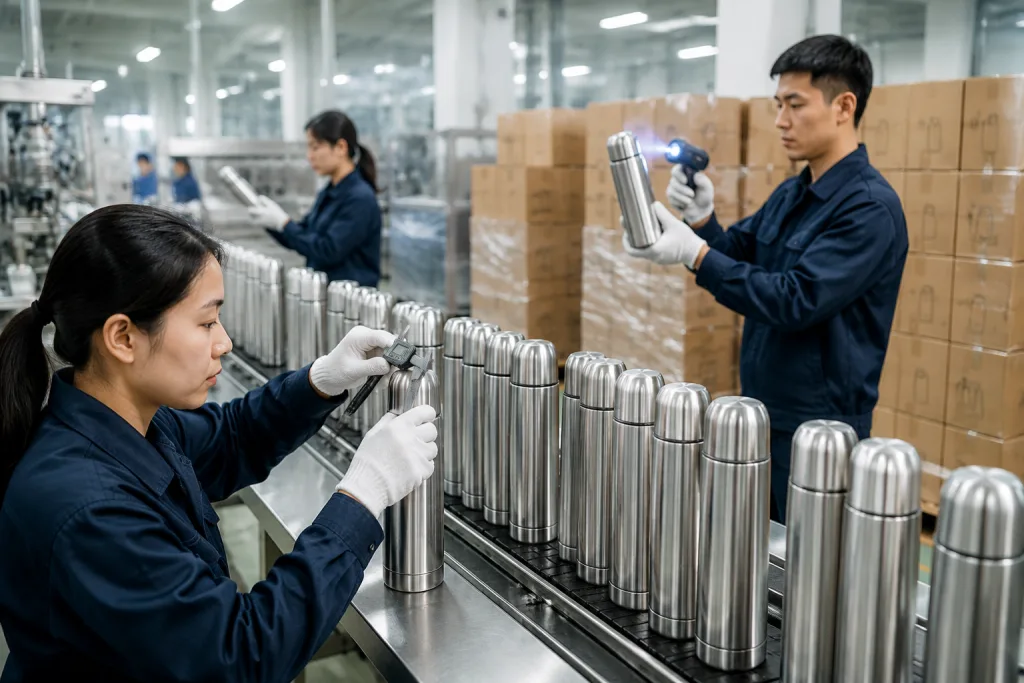
If you are sourcing from a 316 stainless steel double walled bottle manufacturer, do not treat every quote as the same build. It is not. A 500 ml vacuum bottle with matte powder coat, laser logo, and retail carton can land at a different price than a plain brushed sample, even when both come off the same canteen factory in Zhejiang, China. We run that comparison on the line all the time.
You are usually balancing three items at once: unit cost, decoration method, and delivery time. The numbers shift fast when you switch from 304 to 316 inner steel, add a copper-plated vacuum layer, or ask for a canteen customized for Amazon FBA. QC pulled the sample last week and the wall thickness was 0.45 mm, not 0.40 mm, which changed the quote. If you read the cost drivers early, you can push back on the right line item, set a launch date that holds, and avoid rush fees the buyer flagged too late.
What 316 steel changes in cost
316 stainless is not a sticker. It is a material upgrade, and the cost lands in the first quote you get from a canteen manufacturer or canteen supplier in China. We run the same 500 ml double wall bottle in 304 and 316 on the line, and the 316 inner liner usually adds about USD 0.35–1.20 per unit, depending on wall gauge, finish, and order volume. QC pulled the sample once at 0.35 mm, and the buyer flagged the metal content on the PO typo before we even started vacuum sealing.
The real question is whether that extra spend fits the job. For a premium hydration line, travel retail SKU, or outdoor custom growler program, 316 is easy to defend. For short-run canteen promotional stock, the math does not work if the bottle will live in an office bag and never see salt, sweat, or citrus. On bigger runs, the gap shrinks because raw steel, vacuum forming, and welding get spread across more units; a 10,000-piece order behaves differently from a 1,000-piece test order.
- Material delta: 316 inner liner often costs 10%–20% more than 304.
- Common add-on: matte powder coat adds USD 0.18–0.45 per bottle.
- Higher-grade finish: copper-plated vacuum insulation can add another USD 0.20–0.60.
If your spec calls for long shelf life, salty environments, or premium private label retail, the 316 upgrade earns its keep. If you are building a broad custom drinkware line for price-sensitive distribution, keep the spec tight and spend that money on packaging or a stronger closure instead. We’ve seen this go sideways when the buyer chases 316 for every SKU and then has to cut print coverage to hold margin.
MOQ tiers that actually matter
MOQ is where a lot of first-time buyers burn days. We see it on the line all the time. A 316 stainless steel double walled bottle factory may say “flexible,” but the floor still depends on tooling, print setup, carton art, and whether the lid stays standard. For a simple custom bottle with stock mold and one-color logo, 300–500 pcs is often workable. Once the buyer flags a new body shape, a special handle, or a fresh lid, the order usually jumps to 1,000 pcs or more.
The pattern in Zhejiang is simple. Use standard molds and plain decoration, and MOQ stays lower. Ask for tighter control, and the factory wants more pieces to cover setup and scrap. We had one buyer push for 320 pcs with a new Pantone color and a typo on the PO; QC pulled the sample, and the quote had to be redone. A distributor testing one SKU may start at 300 pcs, while a retail program often goes to 3,000 pcs to get a cleaner FOB and better carton packing. The math does not work any other way.
| Order type | Typical MOQ | Buyer use case |
| Stock bottle + logo | 300–500 pcs | Trial launch, distributor drinkware |
| Custom color + logo | 500–1,000 pcs | Retail, canteen customizable programs |
| New lid or shape | 1,000–3,000 pcs | Brand-owned custom drinkware line |
If you need canteen manufacturers to quote cleanly, send the target MOQ first. Otherwise they will price a 1,000-piece run when you only need 300, and your margin sheet is dead on arrival. We ship faster when the buyer gives the floor upfront, and the 50 mm carton spec or logo position can be locked before sampling starts.
Lead time from sample to shipment
Lead time is a chain of steps, and each one can slip when the buyer changes artwork after we start the mold layout. For a canteen manufacturer in China, a normal schedule runs like this: 3–7 days for quote and artwork sign-off, 7–15 days for samples, 20–35 days for bulk production, and 3–7 days for export packing and booking. If the PO has a typo on the lid color code, we stop and confirm it; that alone can push the line back 2 days. If the order needs testing or custom packaging, add more time.
For a 316 stainless steel double walled bottle, the sample stage carries more weight than most buyers expect. QC pulled the sample, and we checked vacuum seal performance, coating consistency, lid torque, and logo placement with a torque meter and a 0.2 mm print tolerance. One missed approval costs a week, and that is the wrong question to ask if you are trying to hit a seasonal launch. We ship faster when the spec is frozen early, because the line does not wait for late changes.
Expect 25–40 days for mass production after sample approval, not counting ocean transit. Air freight can shorten delivery, but it usually adds USD 2.50–6.00 per unit on small cartons.
Build the calendar backward from the ship date, not the order date. If you need retail stock for a trade show, leave room for packaging revisions, inspection, and AQL rework; we have seen that go sideways on a 5,000-piece order when the buyer flagged the carton height at the last minute.
Cost drivers beyond steel grade
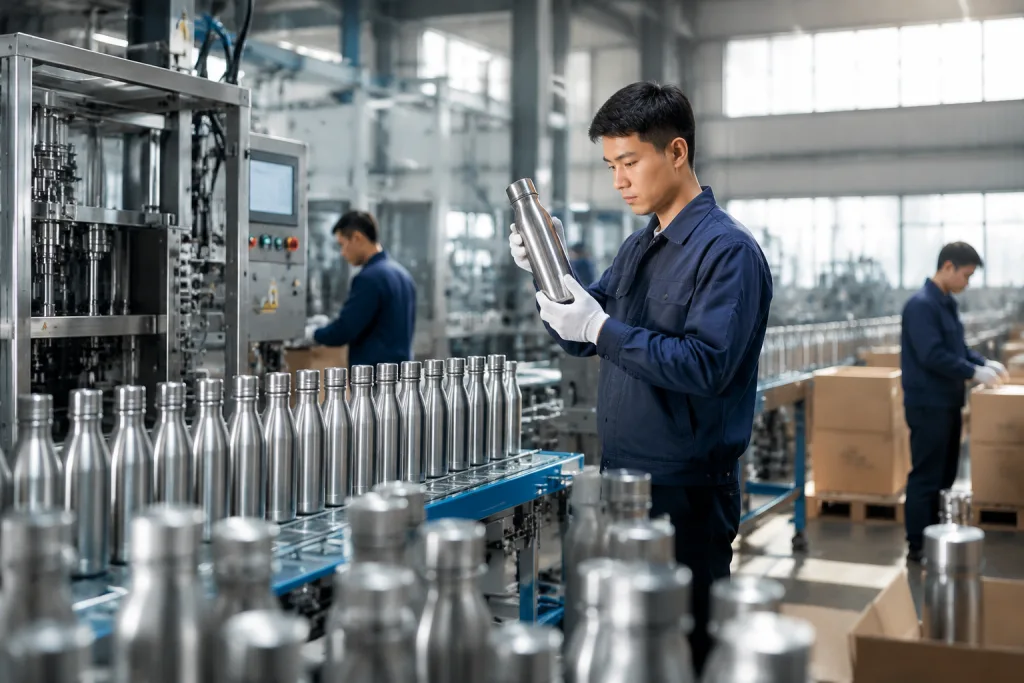
The steel grade is only the starting point. A clean quote from a canteen supplier should split out body finish, lid structure, print method, packaging, and test items. On our line, a laser logo on a 0.8 mm wall is a different job from a 2-color screen print, and the buyer usually spots that gap fast. Laser engraving stays cleaner and holds up better; screen print wins on price when the logo is simple. For custom canteen orders, decoration alone can move cost by USD 0.10–0.90 per unit.
Packaging changes the math just as much. A plain bulk carton costs less than an individual color box with barcode and FNSKU label. We once had a PO with the label line typed as “FNSKU”; QC pulled the sample, the buyer flagged it, and the rework added a day. For Amazon-style launches, label application and carton spec can add another USD 0.15–0.50 per piece. If you ship wholesale, you may skip it. If you ship retail or ecommerce, you usually cannot.
- Logo method: laser, screen print, UV, or embossing each lands on a different price, and the setup fee is not the same.
- Lid structure: flip lid, screw lid, straw lid, or carabiner lid changes tooling, assembly time, and spare parts count.
- Packaging: individual box, mailer, or master carton shifts labor, carton size, and freight weight by route.
- Testing: REACH, food-contact, and leak tests may be included in the quote or billed as separate line items.
When a canteen factory gives you a suspiciously low price, ask what is missing. This is the wrong question to ask if you only chase unit price. We have seen it go sideways when freight, packaging upgrades, or the second sample round were left out, then the extra invoice showed up after approval.
FOB pricing by order size
Good buyers ask for a price ladder, not a single quote. A realistic FOB Zhejiang range for a 500 ml 316 double wall bottle with basic custom logo looks like this: 300 pcs at USD 7.20–10.50, 1,000 pcs at USD 5.40–7.80, and 3,000 pcs at USD 4.20–6.20. If you add a premium lid, gift box, or complex finish, the top end can reach USD 8.80 or more. These are normal numbers for export work. QC pulled a sample on the line last week with a 12 mm lid gap issue, and the buyer flagged it before we packed the carton.
The drop in price is simple. Set-up costs, welding adjustment, print setup, and carton prep stay fixed. Spread them across more units and the unit price falls. That is why canteen distributors usually get better margins on 1,000+ piece runs. A 300 pcs order looks easy, but the math does not work if you need room for freight, duty, and resale margin. We run the same stainless line every day, so we see this go sideways when buyers chase the lowest first quote.
Ask for separate pricing on sample, FOB, and carton loading. Then you can compare quotes from different canteen manufacturers line by line and avoid a PO typo later. If a factory in Zhejiang cannot show a clean price structure, walk away. A serious buyer should be able to see the sample fee, the FOB unit price, and the carton detail in one sheet, with no guesswork.
How to brief the factory clearly
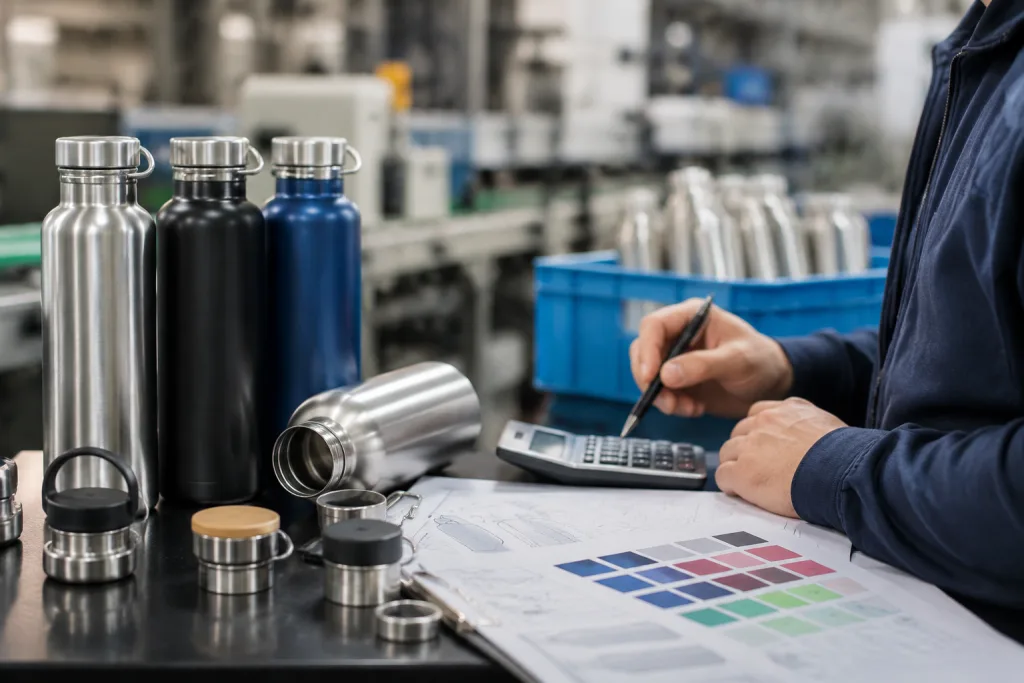
A factory quote is only as good as your brief. Send the capacity, steel grade, wall structure, lid type, logo method, color reference, packing requirement, and target market. That gives us a real number, not a guess. If you want a canteen customizable program, state the use case up front: outdoor, school, office, sports, or promotional. Each one changes the build. We ran a 500 ml sample on the line last month, and the buyer flagged the lid torque because the brief never said it would go in a backpack.
Use a short spec sheet and keep it tight. State the bottle as 316 inner / 304 outer if that is your design, confirm wall thickness if relevant, and ask for leak testing criteria. One buyer sent a PO with “316 SS bottle” and nothing else; QC pulled the sample, and the question back was simple: 0.6 mm or 0.8 mm wall? The math does not work when the target keeps moving, and we’ve seen that go sideways more than once.
What to include in the RFQ
- Capacity in ml or oz
- Inner and outer steel grade
- MOQ target and target annual volume
- Logo method and artwork file format
- Packaging requirement and destination port
- Compliance needs such as REACH or food-contact reports
If you are building a canteen vendor program for retail or distribution, ask for two quotes: one for stock-spec customization and one for fully customized drinkware. You will see the cost gap fast, and the buyer can judge whether the extra tooling and 1,000 pcs MOQ are worth it before budget gets tied up.
Get a factory quote with real numbers
Send your capacity, lid, logo, and target MOQ. We will price the bottle, packaging, and lead time without guessing.
Frequently asked questions
What is the usual MOQ for a 316 stainless steel double walled bottle manufacturer?
For a stock mold with logo work, 300–500 pcs is a common starting point. If you want a custom color, custom lid, or a canteen customized shape, the MOQ usually moves to 1,000 pcs or more. For a new mold or a special promotional pack, some canteen manufacturers in Zhejiang will ask for 3,000 pcs. The cleaner your brief, the easier it is to keep MOQ down without losing margin.
How much should I budget per unit for FOB China?
For a 500 ml 316 double wall bottle, many buyers see FOB Zhejiang pricing around USD 4.20–8.80 depending on order size, finish, and packaging. A 300-piece run is often closer to the high end, while 3,000 pcs can land near the low end. Add packaging, testing, and freight separately so you do not underbudget your landed cost.
How long does sample and bulk production usually take?
Sample lead time is often 7–15 days, especially if you need logo confirmation or a new color. Bulk production after sample approval usually takes 25–40 days. If you add special cartons, third-party inspection, or REACH documentation, leave another 3–7 days. Ocean freight from China adds transit time on top of production, so do not plan retail launch dates too tightly.
Can I order customized drinkware in a small quantity?
Yes, but you need to keep the spec simple. A custom drinkware order with stock mold, standard lid, and one-color logo can sometimes start at 300 pcs. The more you ask for—special coating, printed gift box, or a custom canteen handle—the more the MOQ climbs. Small orders are possible, but the unit price will be higher than a distributor drinkware program at scale.
What compliance documents should I request?
At minimum, ask for food-contact material confirmation, REACH-related declarations for Europe, and leak or durability test results. If you sell into the US or EU, keep records for your importer file. For Amazon or retail channels, also request carton labeling support such as FNSKU placement if needed. A professional canteen factory should be able to show the document set before shipment.