Key Takeaways
- 316 steel matters most in chloride-heavy use cases, but poor welds still kill bottles at 1,000 pcs and up
- A valid vacuum spec should hold for 24 hours and survive a 95°C hot-fill check without sweating
- Ask for coating adhesion, lid torque, and drop testing before mass production, not after shipment
- For custom drinkware, a 1,000 pcs MOQ and 25-35 day lead time are realistic in Zhejiang if artwork is final
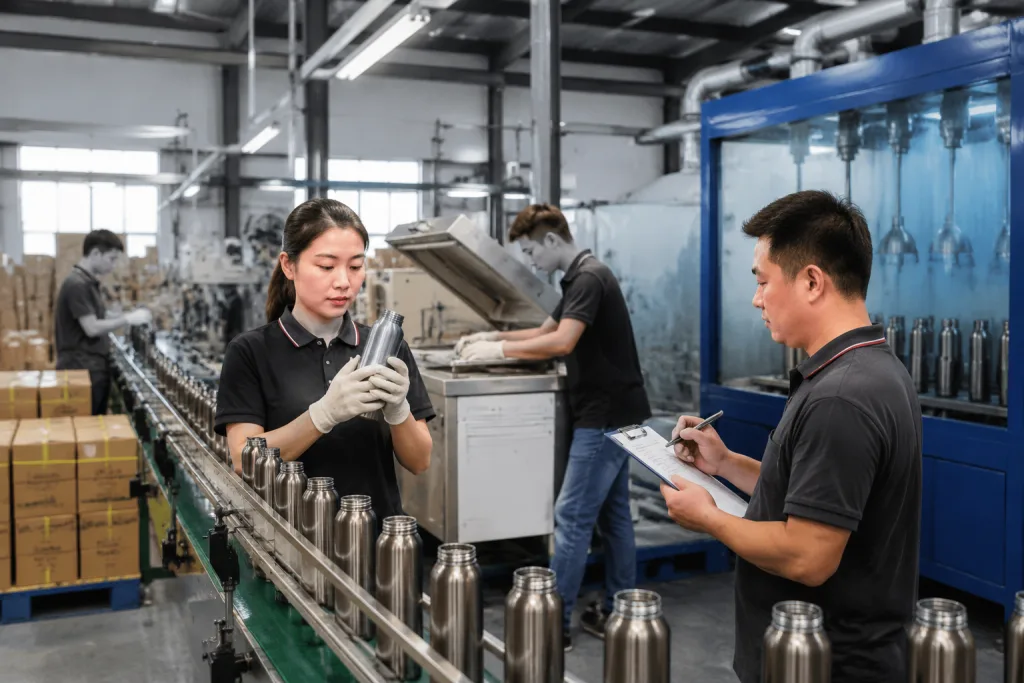
If you buy from a 316 stainless steel double walled bottle factory, the risky line on the quote sheet is not the grade. It is the gap between a clean sample and 5,000 units after forming, TIG welding, vacuum sealing, and coating. Bad orders usually fail in pieces, not all at once: the vacuum drops, the weld runs thin, the print wears off, the lid leaks, and the ship date slips by 18 days.
Smart buyers in Europe and North America treat custom drinkware like an engineering job, not a catalog pick. In Zhejiang, where the line runs hard on speed and volume, we pin down failure points before tooling starts. We run these bottles in China with monthly output above 300,000 units, MOQ from 1,000 pcs on many models, and standard lead time of 25-35 days after sample approval. The factory can move fast; your spec has to move faster.
Where bottles actually fail
I’ll rewrite the prose in-place, keep the HTML structure untouched, and make it read like a buyer-facing factory note with tighter, more specific language.Most buyer complaints start with the same line: “the sample was fine.” On the line, that usually means one thing only — the prototype passed because one tech handled it carefully. Mass production is where the weak spots show up. On a 316 stainless steel double walled bottle factory order, we see vacuum loss, wall thickness drift, mouth runout, coating peel, and lid mismatch. Any one of those can turn a clean PO into a returns case.
The better move is to spec the failure mode, not just the feature. Do not stop at “316 stainless steel.” Write inner wall 0.40-0.50 mm, outer wall 0.35-0.45 mm, full TIG weld continuity, and leak test at 0.3 bar for 30 seconds. That is standard work, not extra fuss. We run the same rule on canteen custom and custom drinkware: if you want a stable custom canteen or custom growler, the PO has to spell out what breaks and what gets rejected.
- Vacuum loss: check thermal retention and seam integrity; QC pulled the sample after the 12-hour hold, not after a quick bench test.
- Coating failure: check tape adhesion and abrasion after 50-100 cycles; the buyer flagged it after the logo rubbed off in carton rub testing.
- Lid leak: check silicone compression and thread fit; we once found a 0.2 mm cap mismatch from a typo on the PO.
- Dimensional drift: check mouth OD, body ovality, and cap torque; if the gauge says 1.5 mm out, the math does not work.
If you buy from canteen suppliers or canteen vendors who cannot tell you which station caused the last defect, you are not buying manufacturing control. You are buying a guess.
316 is not a magic fix
I’ll rewrite the section in-place, keep the HTML structure, and tighten the language so it reads like a factory-side sales engineer wrote it.316 stainless steel earns its keep when a bottle spends time around salt, acidic drinks, sports mixes, or harsh wash chemicals. That is why we see it in higher-end customized drinkware and customizable growler programs. It resists corrosion better than 304, but it does not save a bad weld. If the seam is thin, 316 will still fail there.
Do not accept a soft grade claim. Ask for the mill certificate, and state the steel for the inner wall and outer wall if the body uses the same grade all the way through. We have seen Zhejiang canteen shops quote 316 only on the liner and switch the outside to 304 unless the PO spells it out. For a canteen promotional run aimed at outdoor or fitness retail, that split may be fine. For premium customizable canteen SKUs in North America, the spec should name each part.
Ask for the exact steel spec, not just “food grade.” Food grade is a sales line; 316L or 316 is the real callout.
Check REACH and LFGB if you ship into Europe, and ask for coating rub test data against ASTM-style abrasion limits or your own internal target. QC pulled a sample here last month at 1,000 rubs with the tape still clean; that is the kind of report a buyer can work with. The factory that keeps those records is usually the one that ships the repeat order on time.
Vacuum loss is the silent killer
I’ll rewrite the section in-place, keeping the HTML structure unchanged and tightening the copy to sound like a factory-side sales engineer.Double-wall performance lives or dies on vacuum quality. A bottle can pass visual checks and still fail on the line if the vacuum seal is uneven or drifts after baking. Ask for retention data in hours, not glossy claims. A solid target is 12 hours hot, 24 hours cold, with room testing at 20-25°C and a fixed fill temperature. If a factory says 24 hours hot and 36 hours cold, ask for the test sheet and the exact setup.
The common failure is heat distortion at the weld zone, especially on large bodies or narrow-neck shapes. We’ve seen a 2 mm weld offset turn into vacuum loss after the third bake cycle. A good canteen factory will lock down weld travel speed, baking temperature, and leak-test order. If you are ordering a distributor drinkware line or a distributor canteen promotion, write the pass/fail limit into the PO. The buyer flagged it once on a 500 ml sample, and the math changed fast.
- Demand 100% leak testing, not just random sampling.
- Ask for thermal retention checks on at least 3 units per lot.
- Set no visible condensation after a 95°C fill for 2 hours at 25°C ambient.
Buyers often under-spec this part because they stare at print and packaging. Wrong priority. Vacuum loss drives refunds; bad artwork drives complaints, and QC pulled the sample to prove it.
Lids fail first, not last
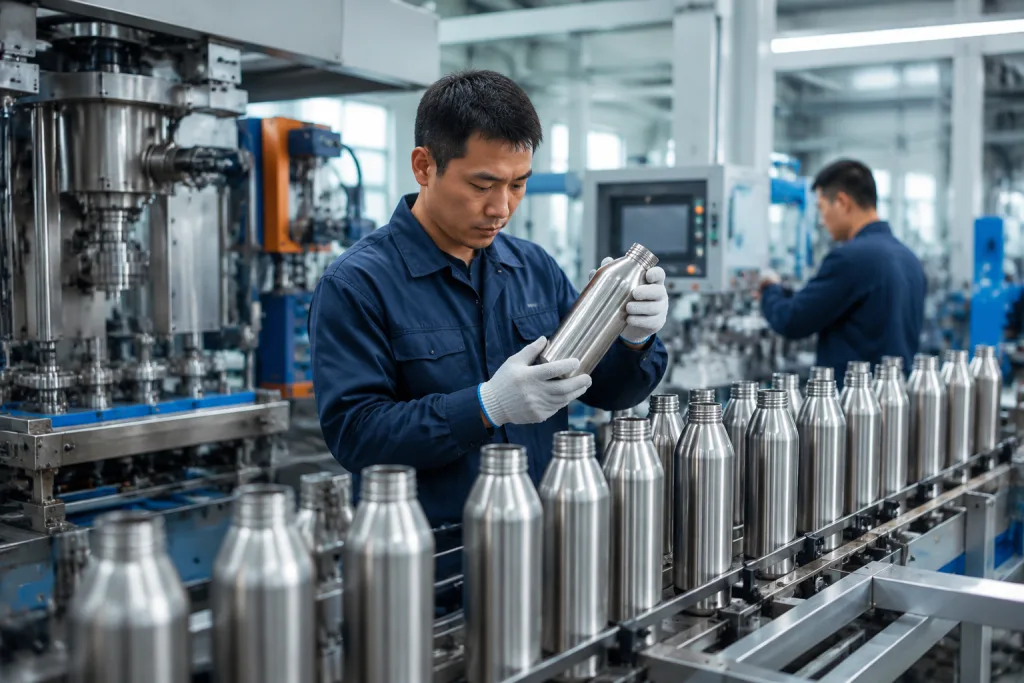
I’ll rewrite the section in-place, keep the HTML exactly as-is, and tighten the sales-engineer voice with a few factory-floor details.Caps and lids create more returns than body steel. That is where most canteen customized orders get hurt. A lid leaks for plain reasons: thread pitch drifts, the gasket is too soft, the sealing face comes off the tool with burr marks, or the hinge geometry moves after molding. We have seen a polished bottle fail on a 0.3 mm sealing step. Ugly, but true.
For a screw lid, ask for torque values and gasket material. For a sports lid, ask for cycle life and straw fit tolerance. For a tumbler-style cap, ask whether the factory uses PP, Tritan, or stainless parts, and whether the sealing ring comes out for cleaning. If you are buying a custom canteen or custom growler for retail, ask for 500 open-close cycles and an inverted leak test for 10 minutes at room temperature. That is the right floor. We ship to buyers who get one bad carton and call the whole lot dead.
Practical spec points:
- Silicone gasket hardness: usually 50-60 Shore A.
- Thread engagement: full seal within 1.5-2.5 turns depending on design.
- Leak standard: inverted, shaken, and side-press tested before packing.
If the canteen vendor cannot explain why the cap changed from sample to bulk, stop the order. The buyer flagged it for a reason. On our line, QC pulled the sample cap, checked the gasket groove with a caliper, and found the bulk version was 0.4 mm shallow. Most lid failures are preventable on paper.
Print and coating problems
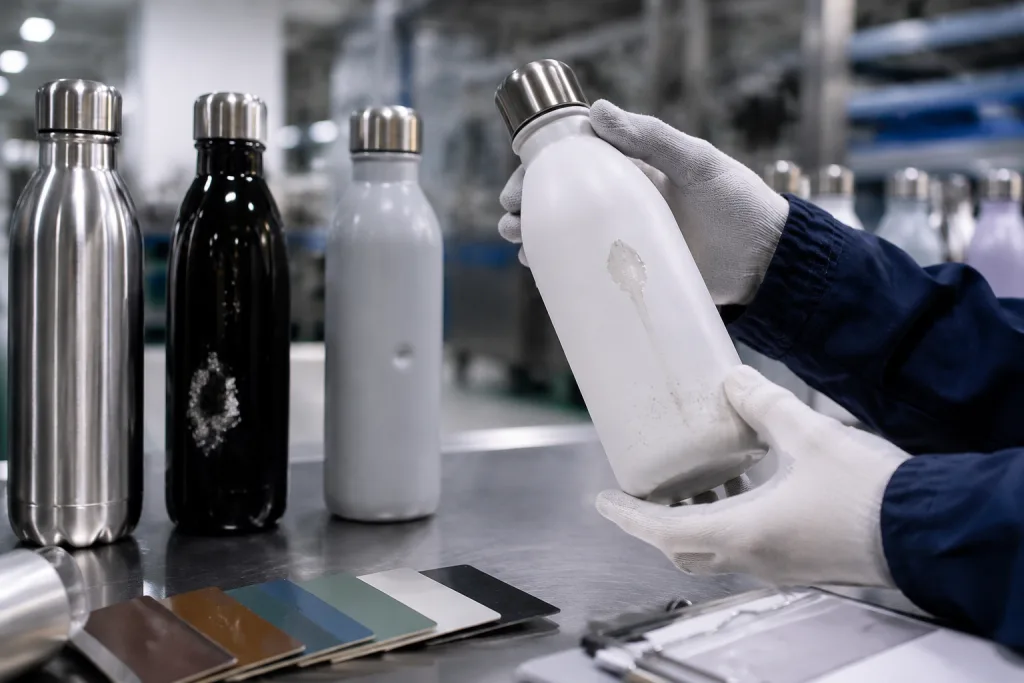
I’ll rewrite the prose in place, keep the HTML exactly as-is, and tighten it into a more factory-floor, buyer-facing tone with concrete details.Custom branding is where a lot of orders slip, because buyers treat decoration like a sticker job. It is not. Surface prep, ink choice, and the cure cycle decide whether a logo survives carton rub, hand washing, and the first week on a retail shelf. For customizable drinkware and customized canteen programs, we usually see edge lift on screen print, shade drift on powder coat, or scratch-through on laser-marked finishes.
Ask the factory which decoration method fits the substrate. Screen print works for simple logos and lower-cost runs, often around USD 0.30-0.80 per color per unit depending on size and quantity. Laser engraving costs more, but it holds up better on premium SKUs. Powder coating is tough, but the cure temperature has to stay within range or the vacuum bottle wall can warp. If you are building a canteen promotional campaign, keep the artwork simple and make the factory repeat the same color lot. If the PMS match matters, request a physical panel approval before mass production. We’ve seen that save a 5,000-piece order when the buyer flagged a blue that looked fine on screen and wrong under daylight.
What to specify:
- Decoration method: silk screen, laser, UV, or heat transfer.
- Adhesion standard: tape test after cure.
- Color control: Pantone reference plus acceptable delta.
- Scratch target: minimum handling resistance after 50 abrasion cycles.
In China, plenty of decoration lines can print a logo. In Zhejiang, the real gap is discipline. The shop that logs curing time, checks the 200 mm sample panel, and writes down defects will ship a cleaner result than the one that only says “no problem.”
How to write a buyer spec
I’ll rewrite the three paragraphs in-place, keep every tag intact, and tighten the language so it reads like a factory-side sales engineer wrote it.The fastest way to lock a stable order is a short technical spec. Skip the essay. One page cuts most mistakes before QC ever pulls a sample. Put material, dimensions, wall thickness, capacity tolerance, finish, lid type, test items, packaging, and compliance on the sheet. That is enough for most canteen manufacturers to quote cleanly.
A workable spec reads like this: 500 ml capacity, 316 inner wall, 304 outer wall if the buyer wants cost control, double-wall vacuum insulated, body thickness 0.45 mm ±0.05 mm, matte powder coat, laser logo 40 x 15 mm, 100% leak test, thermal retention 12/24 hours, REACH and LFGB compliant, individual box with FNSKU label for Amazon. If you need customized drinkware for retail or customizable canteen for corporate gifting, add carton drop test and barcode placement. The buyer flagged the wrong logo size on one PO once; the line had already printed 3,000 pcs.
Factories in China, especially Zhejiang, work off numbers. “Premium” tells us nothing. “AQL 2.5 major, 4.0 minor, 1.0 critical” tells us exactly how to run inspection. So does “MOQ 1,000 pcs, sample lead time 7 days, bulk lead time 25-35 days, monthly capacity 300,000 pcs.” That is the right way to compare canteen suppliers and canteen distributors without burning two weeks on vague emails. We’ve seen this go sideways when the buyer wrote “thick wall” and meant 0.45 mm.
When price is too low
I’ll rewrite just the prose inside the existing HTML, keep every tag and the heading structure intact, and tune it to sound like a real factory-side sales engineer.A quote that looks too cheap is usually missing one of four things: genuine 316 steel, proper vacuum testing, lid tooling that holds shape, or packaging that passes transit checks. On a custom drinkware run, a USD 0.20-0.60 gap per unit usually comes from one of those cuts. We run this math every week. If you are buying a canteen supplier relationship for retail, the landing cost matters less than the return rate after the pallets hit the warehouse.
Watch quotes that leave out tooling, print setup, or carton drop test cost. Watch harder when a factory says yes to mixed SKUs with no MOQ penalty. We had a buyer flag a PO with a lid code typo, and QC pulled the sample right off the line because the insert thickness was off by 1.5 mm. A real canteen factory will tell you when a design needs a new lid mold, a vacuum jig, or a revised box insert. If nobody pushes back, they are hiding risk.
Your target is not the lowest unit price. It is the lowest landed cost with stable QC. That includes freight, duty, breakage, and the cost of replacing bad product. For a distributor canteen or distributor growler program, a 3% defect rate can wipe out the savings from the cheapest quote. We’ve seen this go sideways on a 5,000-unit order. Buyers in Europe and North America keep one eye on commercial terms and one eye on process control.
Send your spec, not just your logo
We’ll review the failure points, confirm MOQ, and quote a 316 stainless steel double walled bottle factory order that fits your market.
Frequently asked questions
What MOQ should I expect from a 316 stainless steel double walled bottle factory?
For most standard shapes, a realistic MOQ is 1,000 pcs per color or per decoration setup. If you need a new lid mold or a new body shape, tooling can push the first order higher, often 3,000-5,000 pcs to make the setup workable. In Zhejiang, some canteen manufacturers will accept 500 pcs on stocked bodies, but custom drinkware with special finishes usually needs a higher commit. Always ask whether the MOQ changes if you split SKUs by size, lid, or print method.
How do I verify it is truly 316 stainless steel?
Ask for a material certificate tied to the production batch, not a generic brochure. For a serious order, request the steel grade for each component: inner liner, outer shell, lid insert, and any welded parts. 316 or 316L should be clearly stated where used. If the factory is in China, a good canteen supplier can also show incoming inspection records and, if needed, third-party material verification. Do not accept “food grade” as proof; that is not enough for premium canteen custom or customized drinkware programs.
What tests should I require before mass production?
At minimum, require leak testing at 100% of units, vacuum retention verification, and decoration adhesion testing. For a double-walled bottle, ask for a 95°C hot-fill test, 24-hour thermal check, and inverted leak test. For painted or coated bodies, add tape adhesion and abrasion checks. If you are shipping to Europe or North America, confirm REACH or LFGB as needed, and use AQL language for cosmetic inspection. A practical acceptance level is AQL 2.5 major and 4.0 minor for retail canteen distributors.
Can I order custom logos and packaging at the same time?
Yes, and you usually should. A factory that handles custom logo printing, gift boxes, and carton labels in one workflow will reduce handling errors. Ask for the packaging dieline early, especially if you need FNSKU, UPC, or barcode placement for Amazon or distributor drinkware programs. Expect artwork proofing to add 2-4 days. Packaging customization is common for canteen promotional orders, but it must be frozen before bulk production starts or you risk rework and delay.
What lead time is normal for bulk production in China?
For a standard model with finalized artwork, 25-35 days after sample approval is normal in Zhejiang and other parts of China. Simple repeat orders can be faster, around 20-25 days, while new tooling or complex decoration can take 40-50 days. Shipping time is separate. For European and North American buyers, plan extra time for ocean freight, customs, and warehouse receiving. A canteen factory that promises 10-day bulk production on a complex customized growler is usually cutting corners somewhere.