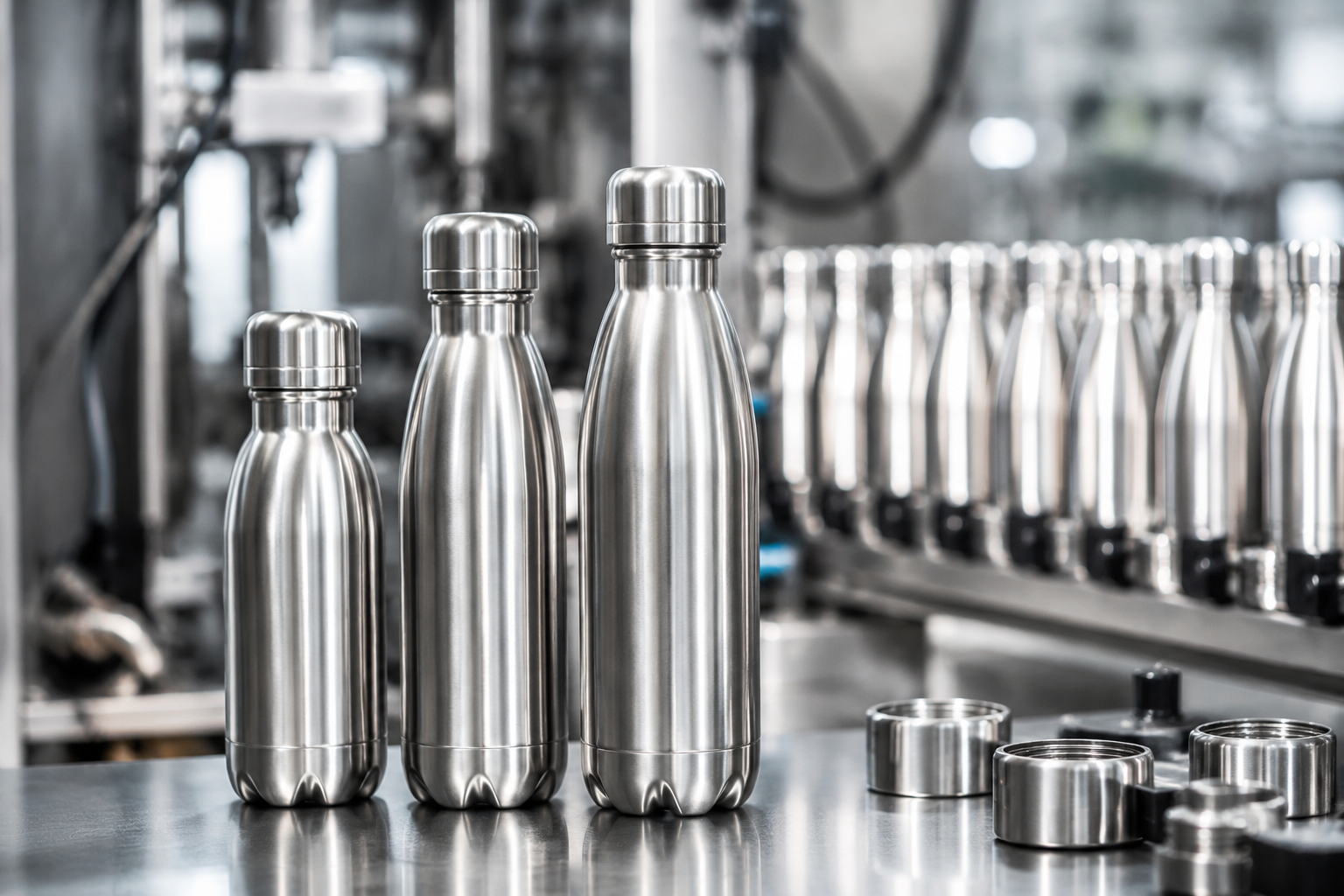
Key Takeaways
- 316 steel helps when chloride exposure is real; 304 is usually enough for dry, low-salt use.
- A 0.4-0.5 mm inner wall with full-vacuum control is more important than a vague “premium” claim.
- Most custom bottle failures come from cap leaks, weld defects, and decoration mismatch, not the steel itself.
- A serious canteen manufacturer in Zhejiang should quote MOQ at 1,000-3,000 pcs and lead time around 35-55 days.
When you buy a 316 stainless steel double walled bottle custom program, the first failure usually shows up on the line, not in the customer’s hand. We see weld pinholes, vacuum loss, weak insulation, powder coat thickness drifting from 60 μm to 90 μm, and laser marks that pass on one sample but go dull in a 5,000-unit run. If you source from China or Zhejiang, you already know the sample is the easy part. The real job is getting 5,000 or 20,000 bottles to match.
This guide focuses on failure modes, not sales talk. If you are a procurement manager, brand owner, or distributor in Europe or North America, the wrong question is “can the factory make it?” The better question is whether the factory can hold the spec on a real production run, with AQL checks, clear weld control, and a finish that does not trigger buyer complaints. We ship these programs every week, and the math does not work if you miss one weak point.
Where the bottle actually fails
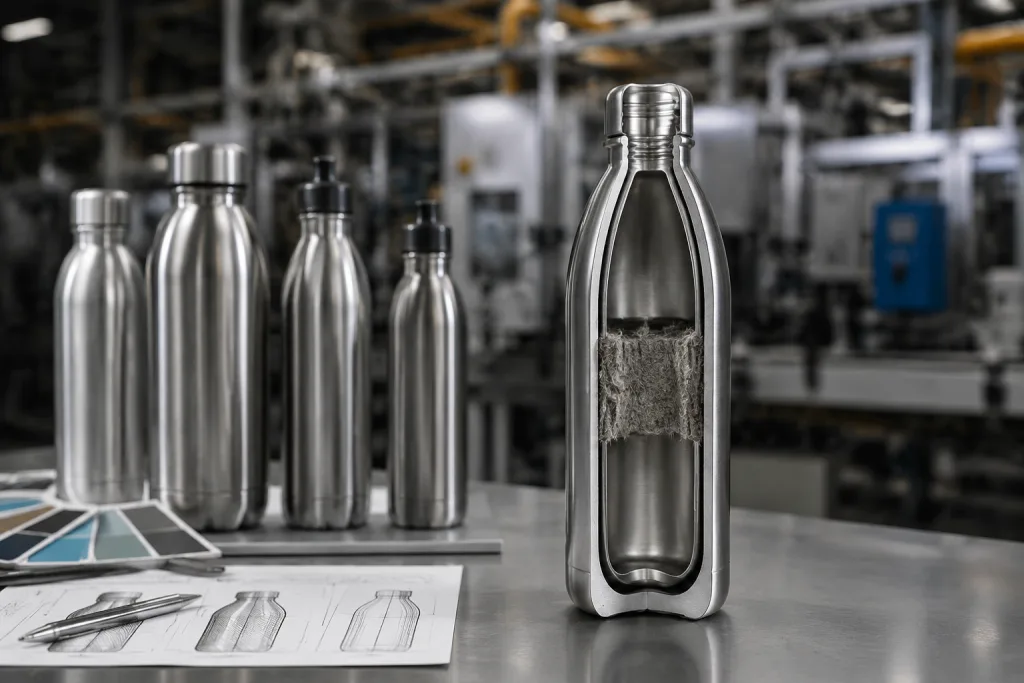
The first mistake is treating 316 like a magic upgrade. It is not. On a double-walled bottle, the failure usually starts at the seam, neck, or cap interface. If the weld is weak, the bottle can pass a visual sample and still lose vacuum after thermal cycling. If the neck geometry is off by 0.3 mm, gasket compression shifts and the shipper gets slow leaks. If the coating goes on too thick, threads bind and lids crack after repeated torque.
When you ask a canteen supplier for a custom canteen, put the failure points on the spec sheet. We run this on the line every week: inner wall 316 at 0.4-0.5 mm, outer wall 304 or 201 only when the price target really demands it, vacuum hold tested at 24 hours, and cap leak tested at 100% air pressure or with an inverted water check. For distributor drinkware programs, this is the part that saves you from returns. The buyer flags the carton count; we watch the seam and the cap.
Typical failure points
- Vacuum loss from weak seam welding
- Cap leakage from poor gasket compression
- Coating flake from bad pretreatment
- Thread mismatch after color coating
- Rust spotting from contamination during polishing
A canteen factory in Zhejiang should show you the process flow, not just the finished item. If they cannot point to where the bottle is deep-drawn, trimmed, welded, evacuated, and leak tested, you are buying luck. QC pulled the sample on one run and found a 0.2 mm neck drift; that kind of miss turns into claims fast.
Why 316 is not enough
Buyers ask for 316 because they heard it is “better stainless.” Sometimes that is true. For food and beverage contact, 316 holds up better than 304 in chloride exposure, which matters for sports drinks, flavored water, and salty storage rooms. But if the wall picked up iron dust, the weld zone ran too hot, or passivation was skipped, 316 still spots. Grade alone does not save a bad line.
This is where a canteen manufacturer is different from a trading desk. A real canteen factory can show alloy certificates, incoming inspection records, and polishing control sheets. We run coil traceability by lot, and QC pulled the sample if the inner liner was only 316 at the drinking-contact area. For a custom growler or customizable growler program for brewery accounts, beer acidity and repeat washing make weld quality and coating integrity as important as the steel itself. The buyer flagged this once on a PO typo: “316 body” meant nothing without the weld spec.
For canteen customizable projects, I would take a clean 304/316 structure with strong vacuum retention over a sloppy all-316 claim. You should too. We’ve seen this go sideways in Zhejiang when a vendor printed the higher grade on the quote and cut corners on the polish wheel. Ask for EN 10088 or ASTM references if your compliance team needs paper, and check the mill cert before the order moves. That is the right question to ask.
Insulation fails in the middle
Most buyers ask for hot and cold retention, but they ask the wrong question. “Keeps water cold for 24 hours” is a marketing line, not a spec sheet item. Insulation comes down to vacuum quality, wall geometry, and the closure system. We’ve seen a bottle with a decent liner lose more thermal performance through a cheap cap than through the body. The lid is the weak point.
For a custom canteen program, ask for a thermal test protocol before you place the order. Our standard check is hot-fill at 95°C, then read the sample at 6, 12, and 24 hours in 20-25°C ambient. For cold retention, we use 0-4°C water on the same schedule. Make sure the test sample uses the same lid, silicone ring, and surface finish as the mass-production unit. QC pulled a sample once where the buyer flagged a cap swap after approval; that was not a minor change, that was a different bottle.
“The bottle body is only half the system. The lid decides whether the program passes.”
If your custom drinkware line includes promotional SKUs, the retail claim has to match the geometry. A wide-mouth promotional canteen usually sheds heat faster than a narrow-mouth vacuum bottle. That is not a defect. It is the design. We run these with the same 95°C fill test, and the math does not work if the promise is too aggressive.
Decoration breaks the program
Most custom bottle jobs miss at branding, not structure. A logo that looks sharp on a white sample can go soft on brushed metal. We’ve seen laser engraving cut too deep on a 0.5 mm wall. Silkscreen scratches when pretreatment misses by one step. Color can drift by ΔE 2 to 4, and that turns into a shelf problem fast when 8,000 units land in a North American warehouse.
If you need canteen custom work for a distributor canteen program, lock decoration before the line starts. A good factory will tell you straight whether the job fits laser, silk print, heat transfer, UV print, or embossing. For stainless steel, laser is usually the safest for wear, but some logos fail the contrast check. For full-wrap graphics, you need a coating system that survives abrasion tests and dishwasher cycles if the buyer asks for them. ASTM or an internal rub test belongs in the PO, not in a late email.
- Approve Pantone code on the actual substrate, not a PDF
- Confirm logo size in mm, not “large” or “centered”
- Specify engraving depth or print thickness
- Require one pre-production sample after tooling setup
For canteen distributors selling into multiple channels, decoration consistency matters as much as function. A customized canteen that shifts by 15% in logo placement looks off, even when the steel passes. QC pulled one sample last month with the mark 3 mm left of spec; the buyer flagged it on the spot.
MOQ, lead time, and factory reality
I’ll rewrite the three paragraphs in-place, keep the HTML tags untouched, and make the copy sound like a factory-side sales engineer with concrete numbers and floor details.Here is the part buyers usually ask us to spell out: a Zhejiang canteen supplier does not set up a custom line for 200 pcs unless the unit price is ugly. For a 316 stainless steel double walled bottle custom order, the normal MOQ is 1,000 to 3,000 pcs per model. If you want a special cap, a new lid insert, or fresh tooling, 5,000 pcs is the number we usually see on the PO.
Lead time sits around 35-55 days after sample approval and deposit. If the cap mold is new, or the line is already loaded with export orders, it moves out. We run this on the floor: one month a laser-weld station can push 60,000 to 120,000 units across several bottle lines, but your order still waits behind tube cutting, polishing, and vacuuming. A buyer flagged a 12-day gap once because the cap drawing had one typo; that is the wrong question to ask if the schedule is still soft. Ask for a real production calendar, not a “yes”.
If you are a canteen distributor or distributor drinkware buyer, send the packing spec before the line starts. Master carton size, divider count, drop-test request, and FNSKU labels all hit the schedule if they come late. We’ve seen a 1,500 pcs order lose two days because the carton mark was added after QC pulled the sample. Low MOQ looks neat on paper, but the math does not work when setup cost gets spread across too few units.
QC checks that save your margin
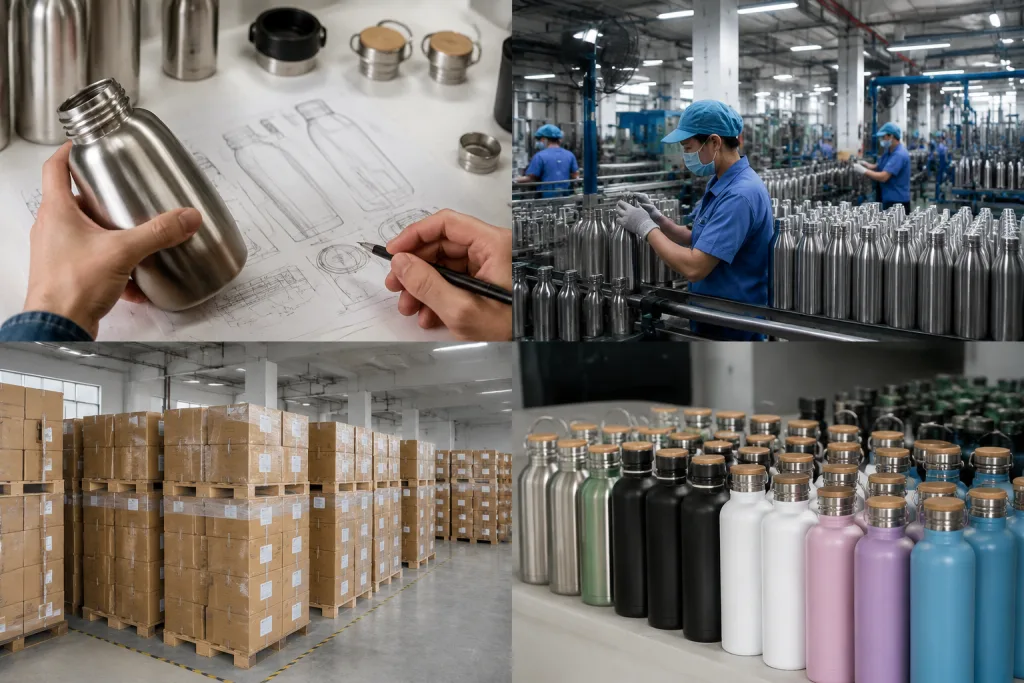
A solid QC plan stops the costly rejects before they leave China. Do not bet on final AQL alone. AQL 2.5 for major defects and 4.0 for minor defects is a normal starting point, but for vacuum bottles we run staged checks: incoming 316 sheet, laser welding on the line, post-vacuum thermal test, decoration inspection, and pre-shipment carton audit. That is how a custom 316 stainless steel double walled bottle order stays on margin.
For each lot, I would require:
- Material certificate for the 316 inner liner
- Leak test on 100% of units or a documented sample basis
- Vacuum retention sample after 24 hours
- Thread gauge check on cap and neck
- Carton drop test if the route is long or rough
If the buyer flags a coating issue, the math gets ugly fast. For Europe, confirm REACH-related coating and ink compliance where applicable. For the U.S., keep customer-facing claims tied to the test report, not a glossy PO line. We have seen a canteen manufacturers claim trigger a chargeback because the carton's 12 mm dent rate did not match the sample sign-off, and that is the wrong question to ask after shipment.
Good Zhejiang suppliers know buyers want a stable process, not a hero sample. Ask for inspection photos with batch numbers, keep the approved sample sealed, and make QC pulled the sample against it before the pallet is closed.
How to spec the order cleanly
If you want the order to move without drama, write the spec like a production sheet and buy like a distributor. Put the body material, wall thickness, finish, cap type, logo method, and packaging on one page. A clean custom drinkware spec also needs BPA-free lids, food-grade silicone, dishwasher tolerance, and carton compression requirements. Leave those out and the line will guess. That is where margin leaks.
Use this format:
- Product: 316 stainless steel double walled bottle custom
- Inner liner: 316, 0.4-0.5 mm
- Outer shell: 304, brushed or powder-coated
- Cap: leakproof, silicone gasket, torque spec confirmed
- Decoration: laser, silk print, or UV with Pantone reference
- Packaging: individual box, master carton, FNSKU if needed
For a custom canteen or custom growler launch, this sheet cuts sample rounds and keeps the PO clean. QC pulled the sample, checked the cap torque, and the buyer flagged a typo on the carton mark before we shipped. That is the right way to run it. In Zhejiang, the factories that answer precise specs usually ship cleaner on the first lot.
Send your spec and get a factory quote
We can review your 316 stainless steel double walled bottle custom requirements, flag risk points, and quote a production plan with MOQ and lead time.
Frequently asked questions
Is 316 always better than 304 for custom bottles?
No. 316 is better when the liquid or environment has more chloride exposure, like salty sports drinks or humid coastal storage. For many standard water bottles, 304 performs well and costs less. The real risk is not the grade alone; it is poor welding, bad passivation, or a weak cap. If you are ordering 5,000 pcs or more, ask the canteen manufacturer for material certificates and a 24-hour vacuum test. That gives you more value than a vague “premium steel” claim.
What MOQ should I expect for a 316 stainless steel double walled bottle custom order?
For a serious factory in Zhejiang, expect 1,000 to 3,000 pcs per model as a normal MOQ, with 5,000 pcs common for new tooling or unusual caps. If a supplier offers 200 pcs with deep customization, the unit price usually jumps hard because setup cost is spread over too few bottles. A canteen supplier should also confirm whether MOQ changes by decoration method, since laser, silk print, and coating each affect setup time and yield.
How do I check if the bottle will leak?
Ask for both cap leak testing and body leak testing. A proper factory should test 100% of units or define a sample plan before shipment. In practice, you want inverted water checks, torque checks on the lid, and a gasket inspection. For custom drinkware going into Europe or North America, keep the approved sample and match the production lot against it. Leak problems usually come from cap fit, thread tolerance, or damaged silicone, not from the steel grade itself.
Can I use the same bottle for a custom growler program?
Yes, but the spec should be tighter. A custom growler or customized growler needs more attention to sealing, thermal retention, and odor resistance because beer and carbonated liquids expose weak closures quickly. Ask for a pressure-safe lid if the use case needs it, and confirm whether the bottle is rated for repeated carbonation exposure. A canteen factory that understands growler work will talk about gasket compression, mouth finish, and washability instead of just quoting a logo price.
What documents should a canteen distributor request from the supplier?
At minimum: material certificate, inspection report, packing list, commercial invoice, and photos of the finished lot. If your market needs it, ask for REACH-related compliance, FDA contact-material support where applicable, and an AQL-based inspection record. For distributor drinkware programs, labeling details matter too: carton marks, SKU codes, and FNSKU if you are shipping to Amazon. Good canteen distributors keep these files because they save time on repeat orders and reduce claim disputes.