Key Takeaways
- 316 liner steel is worth the premium when you need better chloride resistance; expect roughly 8% to 15% higher cost than 304.
- A normal MOQ for custom canteen orders from a Zhejiang canteen factory is often 1,000 to 3,000 units per color, with 35 to 45 days lead time.
- Double wall performance depends on vacuum quality, not just steel grade; a good bottle should hold 60°C+ after 6 hours in a 20°C room.
- For EU and US buyers, ask for REACH, food-contact declarations, and AQL 2.5 inspection before you pay balance.
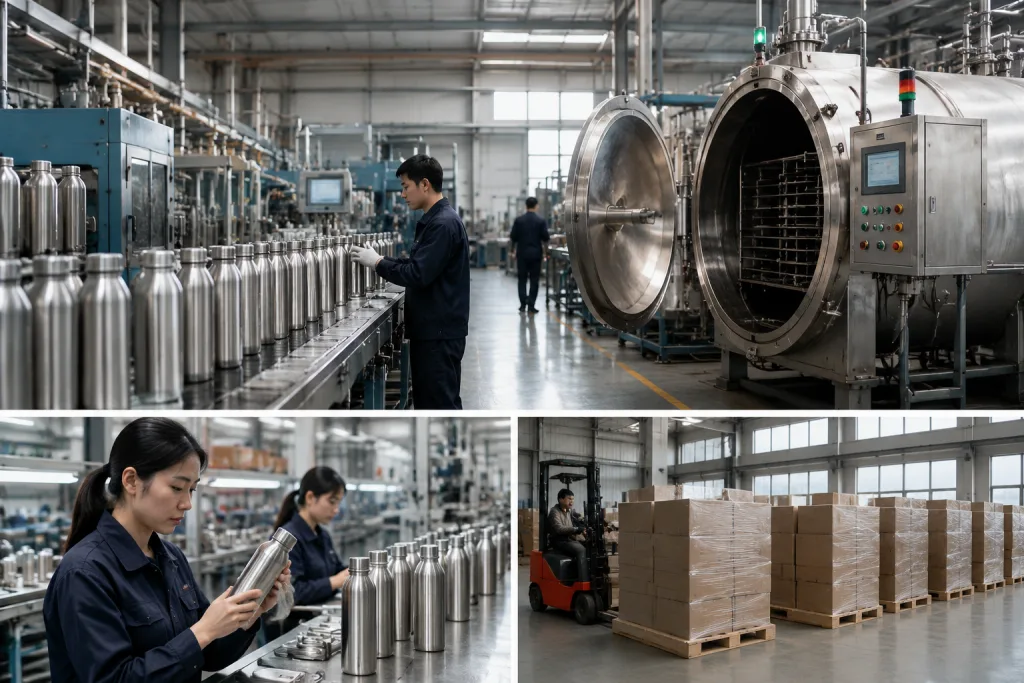
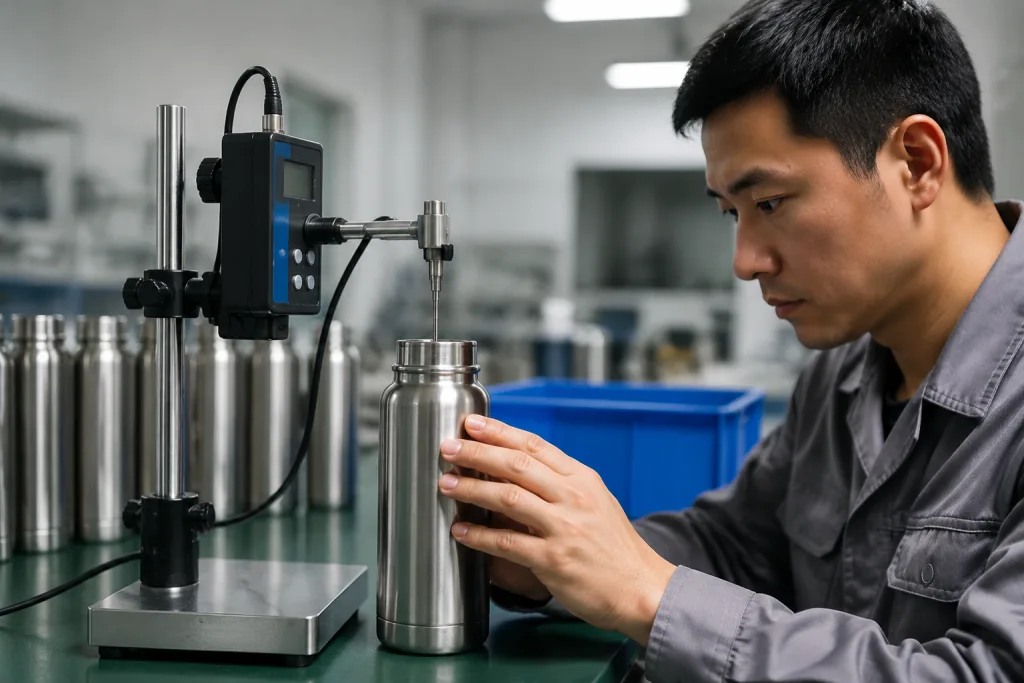
If you are sourcing insulated bottles for Europe or North America, the spec sheet beats the brochure every time. A 316 stainless steel double wall bottle supplier can look the same as any other canteen factory at first glance, but wall gauge, steel grade, and sealing method decide whether the shipment passes testing, survives retail returns, and keeps your margin intact. We run this check on the line with a thickness gauge and a leak tester, because a pretty sample means nothing if the numbers drift.
From our Zhejiang production base in China, we see the same buying mistake every week: importers compare shell prices and ignore the build. A bottle with a 0.4 mm inner wall instead of 0.5 mm, or 304 instead of 316 on the liner, changes corrosion resistance, taste retention, and failure rate; the math does not work any other way. For retail, promotion, or distribution, ask for the spec line by line. The buyer flagged it on a PO typo before—one digit off, wrong steel grade, whole order at risk.
Start with the liner steel
I’ll rewrite the three paragraphs with a more field-side sales tone, keep the HTML intact, and preserve the product spec facts.When a supplier says 316 stainless steel double wall bottle supplier, check the liner first. Not the cap. Not the carton. Not the print. 316 stainless steel has molybdenum, so it holds up better against salts, acids, and harsh wash chemicals. If the buyer runs sports drinks, citrus water, electrolyte mixes, or strong detergent cycles, 316 is the safer pick. For plain water, 304 can work, but this is not a lab question. It is about field use and fewer returns.
Ask the factory to state the inner wall and outer wall grades separately. A real canteen factory will write 316 on the contact side and only use 304 or 201 if the structure is mixed on purpose. If they dodge it, we know the answer. On one job, QC pulled the sample and the PO still said only “stainless bottle” — the buyer flagged it, and the line had to stop. Some low-end canteen suppliers in China like to mix terms like custom canteen, customizable canteen, and customized canteen without fixing the steel grade. Get the grade in writing, and ask for mill certificate references once the order is above 5,000 units. That is standard.
The buyer impact is straightforward: 316 cuts corrosion stains, smell hold, and warranty noise. For a distributor canteen program or a drinkware line sold through gyms, marine accounts, or premium outdoor retail, liner grade decides whether you get repeat business or a dead SKU. We have seen that math go sideways on a 12-day ship date vs 18-day rework cycle.
Read the wall thickness correctly
I’ll keep the tags intact and rewrite the prose in a more field-tested sales-engineer tone, with concrete factory detail and tighter buyer language.Wall thickness is where a lot of buyers get misled. A bottle can feel heavy in hand and still hide thin steel where it counts. For a double wall insulated bottle, ask for separate numbers for the inner wall, outer wall, base, and lid parts. Usable ranges are 0.35 to 0.50 mm for the inner stainless wall and 0.35 to 0.45 mm for the outer shell. If a canteen manufacturer only gives total bottle weight, that answer is weak. We have seen 420 g quoted on a PO, but the vacuum body stayed at 0.35 mm while the weight came from a thick base cap and oversized lid.
The effect shows up on the line. At 0.35 mm, you save material, but dent resistance drops and stamping marks show faster. At 0.45 mm or above, rigidity is better, yet the material bill climbs. For retail custom drinkware sold under a premium brand, that trade usually makes sense. For a canteen promotional order, 0.35 to 0.40 mm is fine if the bottle is for desk use, not trail use. This is the wrong question to ask: “Can you make it heavier?” Ask for the wall spec and the AQL 2.5 check result instead.
Ask whether the factory runs full-body spinning and whether the vacuum chamber is automated. A serious canteen factory in Zhejiang should be able to quote monthly output, often 300,000 to 600,000 units depending on SKU mix, and tell you where the bottleneck sits. QC pulled the sample with a caliper on one order because the inner wall drifted by 0.06 mm after forming. You want a supplier that can hold the same wall spec across 10,000 units, not one that changes it after the sample stage.
Vacuum performance is the real test
I’ll rewrite the section in-place, keeping the HTML tags and the heading intact, while making it read like a factory-side sales note with tighter, more specific wording.Insulation claims mean little unless the factory shows the test setup. The number that matters is hold time at a stated ambient temperature. If a canteen supplier says “12 hours hot and 24 hours cold,” ask for the water fill level, starting temperature, room temperature, and whether the lid stayed closed. We run this check with a thermometer and a stopwatch, and without those details the figure is just carton copy.
For a good double wall bottle, you should see about 60°C or above after 6 hours starting from 95°C water in a 20°C room, cap closed. Better builds can do more, but that depends on the wall geometry and lid fit. A slim custom growler usually loses heat faster than a narrow-neck bottle; 8 mm of neck design can change the result. Same story for a customized growler used for beer or coffee service. The math does not work the same across shapes.
Ask for leak testing and vacuum decay control. QC pulled the sample, cut one open, and checked the weld ring before packing. For Europe and North America, ask whether the bottle meets food-contact expectations under REACH and applicable U.S. standards. If the order ships to Amazon or a big-box retailer, get the FNSKU and carton labels right on the first PO; one typo there can stall a whole batch at the line. Good custom drinkware programs are built for logistics, not for a nice sample photo.
Cap design decides usability
I’ll rewrite the prose only, keep the HTML intact, and make it read like a buyer-facing factory note with concrete details.Most returns do not come from the steel body. They come from the lid. The cap decides whether the bottle rides clean in a backpack, fits a car cupholder, and stays shut when a buyer drops it on the line. A screw cap with a silicone gasket is the baseline. Flip-top, straw lid, and push-button styles add convenience, but they also add parts that wear out or hold odor. For a distributor canteen buyer serving schools or corporate programs, simple usually ships better.
Check the thread style, gasket material, and whether the lid survives repeated dishwasher cycles. We run a 50-cycle wash test on sample lids, and that is where weak parts show up. Silicone gaskets should come out and go back in without a fight. If a canteen manufacturer says the gasket is “permanent,” the math does not work for cleaning or after-sales support. QC pulled one sample with a pinched seal at the 9 mm groove, and it leaked on the second shake test. A customizable canteen with a bad lid is still a bad product.
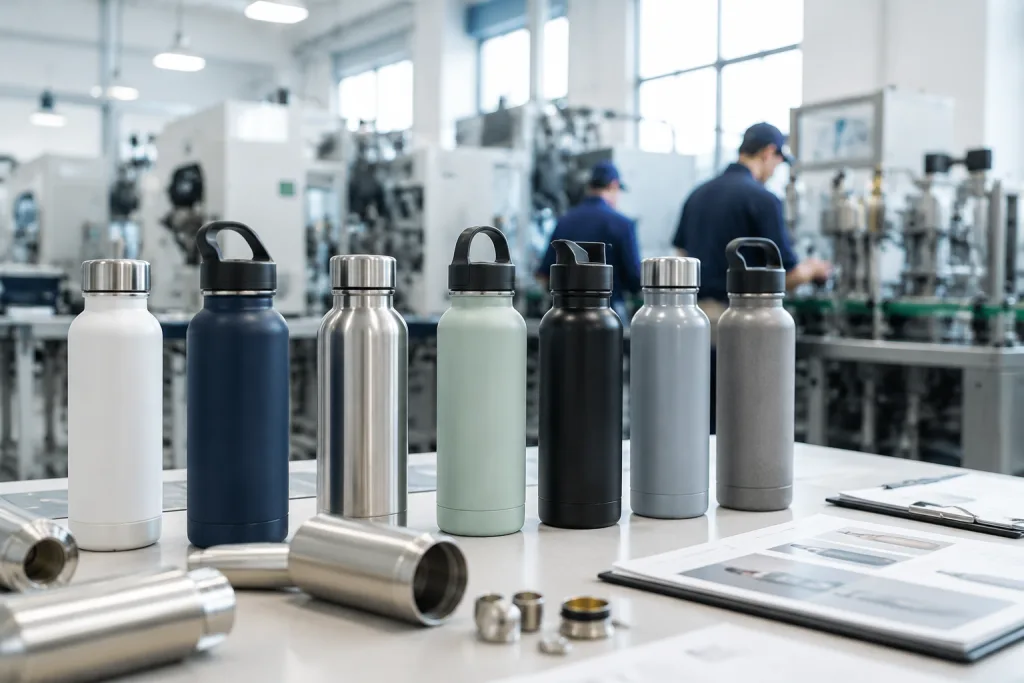
For branding, the lid gives you more room than the body. You can do laser engraving, embossing, printed inserts, or a color-matched cap. If you are building a canteen customizable line or a canteen customized private label, lid color is the fastest way to split SKUs without touching the body mold. That matters when your MOQ is 1,000 units and the buyer wants three colorways on one PO. We have seen a typo on the cap Pantone code turn into a full rework. For canteen distributors, lid changes can cover distributor growler, distributor drinkware, and distributor canteen assortments from one core mold.
Branding should fit the channel
Branding is not decoration. It changes perceived value, decoration cost, and production risk. On a 316 stainless steel double wall bottle, screen print is often the lowest-cost route at scale, especially for 1 or 2 colors. Laser engraving works on brushed stainless steel and gives a cleaner premium look. UV print handles gradients and fine art, but QC pulled the sample for abrasion testing before we signed off. If the bottle gets handwashed every day, choose a decoration method that survives that use case.
When a buyer asks for custom canteen or customizable drinkware, we push them to look at the channel first. A corporate gift program needs a different finish than a retail shelf item. A canteen vendor selling to outdoor shops may want matte powder coating, while a canteen supplier for hospitality may prefer a smoother finish that wipes clean in 10 seconds. Small choices matter. A 0.2 mm logo depth, 1.0 mm stroke width, or a 3-color print limit can decide whether the artwork stays sharp after production; we’ve seen the buyer flag it only after the first pre-production sample.
Be careful with very dark coatings on branded stainless bottles. A 1.2 m drop test can show chipping faster than the steel body failure, and that is the wrong question to ask if the logo is the selling point. If you need premium positioning, ask for adhesion testing and salt spray data. For larger programs, ask the factory to quote decoration, packing, and carton labeling as separate lines. A clean FOB quote from a China supplier should show the bottle, lid, print, and box as separate lines; one PO typo can hide the cost of a carton insert, and the math doesn’t work once the order lands on the line.
MOQ, price, and lead time
This is where procurement gets real. On our line in Zhejiang, MOQ for a standard 316 stainless steel double wall bottle is usually 1,000 to 3,000 units per color and per logo setup. Add two lid colors or a matte powder coat, and the number moves up fast. We’ve seen buyers push back on that, then send a PO with the logo file in the wrong format.
Lead time is usually 35 to 45 days after sample approval and deposit. Peak season can add 7 to 14 days. If a supplier says 10 days on a fully custom bottle, ask what they are skipping. QC pulled a sample last week with a 1.2 mm wall spec off by enough to fail the fit check, and that is the kind of shortcut that shows up later.
Pricing depends on steel grade, lid complexity, coating, packaging, and order volume. A 316 liner build usually costs 8% to 15% more than a 304 version, and laser engraving is cheaper than full-color wrap printing. The math does not work if you compare only FOB bottle price and ignore cartons, inserts, and test reports. We ship a lot of these, and the buyer flagged it immediately when the landed cost came in 9% over the quote.
Ask whether the factory has monthly output above 300,000 units and whether it can handle mixed-SKU shipments. That matters for seasonal canteen orders and distributor programs with multiple retailer accounts. The best suppliers keep one spec stable across reorder cycles. That is how you avoid color drift, lid mismatch, and a 2 mm height change between lots.
Request the spec sheet before you price
Send your target volume, lid style, and market standard. We’ll quote the steel grade, MOQ, lead time, and decoration options clearly.
Frequently asked questions
What is the real difference between 316 and 304 steel in a bottle?
316 stainless steel has molybdenum, which improves resistance to salts, acids, and cleaners. In practical B2B use, that matters for sports drinks, citrus mixes, and coastal or humid markets. Expect a 316 bottle to cost about 8% to 15% more than 304, depending on wall gauge and order volume. If your product is a premium custom drinkware line, that premium is usually justified. If it is a low-cost canteen promotional item, 304 may be enough.
What MOQ should I expect from a canteen manufacturer in China?
For a standard shape, a typical MOQ is 1,000 to 3,000 units per color or decoration setup. Complex lids, special finishes, or multiple artwork versions can increase that. A Zhejiang canteen factory with steady production often handles reorder programs better than a small trader, because it can keep molds, coating, and packing consistent. Always confirm MOQ by SKU, not by general product family.
How do I check insulation claims before placing an order?
Ask for a test report that states starting water temperature, room temperature, fill level, and measurement time points. A useful reference is 95°C water in a 20°C room, with the lid closed, and a reading after 6 hours. Good bottles should still hold 60°C or higher, depending on shape and lid. If the supplier cannot show test conditions, the claim is not reliable.
Can I order a customized canteen with logo and special color?
Yes, and that is common for custom canteen programs. Most factories can do silk screen, laser engraving, powder coating, or printed packaging. For a canteen customizable project, the usual path is sample confirmation, color matching, then mass production after deposit. Keep in mind that special colors or matte coatings can raise MOQ and add 5 to 10 extra days to lead time.
What inspection standard should I request?
For export drinkware, ask for AQL 2.5 on critical and major defects unless your channel requires stricter limits. Also ask for food-contact declarations, REACH-related documentation for Europe, and any relevant U.S. compliance paperwork. For retail or distributor drinkware programs, carton labeling, barcode accuracy, and leak testing should be part of the inspection checklist. A good canteen supplier will accept this without drama.