Key Takeaways
- 316 stainless steel typically adds about 15-25% to material cost versus 304, but it matters for salt, acidic drinks, and premium positioning.
- A practical MOQ for private label bottle programs is often 1,000-3,000 pcs per SKU, with 25-35 days for samples and 35-50 days for bulk.
- Specify wall thickness, lid type, finish, and test standards in the RFQ; vague requests create rework and chargebacks.
- For export orders, ask for AQL 2.5/4.0 inspection, REACH or LFGB where needed, and carton/FNSKU details before PO release.
If you are sourcing a 316 stainless steel double wall bottle private label program, the bottle itself is not the hard part. The hard part is locking the spec so the sample, the bulk run, and the landed cost all line up. We have seen buyers in Germany and the US lose margin because they asked for “premium stainless,” then QC pulled the sample and found 0.3 mm wall variation, a lid that seeped after a 24-hour tilt test, or print that started peeling after two shipments.
We run these jobs in Zhejiang, China, and the same issue comes up every week: the buyer wants a custom line, but the RFQ is too thin. A solid canteen factory can handle the tooling and the line setup; the real job is giving us the bottle spec, finish, test standard, and PO details in plain language. If the drawing says 500 ml but the PO typo says 550 ml, the math does not work. That is how you keep MOQ, lead time, and quality under control.
Start with the use case
I’ll keep the HTML structure intact and rewrite the prose to sound like a factory-side sales engineer, with tighter specifics and fewer generic phrases.Before you ask for pricing, pin down the job. A 316 stainless steel double wall bottle private label run for cold brew is a different spec from a hiking canteen for hot tea or a promo bottle for a trade show. We chose 316 for the better corrosion resistance when the bottle sees salt, sports drinks, citrus, or 200-plus dishwasher cycles. If the buyer is stocking office channels, finish and logo placement carry more weight. If the buyer is selling outdoor retail, we run harder on impact resistance, lid lock-up, and vacuum hold after 12 hours.
Send the first RFQ as a use-case brief, not a style note. Put the target volume, target retail price, shipping regions, and whether you need compliance for Europe or North America right there. A good canteen supplier quotes faster when you say hot and cold use, handle or no handle, and whether the line should be treated as a customizable canteen, customized growler, or standard insulated bottle. We see this all the time in Zhejiang: a clean spec goes straight to the right tooling, cap line, and QC check instead of bouncing around for two days.
RFQ line items to include
- Product type: 316 stainless steel double wall bottle private label
- Capacity: 500 ml, 750 ml, or 1,000 ml
- Target use: office, outdoor, sports, or gifting
- Market: EU, US, or both
- Decoration: silk screen, laser, UV, or wrap print
Lock the bottle structure
I’ll rewrite the section in-place, keeping the HTML tags and structure intact while tightening the prose for a more experienced factory-sales voice.Now turn the concept into a bottle we can actually run. For a double wall insulated bottle, the key points are the inner and outer material, wall thickness, mouth size, coating, and lid system. We usually quote 18/10 or 316 stainless on the inner wall when the buyer wants stronger corrosion resistance; the outer wall is often 316 or 304, depending on budget. Body thickness commonly sits at 0.35-0.5 mm, and we reinforce the neck if the lid is heavy. Skip these numbers and two suppliers can quote the same canteen custom program, then ship two different bottles.
Ask for a drawing with dimensions, weight target, vacuum gap, and tolerance. A serious canteen factory should state grams per piece, not just capacity. QC pulled a 750 ml sample last month at 428 g, and that was with a heavier lid. If you need a canteen promotional line, cut the finish steps and keep the shape simple. If you want a premium customizable drinkware item, ask for powder coating with laser logo reveal or a brushed metal surface. This is where the canteen manufacturer shows whether they run engineering or just send quotes.
Do not skip the lid. A screw cap, flip lid, tea infuser lid, or straw lid changes the leak test and the carton count. For a custom growler style bottle, use a wider mouth and a thicker shoulder. For a distributor drinkware program, stay with one or two lid options so reorder math does not get messy.
Send a clean RFQ package
I’ll rewrite the three paragraphs in-place, keep the HTML intact, and tighten the language so it sounds like a buyer-side sales engineer wrote it. Then I’ll return only the updated HTML.Your RFQ needs to look like a purchasing file, not a mood board. We get better quotes when buyers split must-have specs from nice-to-have upgrades. If you are working with canteen manufacturers in China, send a one-page spec sheet, a vector logo file, and the compliance list up front. State whether you need REACH, LFGB, FDA, or ASTM test support. For Europe, buyers also ask for food-contact declarations and migration reports. For North America, the carton print and barcode rules matter as much as the bottle.
Keep the PO logic visible while you quote. A proper sourcing pack should already show artwork cost, sample cost, tooling if any, unit price, carton layout, and shipping terms. If your team handles multiple SKUs, group them by lid family so the canteen supplier can price tooling and assembly without guessing. We run this every week, and the buyer flags it fast when the lid spec is buried in a note. A clean quote from a canteen vendor should state MOQ by color and by logo method. In Zhejiang, 1,000 pcs per design is normal for standard decoration, but a fully custom lid or custom mold often lands at 3,000-5,000 pcs. The math works there.
Use a simple pricing table in the RFQ:
- EXW or FOB Ningbo/Shanghai price
- MOQ by SKU and by color
- Sample lead time
- Bulk lead time
- Packaging unit and carton count
Treat samples like a test gate
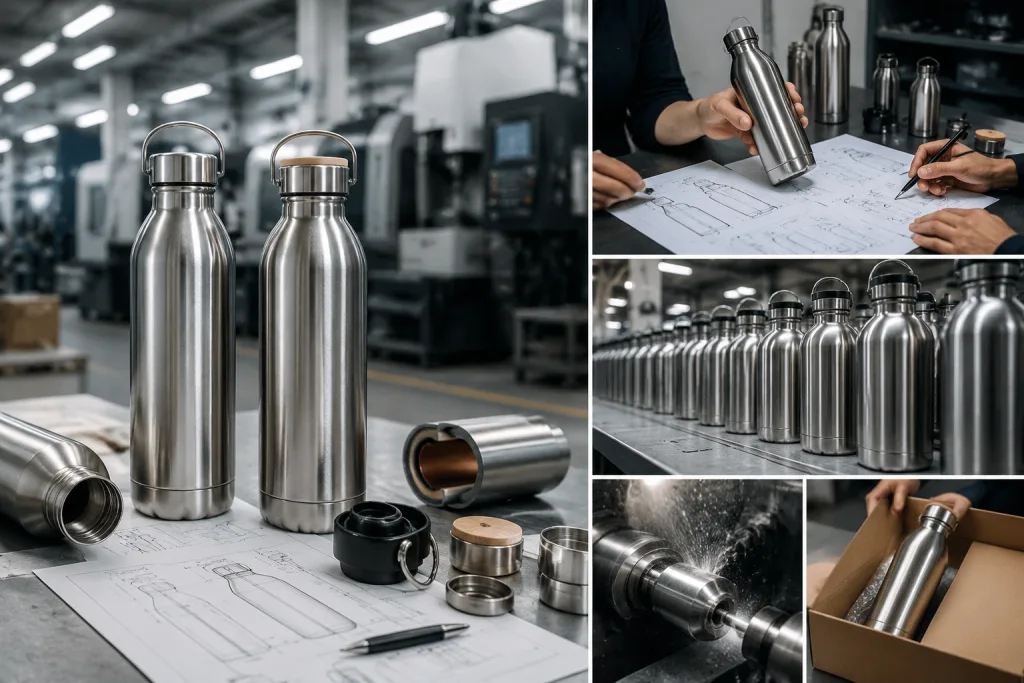
I’ll rewrite the section in-place, keep the HTML tags unchanged, and make the wording sound like a factory-side sales engineer wrote it.Do not sign off on a sample just because it looks clean in photos. A private label bottle wins or loses on function. Run the sample through leak checks, insulation checks, logo rub tests, odor checks, and drop tests. For a 316 stainless steel double wall bottle private label order, we expect the sample to hold heat in a real test: 95°C water should stay above 60°C after 6 hours in a properly built 500-750 ml bottle, and cold retention needs to stay in the same window. The exact result moves with vacuum quality, but the test method must stay the same every time.
Ask the bottle factory for a pre-production sample first, then a golden sample for sign-off. If the bottle goes to retail, test the shipper too. Carton crush, sleeve print, barcode placement, and drop protection are part of the job. We’ve seen a cap scuff the coating or an insert card shift in transit and the buyer flagged it at receiving. For distributor programs, repeatability beats one perfect sample. The approved sample has to lock in the exact print position, lid color, and surface finish that the line will copy in bulk.
A sample only matters when it becomes the control piece for bulk. If the supplier will not put the spec in writing, you are not holding a production-ready product.
Typical sample cost runs USD 50-150 for a simple bottle, and more if new tooling is involved. Sample lead time is usually 7-15 days for existing molds and 20-35 days for new components.
Write the purchase order carefully
I’ll rewrite this section in-place, keep the HTML exactly as-is, and tune the copy to sound like a factory-side sales engineer wrote it.The PO is where import programs get messy. A clean PO for customized drinkware lists every commercial and technical point, so nobody has to guess later. If you buy from a canteen distributor or straight from a canteen factory, keep the same format every time: product name, capacity, material, finish, logo method, packaging, inspection standard, and delivery term. We had one buyer flag a PO typo on `316` versus `304`; QC pulled the sample, and the math did not work after that.
PO line items should include:
- Product: 316 stainless steel double wall bottle private label
- Material spec: 316 inner wall / 304 or 316 outer wall
- Capacity and dimensions
- Logo and decoration method
- Lid type and spare gasket count
- Packaging: polybag, box, master carton, barcode, FNSKU if needed
- Inspection: AQL 2.5 major, 4.0 minor, or stricter
- Delivery term: FOB China, CIF, or DDP if agreed
- Payment: 30/70, 20/80, or LC for larger volumes
For a private label launch, start with a small, repeatable PO. We usually see 1,000-3,000 pcs per SKU on the first run, then the buyer scales after sell-through. If a supplier tries to pack too many lid styles or colors into one order, the line slows down and landed cost jumps. That is the wrong question to ask. Buy one SKU that ships cleanly, then build from there.

Control production and inspection
I’ll rewrite the section in place, keep the HTML exactly as-is, and tune the prose for a more grounded sales-engineer voice with concrete factory details.Once the PO is signed, production control matters more than price talk. Ask for a schedule that shows raw material arrival, body forming, vacuum sealing, logo print, packing, and final inspection dates. A solid canteen factory in China should show monthly capacity on paper, and a mid-sized Zhejiang plant usually runs 200,000-500,000 units per month depending on the mix. For a rush order, ask where your job sits in the queue and whether the lid line is shared with another buyer’s 500 ml bottle run.
Inspection should never be a formality. We run incoming material checks, in-process checks, and pre-shipment checks, and the buyer flagged it fast when a 0.3 mm burr showed up on the rim. For export drinkware, AQL sampling is standard, but you need to name the real defects: leakage, vacuum failure, sharp edge, wrong color, wrong logo, or carton labels that don’t match. If you sell on Amazon, the unit label and FNSKU must match before goods leave China. If you ship to retail chains, confirm outer carton marks, pallet height, and case pack. The factories that hold up in Zhejiang are not the ones with the biggest showroom; they are the ones that keep a clean inspection record and can show the line without hiding anything.
Ask for photos at three checkpoints, not one. Body forming first, decoration second, carton packing third. That catches most avoidable mistakes, and it does not choke the line.
Plan reorders and margin
I’ll rewrite the section in-place, keep the HTML structure untouched, and make the copy sound like a real sales engineer wrote it.Your first shipment tells you how the program will behave once the line starts moving. Track landed cost by SKU, not just factory price. A bottle quoted at USD 4.20 FOB China can land very differently once you add freight, duty, label stickers, and domestic fulfillment. We had a buyer flag a PO typo on carton count once — 2,400 pieces versus 24,000 — and the margin math broke immediately. Ask for a full cost sheet before the first PO. If you run canteen promotional campaigns, a small change in carton pack or logo method can swing margin by 8-12%.
Reorders are where a good canteen supplier earns its keep. If the first run sells through fast, you need tooling records, color codes, artwork files, and packaging specs stored in one place. That is the only way to reorder without resampling every time. On our QC table, a 0.8 mm wall spec and a lid thread check saved one program from a full restart. For a customizable canteen line, keep one base body and two lid variants, not five. For a customized growler program, use seasonal color on the same vacuum body. The more often you change the mold, the less private label leverage you keep. A strong China supplier should help you protect that leverage by keeping the SKU setup tight.
At scale, the best buyers do not ask, “Can you make it?” They ask, “Can you run it the same way three months from now?” That is the real private label test.
Request your private label quote now
Send your target capacity, logo file, and market. We’ll quote the bottle, lid, packaging, MOQ, and lead time from Zhejiang.
Frequently asked questions
What MOQ should I expect for a 316 stainless steel double wall bottle private label order?
For a standard private label bottle with existing molds, a realistic MOQ is often 1,000-3,000 pcs per SKU. If you need a custom lid, special coating, or new tooling, some canteen manufacturers in China will ask for 3,000-5,000 pcs. If you split by color and logo, each variant may carry its own MOQ. Buyers in Europe and North America usually keep the first launch tight: one body, one lid, one print method. That keeps cash tied up lower and makes reorders easier.
How much should sample development cost?
A normal sample for a custom drinkware bottle is often USD 50-150 when the factory uses existing molds and standard decoration. If you need a new cap, a custom box, or a prototype that changes the neck finish, the sample cost can be higher. Allow 7-15 days for an existing sample and 20-35 days for a more customized canteen or custom growler-style build. Always ask whether the sample fee is refundable against bulk, because many canteen suppliers will credit it back after the first PO.
Why choose 316 stainless instead of 304?
316 stainless has better corrosion resistance than 304, especially in salty, acidic, or high-use environments. That matters if your buyers use the bottle for sports drinks, citrus water, or repeated dishwasher cycles. In cost terms, 316 usually adds about 15-25% to the material side, though the exact premium depends on market metal prices and wall thickness. For premium private label lines, that extra cost is often worth it because it supports a stronger selling story and fewer rust complaints.
What tests should I request before bulk approval?
At minimum, request leak testing, insulation retention testing, logo durability, and carton drop testing. For export, many buyers also want REACH, LFGB, or FDA-related food-contact support depending on the market. For inspection, AQL 2.5 major and 4.0 minor is a common baseline, but you can tighten it for retail programs. If the bottle will ship through Amazon or a distributor network, confirm barcode, FNSKU, and master carton rules before the bulk order starts.
Can I build a canteen custom program with multiple lid options?
Yes, but keep it controlled. One bottle body with two lid options is practical; three or more lid systems usually complicate tooling, inventory, and QC. A canteen customizable program works best when the body stays the same and only the lid or finish changes. That lets a canteen factory keep production stable and helps you reorder faster. If you plan to sell into multiple channels, set one core SKU and one seasonal variant instead of trying to make every order unique.