Key Takeaways
- 316 steel is the safer call for acidic drinks and coastal markets; 304 is cheaper but less forgiving.
- A true double wall vacuum bottle usually uses 0.4-0.5 mm inner and outer shells, not generic thin stock.
- For B2B orders, expect MOQ from 3,000 pcs and FOB pricing often from USD 3.80 to 8.60 depending on lid and finish.
- A useful comparison table should cover capacity, lid type, vacuum performance, coating, testing, and pack-out, not just price.
If you are sourcing a premium bottle for retail, corporate gifting, or a private-label launch, the first decision is not logo placement. It is the steel grade, wall construction, and whether the bottle fits the job. A 316 stainless steel double wall bottle manufacturer will often quote the same shape three ways, but the differences show up in corrosion resistance, heat hold, lid sealing, and how the inside smells after 6 months of use.
Smart buyers compare spec by spec instead of chasing the lowest FOB number. In Zhejiang and across China, factories can make the shell look the same while changing the inside spec enough to trigger returns, condensation, or taste transfer. If you are buying for a canteen distributor, a customized drinkware program, or a custom growler line, you need a supplier that holds tolerances, documents material grades, and ships at scale. Our Hangzhou factory runs 120,000 units per month, with a typical MOQ at 3,000 pcs and lead time around 25 to 35 days after sample approval; QC pulled the sample with a 0.3 mm gap on the lid seat, and that is the kind of detail that saves a buyer from a bad PO.
Start with the spec table
Use the table as your filter. Then ask the factory to confirm the exact build, not a generic model name. That is how you tell a bottle maker from a reseller. We’ve had buyers flag a PO typo on carton count, and that one line changed the whole shipment plan. For distributor drinkware programs, carton consistency matters as much as the bottle itself.
316 versus 304, frankly
Ask whether the factory can hold the same finish on repeat lots. On our line, a decent canteen run keeps powder-coat color drift under Delta E 2.0, and we check it with a spectrophotometer before packing. That matters on retail shelves. If the answer stays vague, expect rework and a buyer complaint on the next PO.
Lids decide returns
Decoration never fixes a weak lid. We’ve shipped 316 stainless steel double wall bottles with sharp printing and still seen returns because the cap leaked in a 24-hour courier test. Buy the closure the same way you buy the steel: by spec, not by assumption. QC pulled one sample, shook it for 30 seconds, and the seal failed at the hinge.
Pick the right finish and logo
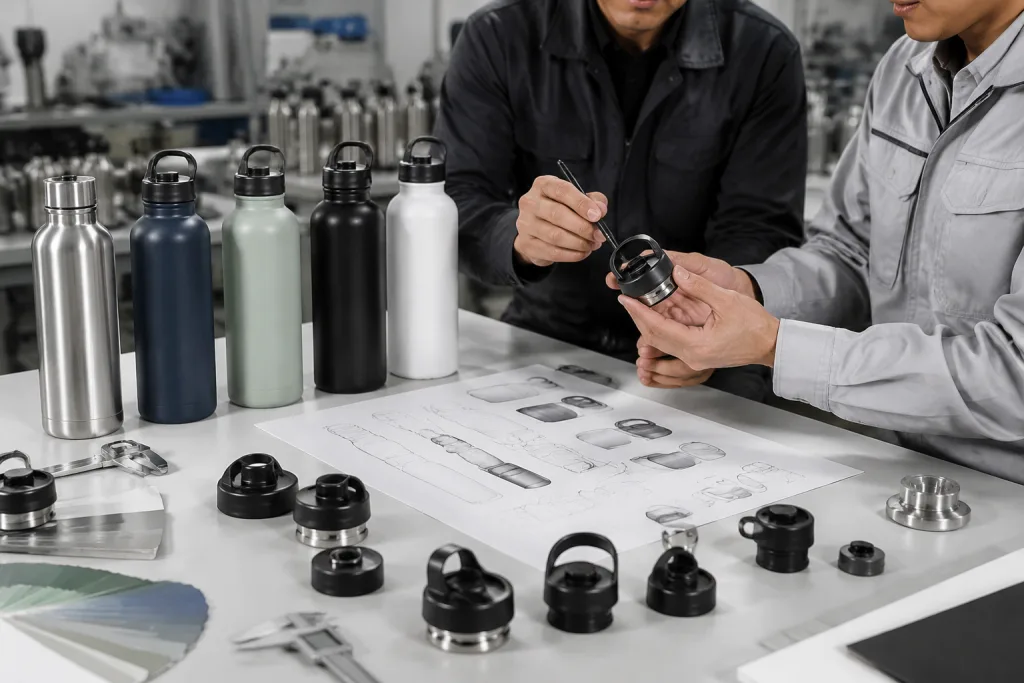
If you ship custom drinkware into Europe or North America, write the artwork tolerance, PMS target, and print shift limit into the PO. We run this on the line because a 2 mm logo drift can turn into a buyer complaint fast, and it keeps the canteen supplier accountable.
Retail, corporate, or outdoor
Use channel logic before price logic. A slightly higher FOB on the right bottle is cheaper than dead inventory in the wrong channel.

What to ask before PO
One more point: if you need repeat orders, ask whether the factory keeps your tooling and color master on file for at least 12 months. That saves time when the next PO lands.
How to price the quote
Ask for a quote structure that separates the bottle, lid, decoration, and packaging. If the supplier refuses, they are hiding cost or complexity somewhere in the build.
Send your bottle brief for a fast quote
We can review steel grade, lid, decoration, and packaging before sampling, so your custom canteen order is built for your channel.
Frequently asked questions
What MOQ should I expect for a 316 double wall bottle?
For most export programs, a realistic MOQ is 3,000 pcs per color or per spec. Some canteen manufacturers in China will quote 1,000 pcs, but the unit price usually rises by 15% to 30% because setup and packing costs are spread over fewer units. If you need multiple lids or finishes, each variant may need its own MOQ. For a distributor canteen program, ask whether mixed-color cartons are allowed; that can reduce inventory pressure but may add 3 to 5 days to pack-out.
Is 316 really worth it over 304?
Yes, if your product faces acidic drinks, salt exposure, or premium positioning. 316 has better corrosion resistance because of its alloy mix, so it is more forgiving for coffee, citrus water, and coastal distribution. The usual factory cost difference is about USD 0.25 to 0.70 per unit, sometimes more depending on steel pricing. For plain water and very tight budgets, 304 can be acceptable. For a customized drinkware line where returns are expensive, 316 is usually the smarter spec.
How long is production lead time?
For a normal sample-approved order, expect 25 to 35 days in a well-run China factory. If the order needs new tooling, special coating, or a complicated print program, plan for 40 to 50 days. Add shipping time separately. A Zhejiang canteen factory with stable capacity may produce 120,000 units per month, but that does not mean every SKU can ship immediately. The best practice is to lock sample approval early and confirm pack-out details before the PO.
What tests should I request before shipment?
At minimum, ask for leak testing, vacuum retention testing, and coating adhesion checks. For export, many buyers also ask for food-contact compliance documents such as REACH-related declarations and, where relevant, LFGB-style support. AQL 2.5 for critical defects is common, but premium orders may need tighter leak and appearance limits. If you sell through Amazon or other marketplaces, confirm barcode or FNSKU placement before packing starts. That reduces relabeling costs and delays.
Can I use the same bottle for retail and corporate gifting?
You can, but you should not use the exact same spec without adjusting finish and pack-out. Retail needs stronger shelf appeal, while corporate gifting needs lower damage risk and a clear logo area. A matte powder-coated customized canteen with laser engraving works well in both channels if you keep the shape clean and the lid reliable. For corporate orders, one-color artwork and efficient packaging usually matter more than maximum insulation time. For retail, the visual finish and carton presentation carry more weight.