Key Takeaways
- 316 stainless usually adds 8% to 20% over 304 in bottle cost, but it makes more sense for acidic, salty, or premium custom drinkware programs.
- A true double wall vacuum bottle is usually 0.4 mm to 0.5 mm inner/outer shell steel with a vacuum gap; anything thinner needs closer QC.
- For a standard canteen custom order, MOQ often starts at 1,000 pcs and lead time runs 25 to 35 days after sample approval.
- Laser engraving, silk screen, and full-wrap print do different jobs; choose decoration based on abrasion, not just appearance.
If you are buying a 316 stainless steel double wall bottle custom, the real question is not whether it is stainless. The real question is whether the bottle holds up in your buyer’s use case without return requests, weak insulation claims, or logo placement that looks off-center on the line. A 316 liner does better with salty liquids, acidic drinks, and harder daily use, but the cost jumps fast, so you need to know when that upgrade pays back.
In Zhejiang and across China, most sourcing mistakes come from comparing finish samples instead of checking specs. We’ve seen the same 500 ml bottle quoted at USD 2.80 and USD 5.40, depending on steel grade, wall thickness, lid structure, and print method. If you are a brand owner, distributor canteen buyer, or canteen supplier, this is the wrong question to ask: the math only works when you match the spec to the market before you lock a 1,000-unit MOQ and wait 25 to 35 days for production.
316 vs 304: where it matters
I’ll keep the HTML structure intact and rewrite the prose to sound like a real factory sales engineer, with tighter language and a few concrete details.For a 316 stainless steel double wall bottle custom run, the first comparison is against 304, because that is the decision point on most buyer calls. 316 adds molybdenum, which gives better resistance against chlorides and harsh liquids. On the line, we see the gap fast: sports drinks, citrus water, electrolyte mixes, and seaside use all punish weak steel. If the bottle is office water only, 304 usually does the job at a lower price.
Here is the trade-off you should actually weigh:
- 304: lower cost, easier sourcing, fits general promotional drinkware.
- 316: stronger corrosion resistance, a better fit for premium custom bottles and acidic fills.
- Cost delta: usually 8% to 20%, depending on steel market moves and whether the lid is a simple PP cap or a more complex vacuum lid.
- Buyer risk: if you upgrade the shell to 316 but keep a weak seal, QC pulled the sample and the bottle still failed. The steel alone does not carry the whole product.
A solid canteen factory in Zhejiang will tell you straight if 316 is needed. We’ve seen this go sideways when a weak vendor pushes 316 on every order because the quote looks premium. Ask for the steel grade on the material certificate, not just the sales sheet. One PO typo can say “316” while the mill cert shows 304, and the buyer flags it immediately. For a distributor program in Europe or North America, keep the message simple: 316 is not a slogan, it is a spec choice.
Spec table that actually helps
I’ll rewrite the prose in place, keep the HTML structure and numbers intact, and make it sound like a factory-side sales engineer wrote it.Use a spec table, not sample photos, when you compare suppliers. Photos hide too much. A real factory can tell you the shell gauge, vacuum test result, and what happened on the line when QC pulled the sample.
Head-to-head spec table
| Spec | Good custom bottle | Low-risk for premium programs |
|---|---|---|
| Steel grade | 304 inner/outer | 316 inner, 304 outer or full 316 |
| Wall thickness | 0.35-0.4 mm | 0.4-0.5 mm |
| Vacuum retention | 6-8 hours hot, 12 hours cold | 8-12 hours hot, 18-24 hours cold |
| Finish | Powder coat or matte spray | Durable powder coat, UV print, or laser logo |
| Lid seal | Standard silicone ring | Food-grade silicone, replaceable seal |
| MOQ | 500-1,000 pcs | 1,000-3,000 pcs |
| Lead time | 20-30 days | 25-35 days |
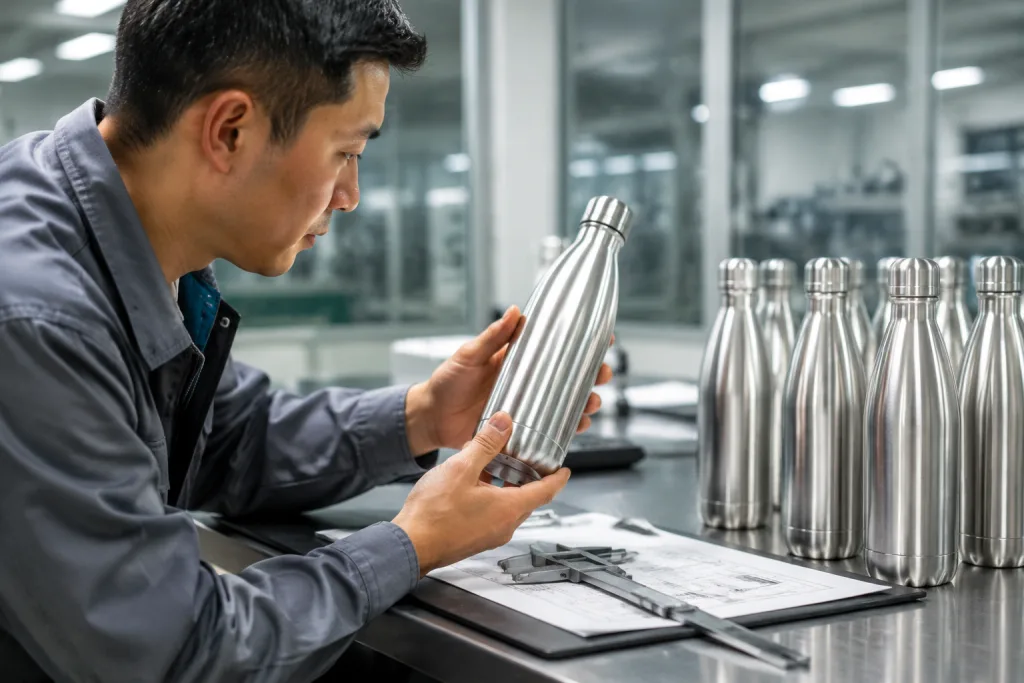
The table matters because it forces your canteen manufacturers to answer in numbers. If a factory says “high quality” but cannot state shell thickness, vacuum test method, or AQL level, the math does not work. We’ve seen this go sideways when a buyer flagged a PO typo on the lid spec and the carton label followed the wrong version. For custom drinkware, I’d take a 0.45 mm shell with a clean vacuum record over a shiny surface with no test sheet.
Use case decides the build
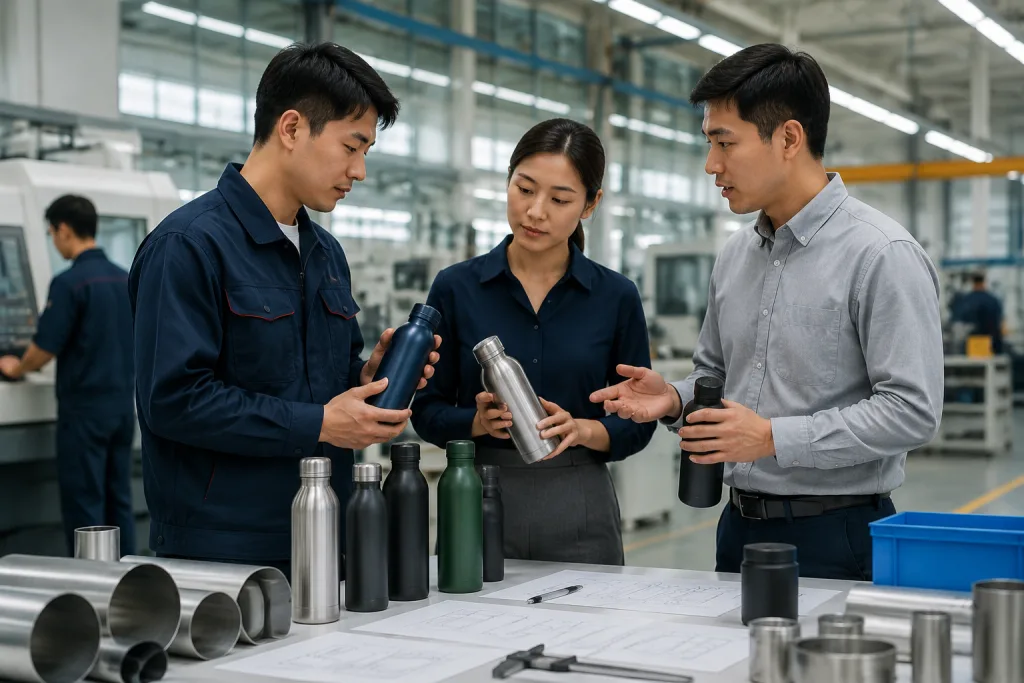
I’ll rewrite the HTML in place, keep the tag structure, and tune the copy to sound like a factory-side sales engineer.Don’t let the spec lead the sale; let the buyer’s channel set the spec. A custom canteen for outdoor retail, a customizable canteen for corporate gifting, and a customized growler for craft beer do not run on the same build. We’ve seen that go sideways on a PO with a typo in the lid code, and head-to-head comparison is where the fix shows up.
Travel and office gifting
If the bottle lives in an office, a car cup holder, or a conference kit, shape, logo clarity, and leak resistance come first. A 500 ml bottle with a 6.8 cm to 7.2 cm diameter usually fits daily carry better. QC pulled the sample through 30 open-close cycles on the lid, and that is the real test for a canteen promotional order, whether you choose 304 or 316 based on the brand.
Outdoor, sports, and travel retail
For camping, hiking, and commuter retail, the bottle needs impact resistance and steady insulation. A double wall vacuum bottle with a powder-coated finish and laser logo usually survives abrasion better than a printed finish. If a buyer puts a custom growler next to a standard bottle, the growler wins on volume, but the bottle wins on 280 g carry weight and shelf appeal.
Premium food and beverage channels
For beverage brands, specialty food stores, and premium distributor drinkware programs, 316 is easier to defend because acidic content and repeat washing are common. On this line, we run spare lids, carton labeling, and barcode checks before packing. A customized canteen or customized drinkware order makes money only when the use case is clear; otherwise the math does not work.
Branding methods change the margin
I’ll rewrite the section in-place, keep the HTML structure, and tighten the sales-engineer tone with concrete factory details and fewer AI-style phrases.Your decoration choice moves unit price, MOQ, and scrap risk more than most buyers expect. On a Zhejiang line, we see buyers pick the wrong branding method because they judge from a product photo. That is the wrong question to ask.
- Silkscreen: best for a simple one-color logo, and usually the lowest-cost route for 1,000 pcs or more.
- Laser engraving: best for wear resistance, especially on brushed or matte steel; QC can spot a clean burn line at 30x magnification.
- UV print: works for color graphics, but it needs abrasion checks, or the first courier scuff will show up fast.
- Heat transfer or wrap print: fits promotional canteen custom runs, though it is a poor match for heavy dishwasher use.
If you sell into retail or e-commerce, ask one direct question: does the logo survive 200 dishwasher cycles, or at least repeated hand washing with detergent? If the answer is no, the decoration is only cheap on day one. We have seen this go sideways when a buyer approved a PO with a logo size typo—18 mm on the artwork, 28 mm on the bottle—and the whole batch needed rework. A canteen factory in China should still give you sample lead times of 7 to 10 days and a pre-production sign-off before mass run. For brand owners, laser engraving on a powder-coated body is often the safer pick because the mark stays readable after use, and that is what the end customer remembers.
Factory checks before you order
I’ll rewrite the section in place, keep the HTML exactly as-is, and make the prose sound like a factory-side sales engineer wrote it.Buying from a canteen factory in China is not hard. Buying well is hard. The gap shows up in the questions you ask before PO. A real plant in Zhejiang answers in numbers, not brochure talk.
Check these points before you confirm a 316 stainless steel double wall bottle custom order:
- Monthly capacity: 200,000 to 500,000 units/month if you need steady replenishment, not a one-off ship-out.
- MOQ by decoration: 500 pcs for blank, 1,000 pcs for logo, 3,000 pcs for full-color print is the usual setup.
- Test standard: vacuum leak test, drop test, and coating adhesion test should all have records from the line.
- Compliance: REACH for EU, food contact documents, and FDA-aligned material declarations if your buyer asks for them.
- Sampling: pre-production sample and golden sample must match on logo, lid color, and finish, or QC pulls it back.
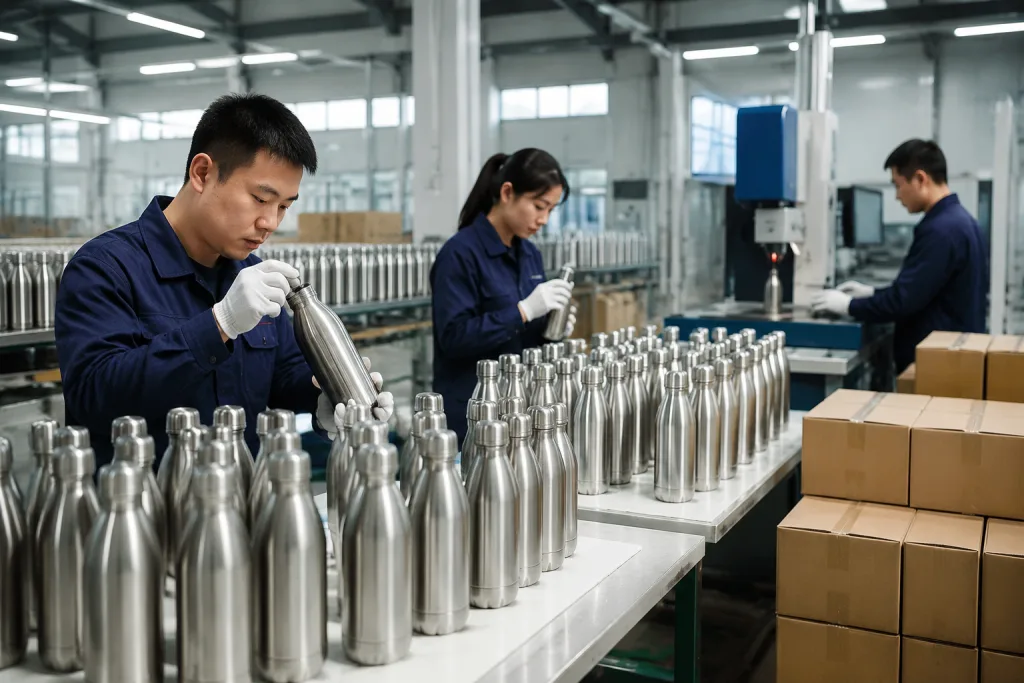
A weak canteen supplier will tell you to place the order first and sort details later. That is the wrong question to ask. We’ve seen that go sideways on a 3,000 pcs PO because the carton mark had one typo and the buyer flagged it after packing. A solid factory gives you dielines, carton sizes, and the inspection plan before production starts. If you sell on Amazon or to big-box accounts, ask for carton pack counts and FNSKU labeling before you pay deposit. The good shops usually run a clear flow from raw tube forming to final packing, and that beats a trading-only vendor every time.
Price ranges and buying logic
I’ll rewrite the section in-place, keep the HTML exactly as-is, and tighten the buying logic with more concrete factory-floor detail and cleaner sales language.Buyers ask for the price first. Fine. But price without spec is noise. For a standard 500 ml custom drinkware order, a plain 304 double wall bottle from a Chinese factory usually lands around USD 2.20 to USD 3.20 FOB, depending on lid, coating, and whether we run a basic PP cap or a stainless lid. Step up to 316 and the range often moves to USD 2.80 to USD 4.50 before custom carton work. Add a 4-color print, gift box, or a premium lid, and USD 5.50 is normal. QC pulled a sample last week with a 0.8 mm wall variance, and that one line item changed the quote. That is the part buyers miss.
The right question is not “what is cheapest?” It is “what gives the lowest landed cost for this channel?” A canteen supplier may throw a low unit price at you, then ask for a 3,000-piece MOQ. On paper it looks good. In the real math, it can cost more than a slightly higher quote with a 1,000-piece MOQ and a 12-day faster lead time. We’ve seen that go sideways more than once. If you are a canteen distributor or a distributor canteen buyer, inventory risk matters as much as factory price. In North America and Europe, slow-moving styles tie up cash fast.
The smarter move is to keep one premium 316 line for margin and one standard line for volume. That gives your customized drinkware range coverage for retail and corporate orders without forcing every customer into the same spec. A buyer once flagged a PO typo on “316L” versus “316,” and that one extra letter changed the whole approval chain. Small detail, big headache.
Send your spec, get a real quotation
Share capacity, steel grade, logo method, and target market. We’ll quote your custom drinkware line with MOQ, lead time, and FOB pricing from Zhejiang.
Frequently asked questions
Is 316 worth it for custom drinkware orders?
Yes, if the bottle will hold acidic drinks, electrolyte mixes, or see heavy washing. 316 usually adds 8% to 20% to the cost, but it gives you better corrosion resistance than 304. For plain water bottles or low-cost canteen promotional runs, 304 is usually enough. If your brand sells into premium outdoor, food, or seaside markets, 316 is easier to defend. For most buyers, the right move is to reserve 316 for higher-margin SKUs and keep a 304 line for volume.
What MOQ should I expect from a canteen manufacturer in China?
For a typical custom canteen or double wall bottle, MOQ is often 500 pcs for blank stock, 1,000 pcs for one-color logo, and 3,000 pcs for complex print or special lids. A serious canteen factory in Zhejiang may offer trial runs lower than that, but the unit price usually rises. If your project needs multiple colors or mixed lids, ask for separate MOQ by variant. That keeps your forecast realistic and avoids dead inventory.
How long does production usually take?
For a standard 316 stainless steel double wall bottle custom order, sample time is usually 7 to 10 days and mass production is 25 to 35 days after sample approval and deposit. If the order includes a new mold, special cap, or gift box, add 10 to 15 days. Freight time is separate: ocean freight to Europe or North America is usually 18 to 35 days depending on port and routing. Plan your launch calendar around those numbers, not around the sales pitch.
What tests should I ask for before shipment?
Ask for vacuum retention, leak test, drop test, coating adhesion, and lid-cycle testing. For export to Europe or North America, also request REACH-related material documentation and food contact declarations. Good canteen manufacturers in China should inspect to AQL, usually AQL 2.5 for major defects and AQL 4.0 for minor defects, unless your contract says otherwise. If the factory cannot explain its inspection plan, it is not ready for a branded program.
Can I use one bottle for both retail and promotional channels?
Yes, but only if the spec is controlled. A 500 ml powder-coated bottle with laser logo can work for both retail and promotional drinkware if the lid, box, and label are flexible. The problem is usually branding, not structure. Retail buyers want better carton presentation and barcode control, while promotional buyers want lower cost and fast turnaround. A canteen vendor that supports both can usually build one core body and swap lids or packaging to fit each channel.