Key Takeaways
- 316 stainless steel bottles usually add USD 0.25-0.80 per unit over 304, depending on finish and lid
- MOQ for custom wholesale drinkware typically starts at 1,000-3,000 pcs, with sample lead time of 7-10 days
- Standard production lead time is 20-35 days after deposit and artwork approval
- Landed cost shifts most from lid type, surface finish, print method, and carton spec, not the bottle body alone
If you are buying a 316 stainless steel bpa free water bottle wholesale program, the real question is not “is 316 better?” The real question is landed cost, Zhejiang ship time, and where the price jumps once you add a lid, logo, or test report. We see buyers miss that every week. On the line, a 0.5 mm wall, a laser logo, and an LFGB report do not sit in the same cost bucket.
For procurement managers and brand owners, the clean way to source is to split the order into cost drivers and lead-time blocks. That is how you compare a bulk canteen order with a bulk drinkware launch, or a canteen wholesale program with a seasonal retail run. BottleForge in Hangzhou runs 180,000 units per month, and our MOQ starts at 3,000 pieces for standard SKUs; QC pulled the sample at AQL 2.5 before we booked cartons. The math does not work any other way.
What 316 really changes
I’ll rewrite the section in-place, keep the HTML exactly as-is, and make the prose sound like a factory-side sales engineer wrote it.316 stainless steel is not a label you buy on faith; it changes the alloy mix, the corrosion resistance, and where the bottle can go without the buyer flagging returns. If you are sourcing for sports hydration, marine retail, or premium corporate gifting, 316 holds up better against salt, acidic drinks, and repeated wash cycles. That is the point when your customer wants a best wholesale drink bottle, not a cheap shell with a shiny spec sheet.
The cost gap stays modest on paper and shows up fast in the margin sheet. For a 500 ml insulated bottle, 304 may land at FOB USD 3.20-4.10 at 1,000 pcs, while a comparable 316 version often sits at USD 3.45-4.90 depending on vacuum wall thickness, powder coating, and lid structure. On the line, we have seen a buyer push back on a 0.5 mm inner wall because the math did not work once the logo, cap, and carton were added. If the bottle is single-wall, the delta can be smaller; if you specify a 0.5 mm inner wall, 18/10 inner liner, and laser logo, the premium climbs fast. Buyers who compare only shell cost miss the real number: 316 cuts claim risk when the product goes into cold-chain, coastal, or premium beverage channels.
If your customer sees “316” on the spec sheet, they expect better durability. If you cannot prove it with mill certs and test reports, the label turns into a liability.
Ask for material traceability, not just a sales promise. A serious factory in Zhejiang should show stainless coil source records, REACH declaration, and food-contact test support; QC pulled the sample, checked the coil mark, and matched it against the cert before release. For Europe and North America, that is basic hygiene, not an upsell.
Where the price really moves
I’ll rewrite the section in place, keep the HTML structure intact, and make the pricing drivers sound like a factory-side sales engineer wrote them.The bottle body is only one line item. The costly misses sit in the parts buyers call small: lid build, coating line, logo method, and carton spec. A plain screw cap with PP insert sits in one cost tier. A push-button lid with silicone gasket, lock, and stainless trim lands in another. On a 1,000-piece order, that lid gap can move unit price by USD 0.40-1.20. We run this comparison every week, and the buyer usually flags the lid first.
Surface finish shifts the quote too. Brushed stainless costs less than powder coating. Soft-touch paint or UV print adds cost and usually needs 1-2 extra production days for curing on the line. A single-color silkscreen logo is still the cheapest branding route, while laser engraving adds a small premium and holds up better against scuffing. If you want to compare silkscreen vs laser engraving, look at rejection rate over a 12-month retail cycle, not just print cost. That is the wrong question to ask if you only want the lowest quote.
- Bottle body: 316 alloy premium, wall thickness, and polishing standard
- Lid: PP, Tritan, stainless trim, silicone gasket, leak-proof mechanism
- Decoration: silkscreen, laser, UV print, powder coat, water transfer
- Packing: white box, kraft box, mailer box, FNSKU sticker, carton test
- Compliance: LFGB, FDA, REACH, food-contact migration, carton labeling
For a 12 oz to 24 oz range, the same bottle can quote at USD 2.60 FOB or USD 5.80 FOB depending on those choices. We saw a PO typo once where the buyer wrote 24oz but wanted 12oz cartons, and QC pulled the sample before packing started. That is why the procurement sheet should split bottle, cap, decoration, and packaging instead of hiding everything in one line. If you are planning MOQ planning, this split keeps the math clean.
MOQ tiers that make sense
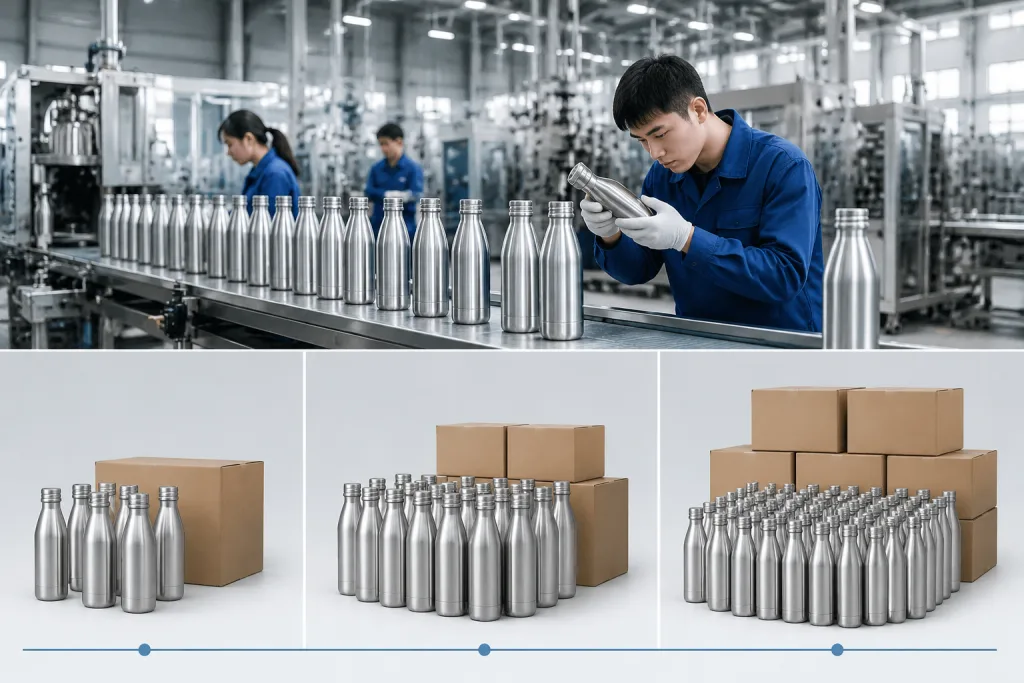
I’ll rewrite this section in-place, keep the HTML exactly as-is, and tune the prose to sound like a factory-side sales engineer.Most factory quotes look fine until the MOQ shows up. Then the math gets real. For wholesale drinkware, the working tiers are usually 500 pcs, 1,000 pcs, 3,000 pcs, and 5,000 pcs per SKU. Under 500 pcs, setup eats the margin. At 1,000 pcs, the line starts to run clean. At 3,000 pcs, color matching and lid swaps get easier. At 5,000 pcs, we can talk packaging and freight with some leverage.
For a custom 500 ml 316 stainless bottle, a normal Zhejiang export quote looks like this: 500 pcs at FOB USD 4.20-5.30, 1,000 pcs at USD 3.55-4.60, and 3,000 pcs at USD 3.10-4.05. On one job, QC pulled the sample at 18.2 oz instead of 500 ml, and the buyer flagged it before booking. If you need a custom mold for a non-standard lid or handle, add USD 1,500-4,000 tooling and 12-20 days. So a canteen wholesale buyer should say up front whether they want stock body plus logo, or true private mold work.
For adjacent categories, the MOQ shifts a bit, not a lot. A bulk canteen order for outdoor channels often works at 1,000 pcs with mixed colors, while a bulk growler or beer growler bulk order usually needs 2,000-3,000 pcs because the lid and carton cost more. If you are buying alcohol flask wholesale or alcohol flask wholesale bulk, the MOQ can drop for plain stainless flasks, but finish consistency and compliance checks get tighter. We’ve seen this go sideways when the PO says “matte black” and the sample sign-off says “dark gray.” A good exporter lays out the tiers plainly; a weak one blurs them to win the order.
Lead time without the guesswork
I’ll keep the HTML intact and rewrite the prose to sound like a factory-side sales engineer, with concrete timing, one floor detail per paragraph, and no AI filler.Lead time should be split into sample, pre-production, production, and shipping. That is how we quote a China factory against a retail launch date. For stock lids and standard cups, sample lead time runs 7-10 days. If the lid is custom or the logo needs Pantone matching, QC pulled the sample back and we need 10-15 days. Once the buyer signs off and the deposit lands, 1,000-3,000 pcs usually take 20-35 days in Zhejiang.
Here is the timeline we run on a custom order: 2-4 days for quotation and mockup, 7-10 days for samples, 2-3 days for sample approval, 20-35 days for bulk production, 5-10 days for inland transport and export packing, then 18-35 days ocean freight to Europe or North America depending on port and routing. We ship faster by air in 5-9 days, but on larger bottles the freight bill can beat the product cost. The math does not work unless the margin is there.
Most delays start in three places: artwork changes after approval, missing compliance papers, and carton label corrections. If your order needs FNSKU, retail barcodes, or multilingual carton marks, send the final file before the line starts. We once had a PO typo on the carton mark, and that added 3 days while the printer reran the labels. For a buyer managing Amazon FBA drinkware, that is usually more expensive than a small unit-price gap.
Fast lead time is not magic. It is frozen artwork, an approved sample, stocked caps, and one clean production schedule.
Compliance buyers should verify
I’ll keep the HTML exactly as-is and rewrite only the prose, with sharper buyer language and a few factory-floor details.For Europe and North America, do not accept a vague “food grade” claim. Ask for compliance papers matched to the exact SKU. On the files we ship, the usual set is LFGB or FDA food-contact support, a REACH declaration for restricted substances, and a material spec that calls out 316 stainless steel for the inner liner or the full body, depending on the build. If the bottle has a painted exterior, ask for coating migration data and abrasion results too. We’ve seen the buyer flag a 0.12 mm coating mismatch and it turned into a hold at customs.
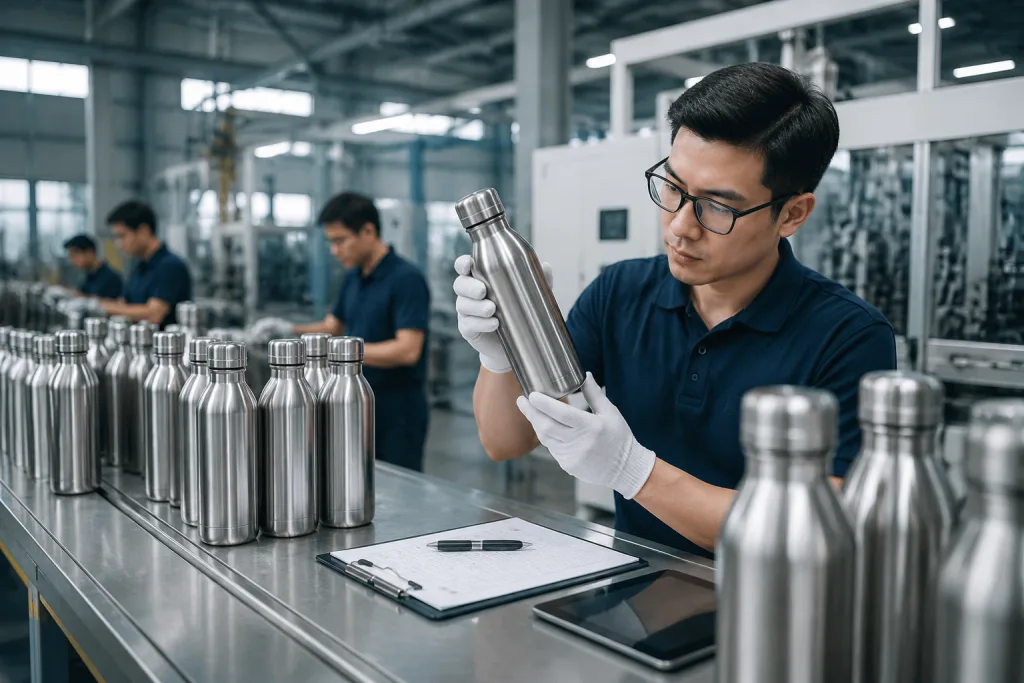
QC should run on AQL, not on eyeballing cartons. For wholesale drinkware, AQL 2.5 for major defects and 4.0 for minor defects is standard on export orders. Leak testing, thermal retention testing, and drop tests need to be set before the line starts. Ask for the numbers: 100% leak test on vacuum lids, 10,000 open-close cycles if the lid is a premium part, and carton compression specs if the shipment goes on pallets. The math does not work if you leave that open.
If you are buying wholesale canteen or wholesale drinkware for a retail chain, ask for lot traceability and batch coding. We run batch marks at the laser station, and that saves time when a buyer asks for one carton out of a 3,000-piece lot. If you are sourcing beer tumbler wholesale or beer tumbler wholesale bulk, the compliance load is lighter than for insulated food-contact bottles, but finish consistency still has to pass. For premium beverage gifts, a rough surface or uneven gloss makes the product look off, even when the stainless spec is right.
How to judge a real factory quote
I’ll rewrite the section in-place, keeping the HTML tags and structure intact while tightening the sales-engineer tone and removing the AI-style phrasing.A real factory quote breaks out product, packaging, testing, and shipping terms. If you only get one number, that is not a sourcing quote; it is a sales teaser. For a Zhejiang supplier, ask whether the price is FOB Ningbo or FOB Shanghai, whether tooling is included, whether the lid is stock or custom, and whether cartons meet export standard. That gap decides whether you have a workable offer or a headache order.
Ask how many units the factory can actually run in a month. BottleForge’s output is 180,000 units/month, enough for repeat replenishment and mixed-SKU programs. A smaller shop may quote lower on paper and still miss your holiday window because it only has one vacuum line or one coating booth. For drinkware bulk programs, capacity is part of the price. If the factory cannot explain line balance, QC flow, or raw material buffer, we know they are not ready for a brand program.
Use the same filter for adjacent products. A growler wholesale program, growler bulk order, or wholesale growler launch usually needs heavier cartons and a stricter drop test. A beer growler wholesale or beer growler wholesale bulk inquiry should cover cap seal performance and odor control too. If you are planning alcohol flask bulk or alcohol flask in bulk, the finish looks simple, but cosmetic reject rates climb fast when the polishing standard is not locked before the line starts.
You want a supplier who quotes like an engineer, not a catalog. We’ve seen this go sideways when a buyer accepted a clean price and missed the packing detail on the PO.
Request a real factory quote today
Send your target size, logo file, and carton spec. We will quote FOB China, confirm MOQ, and give you a production schedule you can actually use.
Frequently asked questions
What is a fair FOB price for a 316 stainless steel BPA free bottle?
For a 500 ml custom bottle at 1,000 pcs, a fair FOB China range is usually USD 3.55-4.60 depending on lid type, finish, and logo method. A simple stock cap with silkscreen is cheaper; a premium leak-proof lid and powder coat pushes it up. At 3,000 pcs, you may see USD 3.10-4.05. If the supplier quotes far below that, check whether the steel is actually 316, whether testing is included, and whether packaging is export grade.
What MOQ should I expect for custom wholesale drinkware?
For most custom wholesale drinkware programs, expect 1,000 pcs as the practical starting point, with 3,000 pcs giving better pricing and color flexibility. Simple stock-body orders can sometimes start at 500 pcs, but the setup cost is spread over fewer units, so the unit price rises fast. For custom lids or molds, tooling may add USD 1,500-4,000. A real supplier should state MOQ by color, logo method, and packaging, not just by bottle shape.
How long does production take in Zhejiang?
For a standard custom order in Zhejiang, production usually takes 20-35 days after deposit and final artwork approval. Samples take 7-10 days if stock components are used, or 10-15 days if the lid or finish is custom. Ocean freight to Europe or North America adds roughly 18-35 days depending on route, while air freight can move goods in 5-9 days. If a factory promises a full custom run in 10 days, you should ask what step they are skipping.
Do I need REACH and FDA documents for stainless bottles?
If you sell into Europe or North America, yes, you should request supporting compliance documents. For a 316 stainless steel bottle, ask for REACH declarations, FDA food-contact support, and if possible LFGB test data. If the exterior is painted or powder coated, ask for coating migration and abrasion evidence too. The documents should match the exact SKU, because a lid change or coating change can invalidate the earlier report. Good exporters in China know this and prepare accordingly.
Can I mix canteen, growler, and flask items in one order?
Yes, but only if you structure the order around shared components and the same production window. A bulk canteen, growler wholesale, and alcohol flask wholesale bulk program can share packaging logic or printing setup, but the lids, necks, and compliance requirements are different. Mixing SKUs can help you reach a better factory slot, yet it can also create bottlenecks if the line needs multiple cap assemblies. Ask the supplier to confirm whether each SKU is stocked, semi-custom, or fully custom before you commit.