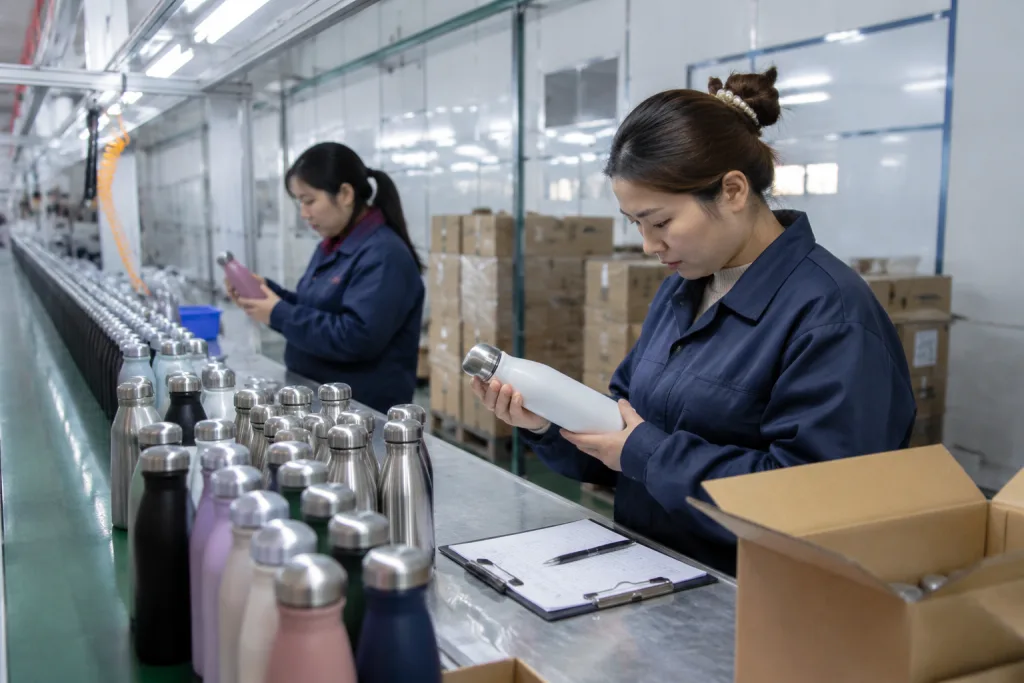
Key Takeaways
- For 316 inner stainless steel bottles, plan around 3,000 pcs MOQ per color for stable factory pricing
- Ask for LFGB, REACH, FDA food-contact, and BPA test coverage for every plastic and silicone contact part
- Normal custom logo lead time is 25-35 days after sample approval, not after inquiry date
- Use AQL 2.5 for major defects and verify vacuum retention, coating adhesion, and carton drop strength
If you are looking for a 316 stainless steel bpa free water bottle supplier, you are not pricing one bottle. You are checking risk: material traceability, lid and straw contact parts, print wear, carton crush strength, 12-day vs 18-day lead time, and whether the same finish comes off the line on the second order.
We make custom drinkware in Hangzhou, Zhejiang, and we see this every week. The buyer flags “food grade steel” on the spec sheet, then asks for the 316 mill cert, lid material data, AQL 2.5 checks, and a PO that matches the actual MOQ; vague claims do not pass with European or North American programs. QC pulled the sample, and the math does not work until the factory can show test reports, inspection points, and a price built on the real packing count.
What 316 actually changes
316 stainless steel does not turn a bottle into lab equipment. It changes corrosion margin. The molybdenum content is the reason buyers ask for it, especially when the bottle sees salt tablets, lemon water, electrolyte powder, or hard tap water above 250 ppm. We had one marine buyer in Busan flag rust spots on a 304 sample after a 48-hour salt-spray check, and the same shape in 316 passed their internal review. For outdoor, marine, wellness, or premium retail channels, 316 is an upgrade you can defend on a spec sheet. For a low-price canteen promotional item handed out during a one-week campaign, 304 is usually the better buy. The math does not work for 316 there.
For insulated bottles, we run 316 on the inner wall and 304 on the outer wall for most B2B orders. Good build. The liquid touches 316, and the outer shell still forms cleanly without pushing cost too far. A common specification is 0.4 mm inner wall and 0.5 mm outer wall before forming, though our drawing room still checks each shape with a digital thickness gauge after stretching because a tall 750 ml body thins differently from a short 500 ml body. For single-wall canteen customized products, 316 throughout is possible. Expect the quote to jump because the whole body uses the higher-cost steel, not just the liner.
Do not accept “316 grade” as one loose line in a quotation. Ask the canteen manufacturer for a material declaration and, for larger orders, a third-party composition test such as SGS, TÜV, Intertek, or Bureau Veritas. A proper canteen factory in China should keep coil purchase records by batch, including heat number and incoming weight; QC pulled one sample last quarter where the supplier typed “SUS316” on the PO but the coil tag read 304, and that is exactly how claims start. At BottleForge Industrial in Zhejiang, our standard monthly capacity is about 450,000 stainless units across bottles, tumblers, growlers, and custom canteen projects, so material traceability is handled by production lot, not by memory.
Practical buying rule: use 316 where liquid contact matters, but do not pay for 316 outer walls unless your brand story or use case needs it.
Questions to ask before quoting
I’ll keep the HTML structure intact and rewrite the prose to sound like a factory sales engineer, with sharper buyer questions, concrete production details, and no AI-flavored filler.A real quotation starts with the bottle job, not a catalog shot. Before you ask any 316 stainless steel bpa free water bottle supplier for FOB pricing, send the details that move tooling, scrap rate, print loss, and carton space. If you only write “500 ml 316 BPA free bottle with logo,” the first number you get will change after the line checks the drawing.
Open with capacity, insulation, lid design, finish, logo method, packaging, and the target market. A 750 ml double-wall bottle with powder coating, laser logo, straw lid, individual kraft box, and Amazon FBA carton label is a different run from a 1 L single-wall customized canteen with silkscreen logo for an event distributor. QC pulled the sample twice on the vacuum gauge. One job needs vacuum testing and lid assembly checks; the other cares more about coating adhesion and print rub resistance than heat retention.
- Capacity: 350 ml, 500 ml, 750 ml, 1 L, 1.2 L, or a custom growler size such as 1.9 L.
- Construction: single-wall, double-wall vacuum, copper-coated vacuum, or wide-mouth food flask style.
- Contact parts: 316 inner steel, PP or Tritan lid, food-grade silicone gasket, optional stainless straw.
- Branding: laser engraving, silkscreen, heat transfer, UV print, embossing, or full-color wrap.
- Channel: retail, distributor drinkware, corporate gift, outdoor, school, travel, or e-commerce.
For MOQ, say the real number up front. A custom color usually starts at 3,000 pcs per color. Existing colors with a simple logo can sometimes start from 1,000 pcs, but the unit cost and logo setup ratio get ugly fast. We’ve seen buyers push back on a 200 pcs quote, then ask why the outer carton was repacked from stock instead of run on one controlled line. That’s the wrong question to ask if you want stable pricing.
BPA free is not one test
I’ll rewrite the prose in place, keep the HTML unchanged, and tighten it so it sounds like a factory-side sales engineer wrote it.When buyers say “BPA free,” they usually mean the bottle is safe for food contact end to end. That’s close, but not the same thing. 316 stainless steel itself has no BPA. The weak points are the lid, straw parts, silicone gasket, coating system, and sometimes the print ink. A real 316 stainless steel bpa free water bottle supplier should tell you which part was tested, under which standard, and for which report number.
For Europe, ask for LFGB and REACH. For the United States, ask for FDA food-contact compliance and, if the market needs it, California Proposition 65 screening. For children’s bottles, ASTM and CPSIA may apply depending on age grade and the accessory set. If the bottle has a painted shell, check heavy metals in the coating and ink too. QC pulled one sample with clean BPA results and a failed ink check at 0.7 mg/kg. That’s the part the buyer flagged.
The clean way is a component compliance table. List the body, lid shell, gasket, straw, powder coating, printing ink, and packaging ink. Then record the material, test standard, report number, and report date. Reports older than 2 years are not garbage, but for a new mass-production order we push for fresh tests on the exact production parts, especially when the lid is customized. The math does not work any other way.
Some canteen makers run the same lid across three bottle bodies. That can save time if the lid report is current. Change the color masterbatch, add a soft-touch coating, or switch from PP to Tritan, and it becomes a new compliance issue. We’ve seen this go sideways on a PO where “lid type” was written as “same as sample” and the sample was from another model. Good suppliers answer with the exact report. Weak ones send a PDF that looks close and misses the part you are buying.
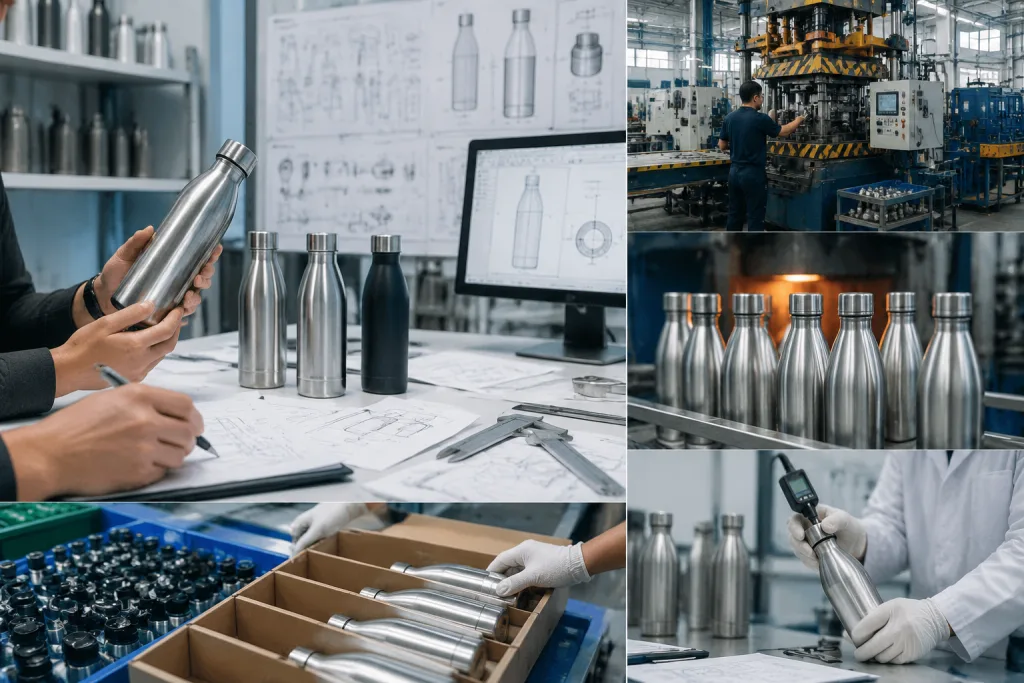
Checklist for factory due diligence
I’ll rewrite the prose only, keep the HTML exactly as-is, and tune it to sound like a factory-side sales engineer. Next I’m checking the wording for the required concrete details and removing the AI-style fillers.Factory due diligence is not about stacking certificates in a folder. The real question is whether the canteen manufacturer can ship the same bottle in week 4 that you signed off in week 1. For B2B buyers in Europe and North America, we check four things first: production capacity, social compliance, QC system, and export history.
- Business fit: Is the supplier a real canteen factory, a trading company, or a hybrid exporter with in-house production under control?
- Audit status: Ask for BSCI, Sedex, ISO 9001, or customer audit records if your retailer asks for them.
- QC process: Confirm incoming material inspection, in-process vacuum testing, coating inspection, and final AQL 2.5 inspection.
- Capacity: Ask for monthly units by category, not total “drinkware capacity.” Bottles, tumblers, and growlers run on different lines.
- Export terms: Confirm FOB Ningbo or FOB Shanghai, payment terms, HS code, carton specs, and the pallet loading method.
If you work with a canteen distributor or a distributor canteen program, ask whether the supplier can keep repeat SKUs alive with spare lids and gaskets that match. A distributor growler or distributor drinkware range needs continuity. We have seen this go sideways when a buyer skipped the lid check and the second order came back with a 0.8 mm mismatch.
At our Hangzhou, Zhejiang plant, a normal stainless bottle order moves through sample confirmation, pre-production sample approval, mass production, inline inspection, final AQL, and loading check. For most custom canteen and customizable drinkware orders, mass production takes 25-35 days after artwork and sample approval. Before Q4, plan 40-50 days if you need 3 colors, custom boxes, or new tooling in China. QC pulled the sample on the line last week for a thread issue, and that kind of catch saves a buyer from a bad PO typo later.
Custom options that affect price
I’ll rewrite the HTML prose only, keep the tag structure intact, and make it read like a factory-side sales engineer wrote it.Customization is where sourcing wins or loses money. We see one PO add a $0.12 logo tweak, then the next one drags in a $12,000 tooling job. A buyer should split surface changes from structure changes before comparing quotes from canteen suppliers.
Visual customization covers logo, coating color, lid color, sleeve, gift box, instruction sheet, barcode, FNSKU label, and master carton marks. On the line, laser engraving is the cleanest option for powder-coated stainless; it holds up after 1,000 rub tests and keeps the mark sharp. Silkscreen costs less for one-color art, but it needs abrasion checks and gets shaky on curved bottles. Heat transfer and UV print handle full-color graphics, but the buyer flagged adhesion issues on textured powder coat after a 24-hour tape test.
Structural customization changes the mold, forming tools, lid mechanism, handle, thread, capacity, or body profile. A customized growler with a new lid and carry handle may need separate tooling for the cap, gasket groove, plastic handle, and body forming. We run tooling from USD 800 for a simple accessory mold to USD 8,000-20,000 for a new lid system or shaped bottle body. If a canteen vendor says tooling is free, the math does not work; the cost is sitting in unit price or hidden behind a high MOQ.
For planning, not a final quote: a 500 ml 316 inner / 304 outer vacuum bottle with powder coating and laser logo may land around USD 4.20-6.80 FOB China at 3,000-5,000 pcs, depending on lid type and packaging. A 1.9 L customizable growler with handle lid and retail box may sit around USD 9.50-16.00 FOB. We’ve seen this go sideways when the buyer added custom color below MOQ and a retail box with a typo on the carton mark; the price moved fast.
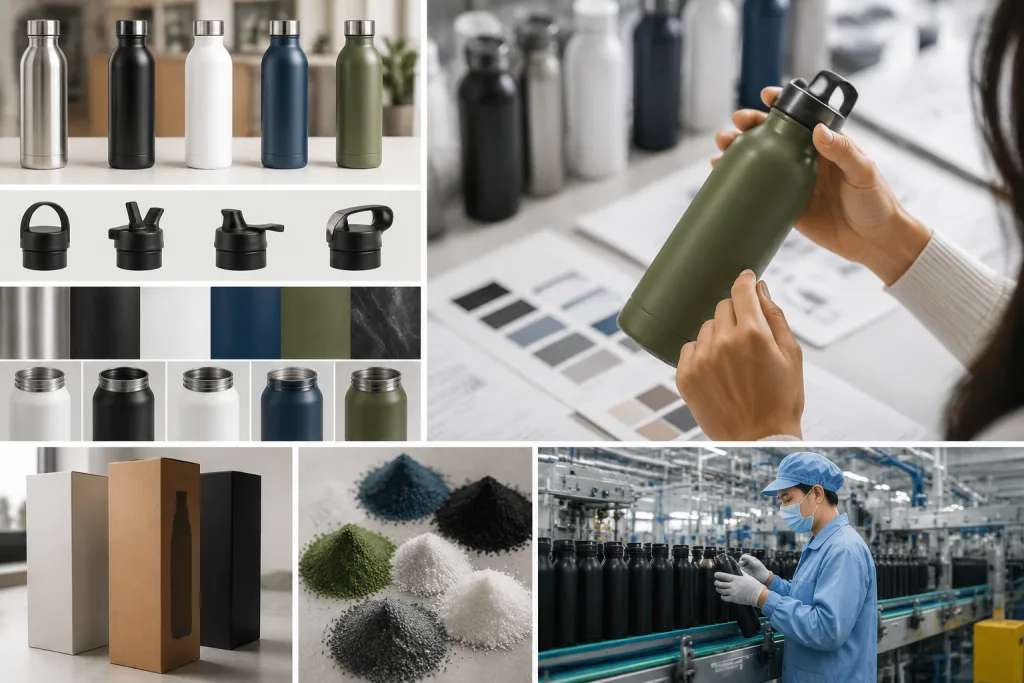
How to inspect the order
I’ll keep the tags and structure intact, then rewrite each paragraph with tighter sales-engineer wording and a few factory-floor specifics.Put the inspection plan into the purchase order before you pay the deposit. Once the line starts, you lose leverage. For a 316 stainless steel bpa free water bottle supplier, spell out material check, leak test, appearance check, print check, packing check, and shipping mark check. We do this on the shop floor with a caliper, a torque tester, and the buyer’s signed sample.
Use AQL as the common language. A normal setup is critical defects 0, major defects AQL 2.5, minor defects AQL 4.0. Critical defects cover sharp edges, leakage, foreign matter inside the bottle, unsafe lid breakage, and the wrong food-contact material. Major defects cover vacuum failure, visible dents, wrong logo position, wrong color, lid mismatch, and coating peel. Minor defects cover small scratches inside the agreed limit, light carton scuffs, or slight print shade shift. The math does not work if the PO says “good quality” and nothing else.
For vacuum bottles, test heat retention by filling with 95°C water, closing the lid, and checking temperature after 6 hours or 12 hours, based on your spec. Run random leak tests, 3M tape adhesion on logo or coating, and cross-hatch coating test where the finish calls for it. Dishwasher claims need real validation, not sales talk. QC pulled a sample last week and the coating started to haze after repeated cycles, so we told the buyer not to print that claim on the carton.
For e-commerce and canteen promotional shipments, packaging is where a lot of orders go sideways. Ask for a carton drop test, usually 1 corner, 3 edges, and 6 faces from the height set by carton weight. If you ship through marketplace fulfillment, confirm FNSKU placement, suffocation warning on polybags if used, carton weight under channel limits, and barcode scan rate. Canteen distributors feel that pain fast when the bottle is fine but the outer box splits on the pallet.
When a supplier is a bad fit
I’ll rewrite the section in place, keep the HTML exactly as-is, and strip the AI-ish phrasing while adding a few factory-floor details and more natural procurement language.Not every canteen supplier is a bad fit because the plant is small. Some small factories in China do solid work on narrow SKUs. The issue is mismatch. If your job needs 316 material, BPA free component files, retail cartons, and repeat color control, you need a factory with process control, not just a low unit price.
Watch for a supplier that will not name the material grade on the proforma invoice, cannot split 304 and 316 in the BOM, or sends a test report for the wrong lid. We saw one buyer flag a PO typo on “316L” because the supplier had copied an old file from a 304 run. Another red flag is instant pricing for every custom option. Real factories need to check lid stock, coating loss, carton size, and the line schedule. If someone answers every quote in 10 minutes, the math usually does not work.
Pay attention to sample and payment behavior. A normal path is quotation, artwork check, sample invoice, sample production in 7-12 days for existing molds, approval, 30% deposit, mass production, inspection, then 70% balance before shipment or against copy documents, depending on the relationship. If a canteen vendor asks for full payment before you see a proper sample, slow down. QC pulled a sample once with a 0.3 mm lid gap; that batch did not ship. We run into this kind of shortcut often, and it goes sideways.
The right partner should handle direct technical questions without dodging. Ask how they control 316 coil batches, how many vacuum failures they accept before rework, what coating thickness they target, and what they do if final inspection misses the mark. A serious canteen factory will answer in production language. A weak one will say “don’t worry.” In procurement, that is not a plan.
Send your 316 bottle specification for a factory quote
Share capacity, lid type, logo, packaging, target market, and annual volume. We will return a practical MOQ, FOB price range, and test plan.
Frequently asked questions
Is 316 stainless steel worth the extra cost for custom drinkware?
It is worth it when the bottle is positioned as premium, used with acidic drinks, or sold into outdoor, marine, wellness, or long-life retail channels. For most vacuum bottles, specifying 316 for the inner wall and 304 for the outer wall is the best cost-performance balance. Compared with 304 inner steel, 316 usually adds noticeable material cost, but not as much as making the full bottle 316. At 3,000 pcs, the finished FOB increase may be around USD 0.25-0.80 per unit depending on capacity, wall thickness, and scrap rate. If your buyer only needs a short-term canteen promotional item, 304 may be commercially smarter.
What MOQ should I expect from a 316 stainless steel bpa free water bottle supplier?
For a standard bottle body with custom logo, expect 1,000-3,000 pcs depending on color and stock availability. For a custom powder-coated color, 3,000 pcs per color is a practical MOQ because coating lines, color changeover, and defect sorting need volume. For a new lid, custom growler body, or canteen customizable mold project, MOQ can move to 5,000-10,000 pcs, plus tooling. If a supplier offers 300 pcs with full custom color, custom box, and low unit price, ask whether it is actual production or stock repainting/repacking. The answer affects color consistency, compliance reports, and reorder stability.
How do I verify BPA free claims on lids and gaskets?
Ask for a test report that names the exact component material, such as PP lid, Tritan straw, or silicone gasket. The report should show BPA testing and food-contact compliance for your target market, not just a generic certificate. For Europe, LFGB and REACH are common requests. For the United States, FDA food-contact and, where relevant, Proposition 65 screening should be discussed. Check the report date, model reference, color, and supplier name. If your customized drinkware order uses a new color masterbatch or soft-touch lid coating, request confirmation that the changed material is covered. For large retail orders, budget for fresh third-party testing before shipment.
Which logo method is best for a customized canteen order?
Laser engraving is usually the safest choice for stainless bottles because it is durable, clean, and does not add ink compliance risk. It works especially well on powder-coated bodies, showing the stainless layer below. Silkscreen is economical for one-color logos and can be good for canteen promotional runs, but it needs rub and tape testing. UV print and heat transfer are better for full-color artwork, gradients, or lifestyle graphics, yet they require stricter adhesion control. For 3,000 pcs, logo setup cost is normally manageable. For 500 pcs, setup and sampling can become a painful percentage of the unit cost.
Can one supplier handle bottles, canteens, and growlers for distributors?
Yes, if the supplier has the right product range and QC structure. A distributor drinkware program often includes sports bottles, custom canteen models, travel tumblers, and customized growler SKUs. The challenge is not only making each item once; it is keeping finishes, logo placement, carton marks, spare lids, and reorder lead times consistent. Ask for monthly capacity by category and current export markets. A capable canteen manufacturer in Zhejiang or elsewhere in China should be able to quote FOB terms, provide component test reports, and support repeat orders within 25-35 days after approval for standard molds.