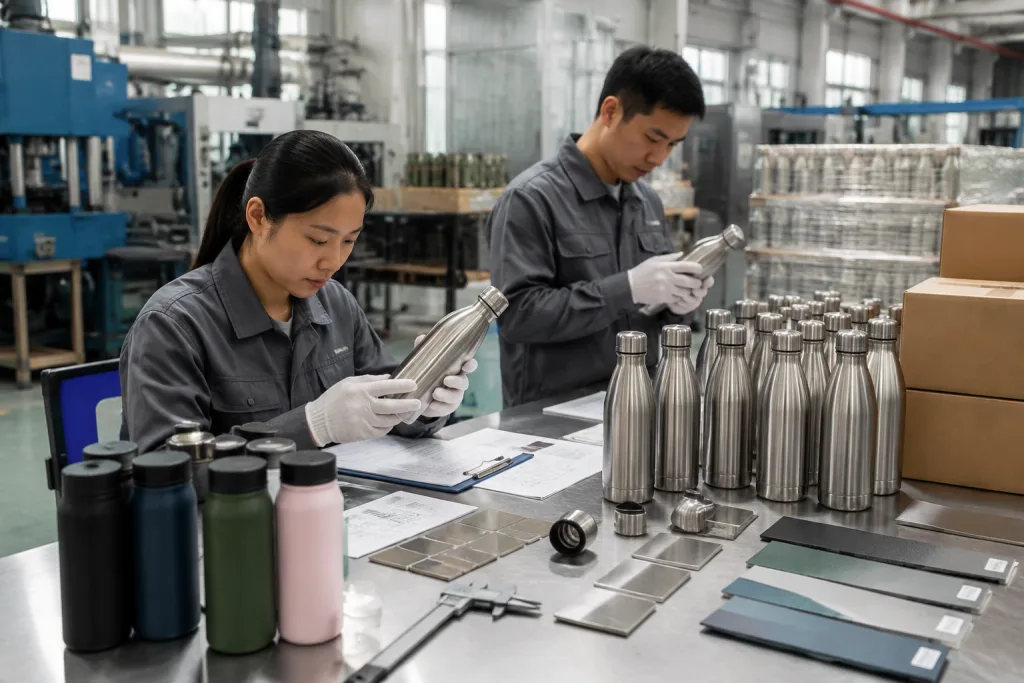
Key Takeaways
- 316 inner stainless steel usually adds USD 0.35-0.90 per bottle versus 304, depending on capacity and gauge
- A practical private label MOQ is 1,000-3,000 pcs per color for powder coating and logo work
- BPA-free claims must cover the lid, straw, gasket, coating contact areas, and packaging declarations
- Normal production lead time from approved sample is 30-45 days, not including sea freight
A 316 stainless steel bpa free water bottle private label project can look clean on a quote sheet: capacity, color, logo, carton size, price. Then the courier drops the samples on our QC table and the real issues start. The lid hinge has play over 1.5 mm, the powder coat fails a 3M tape pull, the 5-layer carton crushes after a 76 cm drop test, or the supplier quietly switches the inner wall to 304 stainless because the PO only said “stainless steel.” We’ve seen this go sideways.
If you buy custom drinkware for retail, promotion, corporate gifting, outdoor channels, or distributor programs, the spec sheet does the heavy lifting before the contract is signed. Our Hangzhou, Zhejiang team checks these lines every week for Europe and North America orders, often at 3,000 to 10,000 pcs per SKU. QC pulled one sample last month where the buyer flagged “BPA free,” but the silicone ring material was missing from the test request. Small line. Big claim risk. The details below are the lines that change cost, shipment risk, and sell-through.
Material line: 316 versus 304
The first line on your spec should not say only “stainless steel.” It should state exactly where 316 is used. For most 316 stainless steel bpa free water bottle private label projects, we run 316 stainless steel on the inner wall and 304 stainless steel on the outer wall. Full 316 inner and outer can be made, but 8 out of 10 buyers push back after seeing the cost sheet, because the outside wall never touches coffee, tea, electrolyte drink, or water.
316 contains molybdenum, so it resists corrosion better against salt, acidic drinks, and long contact time. This matters for marine channels, hiking sets, gym electrolyte bottles, baby or kids hydration, and premium wellness retail. If your customer fills plain water and replaces the bottle every 12 months, 304 may be enough. Short answer: match the claim. If the hangtag says “premium corrosion-resistant inner,” 316 is the cleaner spec, and QC should see “316 inner” on the sample tag before the buyer approves PP samples.
Ask your canteen manufacturer to write the grade into the proforma invoice, sample tag, and production order. A vague line like “SUS stainless steel” is not enough; we have seen this go sideways when a PO typo said “S/S” and the distributor assumed 316 throughout. For higher-value private label orders, request incoming material records or an XRF material check on random sheets. Our QC pulled 3 sheets from one 2,000 pcs batch last quarter, marked them with a paint pen, and checked grade before deep drawing. The math works better than a recall or an angry distributor canteen account.
At our Zhejiang, China canteen factory, we normally quote 316 inner wall bottles with 0.4-0.5 mm inner gauge and 0.5-0.6 mm outer gauge, depending on shape. Thinner material saves a few cents, then dent claims start. Bad trade. On the line, a 0.35 mm inner can look fine after polishing, but the shoulder area often shows soft dents after drop testing in a packed carton. For distributor drinkware, dents are not a small cosmetic issue; they become returns, credit notes, and damaged retailer trust.
BPA-free is a full system claim
About 7 out of 10 buyers we meet treat BPA-free as a plastic lid checkbox. Too narrow. A bottle can use a 316 stainless body and still break your claim if the lid, straw, handle, gasket, or mouth insert uses undeclared materials. On our BOM table, we split PP, Tritan, silicone, stainless, and coated contact parts line by line; QC pulled one sample last month where the PO said “PP lid” but the actual mouth insert was marked PC in 2 mm letters.
For North America, buyers usually ask for FDA food-contact compliance and BPA-free declarations. For Europe, plan for LFGB-style sensory expectations, EU food-contact migration checks, and REACH attention on coatings or decorated parts. If you sell children’s products, ASTM and CPSIA-related reviews may enter the discussion. Do not wait until shipment week to ask your canteen supplier for test reports. Labs need time. One failed odor result on a silicone gasket can move delivery from 12 days to 22–32 days, and the line cannot pack finished goods while the replacement gasket is still in curing.
Here is the buying rule we use with private label clients: the test report must match the actual model, material, and color family. A generic report from another lid design is reference only, not proof for your private label bottle. If you change from a screw lid to a straw lid, or from black PP to translucent Tritan, treat it as a new risk item. The buyer flagged this once on a pre-shipment video because the straw lid mold number, L-2306, did not match the report cover page.
Good canteen suppliers separate food-contact and non-food-contact parts on the bill of materials. For a canteen promotional order, buyers sometimes pick cheaper lids because the campaign runs once. I get the cost pressure, but the math does not work if 5,000 bottles need relabeling or recall handling after launch. The BPA-free claim follows the product into the market. If your logo is on it, the compliance problem lands on your desk first, then the factory’s.
Capacity, shape, and vacuum performance
Capacity is not just a marketing line. A 500 ml bottle, 750 ml custom canteen, 1 L sports bottle, and 1.9 L custom growler all behave differently in tooling, insulation, carton design, and user complaints. We see it on the line. Tall slim bottles fit car cup holders, but a 68 mm body with a long neck can pick up side dents if the inner tray is too loose. Wide growler bodies look premium, but the shoulder area needs slower polishing with a cloth wheel, and the export carton often needs a thicker K=K board instead of standard B-flute.
For vacuum insulation, ask for a test condition, not a slogan. A common internal test is filling with 95°C water, closing the lid, and checking temperature after 6, 12, or 24 hours at room temperature. For cold retention, some factories test with 4°C water over 12 or 24 hours. Cap design matters. Mouth diameter matters. Fill volume matters. In one QC check, a 750 ml wide-mouth sample lost 7°C more than the narrow-mouth version after 12 hours, even though both used the same 316 stainless inner wall. A straw lid usually performs worse than a sealed screw lid because the air path is harder to control.
If you are building customized drinkware for retail, write the intended claim before you approve packaging. “Keeps hot up to 12 hours and cold up to 24 hours” is safer than aggressive claims you cannot defend. We have seen this go sideways when the buyer printed 24-hour hot retention on a matte box before testing the final lid. For distributor growler programs, buyers often ask for a heavier feel, a robust handle, and a lid that survives repeated torque. That can add USD 0.20-0.60 per unit, but the math works if it cuts returns, replacement lids, and noisy emails from beer shop accounts.
Our Hangzhou production planning team usually treats new private label bottle projects as 30-45 days after pre-production sample approval, with monthly capacity around 450,000 stainless bottles across standard lines. If your shape needs new tooling, add 20-35 days before mass production. QC pulled the first sample with calipers last month and flagged a 0.4 mm mismatch at the lid thread; small gap, big delay if it reaches packing.
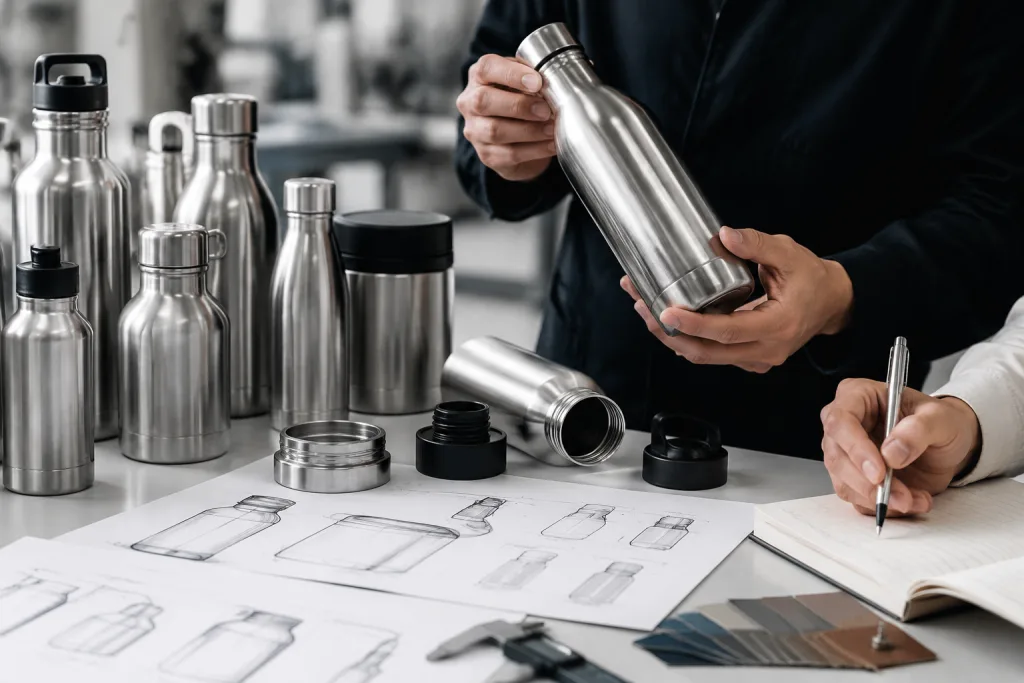
Surface finish and logo method
The outside finish decides the shelf impression and the complaint rate. Powder coating is the default for customizable drinkware because it gives a clean matte look and we can run 20–30 colors without changing the bottle body. On the line, QC checks adhesion with a cross-hatch cutter and 3M tape; if squares lift, the batch stops. For outdoor, gym, or worksite bottles, ask for a harder powder and expect light colors like white, cream, and pale pink to pick up hand oil faster. The math doesn’t work if you choose “soft touch white” for a construction-site promo and then expect zero stain claims.
Silkscreen printing fits simple 1–3 color logos on flat or slightly curved areas. Laser engraving looks cleaner for premium private label, and it will not peel, but the final mark color depends on the coating thickness and the 316 stainless underlayer. Heat transfer handles full-color artwork; it also brings more scrap risk if oven temperature or film pressure is off. Last month QC pulled the sample after a heat-transfer edge lifted by 1.5 mm near the shoulder. For a canteen customizable campaign with names, staff IDs, or small batch personalization, laser is usually the least painful route.
Your spec sheet should define logo size in millimeters, Pantone color, position from bottom or seam, and acceptable tolerance. “Logo centered” is not a production instruction. Use this instead: “Front logo 55 mm wide, centerline aligned to bottle seam opposite side, bottom of logo 90 mm from base, tolerance ±2 mm.” Fussy? Yes. But we have seen this go sideways on 3,000 pcs when the buyer approved a mockup with no seam reference, then flagged the logo for drifting toward the shoulder.
For private label, specify packaging artwork, barcode, FNSKU if needed, warning text, recycling marks, and country of origin. China origin marking must be correct for customs and retail checks; a missing “Made in China” can hold a carton at the warehouse even when the bottle is perfect. We check print files before mass production, including QR scan, barcode contrast, and carton mark spelling—one PO typo turned “BPA FREE” into “BPA FEE” on an outer carton proof. Final approval still belongs to you. If the Pantone or QR code is wrong after coating, fixing it means rework, scrap, or a discount nobody wants.
Private label MOQ and pricing logic
MOQ is where 7 out of 10 quotes start to drift away from factory reality. For plain stock color with laser logo, 500 pcs can be possible; we run those on existing powder inventory and a standard fiber laser jig. For custom powder color with retail box and insert card, expect 1,000-3,000 pcs per color. Add lid color matching, and the line needs separate powder approval under a D65 light box, not just a quick photo check. A custom molded lid, special handle, or customized growler body can push the MOQ to 5,000 pcs or more because tooling, trial shots, and line setup must be spread across enough units.
Typical FOB China pricing for a 316 inner, 304 outer vacuum bottle may sit around USD 4.20-7.80 for 500-1,000 ml, depending on lid structure, finish, steel gauge, export carton strength, and order size. Large growlers can move into USD 9.00-16.00. Sanity-check ranges only. Last month QC pulled a 1,000 ml sample with a 0.38 mm outer wall after the quote claimed heavier steel; the buyer flagged it after drop-test dents showed up on the bottom ring. If a canteen supplier quotes far below the market, check material grade, wall thickness, vacuum failure allowance, and packaging strength.
Buyers often ask why a canteen customized order costs more than a standard bottle with a logo. This is the wrong question to ask. The real cost is process loss. Custom powder color means line cleaning, 25 kg minimum powder purchase, extra QC sorting, and shade rejection risk when the approved sample and mass goods are 1-2 Pantone steps apart. Retail packaging adds printing plate setup, carton coordination, and barcode control; one PO typo on an EAN code can hold a full pallet in our packing area. If you need 12 colors at 300 pcs each, you are asking the factory to run 12 small production jobs, not one 3,600 pc order.
For canteen distributors, the cleanest cost structure is usually fewer body colors with more lid/logo variation and repeatable packaging. The math works better. We ship faster when the same 60 × 40 × 38 cm master carton, same insert card, and same spare-lid spec repeat across orders. That lets the canteen manufacturer buy material efficiently and keep your reorder lead time stable, for example 12 days for repeat laser-logo stock versus 18 days when powder color approval starts again. It also gives you stronger ground when negotiating payment terms, spare lids, and replacement parts.

Quality control points buyers miss
Set AQL before the PO is released. We see 7 out of 10 B2B buyers use AQL 2.5 for major defects and 4.0 for minor defects, with critical defects at 0. For drinkware, critical defects include leakage, sharp edges, contamination, wrong material, unsafe odor, or broken lids. Major defects include poor vacuum performance, serious dents, coating peel, wrong logo, or carton marking errors. Put this in the spec sheet, not only in a WeChat message; we once had a buyer type “AQL 25” on the PO, and QC had to stop the line to confirm it meant AQL 2.5.
Leak testing is not optional. Every bottle should pass an internal pressure or inverted leak check, especially straw lids and flip lids. On our line, QC pulled the sample after lid assembly and used a 0.06 MPa air-pressure tester, then inverted it for 30 minutes on white tissue. Vacuum testing is usually handled by process control plus sampling, because testing every unit for 12 hours does not work on a 20,000 pc order. Still, your canteen factory should have a written vacuum rejection step after welding and before final assembly. Ask for it. We have seen this go sideways when a buyer only checked appearance.
Carton quality gets ignored too often. A 24 pc master carton for 750 ml bottles can weigh 9-13 kg. If the carton board is weak or the inner dividers are loose, the bottle may arrive with shoulder dents even after passing factory QC. The math does not work if you save USD 0.12 on a carton and lose 3% in claims. For e-commerce or Amazon FBA drinkware, ask for individual drop-test thinking with 80 cm carton drops, scannable labels, suffocation warnings for polybags, and clean FNSKU placement on a flat panel.
During pre-shipment inspection, ask the inspector to open cartons across different pallets, not just the top layer near the door. Check capacity by weighing water fill, verify logo position in mm from the bottom curve, inspect lid fit, test 20-50 pcs for leakage, and compare color against approved samples under neutral light. Simple work. It catches problems. Experienced canteen vendors in Zhejiang will not be offended by this, especially if the inspection plan is sent 3 days before shipment. Serious China manufacturers expect professional buyers to inspect.
Documents, samples, and reorder control
Your golden sample is not a souvenir. It is the physical standard for color, hand feel, logo position, lid torque, packaging, and workmanship. Keep one approved sample at your office, one in our sample room, and one with the inspection company when the order value is high or split across 2+ containers. We tag each sample with date, version, PO number, and signed approval; QC also checks lid torque with a small digital torque meter, not by “feel.” If you approve a change by email later, update the version number. No silent revisions.
For a new 316 stainless steel bpa free water bottle private label program, ask for a document pack you can actually use: quotation with material grades, product drawing, BOM, logo proof, packaging dieline, test report list, production schedule, carton marks, and AQL inspection plan. For a canteen distributor serving multiple retailers, add spare lid pricing, reorder MOQ, color retention records, and the notice period for any component change. One buyer once sent a PO with “316 outside / 304 inside” by mistake; the buyer flagged it after the logo proof, not before tooling. Catch these small errors before the line runs.
Reorders fail when nobody controls small changes. A canteen vendor may switch a silicone gasket supplier, adjust coating powder, or replace a carton board grade to solve a supply issue. Sometimes it is harmless. Sometimes the math doesn’t work: 0.3 mm thinner carton board saves cents and gives you crushed corners after 12 days at sea vs 18 days in a wet warehouse. We’ve seen this go sideways. Your purchase order should state that material, color, lid structure, and packaging changes need written approval before production.
Private label drinkware is not complicated, but loose specs are expensive. If you want a premium claim, lock the premium details: 316 inner wall, BPA-free component list, defensible heat/cold testing, correct artwork, and practical QC. On the floor, QC pulled the sample again after printing because the logo sat 2 mm lower than the approved proof. Small miss, big argument. That is how a customizable canteen line becomes a repeat program instead of a one-time shipment with debit notes.
Send your bottle spec and target landed cost
We will review material, MOQ, logo, packaging, and compliance gaps before you commit to a private label production run.
Frequently asked questions
Is 316 stainless steel worth it for private label water bottles?
Yes, if your positioning depends on premium quality, corrosion resistance, outdoor use, marine use, electrolyte drinks, or long product life. For plain office giveaway bottles, 304 may be enough. A 316 inner wall normally adds about USD 0.35-0.90 per unit versus 304, depending on size and gauge. Most buyers choose 316 for the inner wall and 304 for the outer wall to balance cost and claim strength. If you sell through canteen distributors or retail chains, the clearer material story can help justify a higher shelf price.
What MOQ should I expect for a custom canteen private label order?
For a stock color bottle with laser logo, some factories can accept 500 pcs. For custom powder coating, private label box, color lid, and barcode work, a realistic MOQ is 1,000-3,000 pcs per color. If you need a new molded lid, special handle, unique body shape, or customized growler tooling, MOQ often starts at 5,000 pcs. Small mixed-color orders are possible, but unit price rises because each color needs setup, cleaning, QC sorting, and separate packing control.
How do I verify the bottle is really BPA-free?
Ask for a component-level declaration and test reports covering the actual lid, straw, gasket, plastic insert, and any food-contact coating. BPA-free is not proven by the stainless body. For Europe, request food-contact migration support and REACH-related information where relevant. For North America, FDA food-contact declarations and BPA-free statements are common. Check that the report model, material, and color family match your order. If you change from PP to Tritan, or from screw lid to straw lid, treat it as a new compliance check.
What lead time is normal for customized drinkware from China?
For repeat orders with approved components, 25-35 days after deposit and artwork approval is common. For new private label bottles, plan 30-45 days after pre-production sample approval. New tooling can add 20-35 days before production starts. Sea freight to Europe or North America may add another 25-45 days depending on route and port congestion. If your order needs third-party testing, add 7-15 working days. Buyers should avoid booking retail promotions before the golden sample and schedule are confirmed.
Can one canteen supplier handle retail packaging and Amazon FBA requirements?
Yes, but you must specify the requirements early. Retail packaging needs dielines, barcodes, warning text, country of origin, carton marks, and drop-resistant packing. Amazon FBA drinkware often needs FNSKU labels, scannable outer cartons, clean polybag warnings when used, and carton weight control. A 24 pc master carton can weigh 9-13 kg for mid-size bottles, so carton strength matters. Send the platform or retailer routing guide before quotation, not after production, because packaging changes can affect cost and lead time.