Key Takeaways
- 316 stainless steel usually adds USD 0.35-0.90 per bottle versus 304, depending on size and wall thickness
- A serious canteen factory should confirm steel grade by mill certificate and random XRF testing
- BPA-free must cover lids, straws, gaskets, liners, and packaging claims, not only the bottle body
- For custom drinkware, plan 7-10 days for sampling and 30-45 days for mass production after approval
If you are sourcing a 316 stainless steel bpa free water bottle custom project, finding a factory is not the hard part. China has thousands. The real job is spotting a canteen manufacturer that can control steel grade, lid resin, vacuum yield, and logo position across 5,000 units. We have seen this go sideways: QC cut one sample with a wall thickness gauge and found the inner liner marked 304, while the quote said 316.
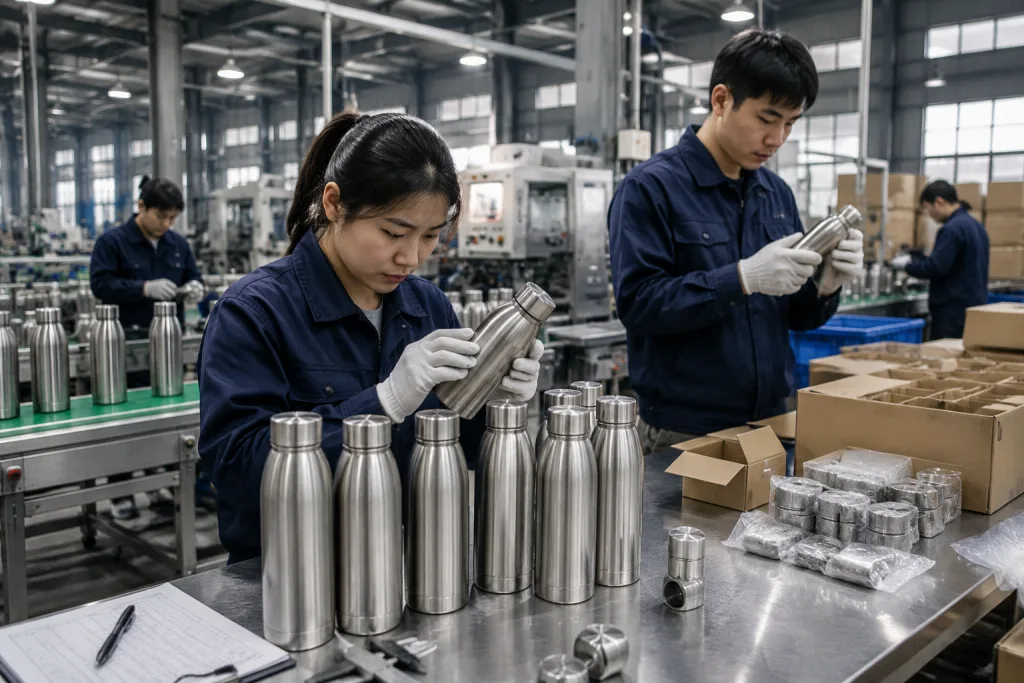
At our Hangzhou, Zhejiang facility, BottleForge runs about 480,000 stainless bottles and tumblers per month, with typical custom drinkware MOQ from 1,000 pieces per model. Before you issue a PO, ask practical questions: what 316 means on the inner liner, when the price gap makes sense, how BPA-free parts are checked, and what can fail before shipment. Simple stuff, but it saves money. Last month, a buyer flagged one PO typo, “316 body” instead of “316 inner,” and that single word changed the costing by 8%.
Is 316 steel worth it?
For most daily-use bottles, 304 stainless steel does the job. On a 316 stainless steel bpa free water bottle custom order, you are paying for better corrosion resistance, not better heat retention. The vacuum decides insulation, not the 316 grade. 316 has molybdenum, so it stands up better to salt air, sports drinks, lemon water, and chloride exposure. We see it make sense for marine crews, hiking brands, gym programs, medical giveaways, and higher-ticket corporate gift projects; last month QC pulled one inner shell after a 5% salt spray pre-check showed light staining on a 304 sample.
The price jump is not small. On a 750 ml double-wall bottle, switching the inner wall from 304 to 316 usually adds USD 0.35-0.60 FOB China. If both inner and outer walls are 316, the extra cost can reach USD 0.70-0.90, and most buyers do not need that. The math doesn't work for decoration. We normally run 316 inner wall, 304 outer wall, PP or Tritan BPA-free lid, food-grade silicone gasket; for a 3,000 pcs order, that can save USD 1,050-2,700 versus full 316/316 while still protecting the liquid-contact surface.
Ask your canteen supplier to write the steel structure on the PI and sample tag: 316/304, 316/316, or 304/304. Do not accept “premium stainless steel.” Too loose. A proper canteen factory in Zhejiang or elsewhere in China should send a material declaration and mill certificate before sampling, not after the deposit lands. For orders above 3,000 pieces, random XRF checks are a reasonable requirement; our QC uses a handheld XRF gun on inner wall cut pieces, because testing the painted outer body tells you nothing about the liner. They cost less than a rejected retail shipment.
Buyer rule: pay for 316 where liquid touches metal. Do not pay for 316 decoration if your customer cannot explain the value.
What means BPA free here?
Stainless steel body material has no BPA. The risk sits in the lid, straw, carry loop, color coating, logo ink, gasket, and any plastic liner. For a 316 stainless steel bpa free water bottle custom program, ask the factory to list every food-contact part on the BOM; last month QC pulled one sample where the shell was correct 316, but the flip lid was marked only “plastic” on the test request. Not good enough.
We usually run PP for flip lids, Tritan for clear lids or straws, and LFGB-grade silicone for gaskets. For Europe, ask for LFGB or EU 10/2011 food-contact testing where relevant. For the United States, FDA food-contact compliance is the normal baseline. If the bottle is for children, add CPSIA and ASTM checks for coating, small parts, and lead/cadmium limits; we have seen a buyer flag a 7 mm loose decorative plug during pre-shipment inspection, and the math does not work if you discover that after 8,000 pcs are packed.
A simple procurement checklist should include:
- Body: 316 stainless inner wall, 0.4-0.5 mm typical inner thickness before forming; our line checks this with a micrometer before necking.
- Lid: BPA-free PP or Tritan, no recycled plastic unless the supplier provides batch documents and food-contact proof.
- Seal: food-grade silicone, hardness around 50-60 Shore A for most screw lids, checked with a Shore A durometer.
- Coating: powder coat or spray paint tested for adhesion and heavy metals; cross-cut tape testing should not lift flakes at the rim.
- Claim: “BPA free” backed by a test report, not just printed on the carton or typed into the PO with a spelling error.
Good canteen manufacturers will answer these questions with material names, test report numbers, and part drawings. Weak canteen vendors send glossy photos. That is the wrong answer, and we have seen this go sideways at AQL 2.5 final inspection when the buyer asked for the lid report too late.
Which customization choices matter?
Customization is where 3 out of 10 projects burn budget without improving shelf pull. A custom canteen can stay simple and still look premium if the surface finish, logo method, and packaging match the sales channel. For a distributor drinkware program, repeatability beats one pretty sample photo. We run a 60° gloss meter check on powder coat because one buyer once flagged a black bottle lot that looked “two shades off” under warehouse LED light.
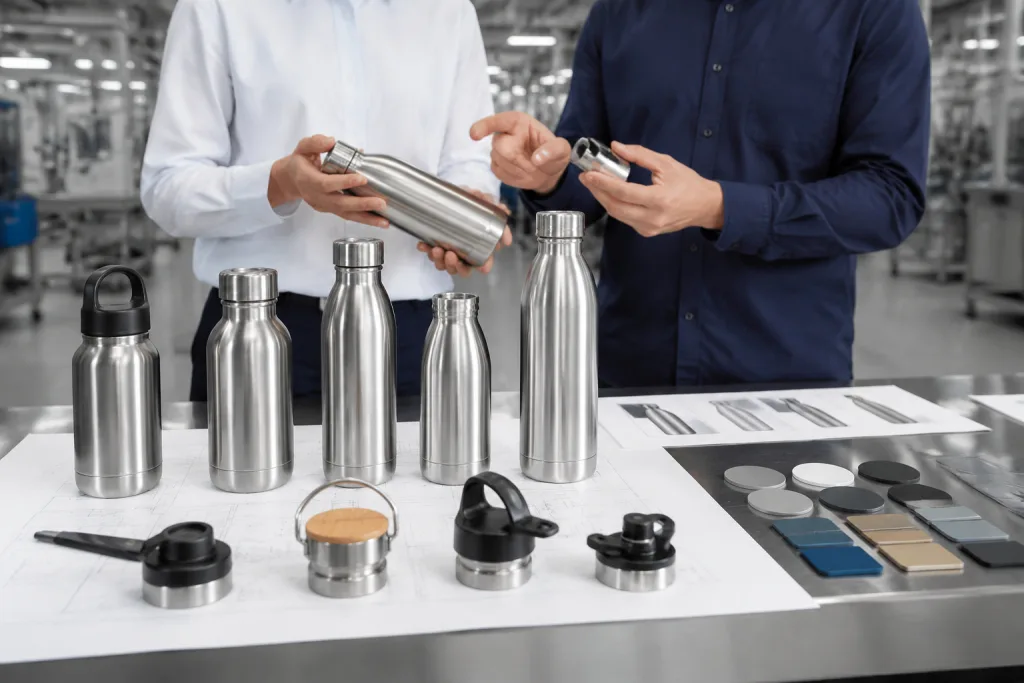
For logos, laser engraving is clean and durable on powder-coated bottles, but it exposes the metal color underneath and needs enough line width; we usually ask for at least 0.3 mm on fine text. Silk screen is lower cost for simple one-color artwork, usually USD 0.05-0.12 per position at scale, but it scratches if the coating and ink are not matched. Heat transfer supports gradients and full-color graphics, often USD 0.25-0.60 per bottle depending on coverage. Embossing or debossing needs tooling, commonly USD 150-400 per design. QC pulled a sample last month where the registered trademark symbol filled in during screen printing. Tiny detail, big complaint.
For a canteen customized for retail, you may need color-matched lids, barcode labels, hang tags, recycled kraft boxes, or FNSKU labels for Amazon FBA. For a canteen promotional campaign, fast delivery and logo accuracy matter more than a 350 gsm gift box. This is the wrong question to ask: “How many decoration options can we add?” The better question is which options survive packing, transit, and store handling. For a custom growler or customized growler, the leak test and handle strength matter more because filled weight is higher; on the line we check lid torque and run a 24-hour inverted leak test before carton packing.
Ask for a pre-production sample made with the actual logo process, not a blank bottle with a nice photo mockup. At BottleForge in Hangzhou, Zhejiang, logo samples normally take 7-10 days after artwork confirmation, and mass production starts only after written approval of color, print position, and packaging layout. We ship the approval set with a marked ruler photo for logo position, because “centered” on a PO has caused 6 mm arguments before.
How should you compare quotations?
A low FOB quote can hide expensive gaps. Put every canteen supplier on the same quotation sheet. We see this weekly: one canteen vendor quotes 304/304, another quotes 316 inner only, and a third drops the white box to hit the buyer’s target. QC pulled a 750 ml sample last month where the quote said “316 bottle,” but the magnet check and XRF gun showed only the inner wall was 316. The cheapest line is often just the thinnest offer.
Your RFQ should lock the details before anyone prices: capacity, steel grade, wall construction, lid material, finish, logo method, packaging, test requirements, Incoterms, destination, and target order volume. For example: “750 ml double-wall vacuum bottle, 316 inner/304 outer, powder coat, one-color silk screen, BPA-free PP screw lid, individual white box, 5-layer export carton, AQL inspection, FOB Ningbo, 5,000 pieces.” That one sentence cuts the email loop from 18 days to about 6 days on our line, because the merchandiser is not chasing missing carton specs or a PO typo like “7500 ml” instead of “750 ml.”
Normal factory pricing for a 316 inner wall bottle changes with diameter, cap design, and finish. A 500 ml unit might land around USD 3.20-4.60 FOB China at 3,000 pieces. A 1,000 ml wide-mouth bottle may run USD 4.80-7.20. Custom growler and customizable growler formats sit higher because the body uses more steel, the vacuum chamber is larger, and the carton jumps from about 0.045 CBM to 0.075 CBM per case. If a supplier quotes the growler like a slim 500 ml bottle, the math doesn’t work.
Check carton loading before you celebrate the unit price. A bottle that looks cheap but ships 24 pieces per oversized carton can lose its advantage after ocean freight, warehouse handling, and parcel dimensional weight. We ask for carton size, gross weight, and CBM before we approve the final model; one buyer flagged a 58 × 42 × 36 cm carton because Amazon parcel billing wiped out USD 0.38 per bottle in savings. Good canteen distributors catch that before deposit, not after the container is booked.
What factory checks reduce risk?
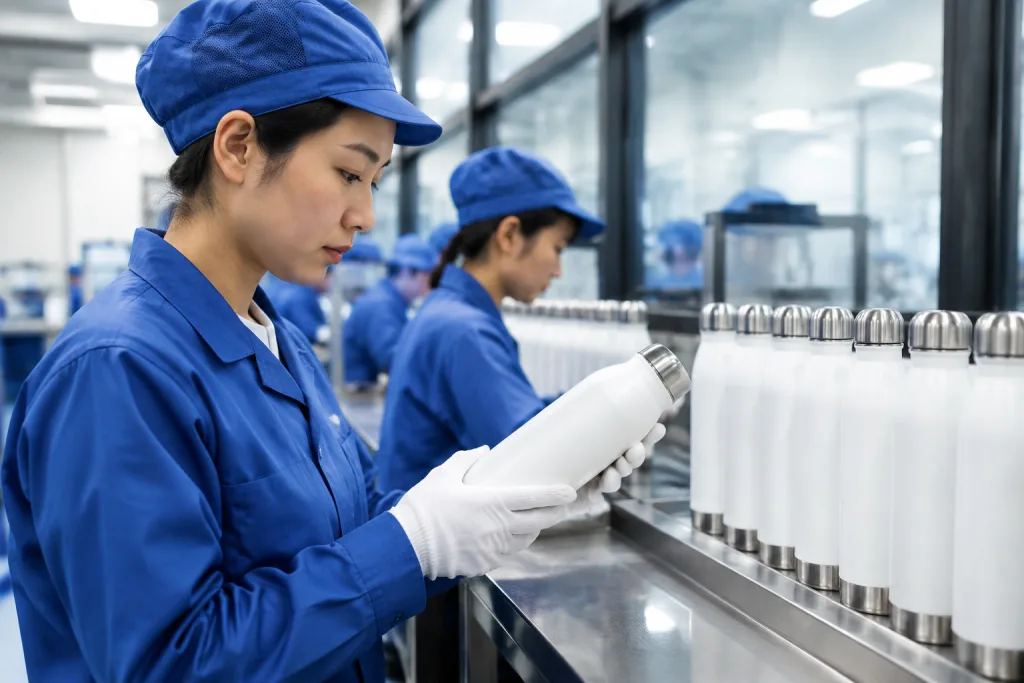
You do not need to audit every screw on the line. You do need to know which checks protect your PO. A capable canteen manufacturer should run incoming material inspection with a handheld XRF gun for 316 stainless, vacuum testing, leak testing, coating adhesion checks, logo inspection, and final AQL inspection. If the supplier only says “QC passed,” ask passed what. We have seen this go sideways when a buyer flagged “316” on the carton, but the incoming sheet record showed 304 stainless.
For vacuum bottles, we run heat retention checks with hot water at 95°C, then measure after 6 hours or 12 hours depending on the product claim. Leak testing should include inverted bottles for 30 minutes, plus pressure or shake checks for sports caps. Powder coating should pass cross-hatch adhesion testing; for retail programs, buyers often request 3M tape tests and 500-cycle abrasion checks. For logo printing, check position tolerance within 1.5 mm, color Delta E where needed, and rub resistance. QC pulled the sample last month because a black logo shifted 3 mm toward the seam.
AQL is not perfect, but it gives both sides the same defect language. Most B2B buyers we ship for use AQL 2.5 for major defects and 4.0 for minor defects, with critical defects set to zero tolerance. Critical defects include sharp edges, leaking, wrong material, contamination, and unsafe small parts. For EU buyers, REACH and LFGB documentation may be required. For North America, FDA food-contact declarations and CPSIA-related checks may apply depending on user group. The wrong question is “Do you have certificates?” Ask whether the same gasket, paint, and 316 stainless body from your order were covered by the test report.
If you are choosing between canteen vendors in China, ask for actual inspection photos from a recent order, not just certificates. We usually show 8 to 12 photos: incoming steel label, vacuum test bench, leak test tray, coating grid cut, logo position ruler, carton drop corner, AQL sheet, and packed pallet. A real canteen factory will show production records; a paper-only canteen supplier usually hesitates. One buyer once sent a PO with “matte balck” in the finish line, and the line still caught it before mass coating.
Buyer checklist before purchase order
Before you issue the PO, freeze the spec sheet. In our Hangzhou line meetings, 7 out of 10 schedule slips start the same way: the buyer signs the look sample, then leaves wall thickness, lid resin, or carton marks open. A 316 stainless custom canteen needs written specs, signed artwork, packaging drawings, and acceptance standards before the deposit hits; QC pulled one sample last month because the PO said “316 inside” but the drawing still showed 304 stainless.
Use this short checklist with your canteen manufacturer; we run it against the pre-production sheet before the first 50 pcs come off the laser marking jig:
- Confirmed model number and capacity, with dimensions checked by caliper and target fill volume measured in ml.
- Steel grade written as 316 inner/304 outer, or the exact structure your market requires.
- BPA-free material list for lid, straw, gasket, plus every plastic part that touches drink or mouth.
- Logo method and Pantone color, with print size in mm and position tolerance marked on the artwork.
- Retail box and master carton drawings, with pallet plan, barcode, FNSKU, or distributor labels shown at actual placement.
- Testing required: FDA, LFGB, REACH, ASTM, CPSIA, or your customer’s own protocol, with lab name agreed before sampling.
- Inspection standard: AQL level, defect photo sheet, reinspection cost owner, and carton drop test requirement if retail packing is light.
- Commercial terms: MOQ, unit price, tooling, sample fee, payment schedule, FOB port, lead time, plus any split-shipment request.
For a normal 1,000-5,000 piece customized drinkware order, plan on 30-45 days production after sample approval and deposit. Peak season before summer and Q4 can add 7-15 days. If you are a canteen distributor or distributor growler buyer with 4-8 SKUs, combine colors under one model where possible; the math does not work when each color sits below the factory MOQ. We ship fewer slow cartons that way, and the line changeover stays closer to 35 minutes instead of burning half a shift.
The best custom drinkware projects are not the complicated ones. They are the ones where buyer and factory agree on measurable details before production starts. We have seen this go sideways over a 2 mm logo shift, so put the tolerance on paper before mass production.
Send your 316 bottle spec for a factory quote
Share capacity, logo, packaging, target quantity, and market. We will return a practical FOB quote and production timeline.
Frequently asked questions
What MOQ should I expect for a 316 stainless custom bottle?
For a new 316 stainless steel bpa free water bottle custom order, a practical MOQ is usually 1,000 pieces per model and 500 pieces per color if the color is standard. Fully custom molds, special lids, or private tooling can push MOQ to 3,000-5,000 pieces. If you need mixed colors, ask whether the canteen factory can combine colors under one production batch. Small trial orders below 500 pieces are possible for some stock models, but unit cost, logo cost, and freight per piece will be higher.
Can I advertise the bottle as BPA free and 316 stainless steel?
Yes, but only if the claim is supported. The stainless body can be declared 316 if the factory provides material documentation and, ideally, XRF verification. BPA-free claims must cover plastic parts such as the lid, straw, handle, and gasket contact areas. For Europe, request LFGB or EU food-contact testing where applicable. For the US, FDA food-contact documentation is common. If you sell to children, add CPSIA review. Do not print broad claims on packaging until the reports match the final production materials.
Is 316 better than 304 for insulation performance?
No. Insulation comes mainly from double-wall vacuum construction, wall geometry, cap design, and production control. 316 improves corrosion resistance, especially against chloride, salt water, acidic drinks, and hard use environments. A well-made 304 vacuum bottle can outperform a poorly made 316 bottle for heat retention. If your buyer wants premium durability, specify 316 inner wall plus a tested vacuum performance target, such as hot water retention measured after 6 hours. Steel grade and insulation test results should both be written into the PO.
Which logo method is best for distributor drinkware programs?
For distributor drinkware, laser engraving is the safest long-term option on powder-coated bottles because it does not peel and handles repeated use well. Silk screen is cost-effective for one-color logos and large volumes, often adding USD 0.05-0.12 per position. Heat transfer is better for full-color retail artwork but costs more and needs careful adhesion testing. If you are supplying canteen distributors with repeat orders, choose a method that your factory can reproduce within tight position and color tolerances across multiple batches.
What should I check in a pre-shipment inspection?
Check quantity, carton marks, barcode or FNSKU labels, appearance, logo position, color, leaks, lid fit, smell, sharp edges, packaging, and random dimensions. For vacuum bottles, include a heat retention sample test if timing allows. Use AQL 2.5 for major defects and 4.0 for minor defects unless your retailer requires a different standard. Critical defects should be zero tolerance. Ask the inspector to open inner boxes, not only master cartons. For customized canteen orders, wrong logo placement is a major commercial defect, even if the bottle itself works.